

As a silicone manufacturer with over 15 years of experience, I have seen the industry evolve, and the standards tighten. One of the most critical terms in our field is FDA silicone, especially for food-contact applications. This guide explains everything you need to know, from properties to manufacturing, and answers frequently asked questions.
What is FDA Silicone?
FDA silicone refers to silicone materials that comply with the U.S. Food and Drug Administration (FDA) food-contact regulations, primarily 21 CFR 177.2600. These silicones are safe for use in applications that come into contact with food, beverages, or related products.
There are two key designations in the industry:
FDA Approved: Officially approved by the FDA for a specific product or application.
FDA Compliant / Food Grade Silicone: Materials that meet FDA standards but may not have official product approval.
Tip: In B2B supply, most silicone raw materials are FDA-compliant, while the final product might require additional documentation.
How is it manufactured?
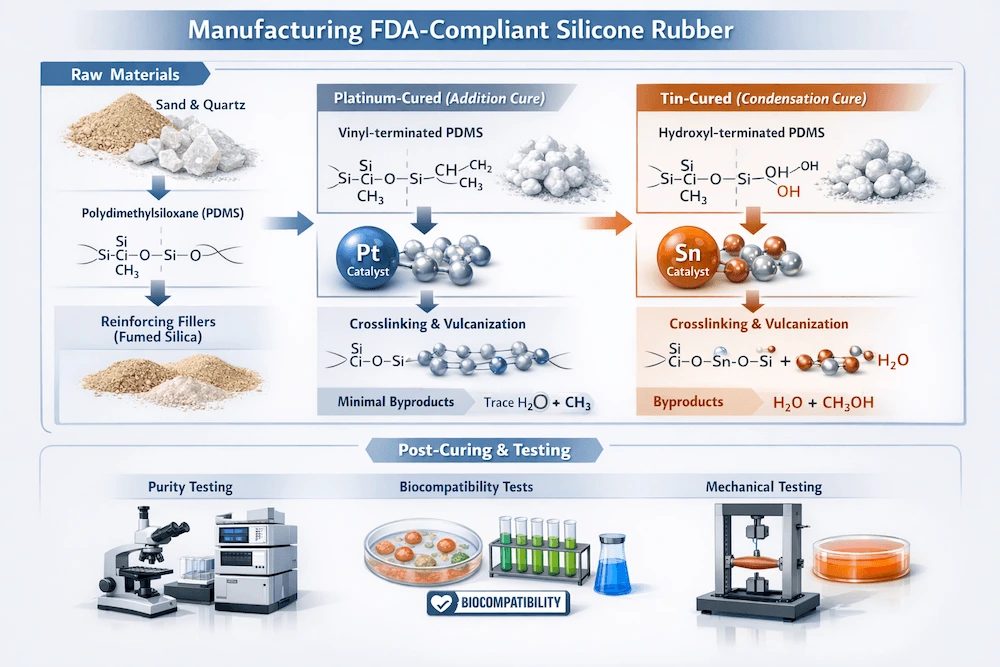
FDA-compliant silicone begins with polydimethylsiloxane (PDMS), a silicone polymer derived from silica (sand and quartz). This base polymer is blended with reinforcing fillers such as fumed silica to improve strength, elasticity, and durability. The formulation is strictly controlled to meet FDA standards, ensuring that the material contains no harmful substances and remains biocompatible for food-contact applications.
Crosslinking / Vulcanization
FDA-approved silicone undergoes vulcanization (crosslinking) to become a durable elastomer with the desired flexibility, strength, and heat resistance. The type of curing defines its chemical behavior:
Platinum-Cured Silicone (Addition-Cure / LSR & HCR):
A platinum catalyst triggers a chemical reaction between vinyl-terminated PDMS molecules. This addition reaction produces no byproducts, ensuring ultra-clean, high-purity silicone suitable for prolonged direct food contact. The result is minimal shrinkage (~0.1%) and excellent dimensional stability, making it ideal for baking molds, baby products, and precise food-contact components.Tin-Cured Silicone (Condensation-Cure / RTV):
A tin-based catalyst promotes crosslinking of hydroxyl-terminated PDMS chains. This condensation reaction releases small byproducts, such as acetic acid or alcohol, which makes tin-cured silicone less suitable for prolonged direct food contact. It is generally used in lower-cost applications or where food contact is indirect.
Post-Curing Testing
After vulcanization, FDA silicone is rigorously tested to ensure purity, biocompatibility, and physical performance. Common tests include:
Extractables and leachables analysis to ensure no harmful substances migrate into food
Biocompatibility testing for direct food or skin contact
Mechanical and thermal tests, such as tear resistance, tensile strength, and heat stability
Through these controlled manufacturing steps and testing, FDA-certified silicone ensures safe, reliable, and durable performance in food-contact and medical applications.
Properties of FDA Silicone
Choosing FDA silicone isn’t just about certification—it’s about performance. Key properties include:
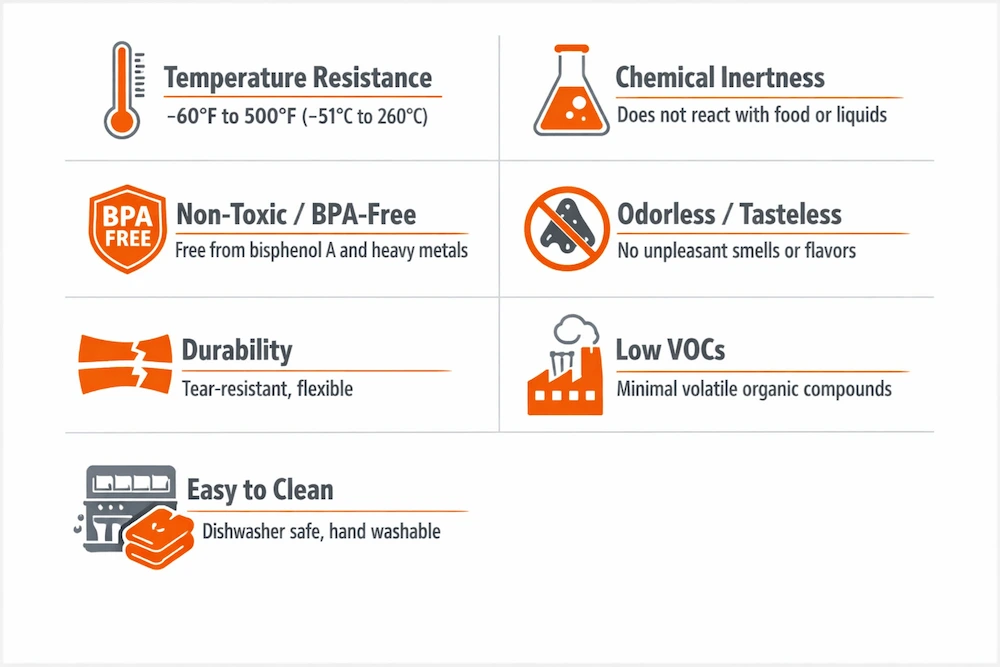
In my 15 years working with silicona alimentaria clients, platinum-cured silicone consistently outperforms other types for both performance and safety.
How FDA Silicone Differs from General-Purpose Silicone
Not all silicone is suitable for food-contact use.
General-purpose silicone may perform well in industrial applications, but it may not be formulated or documented for compliance with FDA food-contact regulations.
Key differences often include:
| Característica | Silicona FDA | General-Purpose Silicone |
|---|---|---|
| Food-contact compliance | Yes, when properly documented | No necesariamente |
| Formulation control | Strictly controlled | Depends on application |
| Extractables considerations | Important | May not be a primary concern |
| Preferred curing system | Often platinum-cured | Varies |
| Typical use | Food-contact parts and repeated-use components | Industrial, sealing, casting, or general applications |
For buyers, the key point is simple:
Do not assume that all silicone is suitable for food contact just because it looks similar.
What is FDA Silicone Used For?
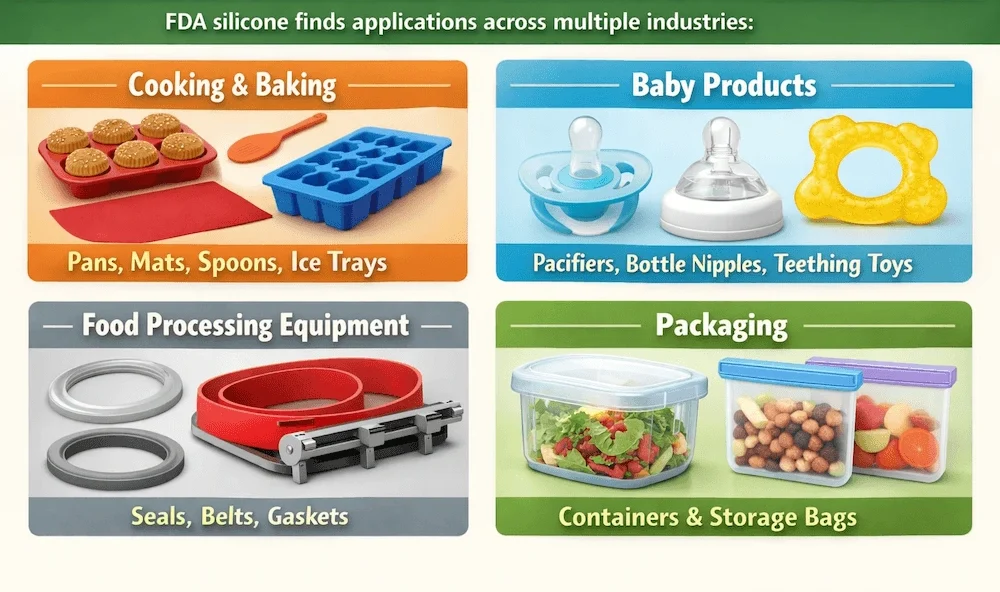
FDA silicone finds applications across multiple industries:
Cooking & Baking: Pans, mats, spoons, ice trays
Baby Products: Pacifiers, bottle nipples, teething toys
Food Processing Equipment: Seals, belts, gaskets
Packaging: Containers and storage bags
Where to Buy FDA-Approved Silicone?
B2B suppliers: Dow Corning, Momentive, Wacker, Smooth-On, and TopSil Silicone (FDA-certified grades).
Key considerations: Check the certificate of compliance, NSF markings, and test reports to ensure the material meets FDA standards.
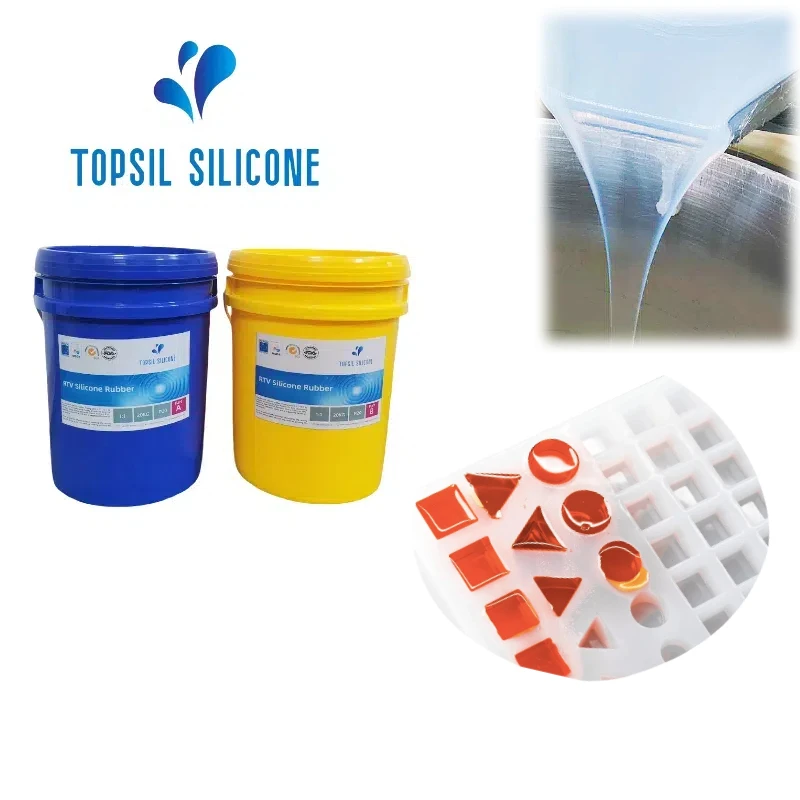
Tips: For high-quality applications, request platinum-cured LSR or HCR from TopSil Silicone to guarantee minimal shrinkage, high stability, and safe direct food contact. Our FDA-compliant silicone is suitable for baking molds, baby products, and food-processing components, providing durability and precision for your projects.
PREGUNTAS FRECUENTES
Q1: Is silicone FDA-compliant?
A: Only if it meets 21 CFR 177.2600. Always ask the supplier for documentation.
Q2: What is the FDA 21 CFR for silicone?
A: It is the code of federal regulations defining safety standards for silicone in food contact applications.
Q3: What is the difference between FDA and LFGB silicone?
A: FDA is the U.S. standard, while LFGB/EU 10/2011 is the European standard. LFGB tests may be stricter in some chemical limits.
Q4: Is silicone oil FDA-approved?
A: Only specific grades tested and documented for food contact are FDA-compliant.
Q5: Are silicone implants FDA-approved?
A: Medical-grade silicone implants must receive FDA approval before use in humans. This is different from food-grade silicone.
Conclusión
For anyone sourcing silicone in B2B for food contact, platinum-cured FDA silicone is the safest choice. Its high temperature resistance, chemical inertness, and low toxicity make it ideal for both industrial and consumer applications.