
중국의 수출세 환급 취소가 실리콘 시장 가격에 어떤 영향을 미칠까요?
I see many exporters facing a direct cost shock. I see many buyers facing price confusion[^1]. I know that this mix can turn the silicone market[^2] noisy very fast.
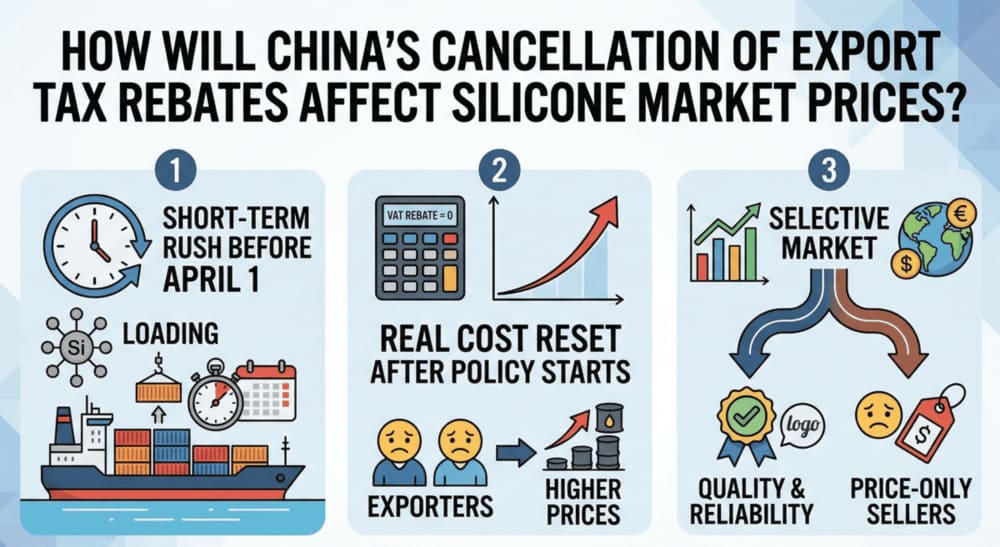
I believe China’s cancellation of the export VAT rebate[^3] for silicones in primary forms will not create one clean price jump. I expect a short-term rush before April 1, a real cost reset[^4] after the policy starts, and then a more selective market where strong suppliers[^5] do better than price-only sellers.
I look at this topic through an SIO angle. I do not stop at the policy headline. I look at order timing, inventory moves, margin pressure, buyer emotion[^6], and supplier strength. That is where I find the real price story. I have seen many markets react before a policy starts, not after. I have also seen markets overreact in the short run and then calm down when real demand shows up. So I want to break this down in a simple way. I want to look at the short-term move, the longer-term price reset, the winners and losers in export trade, and the smart actions that buyers and distributors should take now.
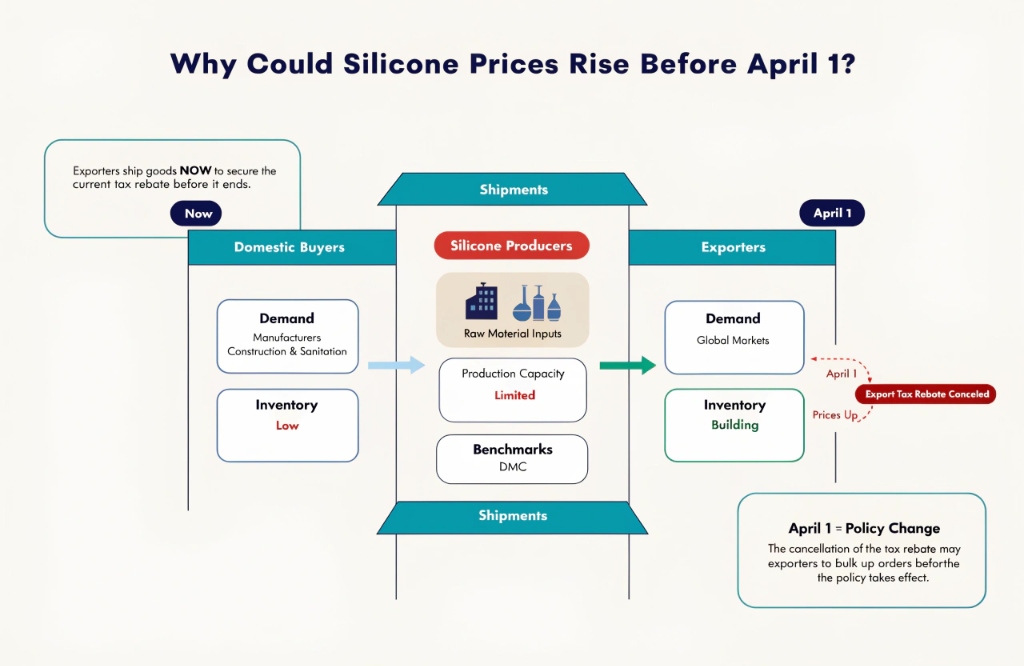
Why Could Silicone Prices Rise Before April 1?
I see many buyers making one common mistake. I see them thinking the market will wait for the policy date. I do not think it will.
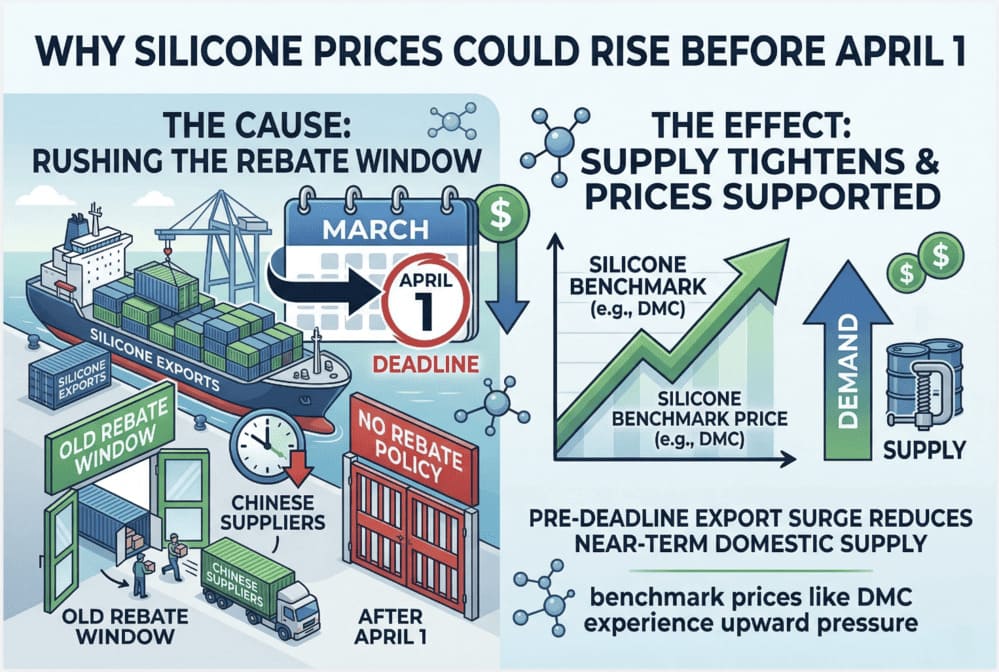
I expect a rush of early shipments before April 1 because exporters still want to use the old rebate window. I believe that rush can tighten near-term supply, support benchmark prices such as DMC, and create a short but real wave of price strength.
What I see in the short run
I see the first move as a timing move, not a value move. I mean that many exporters will try to ship earlier, not because final demand suddenly became stronger, but because the shipment date now changes cost. I have seen this kind of front-loading before. I usually see factories push production, traders push booking, and overseas buyers bring orders forward. That process can tighten supply in the local market for a few weeks. It can also make benchmark products look stronger than they really are. I do not read that as a full trend change. I read it as a policy-driven pull-forward.
How I read the risk
I also see a second side to this move. I think the same rush that lifts prices in the short run can weaken prices later if too much demand gets pulled forward. I would not be surprised if April or the second quarter feels softer after the rush ends.
| What I watch | What it means to me | Likely short-term effect |
|---|---|---|
| Exporters pushing shipment dates forward | Old rebate window still matters before April 1 | More order concentration in the short run |
| DMC and 107 rubber price movement | Upstream confidence is getting stronger | Easier price increase talks |
| Buyer stock building | Fear of higher landed cost is rising | Faster booking, tighter spot supply |
| Order flow after the rush | Real demand starts to show | Risk of later slowdown |
I think this is why the market can feel hot and fragile at the same time. I see activity rising, but I do not automatically call that healthy end demand. I call it a policy-driven squeeze in time. That is why I tell buyers not to read the pre-April price rise in a simple way. I think they should ask one hard question: “Am I buying because I need the stock, or because I fear the next quote?” That answer matters.
Will Silicone Export Prices Reset After April 1?
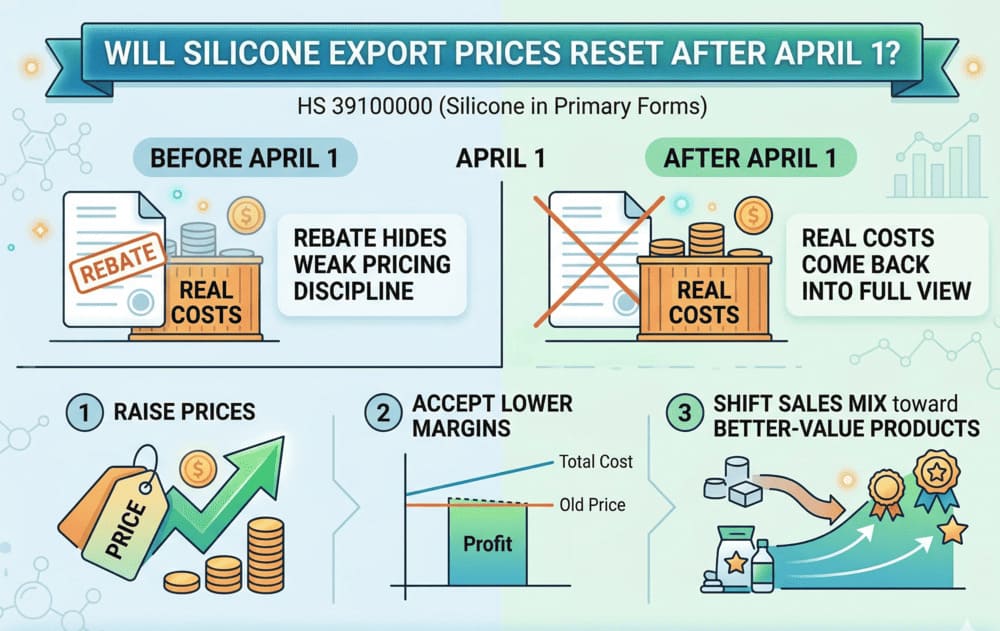
I believe a rebate can hide weak pricing discipline[^7]. I believe that once it disappears, real costs come back into full view.
I expect export quotes[^8] for HS 39100000 silicone in primary forms to reset after April 1. I believe suppliers will have only three choices: raise prices, accept lower margins, or shift the sales mix toward better-value products.
Why I think the old quote logic breaks
I see the old rebate as a cushion that made low-price export competition easier to keep. Once that cushion goes away, I think many suppliers will find that their old quote logic no longer works. I do not mean that every seller can pass the full cost increase to the market at once. I mean that the room for careless price cutting gets much smaller. I also think buyers will start to compare suppliers in a different way. I think they will look less at the first offer and more at total reliability, lead time, claims risk, and 기술 지원[^9].
What the cost reset[^4] means to me
I also think the reset is bigger than one line on an invoice. I see it as a return to more honest pricing. When the rebate era fades, raw materials, energy, process control, compliance, and logistics show up more clearly in the quote.
| Pricing factor | Before cancellation | After cancellation |
|---|---|---|
| Export tax rebate cushion | I see it softening price pressure | I see it disappearing |
| Margin room for low-price sellers | I see it as thin but still workable | I see it as much tighter |
| Price competition style | I see more room for aggressive discounting | I see more need for rational quoting |
| Buyer focus | I see some buyers chasing headline price | I see more buyers asking about supply safety[^10] |
At Topsil Silicone, I do not see this as bad news only. I also see a cleaning effect. I think the market becomes harder, but I also think it becomes fairer. I believe quality stability, formula know-how, and delivery strength matter more when the easy rebate support is gone. I like that direction, because I want silicone prices to reflect real product value, not only short-term policy support.
Who Will Win and Lose in Silicone Export Trade?
I do not think every exporter will feel this policy in the same way. I think cost structure will matter more than sales talk.
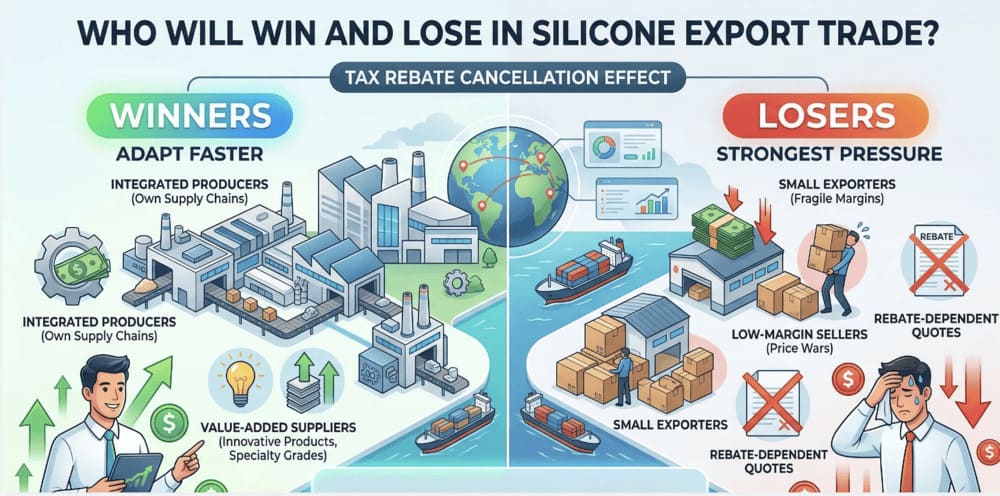
I expect integrated producers and value-added suppliers to adapt faster. I expect small exporters that rely on thin margins and rebate-supported quotes to feel the strongest pressure.
Why I expect the gap to widen
I see this policy as a market filter[^11]. I think it will separate suppliers with real strength from suppliers that live on narrow spreads. If a company has strong upstream cost control, a stable customer base, and a product mix that is not easy to replace, I think that company still has room to move. If a company mainly wins by being a little cheaper every week, I think that company now faces a much harder game. I also think the gap will widen between commodity-style export sellers and suppliers that offer custom grades, stronger consistency, local stock, or better 기술 지원[^9].
How I read the global side
I also see a global trade angle here. Some overseas buyers will push back on higher prices, especially price-sensitive buyers in markets that focus on low cost first. At the same time, I think serious buyers will still prefer China if China can offer stable quality, large-scale supply, and fast response.
| Supplier type | What I think happens | Why it matters |
|---|---|---|
| Integrated large producer | I expect better resilience | Cost control is stronger |
| Mid-sized technical supplier | I expect mixed but manageable pressure | Value-added products can protect margin |
| Small price-led exporter | I expect the hardest squeeze | Old low-price model gets weaker |
| Distributor with strong service | I expect better customer stickiness | Local stock and service reduce buyer risk |
I think this is where the market gets more interesting. I do not believe the policy simply makes all Chinese silicone less competitive. I think it forces the market to ask a better question: “Who is actually good?” I welcome that question. At Topsil, I want to compete on quality consistency, custom solutions[^12], 기술 지원[^9], and supply speed from our warehouse network. I do not want to build business only on the cheapest line in the inbox.
What Should Buyers and Distributors Do Right Now?
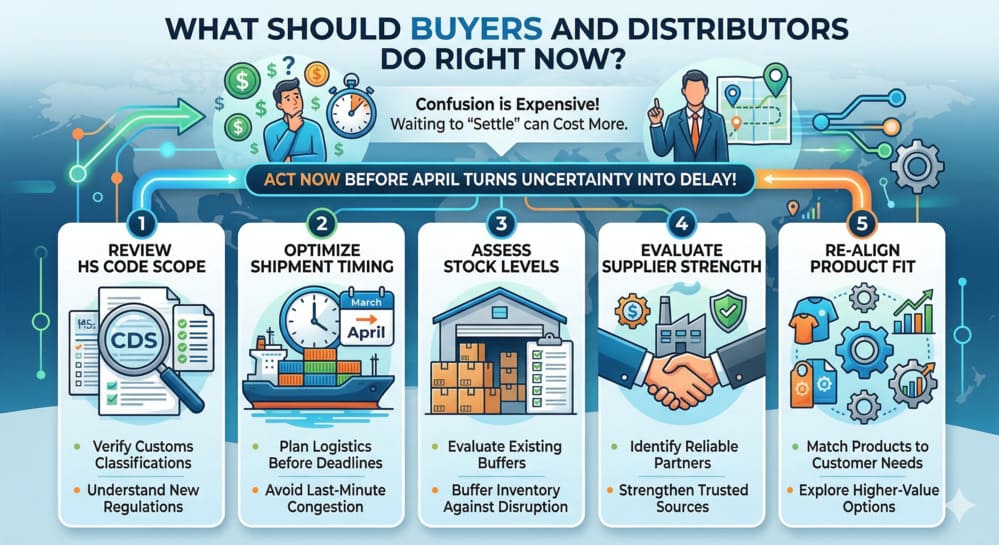
I think waiting for the market to “settle” can cost more than making a clear plan early. I think confusion is expensive.
I would not treat this as a one-time price event. I would review HS code scope, shipment timing, stock level, supplier strength, and product fit now, before April turns uncertainty into delay.
What I would do as a buyer
I would first check whether the product I buy is exposed directly to the rebate cancellation. I would not assume every silicone item is affected in the same way. Then I would review my next 60 to 90 days of demand. I would ask whether I need safety stock, or whether I can manage with staged deliveries. I would also compare suppliers in a harder way. I would not ask only for today’s best price. I would ask who can still hold quality, lead time, and service when the market gets tense. I think that question protects margin better than chasing one cheap lot.
What I would do as a distributor or brand owner
I would also prepare my customers for a more rational market. I would explain why price may move, what part is policy, what part is raw material, and what part is supply chain timing[^13]. That kind of communication builds trust.
| Action | Why I would take it | What it protects |
|---|---|---|
| Confirm product classification early | I want no customs or pricing surprises | Shipment planning |
| Review 60–90 day demand | I want to avoid panic buying or stock gaps | Working capital |
| Ask suppliers about real stock and lead time | I want facts, not only offers | Delivery reliability |
| Compare 기술 지원[^9] and consistency | I want fewer production losses[^14] later | Total cost |
| Build one backup supplier | I want flexibility if the market turns fast | Supply continuity |
At Topsil Silicone, I would use this moment to help buyers make smarter choices, not just faster purchases. I would share market insight. I would explain price logic. I would help customers choose the right RTV-2 silicone grade for mold making, life casting, pad printing, vacuum casting, electronic potting, and other real uses. I would do that because I want to be more than a material seller. I want to be a growth partner[^15] when the market gets harder. I think that is when a real supplier proves value.
I see this policy as a short-term price trigger and a long-term market filter[^11]. I believe the rebate era fades, and real product value, stable supply, and technical strength matter more.
[^1]: Learn about the factors contributing to price confusion to better manage your purchasing strategy. [^2]: Explore insights on market dynamics to make informed decisions in the silicone industry. [^3]: Understanding the implications of the export VAT rebate can help you navigate price changes effectively. [^4]: Discover how cost resets can affect pricing strategies and market stability. [^5]: Identifying strong suppliers can help you ensure quality and reliability in your purchases. [^6]: Explore the psychological factors that can impact purchasing decisions in the silicone market. [^7]: Learn about the importance of pricing discipline for maintaining market stability and competitiveness. [^8]: Explore the elements that affect export quotes to make more informed purchasing decisions. [^9]: Explore the role of technical support in choosing reliable suppliers for your silicone needs. [^10]: Learn strategies to ensure supply safety and mitigate risks in your purchasing process. [^11]: Understanding market filters can help you identify strong suppliers and navigate market changes. [^12]: Discover how custom solutions can enhance your product offerings and supplier relationships. [^13]: Understanding supply chain timing can help you anticipate price fluctuations and secure better deals. [^14]: Identifying causes of production losses can help you mitigate risks and improve efficiency. [^15]: Explore the benefits of having suppliers that support your growth and success in the market.