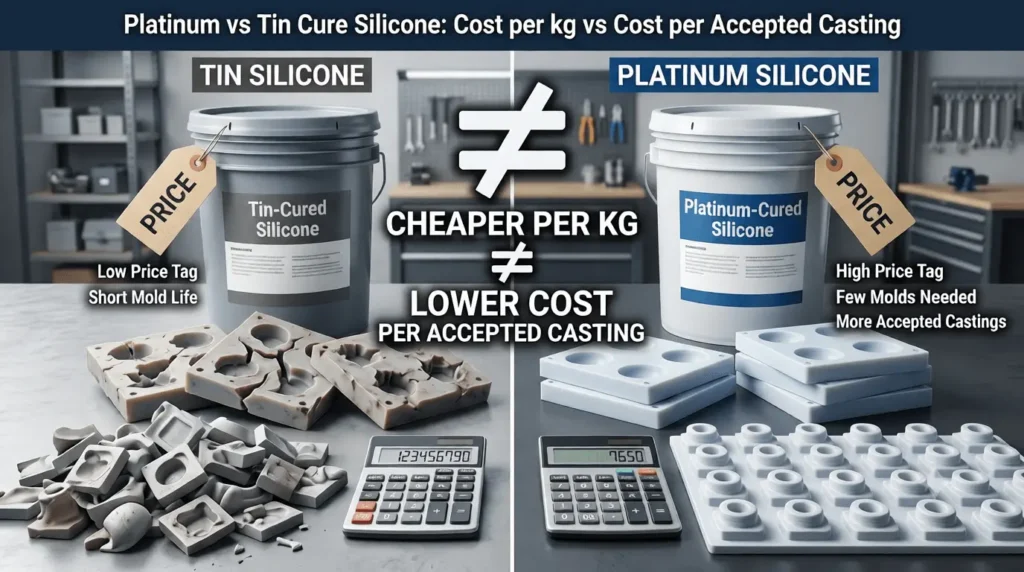

A mold that costs less but fails twice as fast is not always cheaper. It is only cheaper on the invoice.
When buyers compare platinum-cured and tin-cured silicone, the first question is usually:
“Which silicone has the lower price per kg?”
For real mold production, the better question is:
“Which silicone gives me the lower cost per accepted casting?”
Tin-cured silicone usually has a lower upfront price and is a smart choice for many general-purpose molds. Platinum-cured silicone usually costs more per kilogram, but it can reduce total project cost when mold life, dimensional stability, low shrinkage and fewer rejected parts matter.
This guide compares platinum-cured and tin-cured silicone from a practical buyer’s perspective: mold life, failure risk, shrinkage, labor cost, downtime and total cost of ownership.
Quick Answer: Which Silicone Is More Cost-Effective?
Tin-cured silicone is usually more cost-effective for short-run, low-cost molds where slight shrinkage, shorter mold storage life or lower mold durability is acceptable.
Platinum-cured silicone is usually more cost-effective for precision molds, polyurethane casting, food-contact molds, transparent cut molds, high-value resin casting and repeated production where longer mold life and lower rejection rate reduce the cost per accepted casting.
So the right question is not only:
“Which silicone is cheaper?”
Лучше задать вопрос:
“How many good parts can this mold produce before it tears, shrinks, deforms or loses accuracy?”
Platinum-Cured vs. Tin-Cured Silicone: The Basic Difference
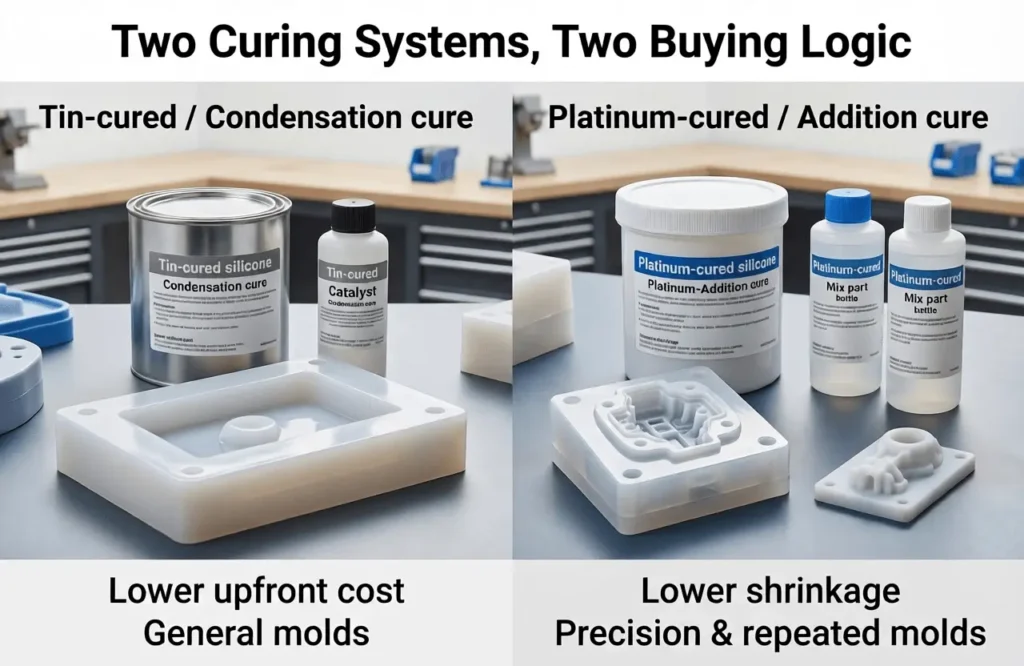
Both platinum-cured and tin-cured silicone are two-component RTV-2 silicone rubbers widely used for mold making. The difference lies in their curing systems and long-term performance.
Tin-Cured Silicone
Tin-cured silicone, also called condensation-cured silicone, is commonly used for:
- Гипсовые формы
- Wax casting
- Concrete molds
- General resin crafts
- Декоративные формы
- Short-run mold making
- Price-sensitive industrial molds
Its biggest advantage is lower upfront cost. For simple molds and low-volume casting, tin-cured silicone can be practical, economical and reliable.
Platinum-Cured Silicone
Platinum-cured silicone, also called addition-cured silicone, is commonly used for:
- Precision mold making
- Polyurethane casting
- Быстрое прототипирование
- Food-contact molds
- Transparent cut molds
- High-value resin molds
- Repeated industrial casting
- Applications requiring low shrinkage
Its key advantages usually include lower shrinkage, better dimensional stability and longer mold life in demanding applications.
However, platinum-cured silicone is not automatically the best choice for every project. It usually costs more and can be more sensitive to cure inhibition caused by sulfur clay, latex, amines, uncured resin, some 3D printed masters, certain release agents or contaminated tools.
A professional supplier should not simply recommend platinum silicone because it is more expensive. The right recommendation depends on application, risk and total production cost.
silicone rubber curing systems
The Real Buying Metric: Cost per Accepted Casting
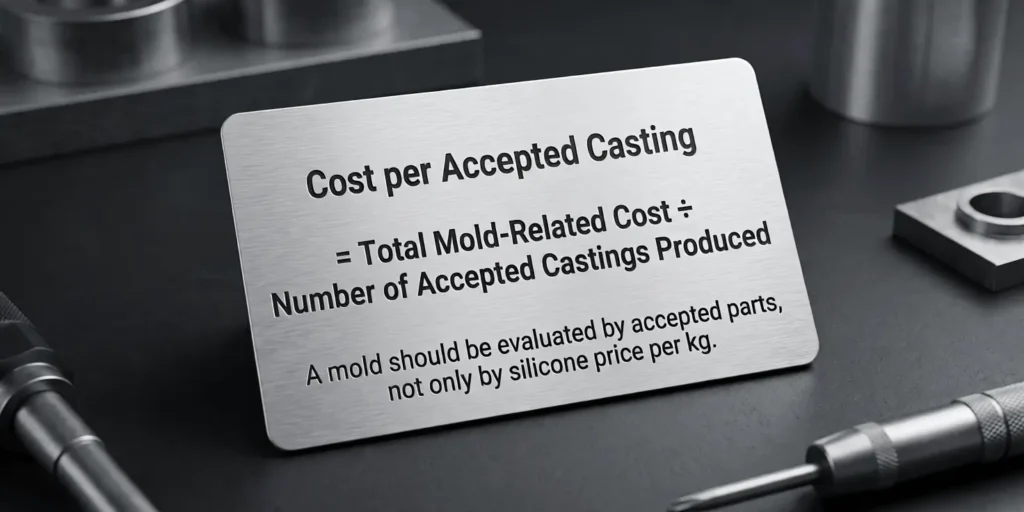
Many buyers compare silicone by price per kilogram. That is understandable, but incomplete.
For mold making, the real cost includes:
- Silicone material cost
- Mold-making labor
- Degassing and pouring time
- Curing and demolding time
- Mold trimming and preparation
- Production downtime during mold replacement
- Failed casting cost
- Dimensional rejection
- Mold remake cost
- Customer complaint risk
The most useful formula is:
Cost per accepted casting = total mold-related cost ÷ number of accepted castings produced
A lower silicone price does not always mean a lower production cost.
If a tin-cured silicone mold costs less but produces fewer accepted castings, the cost per accepted casting may become higher than a platinum-cured silicone mold.
Industrial TCO Example: 1,000 PU Prototype Castings
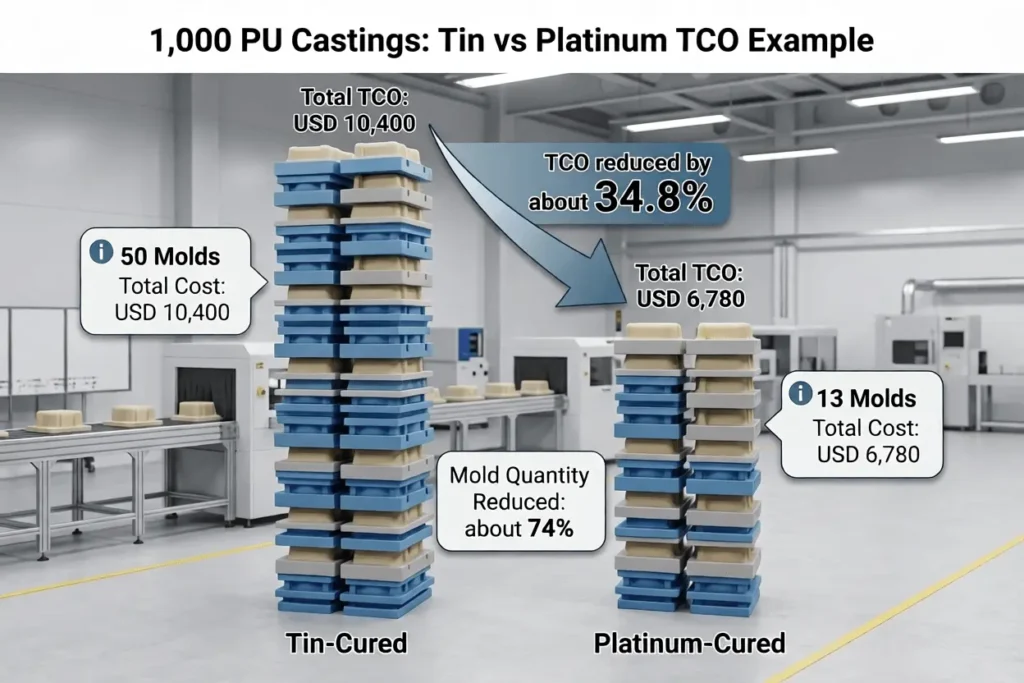
For polyurethane casting and rapid prototyping, the real cost difference between tin-cured and platinum-cured silicone is often not visible in the silicone price alone.
Let’s use a simplified industrial example.
A prototype workshop needs to produce 1,000 polyurethane parts from silicone molds. The buyer is comparing a lower-cost tin-cured silicone with a premium platinum-cured silicone.
This is not a universal promise. The numbers below are an illustrative calculation to show how total cost of ownership can change when mold life, labor, downtime and rejected parts are included.
Project Assumptions
| Артикул | Tin-Cured Silicone | Premium Platinum-Cured Silicone |
| Required PU castings | 1,000 pcs | 1,000 pcs |
| Average mold life | 20 castings per mold | 80 castings per mold |
| Number of molds required | 50 molds | 13 molds |
| Silicone used per mold | 20 kg | 20 kg |
| Silicone price assumption | USD 7/kg | USD 23/kg |
| Mold-making labor cost | USD 30 per mold | USD 30 per mold |
| Changeover / downtime cost | USD 20 per mold | USD 20 per mold |
| Dimensional rejection rate | 3% | 0.50% |
| Cost per rejected PU part | USD 30/pc | USD 30/pc |
Total Cost Comparison
| Cost Category | Tin-Cured Silicone | Premium Platinum-Cured Silicone |
| Silicone material cost | USD 7,000 | USD 5,980 |
| Mold-making labor cost | USD 1,500 | USD 390 |
| Changeover / downtime cost | USD 1,000 | USD 260 |
| Rejected part cost | USD 900 | USD 150 |
| Total project cost | USD 10,400 | USD 6,780 |
In this illustrative scenario, the premium platinum-cured silicone reduces the total project cost from USD 10,400 to USD 6,780.
That is a total cost reduction of about 34.8%.
Почему?
Because the platinum-cured silicone option reduces the number of molds from 50 molds to 13 molds. That means fewer mold-making cycles, less labor, less changeover downtime and fewer rejected parts.
The tin-cured silicone looks cheaper when the buyer only compares price per kilogram. But for a 1,000-piece PU casting project, lower mold life can create extra cost through more mold remakes, more downtime and higher dimensional rejection.
For serious PU casting, rapid prototyping and industrial mold-making projects, buyers should compare cost per accepted casting, not only silicone price per kg.
How Silicone Molds Actually Lose Value
To compare mold life correctly, buyers should understand how silicone molds fail in real production.
A mold does not only fail when it completely breaks. It may become unsuitable much earlier.
Common failure modes include:
- Tearing at undercuts or thin sections: Complex parts can stretch the mold during demolding. If tear strength or elongation is not enough, small cracks can grow quickly.
- Dimensional deformation: The mold may still look usable but no longer produce accurate parts.
- Shrinkage during storage: Some molds must be stored for repeat orders. If the mold shrinks, the next casting may not match the original dimensions.
- Surface detail loss: Fine texture, engraving, sharp lines or glossy surfaces may gradually become dull after repeated casting.
- Difficult demolding: More force during demolding increases the risk of tearing, deformation and surface defects.
- Chemical stress from casting materials: Some resins, PU systems or abrasive materials may shorten mold life after repeated use.
This is why mold life should be evaluated by accepted parts, not by whether the mold still physically exists.
For decorative crafts, slight shrinkage may not matter much. But for precision PU parts, assembly components and prototypes, even small dimensional changes can cause customer rejection.
In these applications, low shrinkage is not a luxury feature. It is a cost-control factor.
Buyer Decision Guide: When to Choose Tin or Platinum
| Buyer Situation | Better Starting Point | Why |
| Lowest upfront cost is the main priority | Tin-cured silicone | Lower initial material cost |
| Simple plaster, wax or decorative molds | Tin-cured silicone | Usually sufficient for short-run use |
| Concrete molds | Tin-cured or high-tear silicone | Depends on mold size, abrasion and demolding force |
| Low-cost resin crafts | Tin-cured or platinum-cured silicone | Depends on budget and expected casting cycles |
| Deep undercut resin molds | Softer platinum-cured silicone | Better flexibility and lower tearing risk |
| High-value epoxy parts | Platinum-cured silicone | Better mold life, detail and dimensional stability |
| PU casting and rapid prototyping | Platinum-cured silicone | Better for precision, repeatability and mold life |
| Transparent cut molds | Transparent platinum-cured silicone | Easier cutting and visual control |
| Food-contact molds | Properly certified platinum-cured silicone system | Food-contact documents matter |
| One-time low-budget mold | Tin-cured silicone | Lower upfront cost |
| Repeated production or high rejection cost | Platinum-cured silicone | Lower cost per accepted casting may be possible |
The final choice should always consider casting material, part design, hardness, viscosity, working time, demold time, expected mold life and compliance requirements.
Important Note: Platinum-Cured Does Not Automatically Mean Food-Grade
Many buyers assume that platinum-cured silicone is automatically food-grade. This is not correct.
Platinum curing is commonly used in food-contact silicone systems, but food-contact suitability depends on:
- Final formulation
- Cured sample testing
- Production control
- Applicable regulations
- Food type
- Contact temperature
- Contact time
- Supporting documents such as FDA or LFGB test reports where applicable
Другими словами:
Cure chemistry is not the certificate.
If the mold will contact chocolate, candy, cake, ice, oil-based food or other food materials, buyers should confirm the exact food-contact requirement before choosing a silicone grade.
Replacing Your Current Silicone? Test More Than Price
Many buyers compare platinum-cured and tin-cured silicone because they are considering replacing an existing brand or supplier.
In this case, price comparison is only the first step.
Before replacing your current silicone, compare:
- Cure system
- Mixing ratio
- Твердость по Шору А
- Вязкость
- Pot life / working time
- Demold time
- Прочность на разрыв
- Tensile strength
- Удлинение
- Усадка
- Color or transparency
- Cure inhibition risk
- Casting material compatibility
- Actual mold life in your process
The best approach is to test both materials under the same production conditions and compare accepted casting output.
A simple test should record:
- Same master model and mold design
- Same silicone quantity and processing method
- Same casting material
- Same demolding method
- Number of accepted castings before tearing, deformation or dimensional failure
- Final cost per accepted casting
This gives buyers a much more reliable comparison than price per kg alone.
Common Mistakes Buyers Make
- Only Comparing Price per kg
A lower silicone price may become more expensive if the mold produces fewer accepted castings.
Better approach: Compare cost per accepted casting.
- Ignoring Mold Failure Modes
A mold can fail through tearing, deformation, shrinkage, detail loss or poor demolding.
Better approach: Define what “acceptable mold life” means before testing.
- Using Tin-Cured Silicone for Precision Parts Without Testing
Tin-cured silicone can work well in many applications, but precision parts need careful validation.
Better approach: Test dimensional stability before mass production.
- Choosing Platinum Silicone Without Checking Cure Inhibition
Platinum-cured silicone may fail to cure when it contacts incompatible materials.
Better approach: Run a small compatibility test before making the full mold.
- Choosing Hardness Only by Habit
Many buyers always choose Shore A 20 or Shore A 30 because they used it before. But different parts need different hardness.
Better approach: Choose hardness based on part size, undercuts, demolding difficulty and support requirements.
- Not Sharing the Current TDS with the Supplier
If you want a replacement grade, your supplier needs to understand the current material.
Better approach: Send your current silicone TDS and explain what you want to improve: price, mold life, hardness, viscosity, cure time or shrinkage.
How Topsil Helps Buyers Choose the Right Silicone
Topsil is a 15-year RTV-2 silicone manufacturer supplying both platinum-cured and tin-cured silicone rubber for mold making, resin casting, food molds, polyurethane casting, быстрое прототипирование and industrial applications.
We do not recommend platinum-cured silicone simply because it is more expensive.
For low-cost, short-run and general molds, tin-cured silicone may be the better choice. For precision parts, PU casting, transparent cut molds, food-contact molds or repeated production, platinum-cured silicone may reduce total cost by improving mold life, dimensional stability and casting success rate.
Topsil can help buyers compare:
- Platinum-cured vs. tin-cured silicone
- Твердость по Шору А
- Вязкость
- Время работы
- Demold time
- Прочность на разрыв
- Удлинение
- Усадка
- Mold life expectation
- Cure inhibition risk
- Food-contact document requirements
- Cost per accepted casting
If you are replacing your current silicone, you can send us your existing TDS and application details. We can help recommend a suitable testing grade and build a simple cost-per-casting comparison.
What Information Should You Send Before Sampling?
To recommend the right silicone, please provide:
- Casting material
- Part size
- Mold structure
- Undercuts or thin sections
- Required Shore A hardness
- Current silicone grade or TDS
- Working time requirement
- Demold time requirement
- Expected casting cycles per mold
- Whether vacuum degassing is used
- Whether food-contact documents are required
- Main problem with the current silicone
Examples of useful information:
- “We cast PU prototype parts and need 50–80 castings per mold.”
- “Our current tin-cured silicone tears after around 20 castings.”
- “We need lower shrinkage for precision assembly parts.”
- “We need a transparent silicone for cut molds.”
- “We need a food-contact silicone for chocolate molds.”
- “We want to replace our current silicone but keep similar hardness and working time.”
The more specific the application, the more accurate the recommendation.
Conclusion: Cheaper per kg or Cheaper per Accepted Part?
Tin-cured and platinum-cured silicone both have important roles in mold making.
Tin-cured silicone is usually the smarter choice for low-cost, short-run and general-purpose molds. It offers a lower upfront price and works well in many basic applications.
Platinum-cured silicone is usually the smarter choice when mold life, low shrinkage, dimensional accuracy, food-contact suitability, transparency or repeated casting performance matter more than the initial material price.
The key is not to ask:
“Which silicone is cheaper per kg?”
Лучше задать вопрос:
“Which silicone gives me the lowest cost per accepted casting?”
For simple molds, tin-cured silicone may win.
For precision, PU casting, repeated production and high-value parts, platinum-cured silicone may reduce the real total cost.
ЧАСТО ЗАДАВАЕМЫЕ ВОПРОСЫ
Need help choosing between platinum-cured and tin-cured silicone?
Send Topsil your current TDS, casting material, silicone consumption per mold, expected mold life and production quantity. We can help you compare cost per accepted casting and recommend a suitable RTV-2 silicone grade for testing.