
A supplier sends you a test report headed “FDA compliant silicone.” The report may be genuine. But if you turn that liquid RTV-2 silicone into red baking molds sold in Germany, does the document actually cover your finished product?
Not necessarily.
The expensive compliance mistake is not simply buying the wrong silicone. It is discovering a documentation gap after tooling, packaging or production has already started.
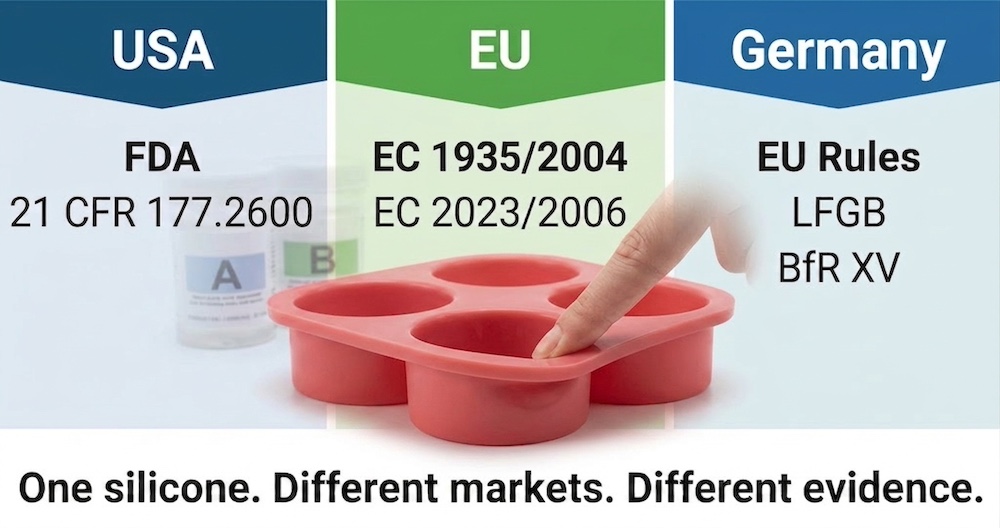
For importers, “FDA,” “EU,” “LFGB” and “BfR XV” should not be treated as interchangeable certificates. The better way to evaluate a food-contact silicone is to connect five things:
target market → intended use → exact formulation → cured article → supporting evidence
Быстрый ответ
FDA 21 CFR 177.2600 compliance does not automatically establish EU or German compliance.
In the United States, 21 CFR 177.2600 addresses rubber articles intended for repeated food contact and includes specified silicone polymers and elastomers.
In the EU, silicone is subject to the general food-contact framework of Regulation (EC) No 1935/2004 and the Good Manufacturing Practice requirements of Regulation (EC) No 2023/2006. Germany applies these EU requirements together with national LFGB provisions, while BfR Recommendation XV – Silicones is an important material-specific scientific reference.
The 5-Layer Food-Contact Verification Model
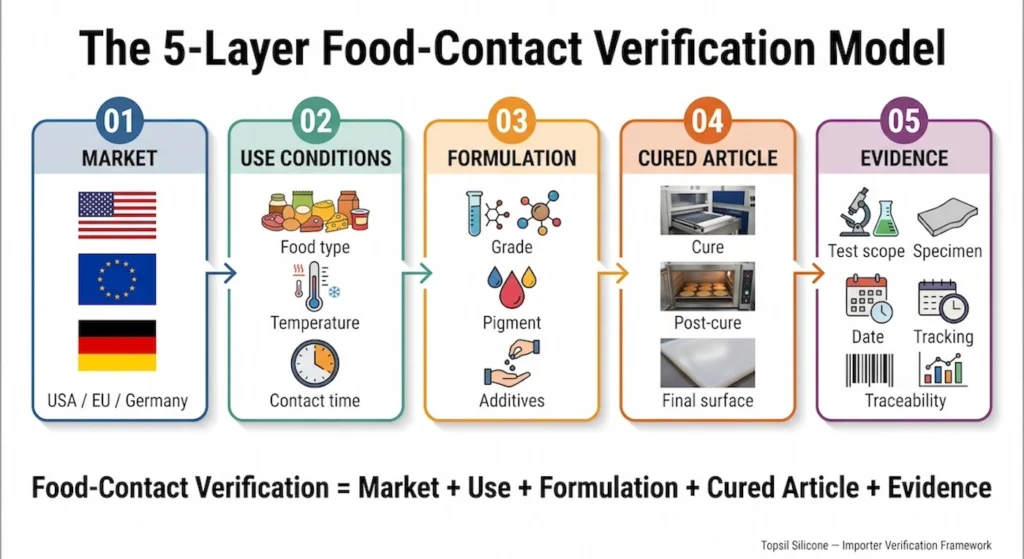
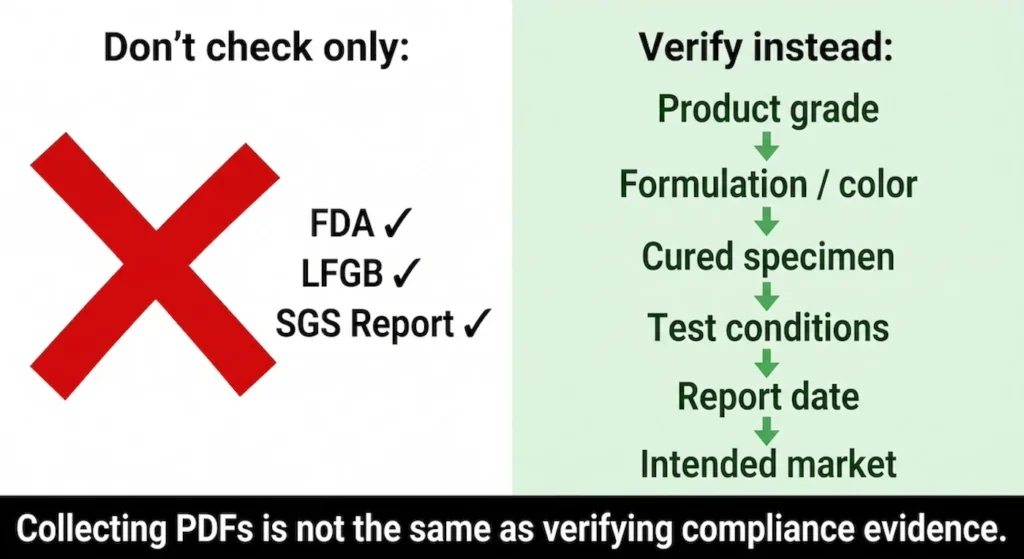
Instead of asking only, “Do you have FDA or LFGB?”, an importer should verify five layers:
| Layer | What You Need to Verify | Common Procurement Mistake |
| 1. Market | U.S., EU, Germany or multiple markets | Assuming one report is globally valid |
| 2. Use Conditions | Food type, temperature, contact time and repeated use | Saying only “for baking” |
| 3. Formulation | Exact grade, A/B ratio, pigments and additives | Assuming every color is identical |
| 4. Cured Article | Cure, post-cure and final food-contact surface | Reviewing only liquid Part A/B |
| 5. Evidence | Test scope, specimen, laboratory, date and traceability | Collecting PDFs without checking coverage |
This distinction matters because platinum curing describes cure chemistry; it does not itself prove food-contact compliance.
Likewise, a TDS, SDS or COA can support technical identification, safety communication or batch traceability, but none of these documents replaces relevant food-contact compliance evidence.
For a deeper explanation of this evidence chain, see our guide: What Does Food-Grade Silicone Really Mean?
FDA 21 CFR 177.2600: What Should an Importer Actually Verify?
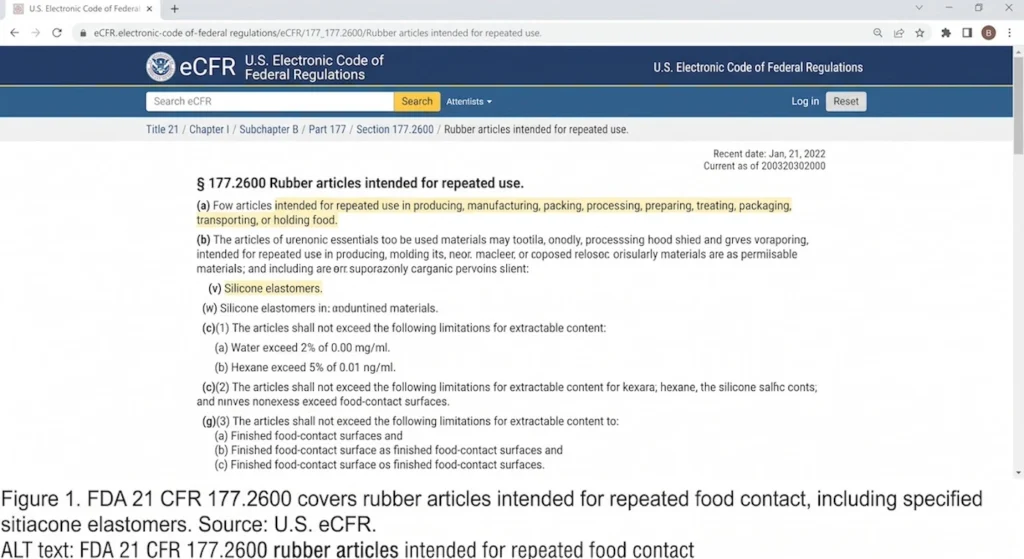
21 CFR 177.2600 is titled “Rubber articles intended for repeated use.”
It covers repeated-use rubber articles for food-contact applications subject to the section’s composition, use and extractives provisions. Silicone basic polymers and silicone elastomers containing methyl, phenyl, vinyl or certain other groups are specifically listed.
That means FDA compliance is not established simply because the material is “silicone.”
The finished food-contact surface matters
For repeated contact with aqueous foods, §177.2600 states that the finished food-contact surface, when extracted using distilled water at reflux temperature, must not yield total extractives above:
20 mg/in² during the first seven hours, и 1 mg/in² during the succeeding two hours.
For repeated contact with fatty foods using n-hexane, the corresponding limits are:
175 mg/in² during the first seven hours, и 4 mg/in² during the succeeding two hours.
The words “in the finished form in which it is to contact food” are particularly important for RTV-2 silicone buyers.
A liquid Part A and Part B eventually become a cured elastomer. If pigment, filler, additive package or processing conditions change, the importer should verify whether the available evidence still applies to the material actually being purchased.
Importer Rule: FDA compliance is evidence linked to a defined formulation and finished food-contact surface—not a universal badge that automatically follows every modification of the silicone.
Why EU and German Silicone Compliance Works Differently
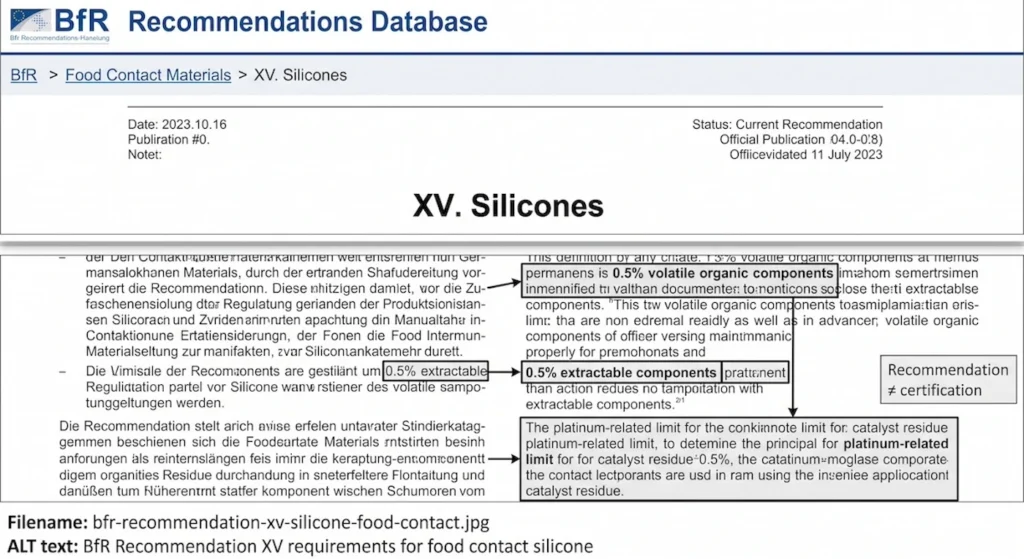
In the European Union, Regulation (EC) No 1935/2004 provides the general legal framework for food-contact materials.
The European Commission summarizes its core principles clearly: food-contact materials must not release constituents into food at levels harmful to human health or unacceptably change the composition, taste or odour of food. The framework also addresses traceability and compliance documentation.
Regulation (EC) No 2023/2006 adds Good Manufacturing Practice requirements, including documented quality assurance and quality-control systems and the selection of suitable starting materials.
One common mistake: treating EU 10/2011 as “the silicone regulation”
Regulation (EU) No 10/2011 is the EU’s specific measure for plastic materials and articles.
The European Commission currently lists plastics, ceramics, regenerated cellulose film, recycled plastics and active/intelligent materials among categories covered by specific EU measures. Silicone does not currently have an equivalent fully harmonized EU-specific measure.
That does не mean silicone is unregulated. It means the general EU food-contact framework remains applicable, supplemented where relevant by national provisions and appropriate material-specific assessment references.
What Does “LFGB Silicone” Actually Mean in Germany?
Фраза “LFGB-certified silicone” is common in supplier marketing, but it oversimplifies the regulatory structure.
Germany first operates within the EU food-contact framework.
German LFGB §31 directly refers to the requirements of Article 3(1) of Regulation 1935/2004 and prohibits non-compliant food-contact materials from being used or placed on the market.
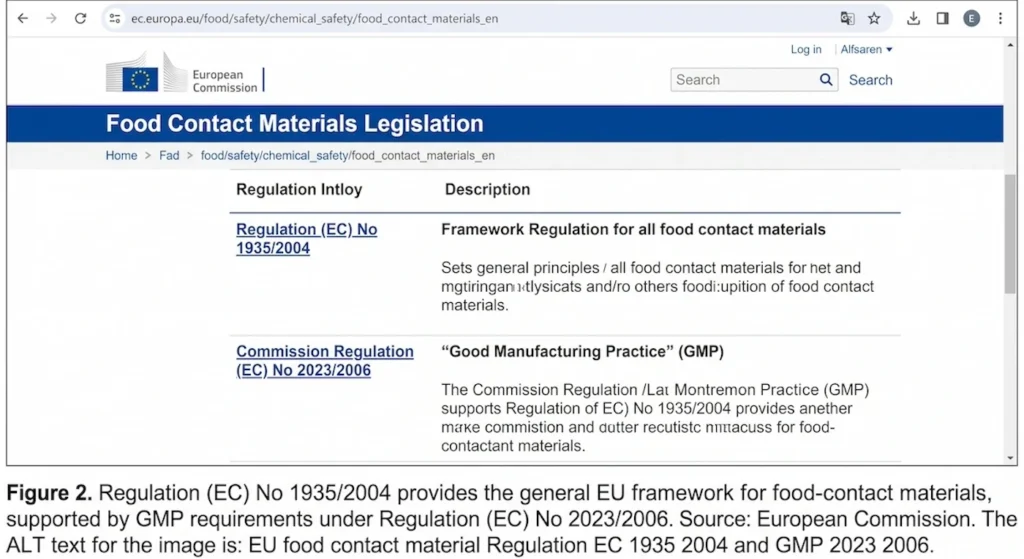
For silicone, BfR Recommendation XV – Silicones is particularly relevant.
But there is an important distinction:
BfR Recommendation XV is not itself a legally binding “LFGB certificate.”
BfR explicitly states that its food-contact recommendations are not binding legal standards. However, they reflect the current state of science and technology for assessing whether high-polymer materials such as silicones meet relevant food-contact health-safety requirements. BfR also states that its recommendations can continue to be used for materials such as silicone for which no harmonized material-specific EU rules exist.
For silicone elastomers, Recommendation XV addresses starting materials, processing aids, crosslinking agents, catalysts and other components.
Among its provisions:
- platinum coordination compounds: max. 50 mg platinum/kg finished product under the general silicone-elastomer provision;
- volatile organic components: max. 0.5%;
- extractable components: max. 0.5%;
- finished products must not test positively for peroxides.
So when a supplier sends an “LFGB report,” the useful question is not whether the PDF exists.
Ask whether it identifies the actual silicone grade, color, cured specimen, test basis and conditions relevant to your product.
7 Things Importers Should Check Before Approving Food-Contact Silicone
- Destination market. Determine whether the finished product will be sold in the U.S., EU, Germany or multiple markets. Do not assume evidence prepared for one jurisdiction automatically covers another.
- Actual food-contact conditions. Define food type, maximum temperature, contact duration, repeated-use cycles and cleaning conditions. Chocolate, ice, hot candy and repeatedly heated baking molds do not represent the same exposure scenario.
- Exact silicone grade and formulation. Documentation should correspond to the grade being purchased. If pigment, filler or another ingredient changes, ask whether the existing evidence still covers the revised formulation.
- Cured specimen versus liquid raw material. Food contacts the cured elastomer—not separate Part A and Part B. Check what material was actually tested and how the specimen was prepared.
- Cure and post-cure conditions. Review A/B ratio, cure time, cure temperature and any specified post-cure. These conditions should be defined rather than left as an assumption.
- Report identity and traceability. Verify manufacturer, product code, specimen description, testing laboratory, report date and test scope. Also ask whether the formulation has changed since testing.
- Give each document the correct role. TDS, SDS and COA are useful supporting documents, but they are not substitutes for a relevant food-contact declaration, assessment or test report.
A practical red flag is a supplier who answers every compliance question with the same PDF but cannot explain which grade, specimen, color, curing process or intended application the report actually covers.
When Is Existing Evidence Enough—and When Should You Reassess?
Existing evidence is more likely to be relevant when the exact grade, formulation, color, cure process and intended conditions of use fall within its documented scope.
Additional assessment may become appropriate when there is a custom pigment, material formulation change, different cure process, more severe heat exposure, different food type or a finished article outside the original evidence scope.
This also explains the division of responsibility.
The silicone manufacturer can provide formulation-specific documentation, technical data and processing guidance. The finished-product manufacturer or importer still needs to determine whether that evidence adequately supports the actual finished article, market and intended use.
That is why:
“Does your evidence cover my finished application?”
is a much stronger procurement question than:
“Do you have FDA and LFGB?”
Practical Example: Red Baking Molds for the U.S. and Germany
Assume you want to purchase a 1:1 platinum-cured RTV-2 silicone for reusable red baking molds.
The finished molds may repeatedly contact fat-containing cake batter at temperatures up to 220°C and will be sold in both the United States and Germany.
A generic statement that “this is FDA food-grade silicone” does not finish the compliance review.
For the U.S., verify that the available evidence corresponds to the exact formulation and is relevant to repeated food contact under §177.2600. If the report was produced using translucent silicone, do not automatically assume it covers the final red formulation.
For Germany, consider the EU 1935/2004 and GMP framework, applicable LFGB obligations and relevant BfR XV evidence.
Then confirm how the test specimen was cured and whether a post-cure was specified.
Finally, validate actual mold performance under real production conditions: complete cure, repeated heating and cleaning, odor, surface condition, dimensional stability, release and mechanical durability.
The commercial lesson is important:
A silicone grade may perform perfectly while its documentation does not adequately cover your finished application—or the documentation may look strong while the silicone performs poorly in the real mold. A professional procurement review has to verify both.
For application-specific differences, read Food-Grade RTV-2 Silicone for Chocolate, Baking, Candy and Ice Molds.
If you are still deciding which cure system to evaluate, see our Platinum-Cured Silicone Guide.
ЧАСТО ЗАДАВАЕМЫЕ ВОПРОСЫ
The Importer’s Final Rule
Do not approve food-contact silicone simply because a datasheet says “FDA,” “LFGB” or “food grade.”
Ask instead:
Which exact formulation was assessed, under which regulatory framework, for which food-contact conditions, in what cured state—and what evidence shows that the report applies to the silicone I am buying?
If you are evaluating RTV-2 silicone for chocolate, baking, candy, ice or another reusable food mold, send Topsil Silicone these four details before requesting a quote:
destination market + food type + maximum use temperature + required color
Our technical team can help review the application, suggest an appropriate platinum-cured silicone direction for testing, and clarify which available documents are relevant to the intended use.
Explore our Food-Grade Silicone for Mold Making application page or contact Topsil Technical Support for an application and documentation-fit review.
Regulatory note: This guide provides general technical information and is not legal advice. Food-contact compliance depends on the exact formulation, finished article, intended conditions of use and destination market.