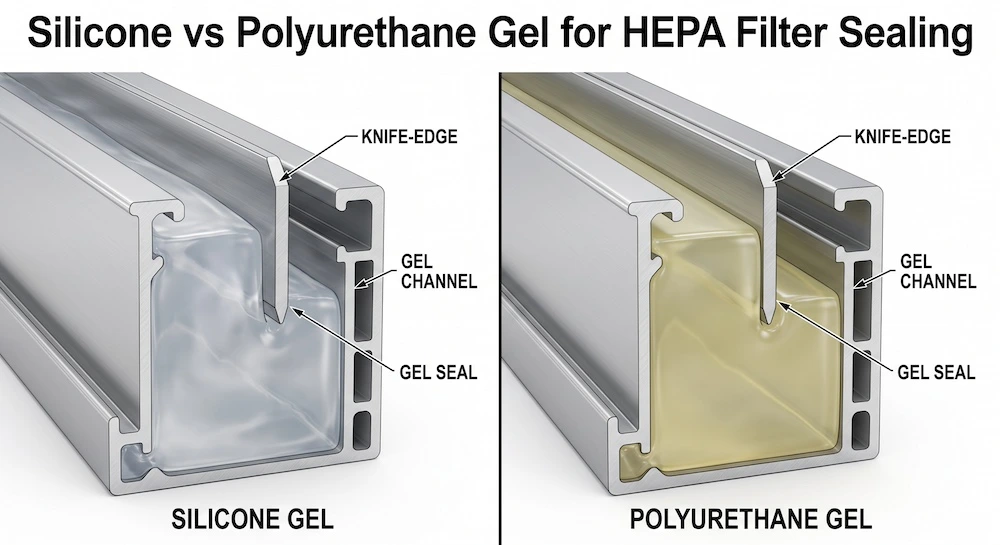

A HEPA or ULPA filter can use high-efficiency media and still allow bypass at the filter-to-housing interface. That makes the gel seal a system decision—not a drum-price decision. Silicone and polyurethane gels can both form soft knife-edge seals, but they do not create the same processing, aging or changeover risks.
Editorial disclosure
Topsil Silicone manufactures silicone gel, including TP-012. This guide does not claim that every silicone gel outperforms every polyurethane gel. It explains when each material deserves consideration and what evidence should decide the final choice.
The 60-Second Decision
Use the following rule to choose a starting candidate:
- Evaluate silicone gel first if the filter will face wide or changing temperatures, prolonged humidity, repeated removal and installation, or a long service period in which seal failure is costly.
- Keep or evaluate polyurethane gel if the environment is stable, the existing PU grade and process are already qualified, and switching offers no measurable lifecycle benefit.
- Test both exact grades if chemical exposure, cleanliness requirements, material migration or compatibility with the frame and adhesives is uncertain.
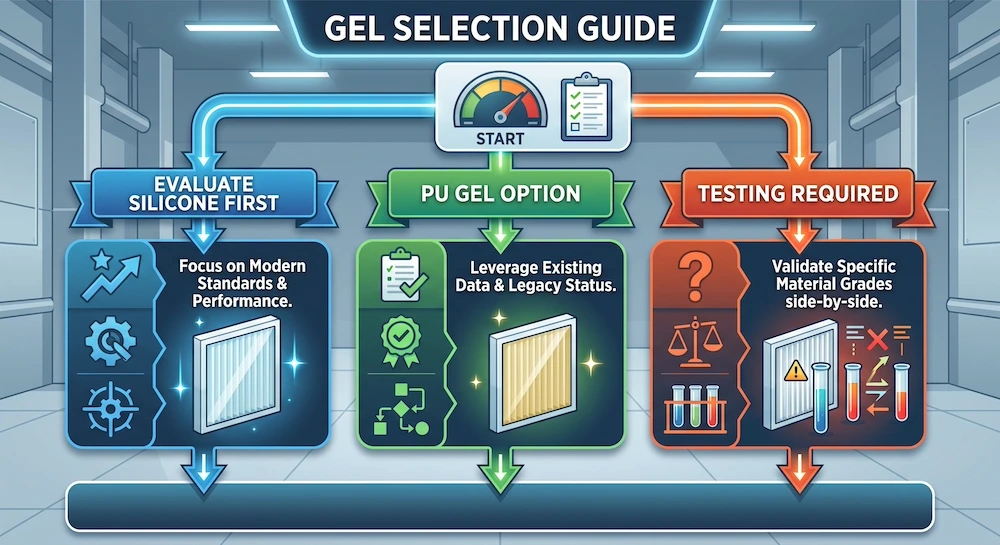
Use this rule to choose what to test first; final approval still depends on the assembled sealing system.
What the Material Names Do—and Do Not—Tell You
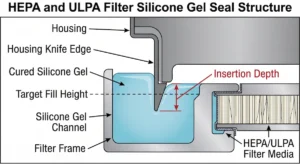
In a gel-seal filter, the cured material fills a perimeter channel. The housing knife edge enters the gel and creates a conformable barrier around the filter. Both silicone and polyurethane can be formulated for this structure.
The names alone do not define softness, cohesive strength, recovery, cure speed or service life. Polyurethane gel is a broad category: backbone, plasticization, fillers and cure package can change its behavior. Silicone gels also vary in formulation, viscosity, softness and cure response. A comparison between “silicone” and “PU” is therefore only useful when it identifies the exact commercial grades and uses the same test conditions.
Silicone Gel vs Polyurethane Gel: Decision Matrix
| Project condition | Best starting move | Why | What must confirm it |
| Wide or cyclic temperature exposure | Evaluate silicone first | Long-term flexibility may carry more weight than initial price | Grade-specific aging followed by insertion and seal tests |
| Prolonged humid service or storage | Evaluate silicone first | Moisture-aging risk deserves priority | Damp-heat exposure with defined acceptance limits |
| Stable indoor environment with qualified PU | Keep PU as the baseline | An approved process has real operational value | Current quality history and finished-filter results |
| Repeated filter replacement | Compare both exact grades | Recovery depends on formulation and geometry | Defined knife-edge insertion-cycle test |
| Disinfectant, cleaner or aerosol exposure | No default winner | Chemical compatibility is application-specific | Exposure test at actual concentration and temperature |
| Strict migration or cleanliness limits | No default winner | Material-family claims are insufficient | Product-specific method, result and acceptance limit |
| Change driven mainly by lower price/kg | Calculate total cost first | Density, cure time, scrap and changeover affect real cost | Cost per accepted filter |
Five Questions That Should Decide the Material
1. What Will the Seal Experience After Installation?
Define normal temperature, short peaks, shutdown conditions, relative humidity, storage and transport. “Room-temperature use” is not enough if filters later face seasonal changes, hot cleaning cycles or humid warehouses.
Silicone is a logical first candidate when the environmental window is demanding, but do not insert a generic temperature range into the specification. Request evidence from the exact grade: exposure temperature, duration, sample geometry, measured property and result. After aging, repeat the tests that matter to the seal—knife-edge entry, gel displacement, recovery and finished-filter integrity.
2. How Many Knife-Edge Insertions Must the Gel Tolerate?
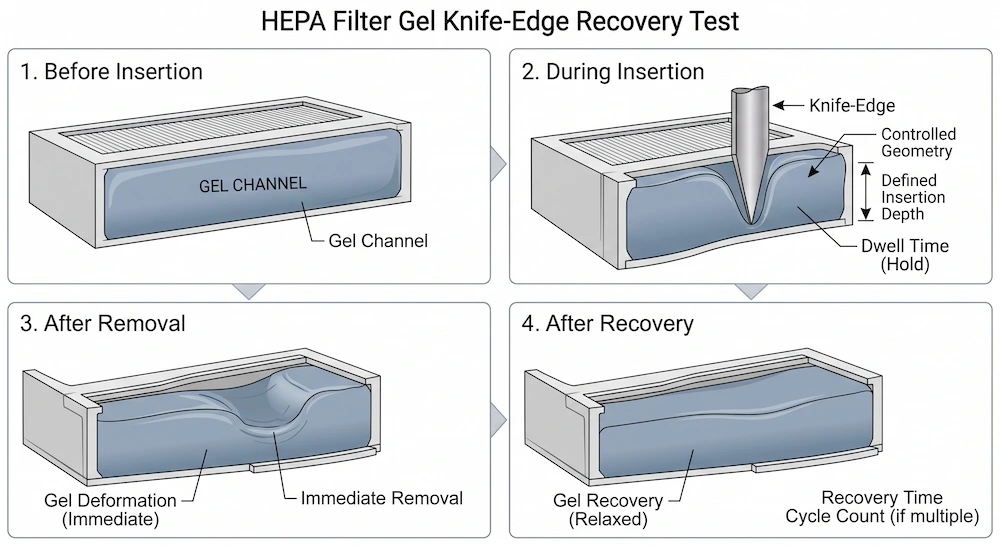
Initial softness does not prove recovery. A gel may accept the knife edge easily yet leave a permanent channel, tear, transfer to the blade or move out of the sealing path. Very low insertion force is therefore not the only goal; the gel also needs enough cohesive stability for the intended installation cycle.
Test both candidates with the same knife-edge thickness, profile, insertion depth, dwell time and number of cycles. Photograph one marked location before insertion, immediately after removal and after a defined recovery period. Without controlled geometry, the comparison measures fixture variation rather than material performance.
3. Does the Material Fit the Production Line?
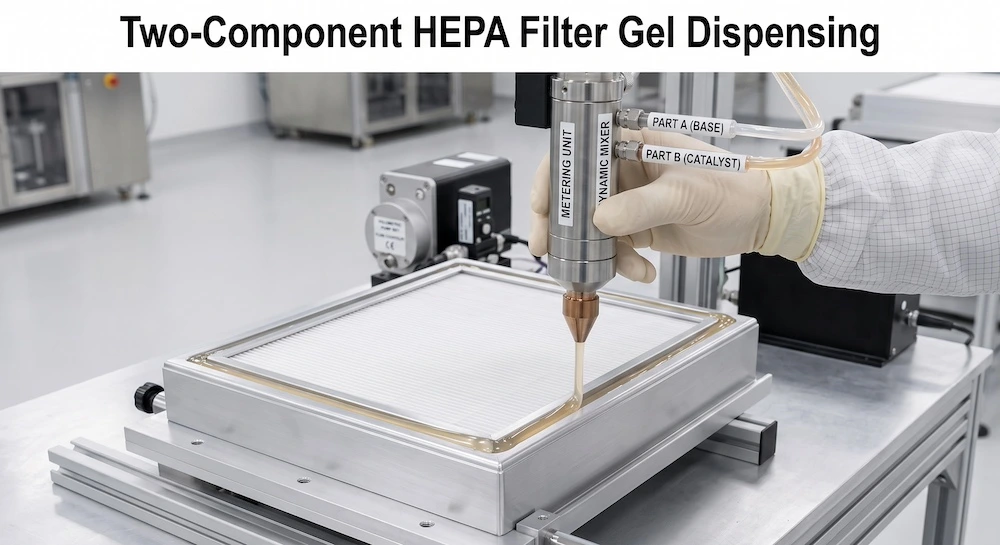
Check the specified mix ratio and whether it is by weight, volume or both. Then compare component viscosity at the real processing temperature, pump capability, hose length, mixer pressure drop, working time, fill control and handling cure.
This reflects what filter manufacturers ask during real sample discussions. Density, mixing ratio and mixing instructions are often among the first questions because they affect metering, trial quantity and cost per filter. A material that performs well in a laboratory cup can still create production problems if the pump output is unbalanced or the filled frame must be moved before the gel is ready.
4. Are All Contact Materials and Chemicals Known?
List the frame material, coating, media adhesive, channel adhesive, release agents, cleaners, disinfectants, test aerosols and any lubricant near the seal. Addition-cure silicone requires careful control of incompatible contaminants; polyurethane systems have different moisture, substrate and processing sensitivities.
Run two cure checks: one in a verified clean container and one against every production contact surface. If the cup cures but the interface remains wet or weak, investigate surface compatibility rather than immediately changing the mix ratio. For chemical exposure, define concentration, contact method, temperature and duration before testing.
5. Which Choice Has the Lower Cost per Accepted Filter?
Purchase price is only one input:
Total sealing cost = gel consumption + dispensing labor + cure-space cost + changeover + scrap + rework + field-failure risk.
The same channel volume can require a different material mass when mixed densities differ. Cure time affects work-in-process space and throughput. An inexpensive gel can become costly if it increases bubbles or rejects; an already-qualified PU may remain economical when a switch provides no verified improvement. Compare production data, not quotations alone.
What Changes When Switching from PU Gel to Silicone Gel?
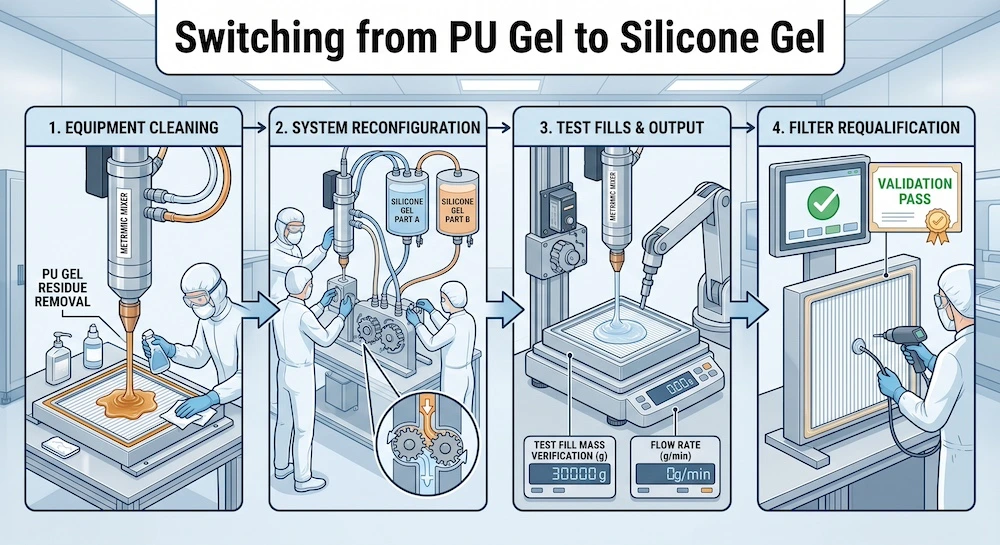
Switching material families should be treated as a controlled process change, not a drum replacement. Metering requirements are covered above; three additional controls become especially important during changeover.
Cleaning and Cross-Contamination
Do not top up old polyurethane gel with silicone or assume that a previously used mixer is clean enough. Residual gel, flushing agent, oil or production contamination may affect cure or create non-uniform material. Follow an approved cleaning/changeover procedure, then perform clean-cup and surface-contact cure checks.
Fill Mass and Process Timing
Recalculate kilograms per filter using the new mixed density and target channel fill. Review when the filter can be moved, stacked, tested and packed; working time, handling cure and full cure are different production milestones.
Requalification
Keep the channel and knife-edge geometry constant during the first comparison. Record batch, temperatures, output ratio, fill mass and cure time. Then repeat the required insertion, aging and finished-filter tests. A successful cup cure is only the beginning of qualification.
When TP-012 Is Worth Evaluating
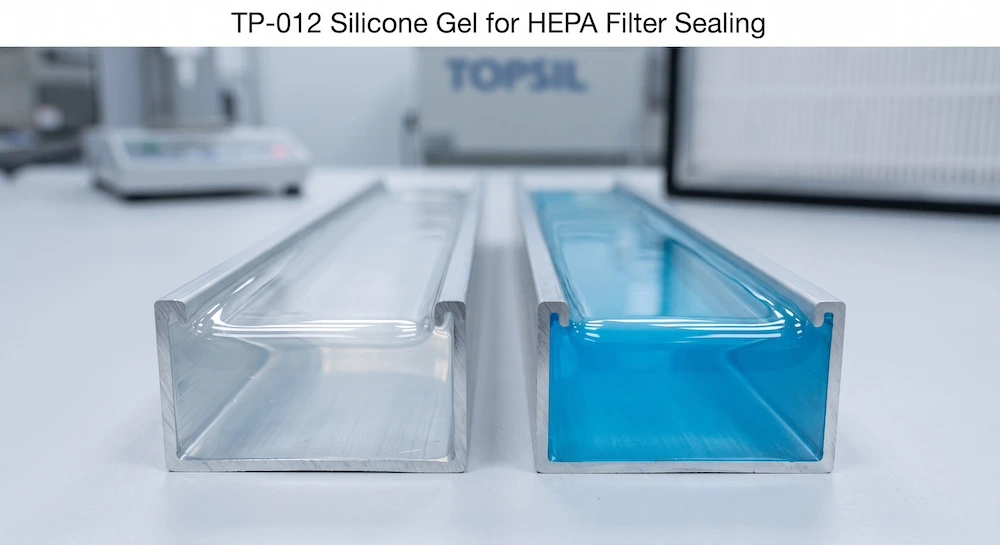
Topsil Silicone TP-012 is a pourable, two-component addition-cure silicone gel available in clear or blue for compatible HEPA and ULPA gel-seal structures.
It is worth evaluating when:
- a soft silicone knife-edge seal is required;
- the dispensing line can process the ratio, viscosity and cure window in the latest TDS;
- the actual frame, coating and adhesives are available for compatibility testing; and
- the customer can validate the finished filter under its applicable requirements.
Additional technical review is needed when the application includes unusual temperatures, aggressive chemicals, strict migration/outgassing limits, repeated high-cycle insertion or an immediate change from equipment containing PU residues. In those cases, a standard room-temperature pour test is not sufficient.
A Practical Pre-Switch Validation Plan
Agree on pass/fail limits before the trial, then:
- Record channel geometry, target fill and knife-edge dimensions.
- Record all frame, coating, adhesive and tooling contact materials.
- Condition both components to the approved processing temperature.
- Measure the actual output ratio and dispensed mass.
- Check clean-cup cure and contact-surface cure.
- Inspect bubbles, fill uniformity, overflow and uncured areas.
- Run the defined knife-edge insertion and recovery cycle.
- Repeat critical checks after relevant temperature, humidity or chemical exposure.
- Complete the applicable finished-filter leak and performance tests.
EN 1822 and ISO 29463 address high-efficiency filter classification and testing; they are not raw-gel certifications. For calculation, dispensing and troubleshooting details, see our HEPA and ULPA filter silicone gel selection guide.
What to Send Before Requesting a Trial
Send the gel-channel width, depth and perimeter; knife-edge thickness and insertion depth; frame and adhesive materials; current gel or TDS; processing temperature; required handling time; service environment; trial quantity and expected annual volume.
Topsil Silicone can use this information to review TP-012 silicone gel suitability, estimate a realistic trial quantity and prepare a focused validation checklist. This is more useful than sending an arbitrary sample that may be too small for equipment setup and repeat testing.
Request a Gel Selection & Trial Plan
Часто задаваемые вопросы
Ready to test silicone gel in your production line?
Share your HEPA filter channel dimensions and process requirements with us. Our engineers will help you calculate actual consumption and build a customized TP-012 validation plan.