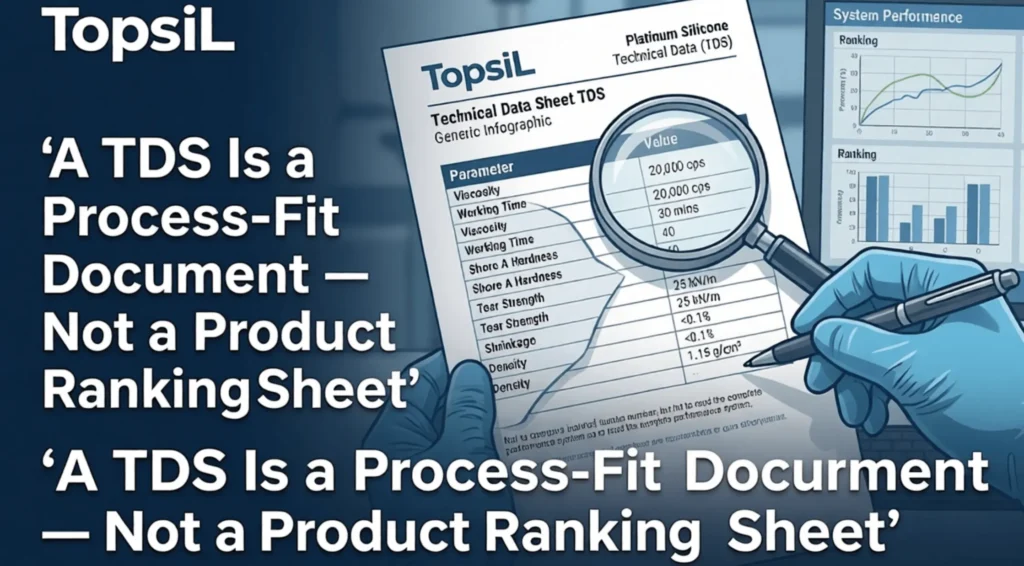

Two platinum silicone products can have the same Shore A sertlik and behave completely differently in production.
One may flow easily but cure too quickly for vacuum degassing. Another may have excellent tear strength but be too viscous for a narrow, detailed mold. A third may look superior on paper but produce poor results because its working time, hardness and cure behavior do not match the customer’s process.
This is why experienced buyers do not compare a platinum silicone TDS line by line.
They read the values as a connected system.
A poorly matched silicone can cause incomplete filling, trapped bubbles, premature tearing, difficult demolding, dimensional rejection or a working window that is too short for the operator.
The purpose of a TDS is therefore not to identify the product with the largest numbers. It is to help determine whether the material fits the application and deserves a production trial.
Quick Answer: How Should You Read a Platinum Silicone TDS?
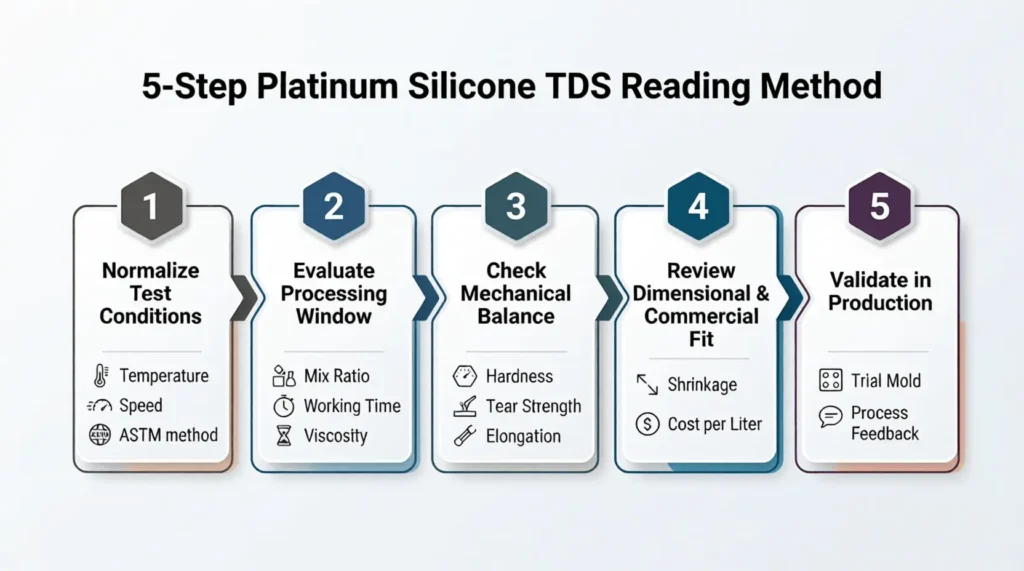
Read a platinum silicone TDS in five steps: first normalize the test conditions; then evaluate the processing window; check the balance of hardness, tear strength, tensile strength and elongation; review shrinkage and material cost by volume; and finally validate the silicone under actual production conditions.
Never approve a plati̇n si̇li̇kon based on one parameter alone.
A technical data sheet is not a product ranking sheet. It is a process-fit document.
The Five-Step Expert TDS Reading Method
| Adım | What to Evaluate | Main Question |
| 1. Normalize test conditions | Temperature, cure condition, test method and value type | Are the figures truly comparable? |
| 2. Evaluate the processing window | Mix ratio, mixed viscosity, working time and demold time | Can the operator process it successfully? |
| 3. Check the mechanical balance | Hardness, tear strength, tensile strength and elongation | Can the mold survive the actual geometry and demolding stress? |
| 4. Check dimensional and commercial fit | Shrinkage, density, shelf life and storage | Will it meet tolerance and cost requirements? |
| 5. Validate in production | Master model, casting material, mold size and real workshop conditions | Does the TDS performance translate into accepted castings? |
This method is more reliable than comparing products by hardness, viscosity or tear strength alone.
Step 1: Normalize the Test Conditions
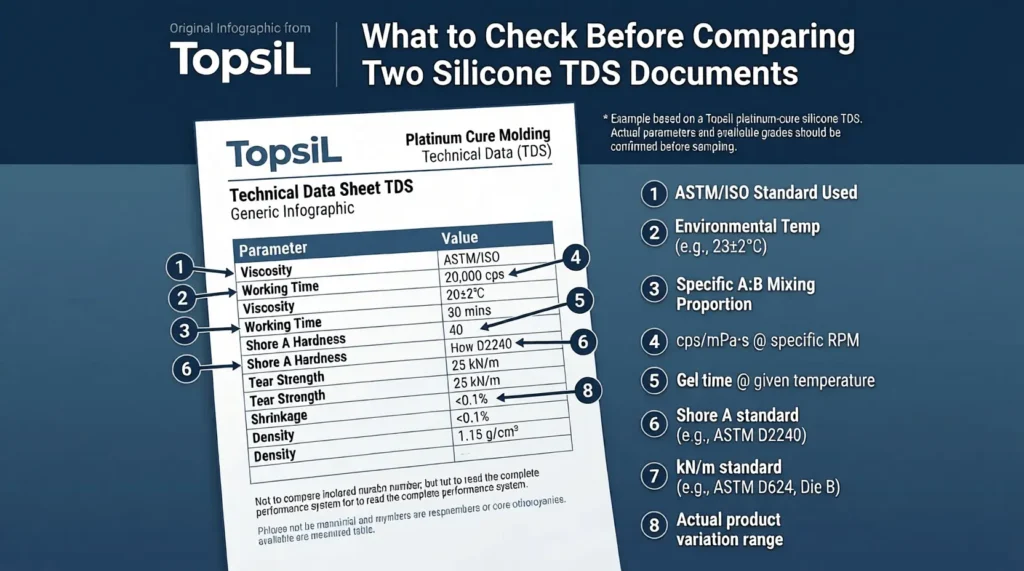
Before comparing any numbers, check how they were measured.
A viscosity value measured at 23°C may not be directly comparable with one measured at 25°C. A hardness value measured after 24 hours may differ from one measured shortly after demolding. Tear strength values based on different test methods or specimen shapes may also produce different results.
Check the following information:
- Test temperature
- Cure time before testing
- Post-cure conditions
- Test method
- Specimen preparation
- Mixing ratio
- Whether data refers to Part A, Part B, mixed material or cured rubber
- Whether the number is a typical value or a guaranteed specification
Common test references include:
- ASTM D2240 for durometer hardness
- ASTM D412 or ISO 37 for tensile strength and elongation
- ASTM D624 or ISO 34-1 for tear strength
Values obtained through different methods should not be treated as directly equivalent without technical review.
Expert rule: Never compare two TDS values until the temperature, cure condition, test method and value type are reasonably comparable.
A TDS usually presents typical laboratory values. A batch COA may show selected quality-control results for the actual production batch. Buyers should understand the difference between the two documents.
Step 2: Evaluate the Processing Window
The first practical question is not whether the cured silicone looks strong.
It is whether the workshop can mix, degas and pour it successfully.
Karışım Oranı
Common platinum cured RTV-2 silikon ratios include 1:1 and 10:1.
A 1:1 ratio may be convenient for manual mixing, equal-size packaging and two-component equipment. A 10:1 system can also perform well but normally requires accurate metering of the smaller component.
Always confirm whether the ratio is:
- By weight
- By volume
- Suitable for manual weighing
- Compatible with existing dispensing equipment
A 1:1 ratio by weight is not automatically 1:1 by volume because the two components may have different densities.
Mixed Viscosity
For mold-making decisions, mixed viscosity is usually more useful than the separate viscosity of Part A or Part B.
Lower viscosity can help the material:
- Enter fine details
- Fill narrow spaces
- Level more easily
- Move trapped air toward the surface
However, lower viscosity does not automatically mean better mechanical properties or longer mold life. It also does not replace correct mixing, vacuum degassing or proper mold design.
Viscosity should ideally be compared using similar temperatures and measurement conditions. Some filled or thixotropic materials may also show shear-dependent behavior, making a single cP value an incomplete description of pouring behavior.
Çalışma Süresi
Working time or pot life represents the available processing window after Parts A and B are mixed.
The exact definition may vary between suppliers. It may refer to the time before viscosity rises significantly, the time before gel begins or the recommended pouring period.
Actual working time can be affected by:
- Workshop temperature
- Batch size
- Mixing speed
- Vacuum degassing time
- Kalıp boyutu
- Heat exposure
A 10-minute working time may suit a small open mold but create a high risk for a large PU prototype mold requiring mixing, vacuum degassing and controlled pouring.
Expert rule: A fast silicone is productive only if it remains workable long enough to complete the process correctly.
Demold Time
Demold time is not always the same as full cure.
A silicone may be firm enough to remove from the master while its tear strength, hardness or dimensional stability continues to develop.
Buyers should distinguish between:
- Tack-free time
- Demold time
- Functional cure
- Full cure
- Post-cure, where applicable
For demanding production, ask when the mold can safely receive its first casting—not only when it can be removed from the master.
Step 3: Evaluate the Mechanical Balance
Hardness, tear strength, tensile strength and elongation must be read together.
Shore A Sertlik
Shore A sertlik measures resistance to indentation. It describes how soft or firm the cured silicone feels.
It does not directly measure mold life or tear resistance.
A harder silicone may provide better support for a large, simple mold. But it may be less suitable for deep undercuts because it cannot flex as easily during demolding.
A softer silicone may release complex parts more easily but may deform if the mold is large or poorly supported.
| Mold Situation | General Selection Direction |
| Deep undercuts and delicate parts | Softer and more flexible |
| Genel reçine kalıpları | Balance flexibility and support |
| Large molds | Firmer grade or supporting mother mold |
| Precision PU casting | Balance support, tear resistance and low shrinkage |
Hardness tells you how strongly the mold resists indentation. It does not tell you how strongly it resists tearing.
Yırtılma Dayanımı
Tear strength indicates resistance to the continued growth of a crack or cut.
It is especially important for:
- Derin alt kesimler
- Thin mold edges
- Sharp details
- Tekrarlanan kalıptan çıkarma
- Cut molds
A high tear-strength value is useful, but it is not a complete mold-life guarantee. Mold geometry, casting material, release method and existing cuts can all affect real performance.
Tensile Strength and Elongation
Tensile strength indicates how much pulling stress the material can withstand before breaking under the stated test conditions.
Elongation indicates how far it can stretch before breaking.
High elongation does not automatically mean high tear resistance. A material may stretch considerably, yet an existing cut may still propagate during demolding.
Expert rule: For complex molds, compare hardness, tear strength and elongation as a group—not as independent rankings.
Step 4: Check Dimensional and Commercial Fit
Küçülme
Platinum cured silicone is often selected for low shrinkage, but the commercial importance depends on the application.
Shrinkage is especially important for:
- PU prototypes
- Assembly parts
- Components made to drawings
- Functional testing
- Master duplication
- Repeat orders requiring consistent dimensions
For decorative molds, a small difference between two low shrinkage values may not affect customer acceptance. For a fitted component, the same difference may cause rejection.
A shrinkage value without a clear test method, cure condition and measurement interval should not be used for direct supplier comparison.
Final casting dimensions should be checked during the application trial.
Density and Cost per Mold Volume
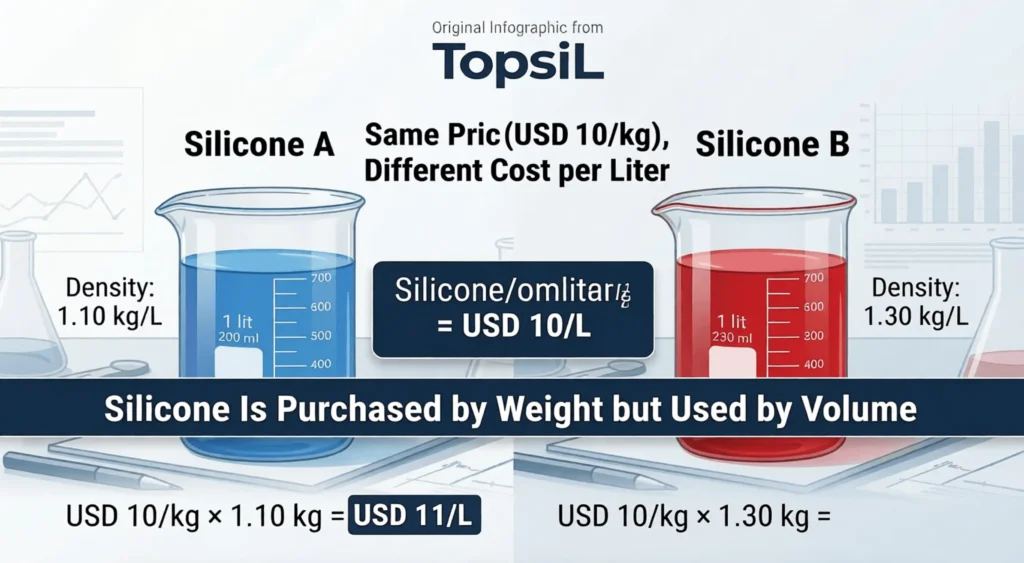
Density is an overlooked purchasing parameter.
Silicone is priced by weight, but molds are filled by volume. A higher-density silicone requires more kilograms to fill the same mold cavity.
Use the mixed uncured density for a simple estimate:
Approximate mixed-material cost per liter = price per kg × mixed density in kg/L
Example:
| Ürün | Fiyat | Mixed Density | Approximate Cost per Liter |
| Silicone A | USD 10/kg | 1.10 kg/L | USD 11.00/L |
| Silicone B | USD 10/kg | 1.30 kg/L | USD 13.00/L |
The price per kilogram is identical, but the approximate material cost for the same mold volume differs.
This calculation excludes mixing loss, residue, overflow and processing waste, but it provides a better purchasing comparison than USD/kg alone.
Shelf Life and Storage
Distributors and inventory buyers should also check:
- Shelf life of both components
- Recommended storage temperature
- Whether high heat or freezing must be avoided
- Whether stirring is required before use
- Open-container handling
- Packaging sizes
- Batch traceability
A technically suitable product may still be commercially unsuitable if its shelf life does not fit the buyer’s inventory cycle.
Step 5: Validate the Silicone in Real Production
A TDS helps select candidates. It cannot replace application testing.
Before bulk approval:
- Test cure compatibility on the actual master.
- Use the intended casting material.
- Make a small mold before producing the full-size mold.
- Record room temperature and batch size.
- Measure actual working time.
- Check flow, detail filling and bubble behavior.
- Record demold time and demolding difficulty.
- Monitor tearing, deformation and surface change.
- Measure casting dimensions where accuracy matters.
- Track accepted castings rather than mold appearance alone.
In Topsil replacement projects, buyers often begin by comparing hardness and viscosity. However, unsuccessful trials are frequently caused by insufficient working time, cure inhibition or a mismatch between hardness and mold geometry.
This is why the application test should reflect the customer’s real process—not only a small laboratory sample.
Illustrative Example: Which TDS Is Better for a Large PU Mold?
Consider two hypothetical platinum silicone grades:
| Mülkiyet | Grade A | Grade B |
| Mixed viscosity | 4,000 cP | 12,000 cP |
| Çalışma süresi | 12 minutes | 40 minutes |
| Demold time | 2 hours | 6 hours |
| Shore A sertlik | 30 | 25 |
| Yırtılma mukavemeti | 18 kN/m | 26 kN/m |
| Uzama | 450% | 650% |
| Küçülme | 0.10% | 0.05% |
A line-by-line comparison may make Grade B look better because it has higher tear strength, higher elongation and lower shrinkage.
But the correct conclusion depends on the application.
| Decision Factor | Grade A | Grade B | Likely Better Fit |
| Small mold filling | Strong | Acceptable | Grade A |
| Fast production turnover | Strong | Slower | Grade A |
| Large-mold degassing | Risky working window | More processing time | Grade B |
| Derin alt kesimler | Orta düzeyde | Better starting balance | Grade B |
| Dimensional accuracy | Acceptable | Better on paper | Grade B |
| Final approval | Production trial required | Production trial required | Neither wins by TDS alone |
For a small, simple mold, Grade A may be more efficient.
For a large, complex PU prototype mold, Grade B may be the safer candidate because its longer working time allows more time for mixing, degassing and pouring.
Neither grade should be approved without checking cure compatibility and actual PU casting performance.
The best TDS is not the one with the most impressive numbers. It is the one whose processing window and cured properties match the application.
Comparing two silicone grades? Send Topsil both TDS documents together with your casting material and mold size. We can identify which differences are commercially meaningful before you arrange full testing.
TDS Red Flags Professional Buyers Should Notice
Be cautious when a TDS:
- Lists only Part A viscosity instead of mixed viscosity.
- Gives working time without a test temperature.
- Reports mechanical values without test methods.
- Claims “low shrinkage” without a value or measurement condition.
- Gives a very short demold time but omits working time.
- Mixes units without clear conversion.
- Uses “food grade” without supporting documentation.
- Does not distinguish typical values from specifications.
- Cannot be supported by a batch COA.
- Cannot be explained by the supplier’s technical team.
Also confirm units before comparing:
- cP and mPa·s are numerically equivalent
- kN/m and N/mm are numerically equivalent
- MPa and psi require conversion
- Other tear units may require careful conversion
Questions to Ask Before Approving a Sample
Ask the supplier:
- Are these values typical or guaranteed?
- At what temperature were working and demold times tested?
- Is the viscosity value for the mixed material?
- Which ASTM, ISO or internal methods were used?
- Which properties are checked on each production batch?
- Has the grade been tested with my casting material?
- Can you provide a commercial-batch COA?
- What should I evaluate during the application trial?
A professional supplier should ask about your application before recommending a product.
Sonuç
Reading a platinum silicone TDS like an expert means understanding how the numbers work together.
First normalize the test conditions. Then evaluate the processing window, mechanical balance, dimensional requirements and commercial factors. Finally, verify the material under real production conditions.
For replacement projects, send Topsil:
- Your current silicone TDS
- Döküm malzemesi
- Mold dimensions
- Target Shore A hardness
- Gerekli çalışma süresi
- Dimensional requirements
- Expected casting cycles
- Current production problem
Topsil can return a side-by-side comparison of the key processing, mechanical and dimensional differences, together with a suitable plati̇nle kürlenmi̇ş si̇li̇kon grade recommendation for testing.
For technical support, visit RTV-2 Silicone Technical Support.