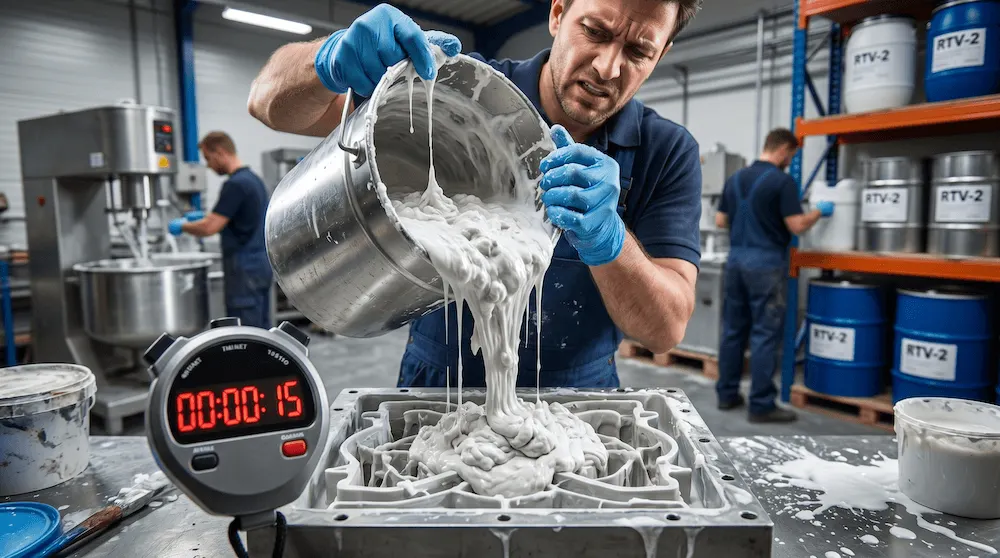

A silicone mold that fails after 10 castings does not only cost you another batch of silicone.
It can also mean another mold-making cycle, more labor, production downtime, rejected parts and delayed delivery.
That is why professional mold makers should not only ask:
“How much does this silicone cost per kilogram?”
Daha iyi bir soru:
“How many usable casting cycles can I get before the mold tears, deforms or loses acceptable detail?”
Quick Answer: What Determines Silicone Mold Lifespan?
There is no universal number of casting cycles for an RTV-2 silicone mold.
Silicone mold lifespan depends on five interacting factors:
Silicone Match × Mold Design × Cure Quality × Casting Stress × Demolding & Care
We call this the Topsil Mold-Life Framework.
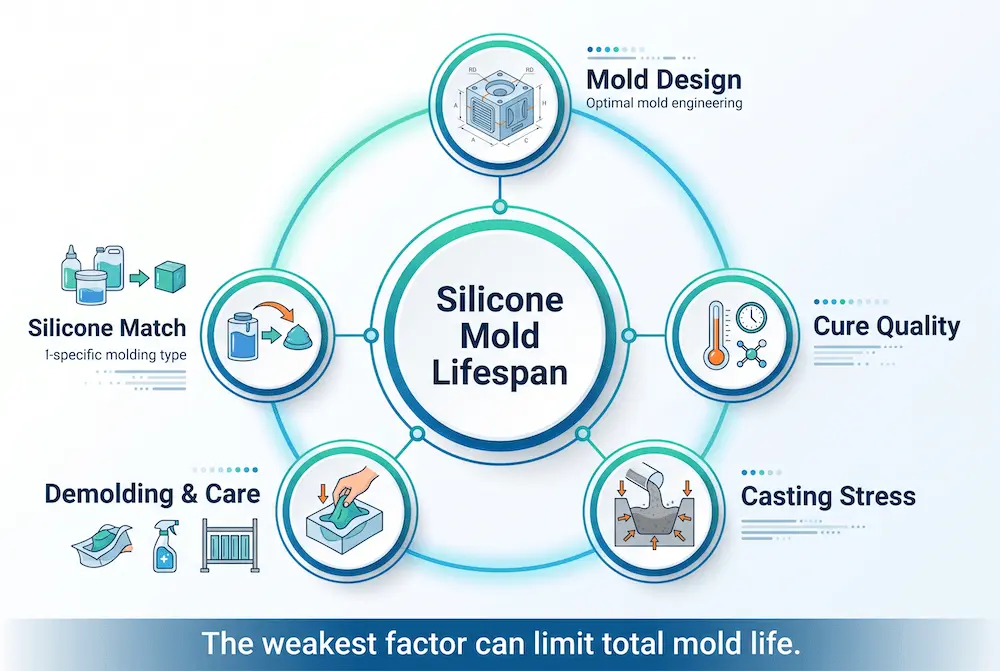
If one factor is badly mismatched, improving another factor may produce only limited gains. A high-tear silicone, for example, cannot completely compensate for an extremely thin section being pulled over a sharp undercut on every casting cycle.
The goal is therefore not simply to buy a “stronger” silicone. It is to identify what is limiting the life of your particular mold.
What Does “Silicone Mold Lifespan” Actually Mean?
For production mold making, silicone mold lifespan is best understood as:
The number of usable casting cycles a mold delivers before tearing, surface degradation, deformation or loss of acceptable detail makes repair or replacement necessary.
This distinction matters because a mold may technically remain in one piece while no longer producing acceptable parts.
A simple wax or gypsum mold with easy release can behave very differently from a deep-undercut mold repeatedly exposed to polyurethane resin, epoxy cure heat or abrasive concrete.
Think of asking “How many casts will this silicone make?” like asking how long a tire will last without knowing the vehicle, load, road or driving conditions.
The material matters—but so does the operating environment.
| Factor | Higher Failure Risk | Better Direction for Repeat Use |
| Mold geometry | Deep undercuts, thin lips, sharp corners | Controlled release geometry and reinforced weak zones |
| Silicone properties | Wrong hardness or low tear resistance | Balanced hardness, tear strength and elongation |
| Mold support | Long unsupported flexible sections | Adequate wall thickness or support shell |
| Tedavi | Incorrect ratio or incomplete cure | Correct mixing and sufficient cure |
| Casting process | High heat, abrasion or difficult release | Controlled process matched to the material |
| Demolding | Sudden pulling and excessive stretching | Gradual release with lower local stress |
This is also why choosing mold-making silicone by Shore A hardness alone can lead to disappointing results.
1. Match the Silicone to the Casting Process—Not Hardness Alone
A common assumption is:
Harder silicone = stronger silicone = longer mold life.
In real mold making, that logic is incomplete.
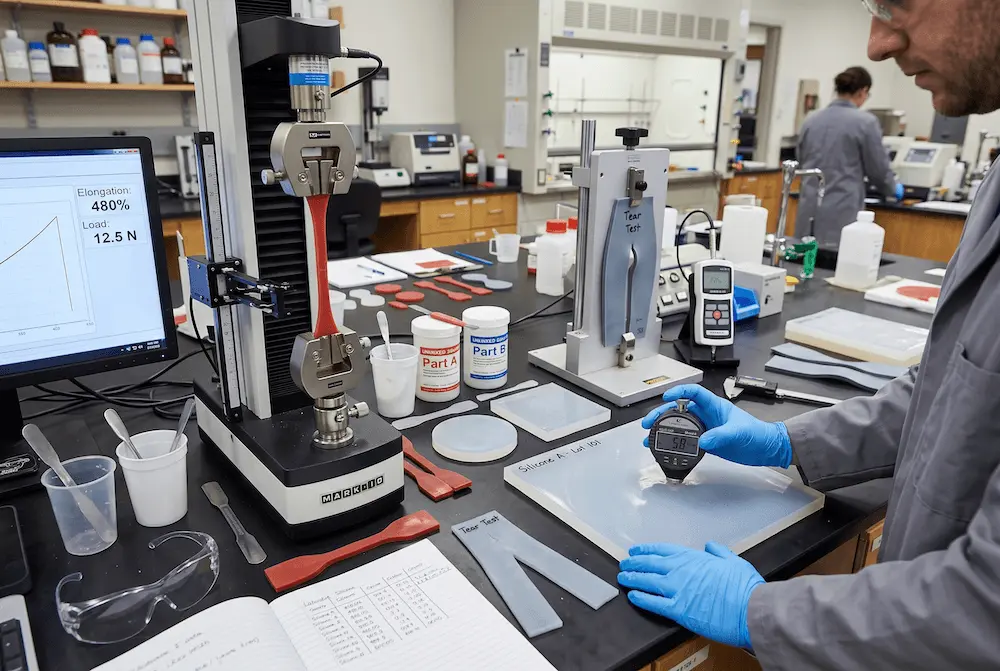
Shore A hardness measures indentation hardness. It does not, by itself, tell you how well a mold will resist tearing while stretching around an undercut. Shore hardness for elastomeric materials is commonly evaluated using methods such as ASTM D2240.
For repeat casting, consider the combination of:
- Shore A sertlik
- Yırtılma mukavemeti
- Uzama
- Çekme mukavemeti
- Mold geometry
- Wall thickness
- Döküm malzemesi
- Demolding force
Tear strength is particularly important where small cuts or thin details can become the starting point for larger tears; test methods such as ASTM D624 are used to evaluate tear strength in rubber and elastomeric materials. Tensile and elongation properties can be evaluated using methods such as ASTM D412.
Why softer is not always better
A softer silicone may flex more easily around difficult undercuts and reduce demolding force.
But if a large mold is too soft and poorly supported, excessive deformation can become a different problem.
Why harder is not always better
A firmer silicone may provide better body and shape retention, but an overly rigid mold around deep undercuts can require more force during release.
The best choice is therefore usually a balance, not the highest number on a TDS.
If your main application is polyurethane or epoxy casting, see our guide to choosing silicone for resin molds.
2. Design Out the Weak Point Before the First Casting
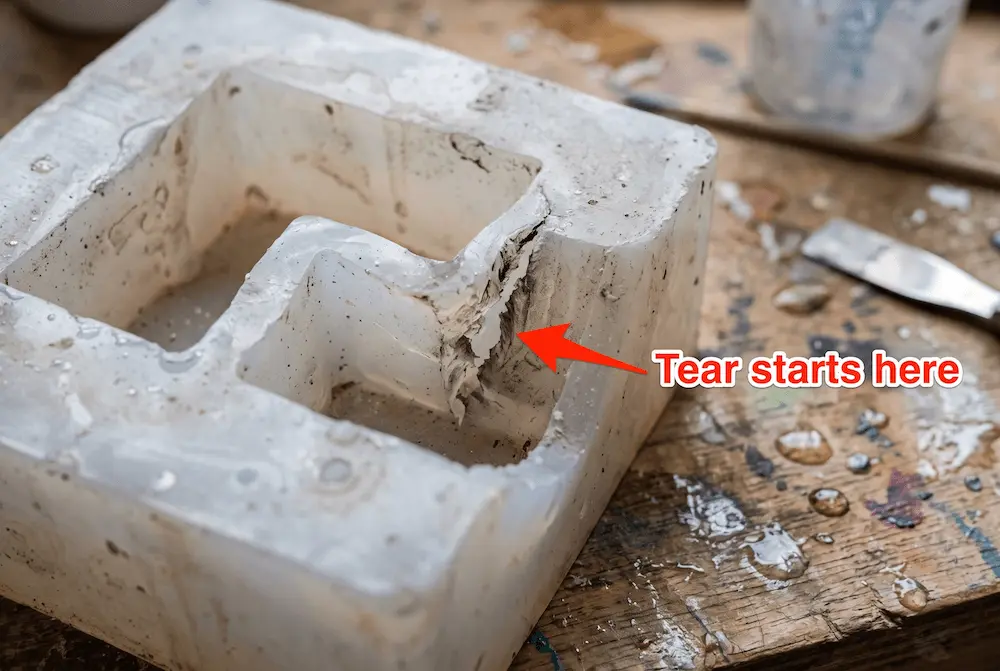
One of the most useful mold-life clues is not ne zaman the mold fails.
Bu where the failure starts.
If tearing repeatedly starts at the same location, first investigate local geometry, thickness and demolding stress—not only general silicone quality.
Common high-stress zones include:
- deep undercuts,
- sharp internal corners,
- very thin mold lips,
- narrow connection points,
- poorly placed cut lines,
- long unsupported flexible sections.
Imagine a tear that repeatedly begins around one sharp undercut.
Changing to a silicone with higher tear strength may improve resistance, but if every demolding cycle still concentrates force at exactly the same point, the underlying stress concentration remains.
Possible improvements include:
- increasing wall thickness around weak zones,
- rounding sharp transitions where the master allows,
- changing the cut or split line,
- using a two-part or multi-part mold for difficult geometry,
- adding a mother mold or support shell,
- redesigning the release direction.
A practical diagnostic rule
A small design improvement repeated over 50 demoldings may be more valuable than a large specification improvement that does not address the failure location.
For a deeper troubleshooting guide, read Why Do Silicone Molds Tear Early?.
3. Make Sure the Mold Develops the Properties You Selected

A mold can look cured and still be a poor starting point for repeated production.
The issue is not simply whether the silicone feels “solid.” The question is whether the system has been mixed and cured consistently enough to develop the intended properties.
Watch four areas in particular.
Correct mixing ratio
Follow the specified A:B or base-to-catalyst ratio. Changing the ratio without technical guidance can change cure behavior and final performance.
Complete mixing
Poor mixing may create localized areas that do not cure consistently. These areas can later become weak zones under repeated flexing.
Sufficient cure before heavy use
The earliest possible demold time is not always the best time to start aggressive repeated production.
Allow the mold to reach the cure condition specified for the selected product and process.
Cure inhibition with platinum silicone
Addition-cure systems can be more sensitive to incompatible materials and contamination. Masters, tooling, coatings, clay, release agents or residues should therefore be checked before full-scale production when compatibility is uncertain.
If you are new to RTV-2 processing, our step-by-step silicone mold-making guide explains the complete mold-making process.
The important mold-life principle is:
Do not expect the TDS mechanical properties to rescue a mold that was never processed consistently enough to develop them.
4. Reduce the Stress Added During Every Casting Cycle
Once production begins, the mold experiences a new combination of mechanical, thermal and material-related stress on every cycle.
Different casting systems create different failure mechanisms.
| Casting System | Main Stress to Watch | What You May Observe | Check First |
| PU resin | Release + material compatibility | Increasing sticking, surface change or tearing | Grade compatibility, release and demolding |
| Epoksi | Cure heat + adhesion | Difficult release or gradual surface deterioration | Cure temperature and release conditions |
| Concrete / GRC | Abrasion + weight | Detail wear, edge damage or tearing | Tear resistance, support and mold design |
| Gypsum / plaster | Primarily mechanical release | Local tearing around details | Geometry and demolding direction |
| Balmumu | Heat + geometry-dependent release | Distortion or local tearing | Casting temperature and mold shape |
| Demolding | Sudden pulling and excessive stretching | Gradual release with lower local stress |
This table should not be interpreted as a fixed ranking of mold life. Actual resin formulations, casting temperatures, part geometry and production conditions vary.
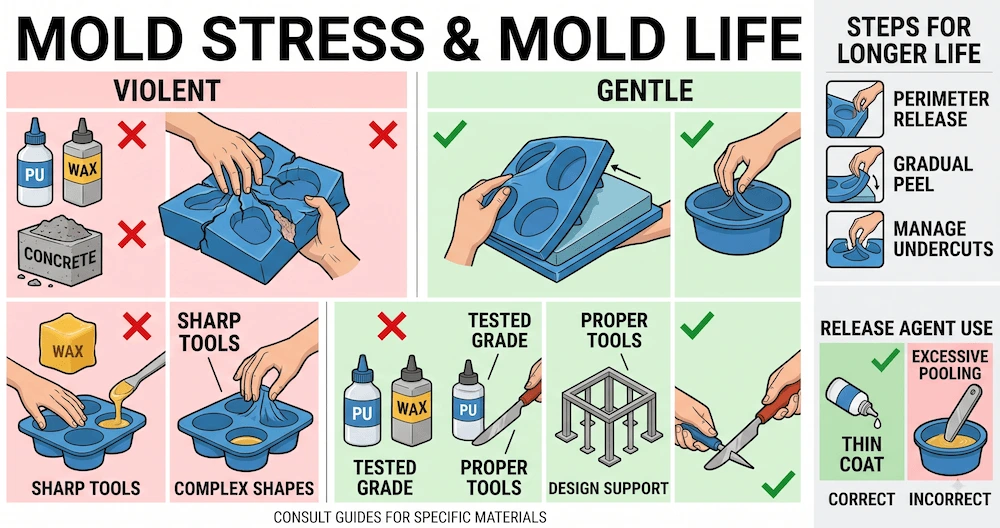
Demold progressively—not violently
Where possible:
- Release the edges first.
- Peel the silicone gradually.
- Release difficult undercuts one by one.
- Avoid stretching the entire mold when local release is possible.
- Avoid sharp tools that can create an initial nick.
A tiny cut may be insignificant on the first casting but become the point from which a larger tear propagates over repeated cycles.
Use release agent for a reason—not by habit
A compatible mold release may reduce adhesion and mechanical stress in some applications.
But “more release agent” is not automatically better. The release system should be compatible with both the silicone and casting material and should not compromise the required casting surface.
If Mold Life Suddenly Drops, Do Not Change Silicone Immediately
Suppose the same mold process previously gave satisfactory repeat use, but recent molds are failing much sooner.
Before assuming the silicone itself has changed, check what else changed in the process:
- Was a new casting resin or resin batch introduced?
- Did casting or curing temperature change?
- Was the silicone mixing ratio or process changed?
- Is the new master geometry different?
- Did the release agent change?
- Was the silicone stored differently?
- Is a different operator demolding the parts?
- Is failure now starting in a different location?
A sudden reduction in mold life is often easier to diagnose by comparing what changed immediately before the problem started.
5. Clean, Inspect and Store the Mold Without Adding New Damage
Good maintenance cannot fix the wrong silicone grade or poor mold design.
But poor maintenance can shorten the life of an otherwise good mold.
Clean gently
Remove residual casting material without unnecessary scraping or abrasion.
Be cautious with strong or unknown solvents unless compatibility with the cured silicone has been confirmed.
Inspect before the tear becomes large
Watch for:
- small cuts around undercuts,
- fine edge tears,
- surface roughening,
- cracking near openings,
- permanent distortion,
- loss of detail.
Small damage tells you where stress is accumulating.
That information can be more useful than simply recording that “the mold failed after 30 cycles.”
Store the mold in its intended shape
Do not leave large flexible molds folded or compressed under heavy objects. Where appropriate, keep the mold supported by its mother mold or shell.
For minor damage, replacement is not always the only option. See our guide on how to repair a silicone mold.
Is the Problem the Silicone—or the Process?
Use the failure pattern as your first diagnostic tool.
| What You See | Likely Direction to Investigate |
| Tears on the first few demoldings | Cure, grade selection, undercuts and release |
| Tear always begins in the same corner | Local geometry, thickness and stress concentration |
| Mold stretches excessively or loses shape | Hardness, wall thickness and support |
| Fine details break away | Local thickness, tear resistance and demolding |
| Surface gradually becomes rough | Casting material and process compatibility |
| Release becomes progressively harder | Surface condition, casting system and release method |
| Soft or tacky areas remain | Mixing, ratio or cure inhibition |
Example diagnostic scenario
Suppose a mold with a deep undercut tears from the same narrow section after several castings.
The first instinct might be to request a harder silicone.
But increasing hardness could make the mold more difficult to flex over the same undercut and increase local demolding force.
A better evaluation would compare:
tear resistance + elongation + local wall thickness + release path + hardness
before deciding which property should change.
That is the difference between buying silicone by specification ve selecting silicone for a production problem.
For application-specific help, visit our RTV-2 silicone technical support page.
Stop Comparing Silicone by Price per Kilogram Alone
A silicone that looks cheaper on the quotation can become more expensive if molds must be replaced more frequently.
Consider this illustrative example only:
| Silicone A | Silicone B | |
| Silicone price | $6.00/kg | $7.50/kg |
| Silicone per mold | 10 kg | 10 kg |
| Material cost per mold | $60 | $75 |
| Usable castings* | 20 | 40 |
| Silicone cost per usable casting | $3.00 | $1.88 |
*Illustrative numbers for explaining the calculation, not a performance claim for any Topsil grade.
Silicone B costs 25% more per kilogram in this example, yet its silicone material cost per usable casting is lower.
And this calculation still excludes:
- mold-making labor,
- master preparation,
- changeover time,
- production downtime,
- rejected castings.
For production buyers, cost per acceptable casting can therefore be more meaningful than raw-material price alone.
If you are comparing cure systems specifically, read Platinum-Cured vs. Tin-Cured Silicone: Total Cost of Ownership & Mold Life.
How to Get More Casting Cycles from Your Next Mold
There is no single “long-life silicone” specification that works for every mold.
The strongest starting point is to match:
Silicone properties + mold geometry + cure quality + casting conditions + demolding stress
Before changing silicone, ask:
- What material are we casting?
- Where does the current mold fail?
- How many usable castings are we getting?
- Is the failure gradual or sudden?
- Does it always begin in the same location?
- What Shore A hardness and cure system are we using?
- How difficult is the part to demold?
These questions often reveal more than comparing two TDS sheets line by line.
Sıkça Sorulan Sorular
Get a Mold-Life Diagnosis Before Simply Changing Silicone
We will first help identify whether the limiting factor is more likely related to silicone selection, mold geometry or processing conditions.