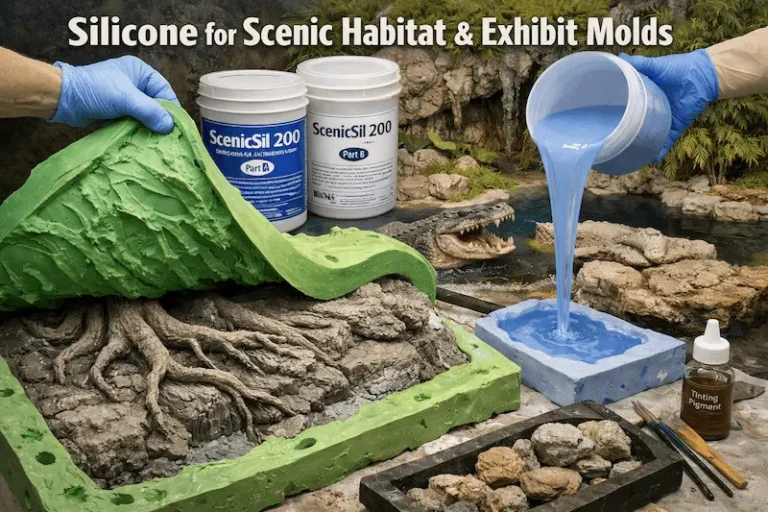
Silicone for Scenic Habitat & Exhibit Molds

Scenic molds fail for reasons different from those of general decorative molds. If your project involves large rockscapes, fine coral textures, vertical scenic masters, or repeated casting for habitat and themed display production, start by matching the silicone to the texture complexity, mold scale, application method, and repeat-use demand.
silicone-for-scenic-habitat-exhibit (1)

Choose by Project Type, Not by Generic Mold Silicone Claims

Large rockscape or faux rock molds

Start with mold body + tear resistance + handling stability

Coral, reef, bark, or fine organic texture molds

Start with detail capture + flexibility + clean release

Vertical or irregular scenic masters

Start with application method + workable brush-on control

Repeatedly exhibit production molds

Start with durability + mold life + consistent reproduction

What Scenic Fabrication Buyers Should Prioritize?

Texture Reproduction

Scenic molds often fail visually before they fail structurally. If the silicone cannot capture coral texture, bark detail, rock variation, or natural organic surface character cleanly, the finished display loses realism.

Mold Body and Handling Stability

Large scenic molds often become difficult not because the silicone is weak overall, but because the grade lacks enough body to stay stable during handling, support, and repeated use.

Repeated Casting Performance

For habitat and exhibit production, the better grade is usually the one that stays reliable across more casts, not the one that only feels easy in the first mold.

Why Scenic Habitat Molds Commonly Fail

In many scenic fabrication projects, the real problem is not “bad silicone” in general. The issue is usually grade mismatch. A silicone may feel easy to use, but still be the wrong choice if it cannot support mold scale, branching texture, vertical application, or repeated scenic casting.
Most scenic mold failures show up in one of these ways:

Texture Is Lost

The mold captures the shape, but not the organic detail needed for realistic display work.

Thin or Branching Areas Tear Early

Complex release paths, sharp edges, and delicate mold zones break down too quickly.

Large Molds Lose Stability

The mold becomes too soft, too difficult to support, or too hard to handle consistently.

Repeat Casting Becomes Inconsistent

The first mold works, but the scenic production quality becomes unstable over repeated casts.

A Common Real-World Mistake

Many buyers ask for the softest or easiest silicone first because they want easier demolding. But scenic molds often fail for a different reason: the grade is too weak for the mold scale, too fragile for branching texture, or too unstable for repeated scenic casting.
That is why scenic habitat and exhibit molds should be matched to project type + mold behavior + production plan, not chosen like a general decorative mold.

A Better Way to Choose the Grade

For Large Rockscapes or Faux Rock Molds

If the mold is large, broad, or difficult to support, body usually matters before softness. A grade that feels very easy in a small test mold may become unstable when scaled into larger scenic sections. For this type of project, start by checking whether the silicone can hold its shape well enough during handling and repeated casting.

For Coral, Bark, or Fine Organic Texture Molds

If the visual realism depends on delicate surface texture, detail capture, and release behavior matter first. In these projects, the wrong silicone often does not fail as a mold body problem. It fails because the texture is softened, the edge quality drops, or thin zones tear during release.

For Vertical or Irregular Scenic Masters

If the master is large, vertical, irregular, or difficult to box up cleanly, the application method becomes a selection factor. In these cases, do not choose only by pourability. Choose based on whether the silicone can be applied in a controlled way across the surface you are actually molding.

For Repeated Exhibit Production Molds

If the mold is used again and again for coral modules, rock pieces, terrain sections, or habitat components, the first cast is not the real test. The real test is whether the mold stays consistent across repeated production. For these projects, durability and mold life should move up the priority list immediately.

Typical Applications

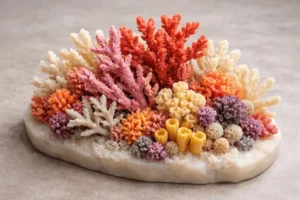
Faux coral molds
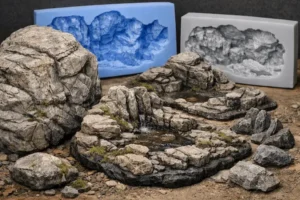
Artificial rock and rockscape molds
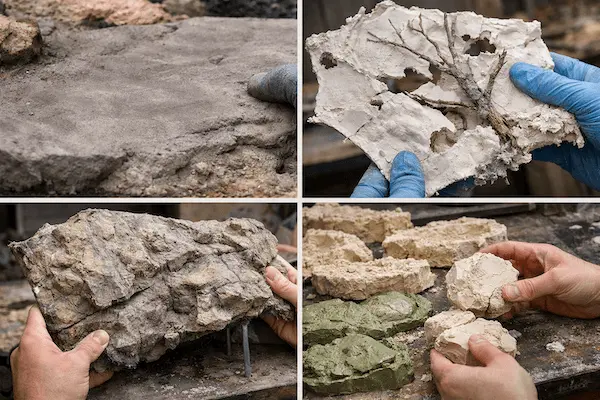
Terrain and habitat texture molds
Tree bark, vines, and organic scenic molds
Themed display and exhibit fabrication molds
Repeat-use scenic production molds for custom environments

Need a Better Silicone Grade for Scenic Habitat or Exhibit Mold Making?

Send us your master type, mold size, texture complexity, whether the surface is vertical, and whether the project is one-off or repeat-use. We’ll help you narrow down a more suitable RTV-2 silicone direction.

FAQs

What matters more for scenic molds: detail capture or tear resistance?

That depends on the project. Fine organic textures usually require better detail capture first, while branching forms, thin sections, and difficult release paths often require stronger tear resistance first.

When is brush-on molding a better choice than a pourable mold?

Brush-on molding is often a better starting point when the master is large, vertical, irregular, or difficult to box up for a simple poured mold.

Why do scenic molds sometimes fail even when the first cast looks good?

Because the first cast does not always reveal the real weakness. Many scenic molds fail later because of repeated release stress, thin texture zones, or lack of body in larger molds.

Can one silicone grade work equally well for coral, rockscape, and large scenic habitat molds?Not always. Different scenic molds stress the silicone in different ways, so the better starting point depends on texture complexity, mold scale, and how often the mold will be used.

Not always. Different scenic molds stress the silicone in different ways, so the better starting point depends on texture complexity, mold scale, and how often the mold will be used.

Can you help review whether a project needs additional material screening before sampling?

Yes. If the project involves underwater display, sensitive habitat conditions, or other special exhibit requirements, share the intended use and project background first.

Contact Us Today, Get Reply in 24 hrs !

Your information will be kept strictly confidential.

This is Evan, the Manager of Topsil Silicone. Congratulations on you to find a professional supplier !  Pls send  your inquiry , we will contact you within 24 hours.

Free ‘Topsil Silicone Rubber’ E-book

If you still want to know more about our products,  a detailed E-catalogue can send to you.