
Low-cost silicone can be useful. Unverified low-cost silicone can be expensive.
For distributors, the real cost of RTV-2-Silikonkautschuk is not only the price per kilogram. It is also the cost of complaints, replacements, technical support, failed molds and lost repeat orders.
A cheap quotation may look attractive at first. But if the silicone cures differently from batch to batch, tears too early, creates too many bubbles or does not match customer applications, the distributor may lose far more than the price difference.
This article is not about avoiding cost-effective silicone.
It is about helping distributors avoid low-cost RTV-2 silicone rubber that creates hidden business costs.
The Real Cost Is Not Only Price per Kilogram
Many distributors compare silicone rubber suppliers mainly by unit price.
That is understandable. Price affects margin.
But in mold making silicone distribution, a lower purchase price does not always mean a lower total cost.
A small saving per kilogram can disappear quickly after:
- one customer complaint
- one replacement shipment
- one failed mold project
- one technical support case
- one lost repeat customer
The better question is not:
Which RTV-2 silicone is the cheapest?
Die bessere Frage ist:
Which RTV-2 silicone gives customers stable results with acceptable cost and fewer complaints?
For distributors, profit does not come only from buying cheaper.
It also comes from reducing failure, protecting customer trust and keeping repeat orders stable.
5 Hidden Costs Distributors Should Watch
Cheap RTV-2 silicone rubber usually becomes expensive through hidden costs.
| Hidden Cost | How It Hurts Distributors |
| Complaint Cost | Customers report tearing, bubbles, sticky surface or unstable curing |
| Mold Failure Cost | Short mold life leads to poor customer satisfaction |
| Sample-to-Bulk Risk | Sample works, but bulk order performs differently |
| Sales Support Burden | Sales team must explain problems without technical support |
| Lost Customer Trust | One bad batch may damage repeat business |
The problem is not low price itself.
The problem is low price without stable quality, clear documents, application matching and repeat batch control.
1. Complaint Cost: When Customers Blame the Distributor
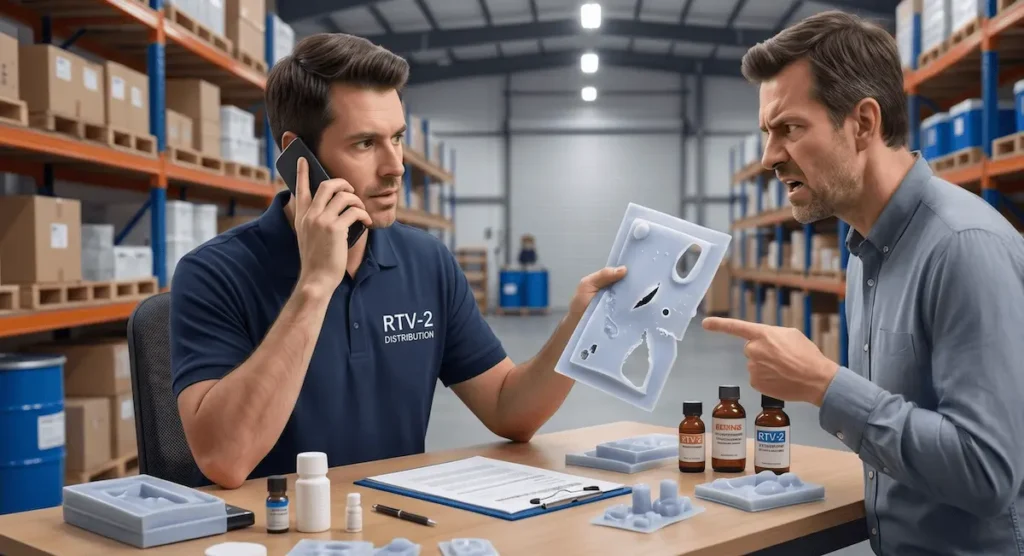
If one batch cures slower, feels softer, has different viscosity or tears earlier, customers usually do not blame the original factory.
They blame the distributor who sold the product.
Für Silikon für den Formenbau, complaints often come from:
- silicone does not cure properly
- too many bubbles appear
- mold tears too early
- demolding becomes difficult
- mold is too soft or too hard
- shrinkage is higher than expected
- mold life is shorter than promised
Some of these problems may be caused by processing mistakes. But many are also related to wrong grade selection or unstable product quality.
A low-cost supplier should still be able to explain hardness, viscosity, working time, curing time, tear strength and application fit.
If the supplier only says “price is good” but cannot help diagnose problems, the distributor will carry the technical risk alone.
2. Mold Failure Cost: Short Mold Life Damages Your Brand
Mold makers do not only judge silicone by how it looks after curing.
They judge it by how long the mold can work.
If a mold tears after fewer castings than expected, the customer may not return for another order. Even worse, the customer may remember the distributor brand as unreliable.
Short mold life may be related to:
- low tear strength
- wrong hardness
- poor elongation
- unsuitable viscosity
- deep undercuts
- aggressive demolding
- wrong silicone grade for the casting material
For distributors, customer trust is often worth more than a small price difference.
A silicone grade with better tear strength and more stable performance may create fewer complaints, fewer returns and stronger repeat orders.
3. Sample-to-Bulk Risk: Cheap Samples Are Not Enough
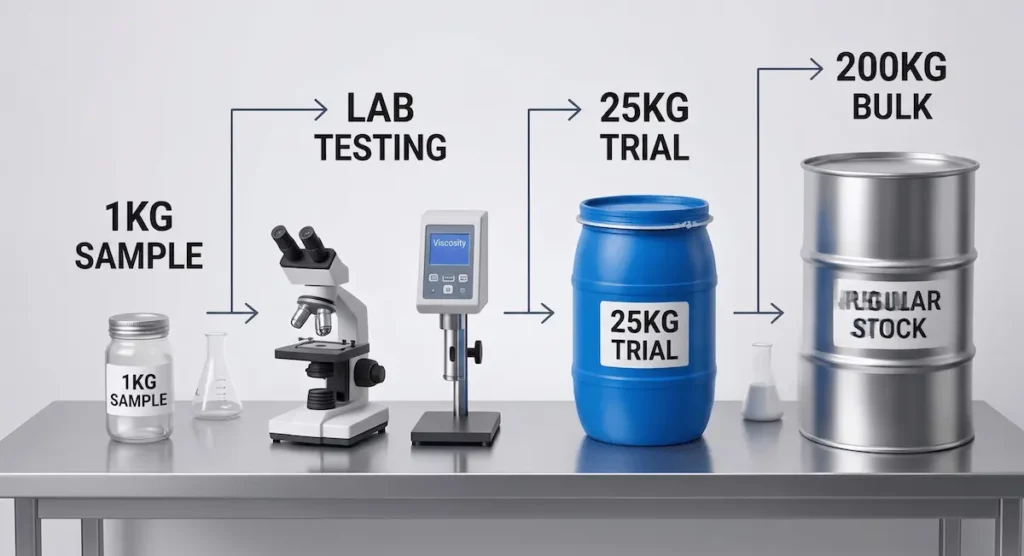
A sample can look good.
But distributors need to know whether the same performance can be maintained in 20kg, 25kg or 200kg supply.
One common risk with very low-cost suppliers is sample-to-bulk inconsistency.
The first sample may cure well. But the later bulk batch may have different viscosity, different working time, different hardness or weaker mold performance.
Before moving to regular stock, distributors should check:
- Does the sample match the TDS data?
- Can the supplier provide the same grade repeatedly?
- Is a 20kg/25kg trial order available before bulk purchase?
- Can the supplier provide COA or batch information?
- Does the bulk batch perform like the sample?
A safer process is:
Sample testing → Trial order → Customer feedback → Regular stock or bulk supplyA cheap sample is not enough.
Distributors need sample-to-bulk consistency.
4. Sales Support Burden: Low Price Cannot Replace Technical Support
Cheap RTV-2 silicone becomes expensive when your sales team has to solve every customer problem alone.
If the supplier recommends silicone only by price, the distributor may later face many difficult questions:
- Why did the silicone not cure?
- Why are there so many bubbles?
- Why did the mold tear early?
- Is the hardness wrong?
- Should the customer use tin cure or platinum cure silicone?
- Is this grade suitable for concrete, resin, wax, gypsum or PU casting?
A serious supplier should ask about application before recommending a grade.
Important information includes:
- target application
- casting material
- mold size
- target Shore A hardness
- working time requirement
- cure system preference
- Entformungsschwierigkeit
- expected mold life
Low price can support distributor margin.
But technical support helps protect distributor reputation.
Comparing a Low-Cost RTV-2 Silicone Supplier?
Send us your current grade, target application, required hardness and expected quantity. Topsil can recommend cost-effective RTV-2 silicone grades for distributor testing.
5. Lost Customer Trust: One Bad Batch Can Cost More Than the Saving
For distributors, the biggest hidden cost is not always the replacement cost.
It is lost customer trust.
A customer who receives unstable silicone may not complain loudly. They may simply stop buying.
That is why distributors should not judge low-cost RTV-2 silicone only by the first quotation.
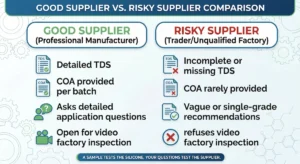
They should check whether the supplier can support:
- stable batch quality
- clear TDS / MSDS / COA
- application-based grade matching
- sample-to-bulk consistency
- suitable packaging
- troubleshooting support
- repeat supply planning
A supplier that helps reduce complaints can be more valuable than a supplier that only offers the lowest price.
When Low-Cost RTV-2 Silicone Can Still Be a Good Choice
Low-cost RTV-2 silicone is not always a bad choice.
In many markets, cost-effective tin cure silicone is an important daily-selling product for general mold making.
A low-cost silicone grade can be useful when:
- the application is not highly precision-sensitive
- the grade is tested under real customer conditions
- the supplier provides clear technical data
- batch consistency is acceptable
- the distributor understands the suitable application range
- customers know what performance level to expect
The key is not to avoid cost-effective products.
The key is to verify that the lower price does not come with unacceptable quality, technical or supply risk.
A strong distributor product line can include:
- cost-effective daily-selling grades
- higher tear strength professional grades
- Platinum Cure Premium Grades
- clear or translucent differentiated grades
Each grade should have a clear position.
What to Check Before Choosing a Low-Cost Supplier
Before choosing a low-cost RTV-2 silicone supplier, distributors should ask:
- Is RTV-2 silicone rubber your core product line?
- Can you supply both tin cure and platinum cure silicone?
- Can you provide grade-specific TDS, MSDS and COA?
- Can you explain hardness, viscosity, working time and tear strength?
- Can you recommend grades by application?
- Can you support sample testing before bulk supply?
- Can you support 20kg / 25kg trial orders before 200kg bulk supply?
- Can you help compare with our current silicone grade?
- Can you support troubleshooting if customers report curing, bubbles or tearing problems?
- Can you support distributor stock or private label discussion after validation?
If the supplier cannot answer these questions clearly, the low price may carry higher risk.
Total Cost Checklist for RTV-2 Silicone Distributors
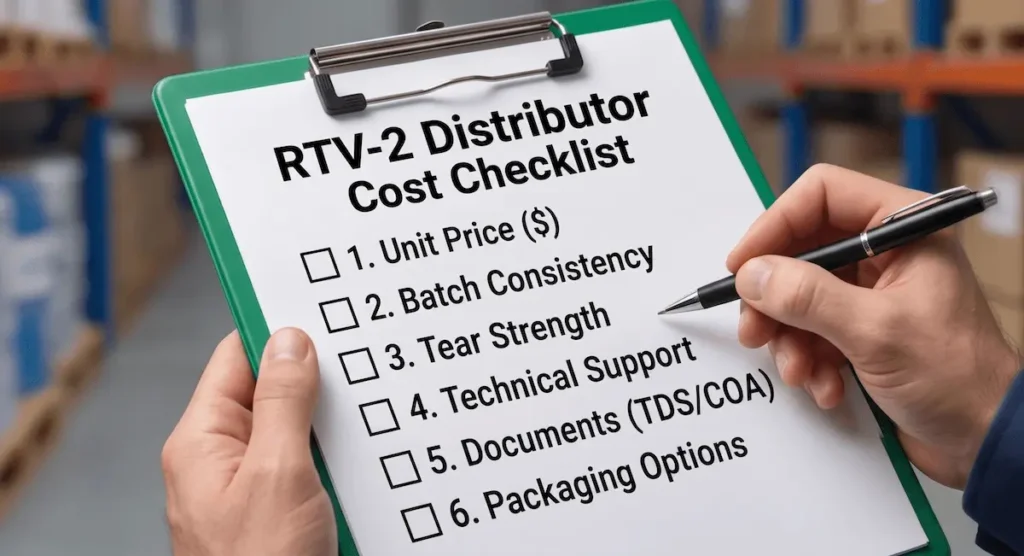
Use this checklist before choosing a low-cost supplier.
| Check Point | Warum es wichtig ist |
| Unit Price | Direct purchase cost |
| Batch Consistency | Reduces customer complaints |
| Reißfestigkeit | Affects mold life |
| Viscosity Stability | Affects flow, bubbles and processing |
| Arbeitszeiten | Affects ease of use |
| TDS / MSDS / COA | Supports distributor sales |
| Sample-to-Bulk Match | Reduces bulk order risk |
| Technische Unterstützung | Helps solve customer problems |
| Haltbarkeitsdauer | Reduces inventory risk |
| Packaging Options | Fits distributor sales model |
The safest low-cost supplier is not the one with the lowest number on the quotation.
It is the one who can prove stable batches, clear documents and application-based grade matching.
RECOMMENDED NEXT STEP
Comparing low-cost RTV-2 suppliers?
Skip bulk orders. Start with controlled sample-to-trial validation. Topsil supplies tin/platinum cure silicone for B2B buyers. Send us your current grade, application, and quantity.
Request Grade Evaluation