
Resposta rápida
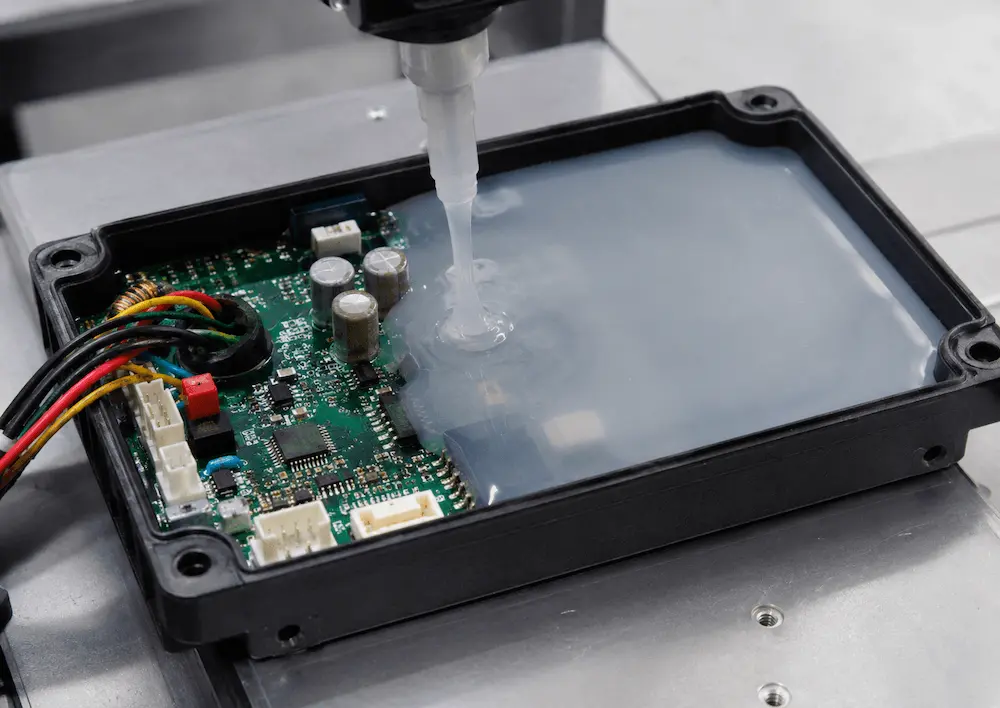
Silicone potting compound is a liquid RTV silicone engineered to encapsulate and insulate electronics. Once cured, it forms a highly resilient, rubbery barrier that protects sensitive components from deep-section moisture, high voltage, heavy vibration, and thermal shock. It is widely specified across automotive ECUs, LED drivers, and industrial PCB assemblies to prevent premature field failures.
What Is Silicone Potting Compound?
On the manufacturing floor, this material is typically delivered as a two-part (Part A and Part B) system that stays easily flowable during dispensing to completely submerge dense circuitry.
The real magic happens post-cure. Unlike traditional epoxy resins that harden into rigid, brittle blocks, silicone retains its elastomeric flexibility indefinitely. This makes it an absolute necessity for assemblies subjected to constant thermal cycling or heavy mechanical stress. It allows the components to expand and contract naturally without cracking the protective seal or snapping fragile solder joints.
What Is Silicone Potting Compound Used For?
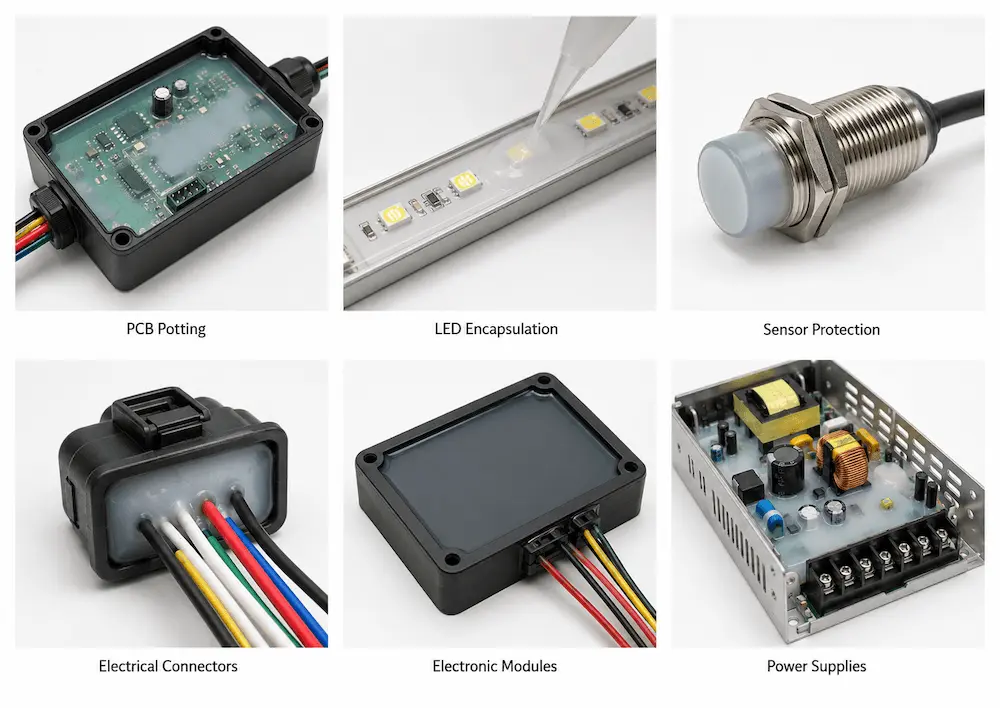
Composto de silicone para vasos is the go-to defense system across high-reliability industries where component failure is not an option. Here is where and why engineers deploy it on the shop floor:
PCB Potting: Defending High-Density Circuitry
Modern PCBs pack tight component spacing and high-voltage traces into shrinking footprints. Silicone potting encapsulates the entire board, providing a flawless dielectric barrier and shielding sensitive chipsets from moisture, salt spray, and severe vibration. When choosing a grade, you must look at viscosity and component clearance to ensure the liquid fills every micro-void under your BGAs.
LED Encapsulation: Thermal Stress Relief & Optical Clarity
LED drivers and outdoor fixtures face brutal weather shifts. Traditional rigid materials shrink during curing, pulling directly on delicate wire bonds and snapping them. Silicone maintains its elastomeric cushion, absorbing thermal expansion while protecting internal power components from rain and UV degradation.
Sensors: Preventing Calibration Drift
Industrial and automotive sensors are all about precision. A harsh, shrinking encapsulant like standard epoxy will crush micro-MEMS chips or warp the housing, throwing off sensor calibration entirely. Silicone cushions these fragile internal elements against thermal shock without putting physical pressure on the circuitry.
Electrical Connectors: Blocking Capillary Moisture Ingress
Connectors operating in rugged environments are highly vulnerable to dust, condensation, and water ingress via capillary action. Potting the connector backshells with silicone creates a permanent, flexible plug that seals out the elements while relieving strain on the wire terminations during cable flexing.
Power Supplies & Industrial Control Units
Heavy-duty power modules generate intense heat. Silicone potting compound acts as both a high-voltage insulator and a thermal conduit, transferring heat away from transformers and power transistors to the outer housing. This prevents hot spots, eliminates corona discharge, and drastically extends component life.
Cable Accessories: High Dielectric Sealing
Splices, joints, and terminations in high-voltage cable systems require massive insulation support and flexible sealing. Depending on whether your line demands future maintenance access or permanent ruggedization, you will need to choose between a self-healing silicone gel or a tougher silicone rubber compound.
Why Use Silicone Potting Compound for Electronics?
Engineers specify silicone because it solves the fundamental flaw of rigid encapsulation: it protects components without locking them inside a brittle, stress-inducing block.
- Permanent Elastomeric Flexibility: It absorbs violent mechanical shocks and handles extreme thermal expansion cycling (-50°C to 200°C) without cracking, delaminating, or tearing away from the housing walls.
- Bulletproof Dielectric Insulation: It creates a high-purity barrier that isolates high-voltage components, preventing electrical leakage, tracking, and short circuits caused by ambient humidity or contamination.
- Hydrophobic Environmental Shielding: Once fully cured, the material forms an inherently water-repellent seal that completely blocks out rain, moisture vapor, dirt, and corrosive industrial chemicals.
- Low Exotherm & Zero Shrinkage: Unlike epoxies that get hot during polymerization and shrink significantly, platinum-cure silicones cure with virtually zero heat generation and negligible shrinkage, protecting sensitive components from installation stress.
- Excellent Wetting and Flow: Its self-leveling fluid dynamics allow the liquid to flow effortlessly into complex geometry, deep cavities, and irregular component layouts before the curing clock kicks in.
- Tailored Processing Profiles: The chemical matrix can be easily adjusted. Whether your automated line requires a specific viscosity for fast dispensing, a precise pot life to prevent line clogs, or custom flame-retardant (UL94 V-0) properties, silicone accommodates your workflow.
Silicone Potting Compound vs Epoxy and PU
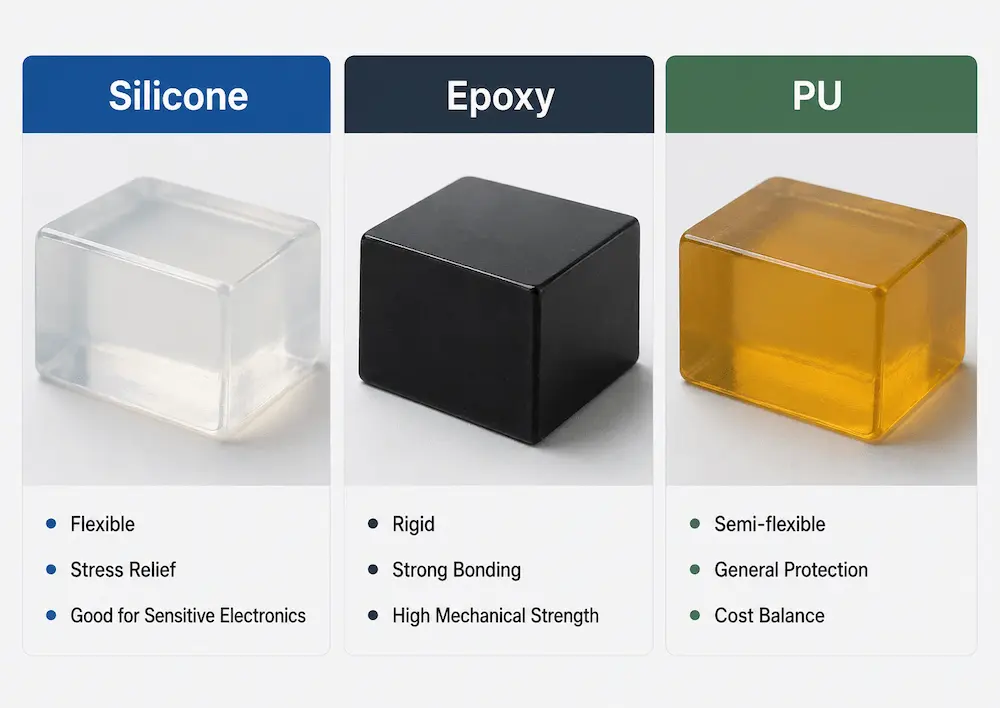
Choosing a potting material is not about finding the “strongest” polymer on the market—it is about choosing the right mechanical defense for your specific circuit architecture.
The bottom line on material selection: If your electronics are delicate, contain fine wire bonds, or operate in environments with constant temperature swings and high vibration, silicone potting compound is your correct starting checkpoint. Save the epoxy for static applications requiring brute-force physical security and high structural strength.
(For a deep-dive technical comparison, read our full breakdown on [Epoxy vs Polyurethanevs Silicone Potting Compound]).
Silicone Potting Compound vs Silicone Gel
While both share an organic silicone backbone, they target entirely different engineering issues on the manufacturing floor.
| Item | Gel de silicone | Composto de silicone para vasos |
| Forma curada | Gel muito macio | Borracha elastomérica macia |
| Reentrada | Mais fácil | Geralmente mais baixo |
| Alívio do estresse | Excelente | Bom |
| Suporte mecânico | Inferior | Mais alto |
| Uso típico | Juntas de cabos, conectores, componentes eletrônicos delicados | PCB, LED, modules, sensors, assemblies |
| Foco na seleção | Softness, re-entry, cushioning | Isolamento, vedação, dureza, fluxo, perfil de cura |
When to deploy gel: Go with a gel if your priority is absolute stress relief for micro-components or if you need to stick a multimeter probe through the encapsulant for field testing and have it seal itself back up afterward.
When to deploy a compound: Choose a standard compound when you need robust encapsulation that can support heavy transformers, fill a structural housing, and handle external mechanical wear.
(For ultra-soft, probe-testable protection, explore our specialized [Gel de silicone para eletrônicos] page. For rugged, rubbery encapsulation, head directly to our product matrix on [Composto de silicone para encapsulamento de eletrônicos]).
Como escolher o composto de silicone correto para vasos
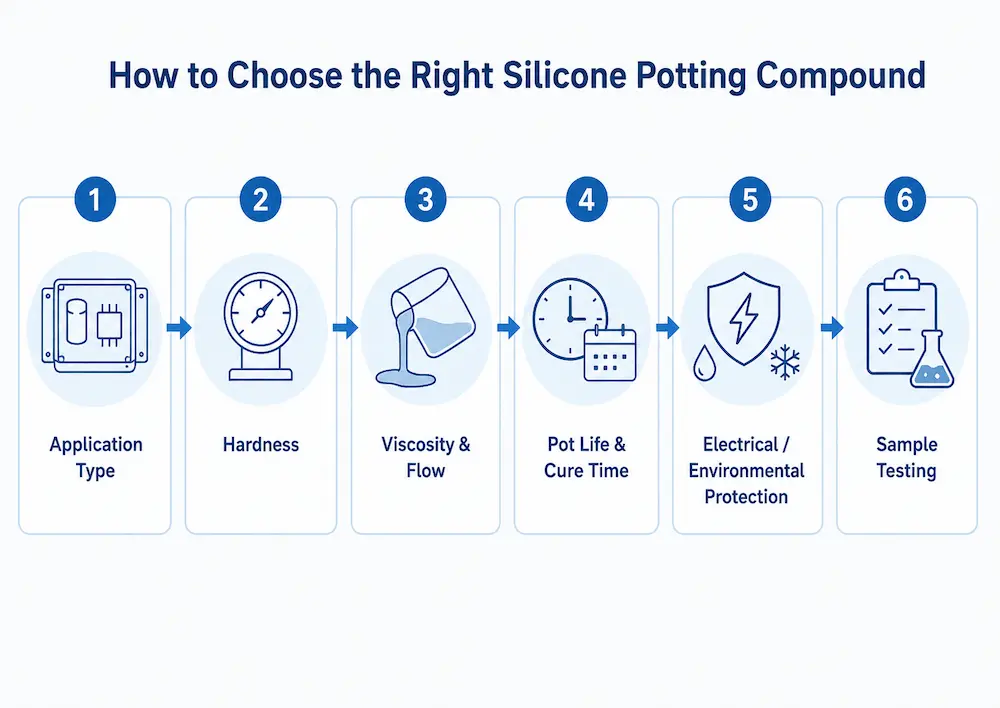
Selecting a grade requires auditing your production line mechanics alongside your environmental end-use targets. Do not simply ask for an “electronics grade” silicone—vet your options against these core operational benchmarks:
Viscosity & Surface Clearance
Viscosity dictates your dispensing cycle times. Low-viscosity fluids (below 3,000 cPs) are essential if your PCB features low-clearance components like BGAs, where the compound must flow underneath chips via capillary action. Higher viscosity grades work best if your housing has unsealed seams or cable exits where you need the liquid to stay put without weeping out before it cures.
Shore Hardness & Component Strain
Cured hardness (typically measured on the Shore A scale) alters the level of physical protection. A softer compound (e.g., Shore A 30) acts as an excellent dampener for fragile surface-mount parts during intense vibration. A firmer compound (e.g., Shore A 60) delivers excellent structural support for larger, heavier industrial components.
Pot Life vs. Line Throughput
Pot life is your operational safety window. If you are mixing manually or running small batches, you need a long pot life (e.g., 60 to 90 minutes) to prevent the material from gelling in the cup. For fast-paced, high-volume automated lines utilizing dynamic meter-mix machinery, a short pot life combined with downstream thermal acceleration is preferred to keep the cycle times tight.
Electrical & Insulation Requirements
Review the dielectric strength (kV/mm) and volume resistivity ($$\Omega\cdot\text{cm$$) listed on the Technical Data Sheet (TDS). High-voltage modules, transformers, and inverter circuits require high dielectric thresholds to prevent arc-over and insulation breakdown under continuous electrical loads.
Thermal Transfer Parameters
Standard silicones are naturally insulative, but if you are potting heat-generating components like MOSFETs or power resistors, you must specify a thermally conductive silicone potting compound. Look for a grade formulated with specialized ceramic fillers to drive heat away from the board while maintaining electrical insulation.
Visual Inspection Needs
If your quality control process requires automated optical inspection (AOI) or manual troubleshooting after potting, specify a transparent or clear translucent grade. For proprietary designs where you want to mask component values or protect intellectual property from reverse engineering, an opaque black or grey compound is the industrial standard.
Perguntas frequentes
Is silicone potting compound good for electronics?
Yes. Silicone is the premier choice for electronics exposed to thermal cycling, constant vibration, and harsh outdoor environments. Its primary engineering advantage is its ability to provide long-term dielectric insulation and moisture sealing without exerting mechanical curing stress on delicate solder joints and micro-components.
Can silicone potting compound be used for PCB potting?
Absolutely. It is widely deployed for PCB potting in automotive, aerospace, and industrial control applications. The material flows around tightly packed components to form a seamless, rubbery block that isolates circuits from humidity, dust, and mechanical shock.
What is the difference between silicone potting compound and epoxy?
The difference comes down to flexibility and stress. Silicone cures into a flexible elastomer that handles extreme temperature swings without cracking. Epoxy cures into a rock-hard, rigid structure that delivers massive physical security and bond strength, but can snap fragile electronic components during thermal expansion.
Is silicone potting compound waterproof?
Yes, once fully cured, silicone forms an inherently hydrophobic barrier that blocks out liquid water and heavy humidity. However, a true waterproof rating (like IP67) depends on how well the gel wets and adheres to your specific housing material. That’s why we always insist on run-time testing before bulk ordering.
O composto de silicone para vasos pode ser transparente?
Yes. Many formulations use highly purified silicone matrices that cure into crystal-clear or translucent layers. This is highly utilized in LED encapsulation to allow light transmission without yellowing, or in aerospace applications where technicians need to visually inspect components during servicing.