
إجابة سريعة
Silicone potting compound is a liquid material dispensed around electronic components and cured in place to form a protective layer. For PCBs, sensors and control modules, a two-part RTV silicone can provide flexible electrical insulation and help protect the assembly from moisture and mechanical stress. Shortlist a grade by checking how it fills the housing, how much support the cured material provides and how the complete assembly will be tested.
What Is Silicone Potting Compound?
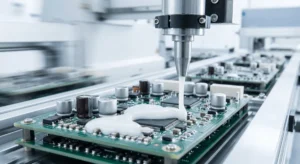
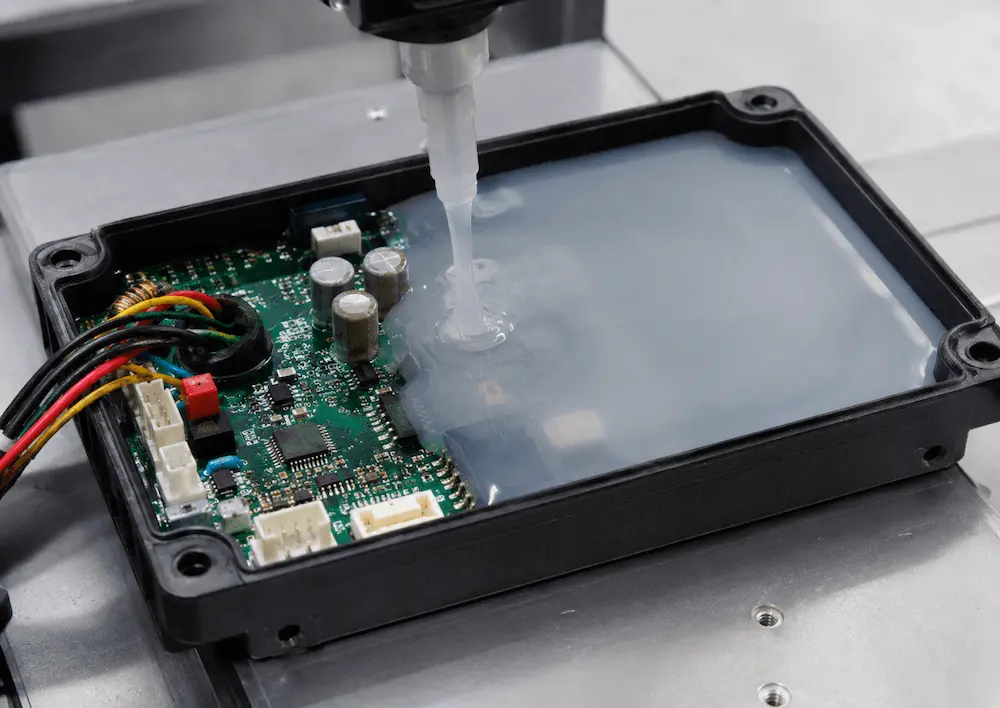
In industrial electronics manufacturing, silicone potting compounds are commonly supplied as two-part RTV systems. After Parts A and B are mixed at the specified ratio, the liquid material is dispensed into an electronic housing to surround components and fill accessible spaces.
After curing, the silicone forms a flexible elastomer that helps provide electrical insulation, moisture protection, and resistance to vibration. Compared with many rigid encapsulation materials, flexible silicone can better accommodate differences in thermal expansion between components and the housing.
The actual protection depends on the silicone formulation, enclosure design, processing conditions, and application testing.
What Is Silicone Potting Compound Used For?
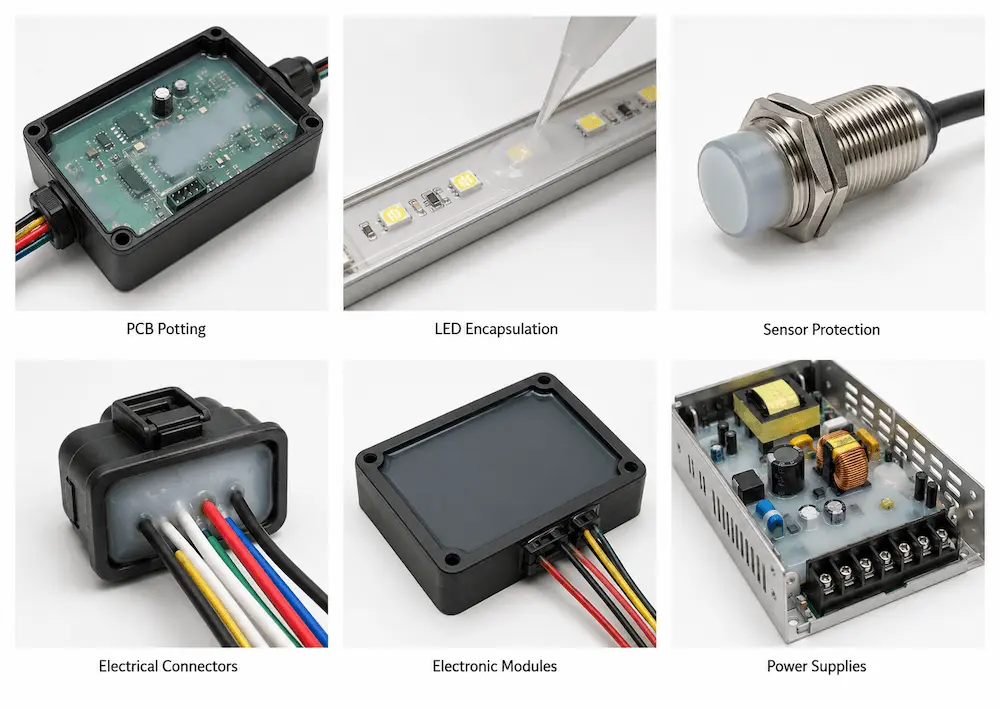
مركب سيليكون الإناء السيليكون is the go-to defense system across high-reliability industries where component failure is not an option. Here is where and why engineers deploy it on the shop floor:
PCB Potting: Defending High-Density Circuitry
Modern PCBs pack tight component spacing and high-voltage traces into shrinking footprints. Silicone potting encapsulates the entire board, providing a flawless dielectric barrier and shielding sensitive chipsets from moisture, salt spray, and severe vibration. When choosing a grade, you must look at viscosity and component clearance to ensure the liquid fills every micro-void under your BGAs.
LED Encapsulation: Thermal Stress Relief & Optical Clarity
LED drivers and outdoor fixtures face brutal weather shifts. Traditional rigid materials shrink during curing, pulling directly on delicate wire bonds and snapping them. Silicone maintains its elastomeric cushion, absorbing thermal expansion while protecting internal power components from rain and UV degradation.
Sensors: Preventing Calibration Drift
Industrial and automotive sensors are all about precision. A harsh, shrinking encapsulant like standard epoxy will crush micro-MEMS chips or warp the housing, throwing off sensor calibration entirely. Silicone cushions these fragile internal elements against thermal shock without putting physical pressure on the circuitry.
Electrical Connectors: Blocking Capillary Moisture Ingress
Connectors operating in rugged environments are highly vulnerable to dust, condensation, and water ingress via capillary action. Potting the connector backshells with silicone creates a permanent, flexible plug that seals out the elements while relieving strain on the wire terminations during cable flexing.
Power Supplies & Industrial Control Units
Silicone potting compounds can provide electrical insulation and flexible protection for power supplies, transformers, and industrial control modules.
For heat-generating components, thermal management must also be considered. Standard silicone potting compounds are not necessarily thermally conductive. Applications requiring heat dissipation may need specially formulated grades with verified thermal conductivity.
The final material should be evaluated together with the assembly’s electrical requirements, heat-transfer design, and operating conditions.
Cable Accessories: High Dielectric Sealing
Splices, joints, and terminations in high-voltage cable systems require massive insulation support and flexible sealing. Depending on whether your line demands future maintenance access or permanent ruggedization, you will need to choose between a self-healing silicone gel or a tougher silicone rubber compound.

Why Use Silicone Potting Compound for Electronics?
Engineers specify silicone because it solves the fundamental flaw of rigid encapsulation: it protects components without locking them inside a brittle, stress-inducing block.
- Flexible Protection: Cured silicone elastomers can accommodate thermal expansion and help reduce mechanical stress on sensitive electronic components. Performance depends on the selected grade and operating conditions.
- Electrical Insulation: Suitable silicone formulations provide dielectric insulation for electronic assemblies. Dielectric strength, volume resistivity, and other electrical properties should be confirmed against product test data.
- Moisture Resistance: Silicone’s hydrophobic properties help protect electronic assemblies against moisture exposure. However, silicone is not a completely impermeable vapor barrier, and the final enclosure must be tested for its required protection level.
- Low Curing Shrinkage: Many silicone potting systems offer relatively low curing shrinkage and low curing stress. Actual shrinkage and cure exotherm vary by formulation and processing conditions.
- Flow and Filling Performance: Silicone potting compounds are available in different viscosity ranges to suit various dispensing and filling requirements. Flowability and air entrapment should be evaluated using the actual assembly.
- Adjustable Processing Properties: RTV-2 silicone formulations can be selected or customized for viscosity, hardness, working time, curing profile, and color. Specific requirements such as flame retardancy must be supported by appropriate grade-level test data.
Silicone Potting Compound vs Epoxy and PU
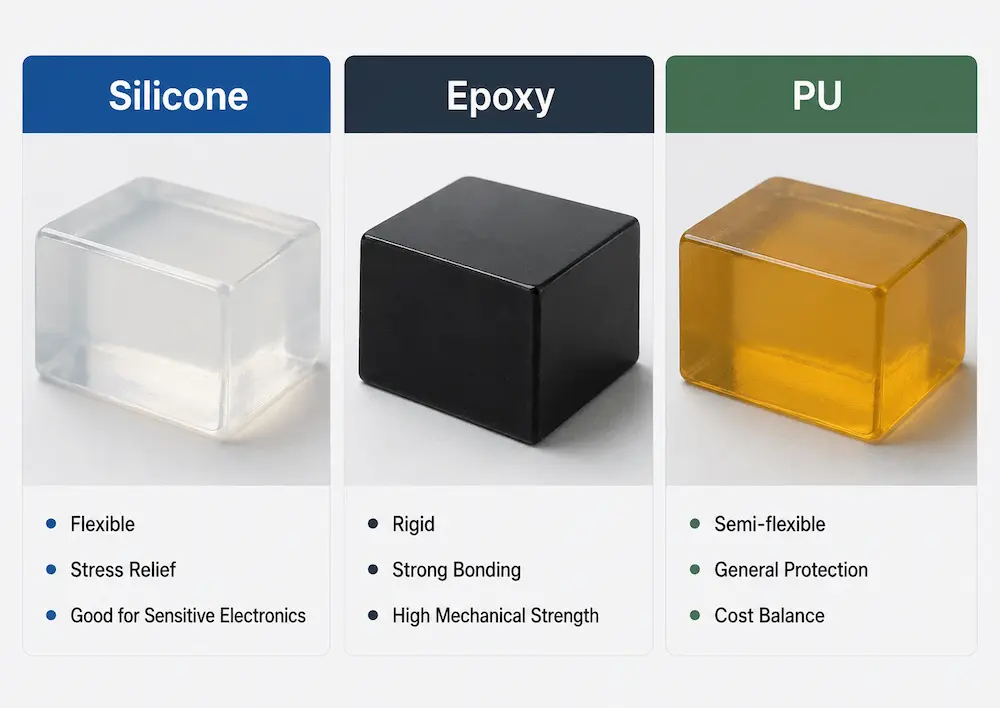
Choosing a potting material is not about finding the “strongest” polymer on the market—it is about choosing the right mechanical defense for your specific circuit architecture.
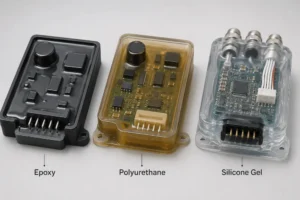
Silicone, epoxy, and polyurethane potting compounds each have advantages depending on the application.
Silicone is often preferred when flexibility, thermal cycling performance, and low mechanical stress are important. Epoxy systems can offer strong adhesion and mechanical protection, while polyurethane formulations provide a range of flexibility and processing options.
The final choice should be based on electrical requirements, operating temperature, mechanical protection, chemical exposure, and production conditions.
(For a deep-dive technical comparison, read our full breakdown on [Epoxy vs Polyurethanevs Silicone Potting Compound]).
Silicone Potting Compound vs Silicone Gel
While both share an organic silicone backbone, they target entirely different engineering issues on the manufacturing floor.
| البند | جل السيليكون | مركب التخزين السيليكوني |
| الشكل المعالج | جل ناعم جداً | لينة إلى مطاط مرن إلى مطاط مرن |
| إعادة الدخول | أسهل | عادةً ما تكون أقل |
| تخفيف التوتر | ممتاز | جيد |
| الدعم الميكانيكي | أقل | أعلى |
| الاستخدام النموذجي | وصلات الكابلات والموصلات والإلكترونيات الحساسة | PCB, LED, modules, sensors, assemblies |
| التركيز على الاختيار | Softness, re-entry, cushioning | العزل، والختم، والصلابة، والتدفق، وملف المعالجة |
When to choose silicone gel: Consider silicone gel when low-stress protection or future access to the assembly is important. Certain gel formulations allow easier inspection or re-entry than cured silicone elastomers, but removal and resealing behavior must be verified for the actual application.
When to deploy a compound: Choose a standard compound when you need robust encapsulation that can support heavy transformers, fill a structural housing, and handle external mechanical wear.
(For ultra-soft, probe-testable protection, explore our specialized [جل السيليكون للإلكترونيات] page. For rugged, rubbery encapsulation, head directly to our product matrix on [مركب السيليكون لتخزين السيليكون للإلكترونيات]).
كيفية اختيار مركب التخزين السيليكوني المناسب
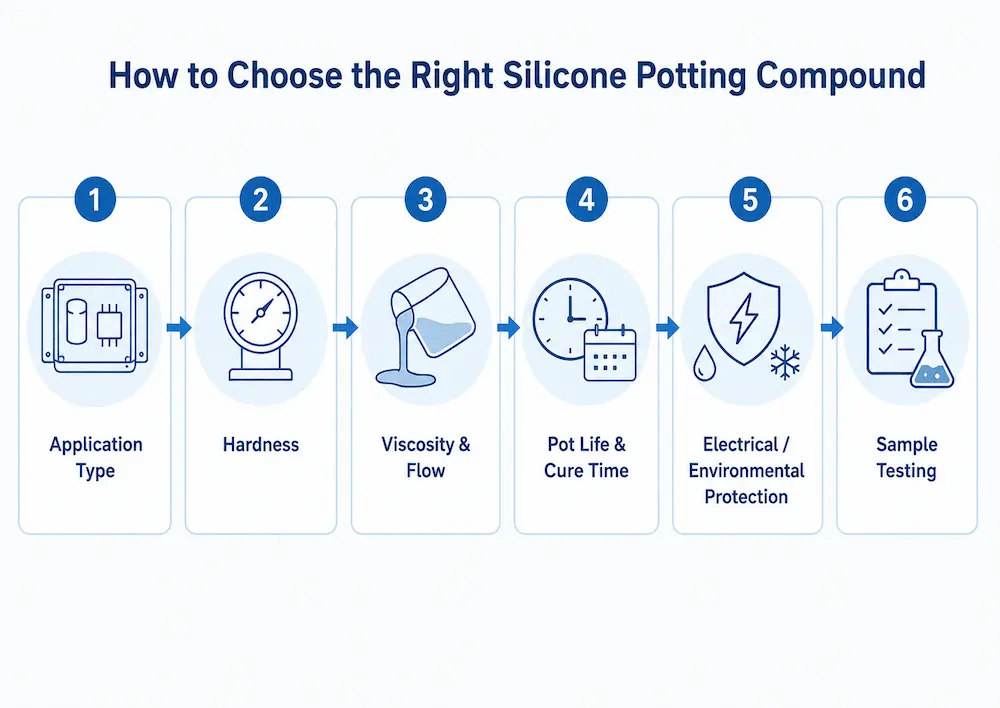
Start with the part you need to protect. A shallow PCB with fine component gaps, a vibration-sensitive sensor and a module with heavy components can require different flow and cured properties. Bring a drawing, a fill depth and a description of the production process to your material comparison.
| What the assembly needs | What to compare | What to check on the trial |
|---|---|---|
| Fill under components or through narrow spaces | Mixed viscosity at the actual material temperature and the usable filling time | Coverage in the hardest-to-fill area, trapped air and material escape through openings |
| Protect delicate parts during temperature changes | Cured flexibility and the support provided by the housing | Signs of stress, separation or damage at critical interfaces after the required conditioning |
| Provide more defined support around a board or module | Cured hardness, adhesion requirements and mechanical fit | Whether the material holds its shape, stays where intended and preserves any required access |
| Transfer heat to the enclosure | Verified thermal conductivity for the selected grade and the complete heat path | Component temperature in the representative assembly under the intended load |
| Meet electrical or ingress requirements | Grade data measured under defined conditions and your assembly test plan | The results on the cured assembly, including cable entries and other seal interfaces where relevant |
For assemblies that require service access, first decide where technicians need to reach. A soft silicone gel may be a suitable starting point for those areas. A flexible elastomeric compound is worth evaluating when the design calls for more defined encapsulation. The choice also depends on how the material will be removed, inspected or repaired in the actual housing.
Two RTV-2 grades to compare in an electronics trial
| Topsil grade | Mixed viscosity at 25°C | Cured hardness | Why include it in a first trial? |
|---|---|---|---|
| TE-8810 | 800 ± 500 mPa·s | Shore A 10 ± 2 | Evaluate this lower-hardness option for delicate electronics or when flow into narrow spaces is a priority. |
| TE-8830 | 2,000 ± 500 mPa·s | Shore A 30 ± 2 | Compare this general-purpose option when you need a firmer flexible encapsulant for a PCB or control module. |
These are typical values for screening. Obtain the current technical data sheet (TDS) for the intended grade and use the same test conditions when comparing materials. Check flow, cure and fit on a representative assembly before setting production limits. See the RTV-2 potting grade table, or use the electronics potting selection guide to work through a more detailed shortlist.
الأسئلة الشائعة
Is silicone potting compound good for electronics?
Yes. Silicone is the premier choice for electronics exposed to thermal cycling, constant vibration, and harsh outdoor environments. Its primary engineering advantage is its ability to provide long-term dielectric insulation and moisture sealing without exerting mechanical curing stress on delicate solder joints and micro-components.
Can silicone potting compound be used for PCB potting?
Absolutely. It is widely deployed for PCB potting in automotive, aerospace, and industrial control applications. The material flows around tightly packed components to form a seamless, rubbery block that isolates circuits from humidity, dust, and mechanical shock.
What is the difference between silicone potting compound and epoxy?
Silicone potting compounds typically cure into flexible elastomers, while many epoxy potting compounds form harder, more rigid materials. Silicone is often selected for low-stress protection and thermal cycling, whereas epoxy may be preferred for stronger adhesion and mechanical support. Modified epoxy systems can also offer flexibility, so selection depends on the application.
Is silicone potting compound waterproof?
Cured silicone potting compounds are generally hydrophobic and can help protect electronic assemblies against water and moisture exposure. However, silicone is permeable to water vapor to varying degrees, and waterproof performance depends on the complete enclosure design, adhesion, and sealing process. Ratings such as IP67 or IP68 require appropriate assembly-level validation.
هل يمكن أن يكون مركب السيليكون شفافاً؟
Yes. Transparent and translucent silicone potting compounds are available for applications requiring optical transmission or visual inspection. Actual clarity, yellowing resistance, and long-term optical stability depend on the specific formulation and operating conditions.
Find a Potting Grade for Your Assembly
If you have a board drawing or sample housing, start with three details.
- What you are potting and the approximate fill depth or volume.
- Your mixing and dispensing method and the time available before the assembly has to move.
- The main requirement you need to verify, such as narrow-gap filling, electrical insulation, heat transfer or service access.
With those details, Topsil can help identify a candidate grade and the properties to check before you request a trial sample.