
Resposta rápida
Silicone potting compound is used in LED drivers and outdoor lighting to protect electronic components from moisture, electrical leakage, vibration, heat build-up and outdoor temperature changes.
But for outdoor LED driver applications, potting is not just a “waterproofing” step.
Most LED driver failures are caused by combined risks: moisture, condensation, heat, voltage, bubbles, thermal cycling and unstable production process. The right silicone potting compound should reduce these risks together, not solve only one of them.
For LED drivers and outdoor lighting, the best potting silicone should provide:
- moisture and condensation protection
- electrical insulation
- suitable heat transfer
- low-stress flexibility
- good flowability around components
- stable curing in production
- long-term outdoor reliability
The right material is not selected by one single property. It is selected by how well it works in the real driver structure, outdoor environment and production process.
For general PCB and electronic module protection, you can also review our silicone potting compound for electronics before selecting a grade for LED driver testing.
Why Outdoor LED Drivers Fail Even When the Housing Looks Sealed
Many outdoor lighting products are designed with sealed housings. However, a sealed housing does not always mean the LED driver is fully protected.
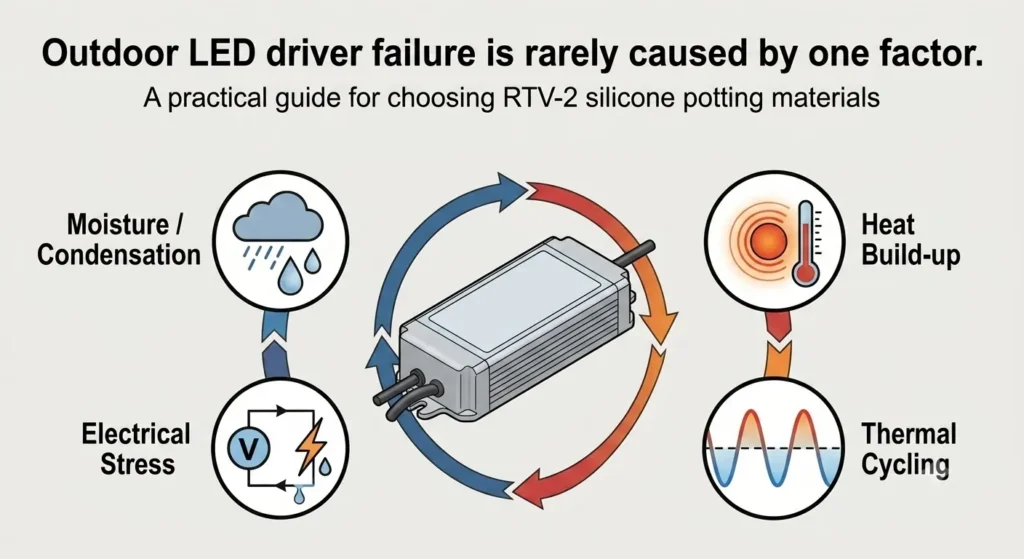
In real applications, LED drivers may still fail because several hidden risks happen inside the enclosure.
Condensation Inside the Housing
Outdoor lighting products often experience temperature differences between day and night. When warm air inside the enclosure cools down, condensation may form on the PCB or electronic components.
Even if rainwater does not directly enter the housing, water vapor and condensation can still create corrosion, leakage and insulation risks.
Heat Build-Up Around Power Components
LED drivers contain transformers, MOSFETs, capacitors, resistors and coils. These parts generate heat during operation.
If the driver is installed in a compact or sealed housing, heat may not escape efficiently. Over time, high temperature can shorten component life and increase failure risk.
Moisture Plus Voltage
Moisture alone is already a problem. Moisture plus voltage is more dangerous.
In humid outdoor conditions, bubbles, voids, incomplete curing or poor insulation may increase the risk of leakage, short circuit or electrical failure.
Thermal Cycling Stress
Outdoor LED drivers heat up during operation and cool down after shutdown. This cycle repeats daily.
If the potting material is too rigid, it may transfer stress to solder joints, wires and components during expansion and contraction.
Practical conclusion: LED driver potting should be evaluated as a long-term reliability solution, not only as a waterproof seal.
What Silicone Potting Compound Can and Cannot Do
A two-component composto de silicone para vasos flows around the LED driver PCB and components, then cures into a flexible protective elastomer.
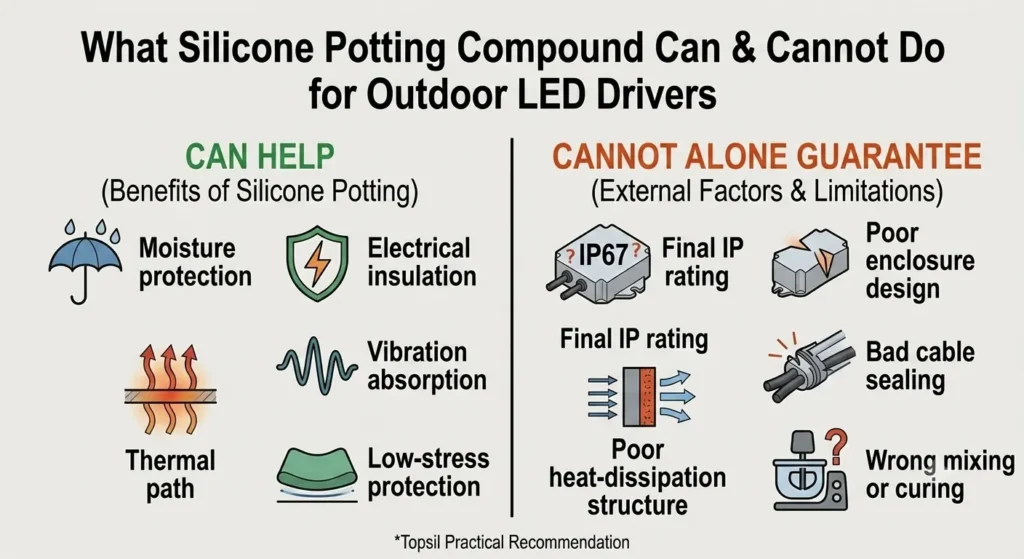
For outdoor LED drivers, silicone potting compound can help:
| LED Driver Risk | How Silicone Potting Helps |
| Moisture and condensation | Reduces direct moisture contact with PCB and components |
| Electrical leakage | Improves insulation around electronic components |
| Heat build-up | Helps transfer heat from components to housing or surrounding structure |
| Vibration | Absorbs mechanical stress during transport, installation and operation |
| Thermal cycling | Flexible silicone helps absorb expansion and contraction |
| Dust and pollution | Covers sensitive components and solder joints |
| Outdoor aging | Supports long-term protection in harsh environments |
However, silicone potting compound cannot solve every design problem by itself.
It cannot independently guarantee:
- the final IP rating of the whole lighting product
- poor enclosure design
- badly sealed cable entries
- insufficient heat dissipation path
- incorrect mixing ratio
- poor surface cleanliness
- unsuitable dispensing or curing process
A potting compound can improve internal protection, but the final outdoor reliability still depends on the complete product design and validation test.
If your project includes other electronic modules besides LED drivers, see our silicone encapsulants and potting compounds for broader application options.
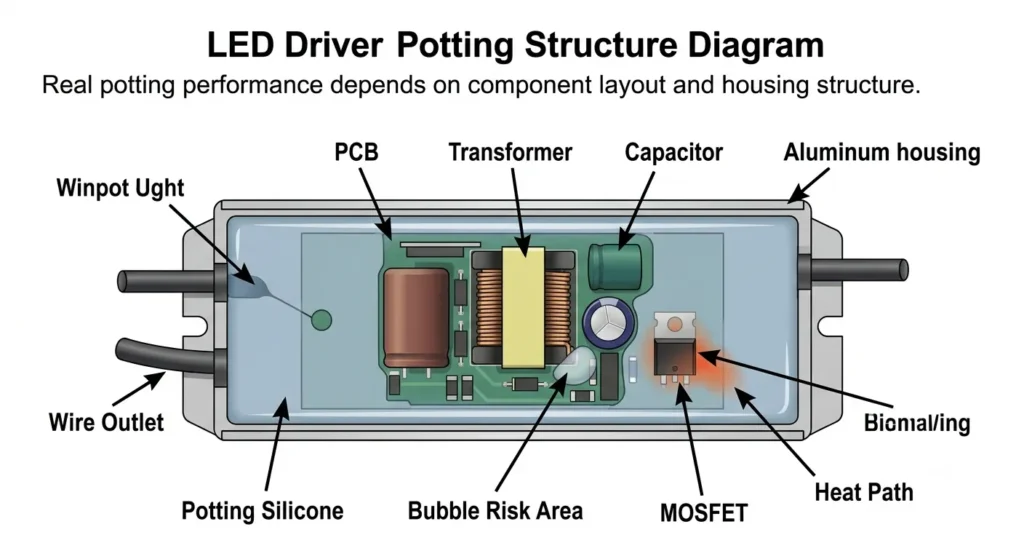
Where Potting Silicone Works Inside an LED Driver
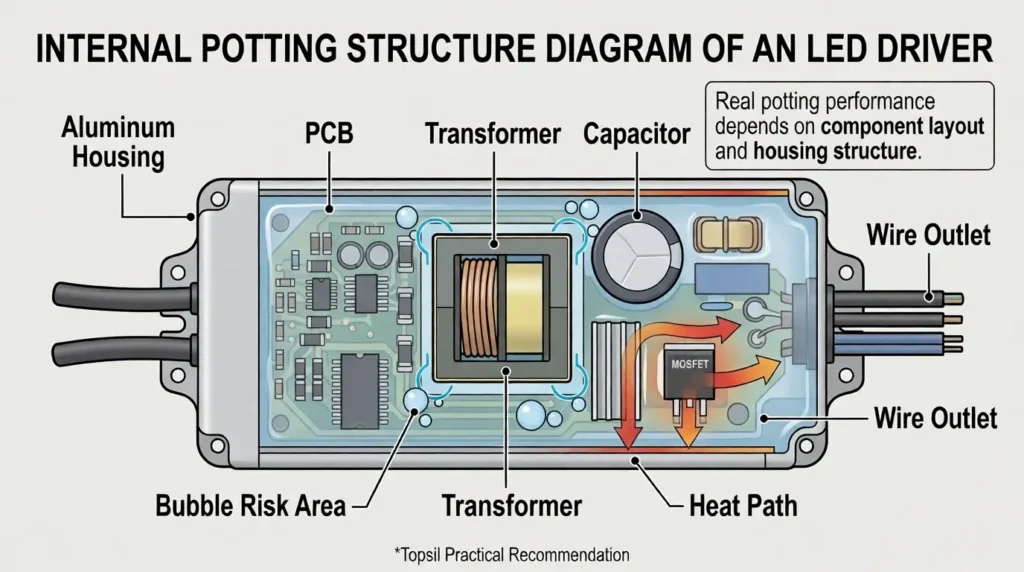
To choose the right potting compound, it helps to understand where the material must flow and protect inside the driver.
Common potting areas include:
- PCB surface
- transformer area
- capacitor area
- MOSFET and power component area
- solder joints
- wire outlet area
- housing bottom
- aluminum or metal casing contact area
Each area creates different material challenges.
Transformers and capacitors can trap air if the silicone is too viscous. MOSFETs and power components may need a better thermal path to the housing. Wire outlets and cable areas are common moisture-risk points. Aluminum housings may support heat dissipation only when the silicone fully contacts the surface without voids.
This is why LED driver potting should be tested in the real housing, not only in a small sample cup.
Full Potting, Partial Potting or Conformal Coating?
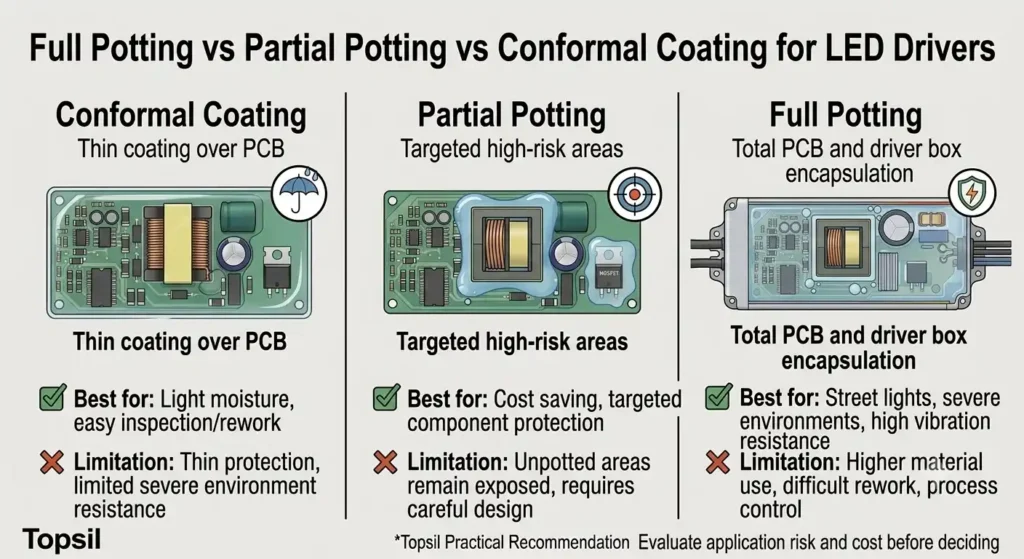
Not every LED driver requires the same protection method. The right choice depends on outdoor risk level, repair needs, cost target and reliability requirements.
| Protection Method | Melhor para | Limitações |
| Conformal coating | Light moisture protection, easier inspection and rework | Thin protection layer; limited protection against severe moisture, vibration or full encapsulation needs |
| Partial potting | Protecting selected high-risk areas while saving material | Requires careful design; unpotted areas may still be exposed |
| Full potting | Stronger moisture protection, vibration resistance and full encapsulation | Higher material use, harder rework, more process control required |
| Silicone potting | Outdoor LED drivers needing flexibility, insulation and thermal cycling resistance | Must match viscosity, hardness, cure time and production process |
For indoor LED drivers or low-risk applications, conformal coating may be enough.
For street lights, flood lights, landscape lighting, solar street light controllers and sealed outdoor driver boxes, full or partial silicone potting is often considered when stronger moisture protection, insulation and vibration resistance are needed.
How to Choose Potting Silicone for Different Outdoor Lighting Applications
Different outdoor lighting products face different failure risks. The potting compound should be selected based on the actual working environment, not only by a general “waterproof silicone” claim.
| Aplicativo | Main Failure Risk | Potting Silicone Selection Focus |
| Street light driver | Rain, humidity, heat and thermal cycling | Moisture resistance, thermal stability, low stress |
| Flood light driver | High power and heat build-up | Thermal transfer, bubble control, stable curing |
| Landscape lighting | Soil humidity, outdoor moisture and cable area risk | Moisture protection, adhesion, flexible protection |
| Solar street light controller | Sealed housing, outdoor aging and temperature change | Weather resistance, insulation, cure stability |
| LED display module | Outdoor exposure, vibration and electrical safety | Dielectric strength, flame retardancy, low stress |
| Signage lighting | Long working hours and outdoor exposure | Stable cure, insulation, moisture protection |
| Marine or coastal lighting | Humidity, salt exposure and corrosion risk | Moisture barrier, adhesion and aging resistance |
| Industrial outdoor lighting | Heat, dust, vibration and long operating hours | Mechanical protection, thermal stability, insulation |
This table is only a starting point. Final material selection should be confirmed through real product testing.
For a broader electronic potting selection framework, read our guide on how to choose silicone potting compound for electronics.
6 Selection Factors That Matter Most for LED Drivers
1. Moisture Resistance Under Condensation
Outdoor LED drivers may face water vapor and condensation even when the housing looks sealed.
The potting compound should help reduce moisture contact with the PCB, solder joints and components. Buyers should also check adhesion to PCB, housing and cable areas after humidity aging.
What to check:
- coverage around sensitive components
- adhesion to PCB and housing
- wire outlet protection
- humidity aging performance
- water ingress or IP-related product testing
2. Thermal Path to the Housing
LED drivers generate heat. Potting material can help transfer heat only when it forms a good thermal path between the heat source and the housing or heat-dissipation structure.
For high-power LED drivers, thermally conductive silicone may be needed. But higher thermal conductivity is not always better if the material becomes too viscous to fill the structure properly.
What to check:
- driver power level
- heat source location
- potting depth
- housing material
- contact area with aluminum or metal housing
- temperature rise after potting
- bubble control around power components
Selection tip: A moderate thermal grade with good flowability may perform better than a high W/m·K material that traps air or leaves voids.
If heat dissipation is the main challenge in your LED driver, compare thermal conductivity, viscosity and potting depth in our thermally conductive silicone potting compound selection guide.
3. Dielectric Strength After Humidity Aging
LED drivers work with voltage and current. In outdoor applications, electrical insulation must remain reliable after humidity and temperature aging.
Initial dielectric strength is important, but long-term insulation performance is more important for outdoor products.
What to check:
- dielectric strength
- volume resistivity
- operating voltage
- insulation distance
- insulation after damp heat aging
- insulation after thermal cycling
- effect of bubbles or voids on electrical reliability
4. Viscosity Around Transformers and Capacitors
LED driver PCBs often have transformers, capacitors, coils and narrow component gaps. These areas are easy to trap air.
If the silicone is too viscous, it may not flow under or around components. This can cause bubbles, incomplete filling and weak insulation points.
What to check:
- flow around transformers
- flow under large capacitors
- filling around wires and solder joints
- bubble release after dispensing
- vacuum degassing requirement
- suitability for automatic dispensing
Selection tip: For dense LED driver boards, viscosity and bubble control are often as important as thermal conductivity.
5. Low Stress Under Thermal Cycling
Outdoor LED drivers repeatedly heat up and cool down. During this process, the PCB, metal housing, components and potting material expand and contract at different rates.
A rigid material may increase stress on solder joints, wires and components. Flexible silicone helps absorb this movement.
What to check:
- cured hardness
- flexibilidade após a cura
- adhesion after thermal cycling
- cracking or separation after aging
- stress on wires and solder joints
Buyer note: Do not choose a harder potting material only because it feels stronger. For LED electronics, low-stress flexibility can be part of long-term protection.
6. Cure Stability for Production
A material that performs well in the lab may still fail during mass production if pot life, viscosity, mixing ratio or curing speed does not match the process.
This is especially important for LED driver factories using automatic dispensing.
What to check:
- mixing ratio, such as 1:1 or other ratio
- manual or automatic potting
- static mixer compatibility
- dispensing pressure
- vida útil da panela
- cure time before handling
- room temperature cure or heat-accelerated cure
- batch-to-batch stability
- production line speed
Selection tip: A good LED driver potting silicone must work not only in the product, but also on the production line.
Common LED Driver Potting Problems and How to Avoid Them
| Problema | Possible Causes | How to Reduce the Risk |
| Bubbles around transformers | High viscosity, fast mixing, poor degassing, complex transformer geometry | Choose suitable viscosity, control mixing speed, consider vacuum degassing and test in the real housing |
| Temperature rise after potting | Poor thermal path, trapped air, wrong thermal grade, poor housing heat dissipation | Test temperature rise before and after potting and check contact with the housing |
| Poor insulation after aging | Moisture exposure, bubbles, incomplete curing, contamination | Test dielectric strength and insulation resistance after humidity aging |
| Cracking or separation | Material too hard, poor adhesion, thermal expansion mismatch | Use lower-stress silicone and test adhesion after thermal cycling |
| Slow production | Unsuitable pot life or cure time, low temperature curing condition | Confirm handling time, cure schedule and heat acceleration options |
| Sample works but mass production fails | Small-cup test does not represent real dispensing or real housing geometry | Test under actual production conditions before approval |
A sample that cures well in a cup may still fail in a real LED driver housing. The test must reflect the real structure and production process.
Mass Production Validation Checklist
Before approving a silicone potting compound for LED drivers or outdoor lighting, test it under conditions close to the real product and production line.
Recommended validation items include:
- A/B mixing accuracy
- flowability in the real LED driver housing
- bubble release around transformers and capacitors
- curing time and handling time
- hardness after curing
- temperature rise before and after potting
- dielectric strength
- insulation resistance after humidity aging
- thermal cycling
- adhesion to PCB and housing
- vibration resistance
- water ingress or IP-related product testing
- flame retardancy if required
- automatic dispensing stability
- batch-to-batch consistency
The goal is not only to confirm that the silicone cures. The goal is to confirm that the material protects the LED driver reliably in the real outdoor environment.
What Information Should You Send Before Asking for a Sample?
A supplier cannot recommend the right potting silicone based only on the sentence “We need waterproof silicone for LED drivers.”
Before requesting a sample, prepare the following information:
- LED driver type or lighting application
- Indoor or outdoor use
- Power level
- Product size and potting depth
- Housing material, such as plastic, aluminum or metal
- Main heat source
- Required thermal conductivity, if specified
- Required hardness after curing
- Required viscosity or flowability
- Manual potting or automatic dispensing
- Pot life and cure time target
- Operating temperature range
- Waterproof or IP target
- Flame-retardant requirement
- Color requirement
- Current problem, such as bubbles, heat, poor cure or insulation failure
- Estimated monthly or annual usage
The more clearly you describe the LED driver structure, working environment and production method, the easier it is to recommend a practical RTV-2 silicone potting compound for testing.
Topsil Practical Recommendation
As a 15+ years RTV-2 silicone manufacturer, Topsil usually suggests LED driver and outdoor lighting buyers evaluate potting silicone from three angles:
Application risk: moisture, condensation, heat, insulation failure, vibration, thermal cycling, flame retardancy or production instability.
Driver structure: transformers, capacitors, MOSFETs, wires, narrow PCB gaps and contact with aluminum or metal housing.
Production process: manual pouring, vacuum potting, automatic dispensing, room temperature curing or heat-accelerated curing.
For LED driver projects, Topsil does not suggest choosing a material only by waterproof claim or thermal conductivity value. The right silicone potting compound should match the real driver design, heat source, potting depth and production process.
If you are not sure which grade is suitable, send us your power level, housing material, potting depth, thermal requirement, hardness target, dispensing method, curing process and current material problem.
Topsil can help review your application details and recommend a practical RTV-2 silicone potting compound direction for evaluation.
FAQs About Silicone Potting Compound for LED Drivers
Share your power level, potting depth, housing material, target hardness, viscosity requirement, thermal requirement and dispensing method. Topsil can help check which RTV-2 silicone potting compound direction is suitable for your LED driver test.