
Many electronics potting failures do not start in production. They start from material selection.
A silicone compound that cures well in a small test cup may still fail in a real PCB housing because of poor flow, trapped bubbles, heat build-up, unsuitable hardness, weak adhesion, or unstable insulation under humidity.
For electronics manufacturers, choosing the right silicone potting compound is not only about price, hardness, or curing time. The right material must match your component structure, working environment, protection target, and production process.
This guide will help you understand what to check before choosing silicone potting compound for electronics.
Quick Answer: How to Choose Silicone Potting Compound for Electronics?
Choose silicone potting compound based on five key requirements: operating conditions, electrical insulation, thermal management, hardness and viscosity, and production compatibility.
For sensitive PCBs and sensors, flexible low-stress silicone or silicone gel may be suitable. For heat-generating electronics, evaluate whether a thermally conductive grade is needed. For automated potting, viscosity, mixing ratio, working time, and curing conditions must match the dispensing process.
The right material should pass testing in your actual electronic assembly—not just a laboratory sample cup.
Why Silicone Potting Compound Is Used in Electronics
Silicone potting compound is widely used to protect electronic components from moisture, dust, vibration, temperature change, and electrical failure.
After curing, silicone remains flexible. This flexibility helps reduce stress on sensitive electronic parts, especially when the product experiences thermal expansion, vibration, or temperature cycling.
Silicone potting compound is commonly used for:
- PCB protection
- LED power supplies
- Outdoor electronic modules
- Датчики
- Control units
- Electrical connectors
- Power electronics
- Automotive electronic parts
- Cable and wire connection protection
- Industrial electronic modules
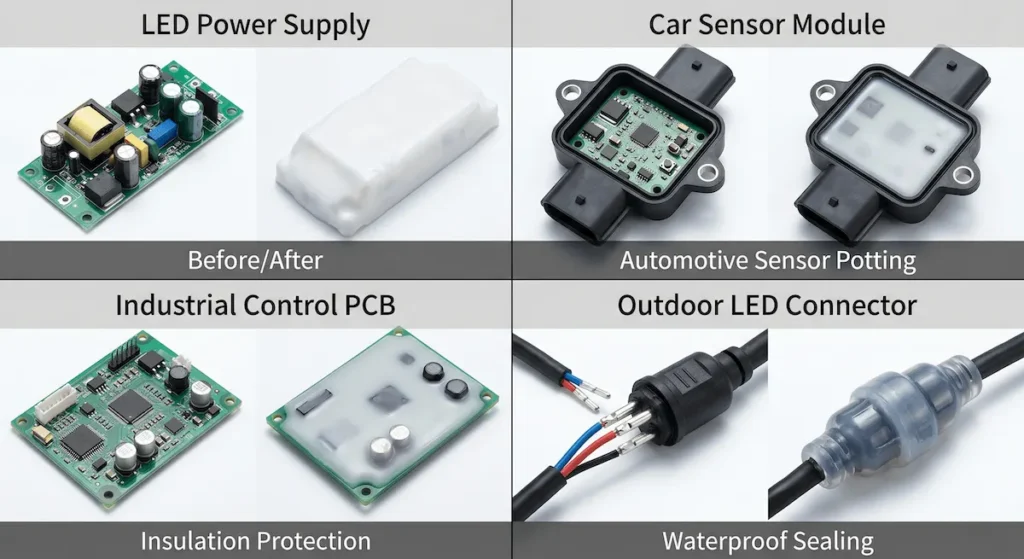
For many electronic applications, silicone is selected because it offers a practical balance of electrical insulation, moisture resistance, flexibility and long-term stability.
Silicone vs Epoxy vs Polyurethane Potting Compound
Different potting materials solve different problems. Before choosing silicone, it is useful to understand how it compares with epoxy and polyurethane.
| Тип материала | Главная сила | Possible Limitation |
| Epoxy potting compound | High hardness, strong bonding, good mechanical strength | More rigid, higher stress on sensitive components, difficult to rework |
| Polyurethane potting compound | Flexible protection, cost-effective in some applications | Heat resistance and long-term stability may be limited in demanding conditions |
| Силиконовый герметик | Flexible, low-stress, moisture resistant, electrically insulating, thermally stable | Adhesion and mechanical strength should be matched to the application |
There is no universal potting material for every electronic project.
If your product needs very strong structural bonding, epoxy may be suitable.
If your product needs flexible protection at a moderate cost, polyurethane may be considered.
If your product needs low-stress protection, electrical insulation, moisture resistance, and thermal cycling stability, silicone potting compound is often a better choice.
8 Key Factors When Choosing Silicone Potting Compound for Electronics
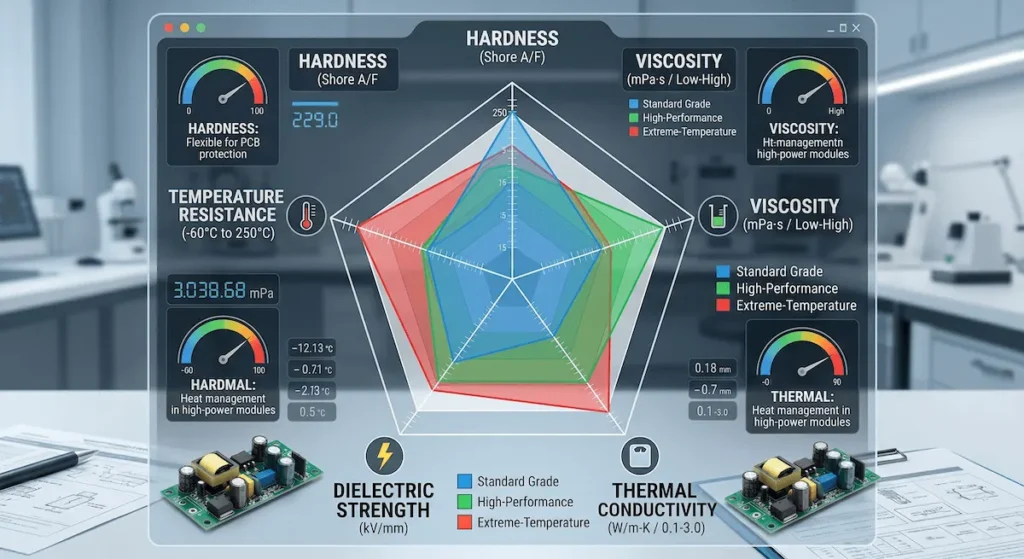
1. Operating Temperature Range
The first question should be: where will the electronic module work?
Indoor electronics, outdoor lighting, industrial controls, automotive modules and power electronics may face very different temperature conditions.
You should consider:
- Normal working temperature
- Maximum short-term temperature
- Low-temperature exposure
- Thermal cycling
- Outdoor weather conditions
- Heat generated by the component itself
If the module experiences frequent temperature change, flexibility becomes important. A material that is too rigid may create internal stress and damage sensitive parts over time.
2. Electrical Insulation Requirements
Electronic potting is not only about filling space. The material must protect the electrical function of the component.
Before choosing a silicone potting compound, check whether your application requires:
- Stable insulation under humidity
- Protection against leakage current
- PCB protection
- Wire and connector insulation
- Power supply or control module protection
For electronic assemblies, insulation stability is often more important than high hardness.
3. Thermal Conductivity
For heat-generating electronic assemblies, thermal management is an important part of material selection.
Standard insulating silicone does not necessarily provide sufficient heat dissipation. Applications involving LED drivers, power modules, and other heat-generating components may require thermally conductive silicone potting compounds.
Thermal conductivity is measured in W/(m·K). However, selecting a material based only on this value is not sufficient. The assembly’s heat path, housing design, potting thickness, operating temperature, and allowable component temperature must also be considered.
Thermally conductive fillers may affect viscosity, flowability, sedimentation behavior, and dispensing performance.
If flame retardancy is required, verify the specific grade’s UL 94 classification and applicable test thickness. Flame-retardant performance should not be assumed for all silicone potting compounds.
Selection tip: Evaluate thermal performance and dispensing compatibility together before approving a material for production.
4. Hardness and Flexibility
Many buyers start by asking for a certain hardness, such as 20 Shore A, 30 Shore A, or 40 Shore A.
But hardness alone is not enough.
A 30 Shore A silicone used for a small indoor PCB may be very different from a 30 Shore A silicone used for an outdoor LED power supply with heat generation and waterproofing requirements.
In general:
| Требование | Suggested Direction |
| Sensitive electronic parts | Softer, low-stress silicone |
| PCB protection | Flexible insulating silicone |
| LED power supply | Medium-soft or thermally stable silicone |
| Sensor module | Soft silicone elastomer or силиконовый гель |
| Vibration protection | Flexible silicone potting compound |
| Stronger mechanical support | Higher hardness silicone compound |
If the material is too hard, it may stress delicate components.
If the material is too soft, it may not provide enough mechanical protection.
Related Reading: How to Choose Shore A Hardness
5. Viscosity and Flowability
Viscosity affects how well the silicone potting compound flows into the electronic assembly.
Low-viscosity silicone is useful for:
- Small gaps
- Complex PCB structures
- Manual pouring
- Better flow around components
- Easier bubble release
- Thin or narrow potting areas
Higher-viscosity silicone may be better when:
- The structure is open or vertical
- Leakage control is needed
- Better positioning is required
- The formula contains thermal fillers
- Deep penetration is not required
A material that looks good in a cup test may fail in real production if it cannot flow into small gaps or release trapped air.
6. Working Time, Mix Ratio & Dispensing Compatibility
A silicone potting compound must fit the manufacturer’s production process—not just meet its final cured properties.
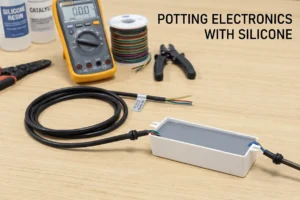
Для manual potting, sufficient working time is needed for weighing, mixing, degassing, and pouring.
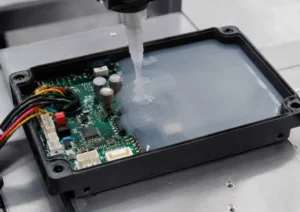
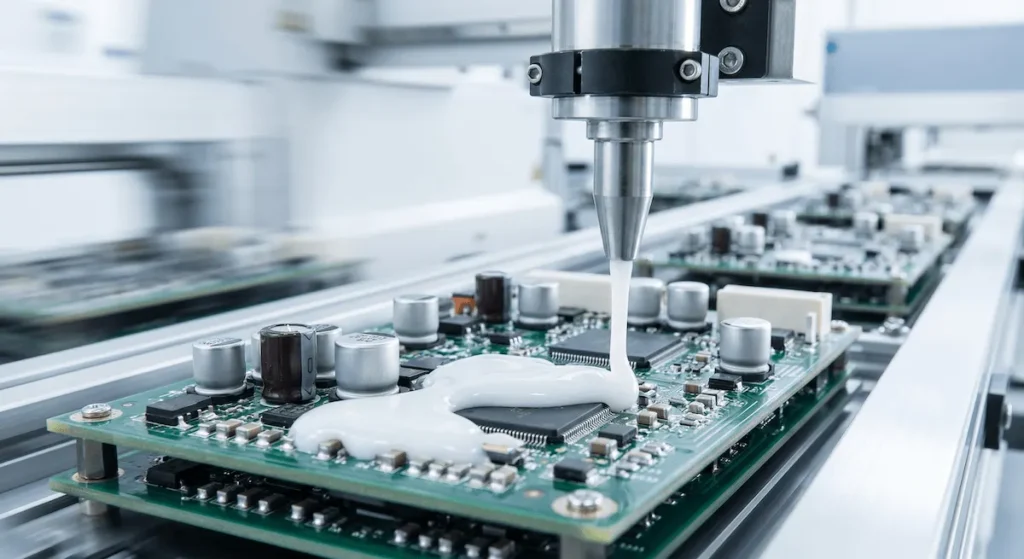
Для automated dispensing, check the mixing ratio, viscosity of each component, metering accuracy, mixer compatibility, dispensing cycle, and cure schedule.
A 1:1 silicone system and a 10:1 system require different metering configurations. The equipment must be compatible with the selected formulation and its specified mixing ratio.
Working time and curing speed are also temperature-dependent. A material tested at 23°C may behave differently on a colder or warmer production line.
Before approving a grade, verify:
- Mixing ratio by weight or volume, as specified by the manufacturer
- Component and mixed viscosity
- Working time at the actual production temperature
- Dispensing cycle and potential material residence time
- Curing conditions and time before the next production step
Selection tip: Request a grade that matches your equipment and production cycle rather than selecting the fastest-curing material available.
7. Flame-Retardant and Safety Requirements
Some electronic applications may require flame-retardant performance, especially for LED drivers, power supplies, industrial electronics, and electrical modules.
Before selecting a silicone potting compound, check whether your project requires:
- Flame-retardant direction
- Required UL 94 classification (if applicable)
- RoHS-related requirement
- REACH-related documentation
- Low odor
- Low volatile content
- TDS and SDS documents
- Other customer-specific compliance requirements
If your application requires a specific flame-retardancy classification, verify the material grade, applicable test thickness, and supporting test documentation. Do not assume that all silicone potting compounds meet UL 94 V-0.
8. Adhesion and Reworkability
Silicone potting compound may contact different substrates, such as PCB, plastic housing, aluminum housing, copper, wires, connectors, and cable joints.
Before choosing a material, confirm whether your application requires strong adhesion or mainly filling and protection.
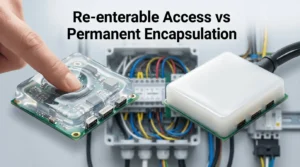
In some electronic applications, reworkability is also important. Silicone may be easier to remove than rigid epoxy in certain repair or maintenance situations.
You should consider:
- Does the silicone need to bond strongly to the housing?
- What substrate will the silicone contact?
- Is primer needed?
- Will the product need repair later?
- Will it face vibration, moisture, or thermal cycling?
- Is long-term elasticity required?
A good silicone potting compound should not only pass the first sample test. It should remain stable under real service conditions.
When Reworkability Matters
Some electronic assemblies, including serviceable control modules and BMS electronics, may require access to components after potting.
In such cases, a low-adhesion silicone gel may be more suitable than a conventional cured silicone elastomer.
However, low hardness does not automatically mean easy removal. Reworkability should be evaluated based on adhesion to the actual substrates, component geometry, removal method, and the protection required during service.
For applications requiring very soft materials, Shore 00 hardness may be more appropriate than Shore A measurements.
Explore our Электронный силиконовый гель for low-stress protection applications.
What Happens If the Wrong Potting Compound Is Selected?
Choosing an unsuitable silicone potting compound can cause processing problems, premature component failure, and unnecessary production costs.
| Selection Problem | Potential Consequence |
|---|---|
| Incorrect hardness | Component stress or insufficient mechanical support |
| Unsuitable viscosity | Poor filling, trapped air, or voids |
| Incorrect working time | Dispensing difficulties and production waste |
| Inadequate thermal management | Excessive component temperatures |
| Poor moisture or adhesion performance | Insulation problems or interface leakage |
| Unverified production compatibility | Inconsistent mixing, curing, or final properties |
Key takeaway: Material performance must be evaluated together with the actual electronic assembly and production process.
Quick Selection Guide by Application
Different electronic applications require different material properties. Use the following guide to identify your initial selection priorities.
| Приложение | Main Selection Priority | What to Verify Before Sampling |
|---|---|---|
| PCB & Control Modules | Electrical insulation and flowability | Viscosity, dielectric properties, gap filling, and curing |
| LED Drivers & Power Supplies | Thermal management and insulation | Heat dissipation, flowability, and required flame rating |
| Sensitive Sensors | Low mechanical stress | Hardness, component compatibility, and adhesion |
| BMS Electronics | Low stress and possible reworkability | Shore 00 hardness where applicable, adhesion, removal behavior, and insulation |
| Outdoor Electronic Modules | Moisture and temperature cycling resistance | Enclosure sealing, substrate adhesion, and environmental reliability |
| Automated Potting Lines | Stable dispensing and production efficiency | Mixing ratio, viscosity, working time, and dispensing cycle |
These are initial selection guidelines. Final grade approval should be based on product-specific technical data and testing in the actual assembly.
3 Common Mistakes When Selecting Silicone Potting Compound
Mistake 1: Choosing Based on Price or Hardness Alone
A lower price or a specified Shore hardness does not guarantee the right material. Electrical insulation, flexibility, thermal requirements, and processing conditions must also be considered.
Better approach: Compare total application requirements and production costs—not just price per kilogram.
Mistake 2: Ignoring Thermal Management and Dispensing Compatibility
A material may have suitable cured properties but still cause production problems if its viscosity, mixing ratio, or working time does not match the dispensing process. Heat-generating components also require thermal evaluation.
Better approach: Verify material performance and equipment compatibility before approving a grade.
Mistake 3: Testing Only in a Sample Cup
A silicone that cures successfully in a small cup may behave differently inside an electronic housing, where narrow gaps, trapped air, component geometry, and temperature affect the result.
Better approach: Test the actual assembly using representative mixing, dispensing, filling, and curing conditions.
What Information Should You Provide Before Requesting a Silicone Potting Sample?
To recommend a suitable silicone grade, our technical team needs to understand your actual application and production conditions.
| Information | What to Share |
|---|---|
| Приложение | PCB, LED driver, sensor, BMS, connector, or control module |
| Operating Conditions | Temperature range, moisture exposure, electrical and thermal requirements |
| Material Properties | Target hardness, viscosity, color, adhesion, or reworkability |
| Production Process | Manual or automatic dispensing, mixing ratio, working time, and cure schedule |
| Current Challenges | Bubbles, incomplete filling, overheating, poor adhesion, or cure problems |
| Project Stage | Trial quantity, expected bulk demand, and testing timeline |
You do not need to know every specification before contacting us. Share what you already know, and Topsil can help identify the remaining parameters to evaluate.
Request a Grade Recommendation →
How Topsil Silicone Can Help
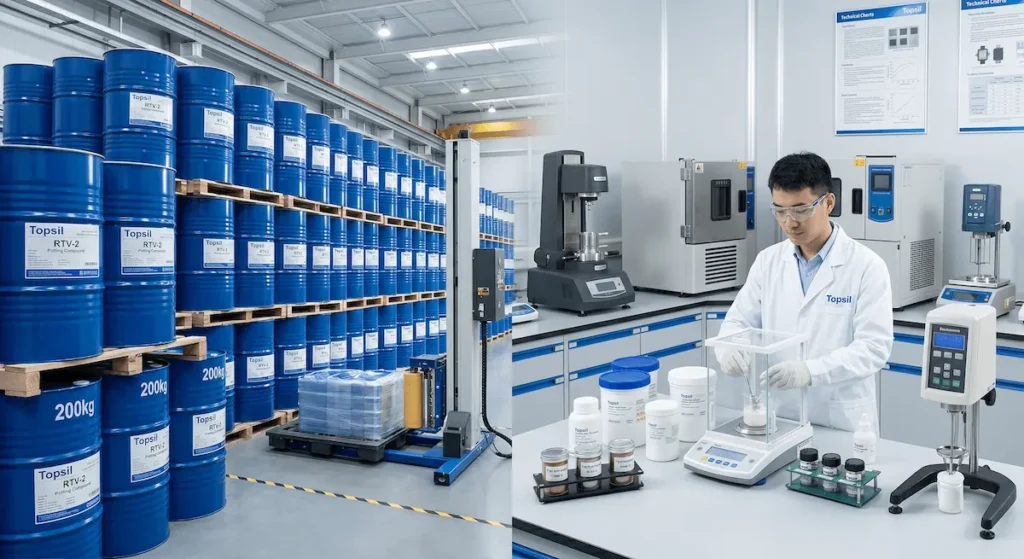
Topsil Silicone is a China-based RTV-2 silicone manufacturer with more than 15 years of experience in liquid silicone materials.
For electronics potting applications, we can help match silicone grades based on hardness, viscosity, pot life, curing speed, color, thermal conductivity, insulation needs, and production method.
Instead of sending a general sample, we prefer to understand your component structure, working environment, and potting process first. This helps reduce testing risk and improves the chance of selecting a suitable silicone potting compound for your project.
The goal is not only to send a sample.
The goal is to recommend the right sample for your real application.
Need Help Choosing Silicone Potting Compound for Your Electronics Project?
Choosing the right silicone potting compound for your electronics project?
Share your application and key processing requirements. Topsil can help identify suitable RTV-2 silicone grades and provide technical data and samples for evaluation.
ЧАСТО ЗАДАВАЕМЫЕ ВОПРОСЫ
1. How Do I Choose Between Standard and Thermally Conductive Silicone Potting Compound?
Standard insulating silicone may be suitable for electronics requiring electrical insulation and flexible protection. If the assembly generates significant heat, a thermally conductive grade may be needed. Evaluate thermal performance based on the actual heat path, operating temperature, and component requirements.
2. What Viscosity Is Best for PCB Potting?
Lower-viscosity silicone can help fill narrow gaps and flow around complex PCB components. However, the ideal viscosity depends on the enclosure design, filling depth, dispensing method, and working time. Always verify flowability using the actual assembly.
3. What Causes Bubbles in Silicone Potting Compound?
Bubbles may result from air introduced during mixing, trapped air around components, insufficient degassing, unsuitable viscosity, or dispensing conditions. To reduce voids, optimize material preparation, mixing, dispensing, and curing according to the selected grade.
4. What Information Should I Provide Before Requesting a Silicone Potting Sample?
Share your application, operating temperature, electrical and thermal requirements, preferred hardness, dispensing method, and expected quantity. If you have specific problems such as bubbles or incomplete curing, include those details so Topsil can recommend suitable grades for evaluation.