
Many electronics potting failures do not start in production. They start from material selection.
A silicone compound that cures well in a small test cup may still fail in a real PCB housing because of poor flow, trapped bubbles, heat build-up, unsuitable hardness, weak adhesion, or unstable insulation under humidity.
For electronics manufacturers, choosing the right silicone potting compound is not only about price, hardness, or curing time. The right material must match your component structure, working environment, protection target, and production process.
This guide will help you understand what to check before choosing silicone potting compound for electronics.
Quick Answer: What Should You Check First?
Before selecting a silicone potting compound, check these key points:
- What electronic component will be potted?
- Is the product used indoors or outdoors?
- Does the component generate heat?
- Is electrical insulation the main requirement?
- Do you need standard silicone or thermally conductive silicone?
- What hardness or softness is suitable?
- Is low viscosity required for better flow?
- Do you need fast curing or longer working time?
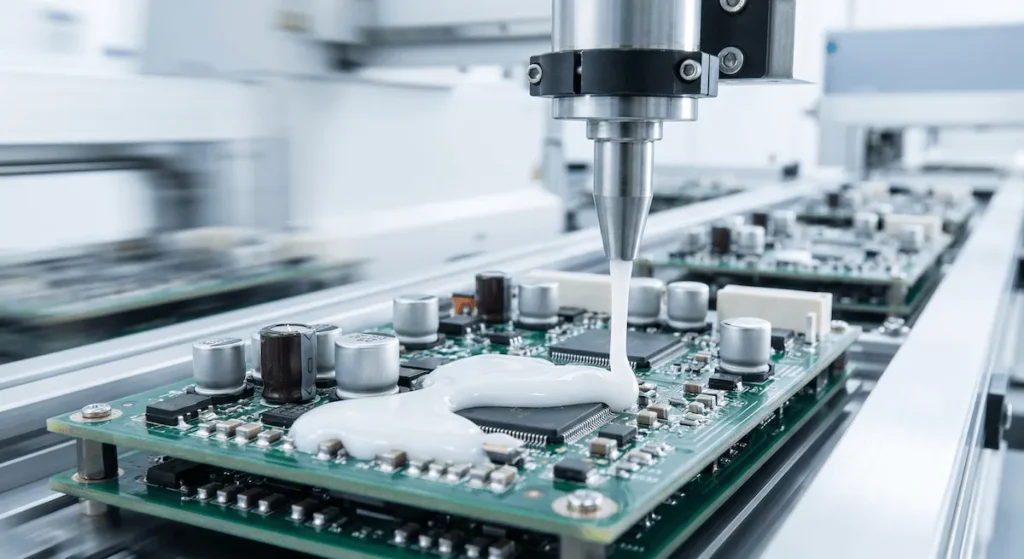
- Will the material be manually poured or automatically dispensed?
The best silicone potting compound is not always the hardest, fastest-curing, or cheapest one. It is the one that fits your real application.
Not sure which grade fits? Send us your application details for silicone potting compound recommendation.
Why Silicone Potting Compound Is Used in Electronics
Silicone potting compound is widely used to protect electronic components from moisture, dust, vibration, temperature change, and electrical failure.
After curing, silicone remains flexible. This flexibility helps reduce stress on sensitive electronic parts, especially when the product experiences thermal expansion, vibration, or temperature cycling.
Silicone potting compound is commonly used for:
- PCB protection
- LED power supplies
- Outdoor electronic modules
- Sensors
- Control units
- Electrical connectors
- Power electronics
- Automotive electronic parts
- Cable and wire connection protection
- Industrial electronic modules
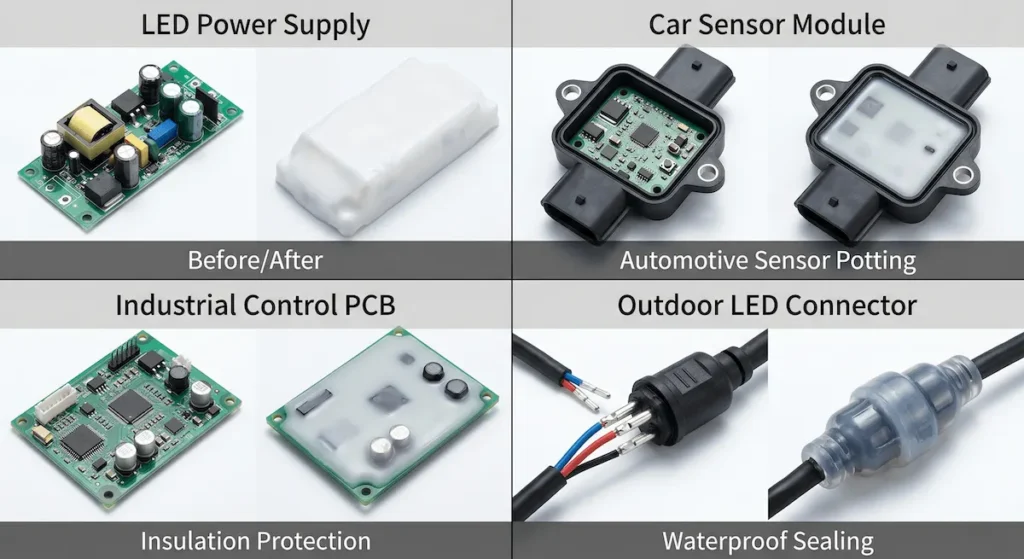
For many electronic applications, silicone is selected because it offers a practical balance of electrical insulation, moisture resistance, flexibility and long-term stability.
Silicone vs Epoxy vs Polyurethane Potting Compound
Different potting materials solve different problems. Before choosing silicone, it is useful to understand how it compares with epoxy and polyurethane.
| Material Type | Main Strength | Possible Limitation |
| Epoxy potting compound | High hardness, strong bonding, good mechanical strength | More rigid, higher stress on sensitive components, difficult to rework |
| Polyurethane potting compound | Flexible protection, cost-effective in some applications | Heat resistance and long-term stability may be limited in demanding conditions |
| Silicone potting compound | Flexible, low-stress, moisture resistant, electrically insulating, thermally stable | Adhesion and mechanical strength should be matched to the application |
There is no universal potting material for every electronic project.
If your product needs very strong structural bonding, epoxy may be suitable.
If your product needs flexible protection at a moderate cost, polyurethane may be considered.
If your product needs low-stress protection, electrical insulation, moisture resistance, and thermal cycling stability, silicone potting compound is often a better choice.
Start With These 4 Questions
Before asking for a sample, these four questions can help narrow down the selection direction:
- Is the component mainly exposed to moisture, heat, vibration, or electrical stress?
- Does the electronic module generate heat during operation?
- Do you need soft protection or stronger mechanical support?
- Will the material be manually poured or automatically dispensed?
For example, a simple indoor PCB may mainly need low-viscosity insulation and moisture protection.
An LED power supply may need heat resistance, waterproofing, and flame-retardant properties.
A sensor module may need a softer, low-stress silicone to protect sensitive parts from vibration and thermal cycling.
8 Key Factors When Choosing Silicone Potting Compound for Electronics
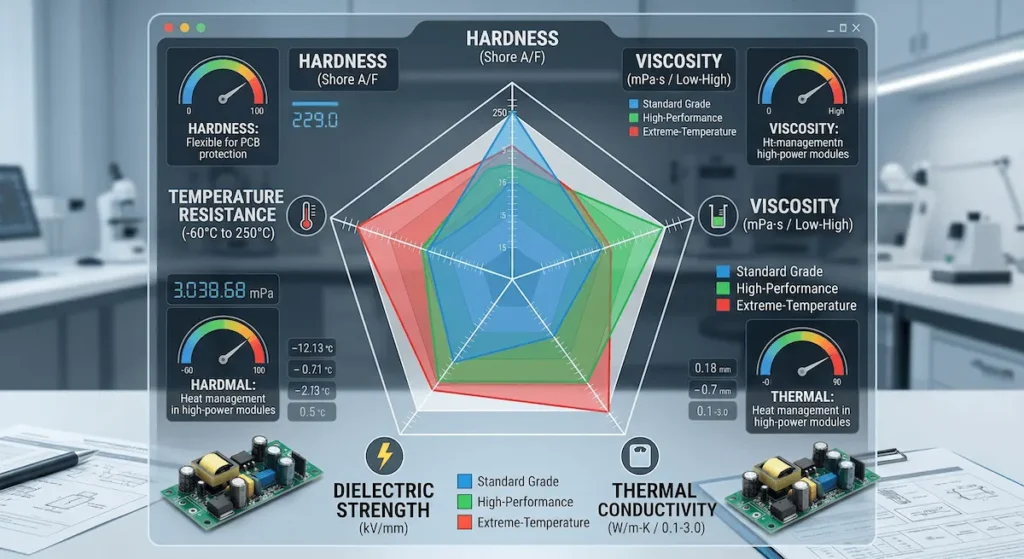
1. Operating Temperature Range
The first question should be: where will the electronic module work?
Indoor electronics, outdoor lighting, industrial controls, automotive modules and power electronics may face very different temperature conditions.
You should consider:
- Normal working temperature
- Maximum short-term temperature
- Low-temperature exposure
- Thermal cycling
- Outdoor weather conditions
- Heat generated by the component itself
If the module experiences frequent temperature change, flexibility becomes important. A material that is too rigid may create internal stress and damage sensitive parts over time.
2. Electrical Insulation Requirements
Electronic potting is not only about filling space. The material must protect the electrical function of the component.
Before choosing a silicone potting compound, check whether your application requires:
- Electrical insulation
- Stable insulation under humidity
- Protection against leakage current
- PCB protection
- Wire and connector insulation
- Power supply or control module protection
For electronic assemblies, insulation stability is often more important than high hardness.
3. Thermal Conductivity
Some electronic components generate heat during operation. In this case, the potting compound must not only protect the component but also help manage heat.
For low-power electronics, a standard insulating silicone potting compound may be enough.
For LED power supplies, transformers, power modules, or high-power electronics, a thermally conductive silicone potting compound (measured in $$W/m\cdot $$) with standard flame retardancy (such as UL94 V-0) may be required.
However, higher thermal conductivity is not always better. Thermally conductive silicone usually contains functional fillers, which may affect viscosity, flowability, bubble release, sedimentation stability, dispensing performance, and cost.
The right choice should balance heat dissipation, processability, and final protection performance.
4. Hardness and Flexibility
Many buyers start by asking for a certain hardness, such as 20 Shore A, 30 Shore A, or 40 Shore A.
But hardness alone is not enough.
A 30 Shore A silicone used for a small indoor PCB may be very different from a 30 Shore A silicone used for an outdoor LED power supply with heat generation and waterproofing requirements.
In general:
| Requirement | Suggested Direction |
| Sensitive electronic parts | Softer, low-stress silicone |
| PCB protection | Flexible insulating silicone |
| LED power supply | Medium-soft or thermally stable silicone |
| Sensor module | Soft silicone elastomer or silicone gel |
| Vibration protection | Flexible silicone potting compound |
| Stronger mechanical support | Higher hardness silicone compound |
If the material is too hard, it may stress delicate components.
If the material is too soft, it may not provide enough mechanical protection.
Related Reading: How to Choose Shore A Hardness
5. Viscosity and Flowability
Viscosity affects how well the silicone potting compound flows into the electronic assembly.
Low-viscosity silicone is useful for:
- Small gaps
- Complex PCB structures
- Manual pouring
- Better flow around components
- Easier bubble release
- Thin or narrow potting areas
Higher-viscosity silicone may be better when:
- The structure is open or vertical
- Leakage control is needed
- Better positioning is required
- The formula contains thermal fillers
- Deep penetration is not required
A material that looks good in a cup test may fail in real production if it cannot flow into small gaps or release trapped air.
6. Pot Life and Curing Speed
Pot life and curing speed directly affect production efficiency.
Fast curing may shorten production time, but it can also create problems if operators do not have enough time for mixing, degassing, and pouring.
Longer pot life may be better for large-volume potting or complex structures, but it may slow down the next production step if curing time is too long.
Before choosing a grade, consider:
- Manual or automatic operation
- Mixing volume each time
- Degassing requirement
- Pouring time
- Room temperature curing or heat curing
- Next process timing
- Production line speed
For bulk production, the best silicone potting compound is not always the fastest one. It is the one that fits your actual production rhythm.
7. Flame-Retardant and Safety Requirements
Some electronic applications may require flame-retardant performance, especially for LED drivers, power supplies, industrial electronics, and electrical modules.
Before selecting a silicone potting compound, check whether your project requires:
- Flame-retardant direction
- UL94 V-0 related requirement
- RoHS-related requirement
- REACH-related documentation
- Low odor
- Low volatile content
- TDS and SDS documents
- Other customer-specific compliance requirements
Not every silicone potting compound is flame-retardant. If flame retardancy is important, it should be mentioned at the beginning of the inquiry.
8. Adhesion and Reworkability
Silicone potting compound may contact different substrates, such as PCB, plastic housing, aluminum housing, copper, wires, connectors, and cable joints.
Before choosing a material, confirm whether your application requires strong adhesion or mainly filling and protection.
In some electronic applications, reworkability is also important. Silicone may be easier to remove than rigid epoxy in certain repair or maintenance situations.
You should consider:
- Does the silicone need to bond strongly to the housing?
- What substrate will the silicone contact?
- Is primer needed?
- Will the product need repair later?
- Will it face vibration, moisture, or thermal cycling?
- Is long-term elasticity required?
A good silicone potting compound should not only pass the first sample test. It should remain stable under real service conditions.
What Happens If the Wrong Potting Compound Is Selected?
Wrong material selection can create problems during testing, production, or final use.
| Wrong Selection | Possible Result |
| Too hard | Stress on sensitive components during thermal cycling |
| Too soft | Insufficient mechanical protection |
| Too viscous | Poor flow, trapped air, incomplete filling |
| Too fast curing | Short working time, production waste, poor operation control |
| Poor thermal design | Heat build-up and shorter component life |
| Poor moisture protection | Insulation failure or outdoor reliability problems |
| Poor adhesion matching | Separation from housing or component surface |
| Unstable batch quality | Inconsistent production performance |
For electronics manufacturers, these problems may lead to rework, customer complaints, delayed delivery, or product failure.
That is why technical matching before sample testing is important.
Quick Selection Guide by Application
| Application | Main Concern | Suggested Silicone Direction |
| Simple PCB protection | Insulation, moisture resistance, flowability | Low-viscosity insulating silicone encapsulant |
| LED power supply | Heat, waterproofing, flame-retardant expectation | Thermally stable or flame-retardant direction silicone potting compound |
| Sensor module | Low stress, vibration, sensitive components | Soft silicone elastomer or silicone gel |
| Outdoor electronics | Moisture, UV exposure, temperature cycling | Weather-resistant silicone potting compound |
| Automotive electronics | Vibration, heat, thermal cycling | Flexible and durable silicone encapsulant |
| Power electronics | Heat dissipation and insulation | Thermally conductive silicone potting compound |
| Electrical connector | Waterproof sealing, flexibility | Soft silicone potting or sealing compound |
| Control module | Insulation, production stability | RTV silicone potting compound matched to process |
This table is only a general guide. The final grade should be selected based on your component structure, working environment, production process, and testing requirements.
Send your PCB or electronic module requirements to get a suitable silicone potting compound recommendation.
Common Mistakes When Selecting Silicone Potting Compound
Mistake 1: Only Comparing Price per Kilogram
A lower unit price does not always mean lower total cost.
If the material causes bubbles, poor curing, insulation failure, cracking, or production delays, the real cost will be much higher than the price difference.
Mistake 2: Choosing Hardness Without Checking the Application
Hardness is important, but it should not be the only selection standard.
A buyer may ask for 30 Shore A silicone, but the real requirement could be low stress, better flow, waterproofing, heat resistance or flame-retardant direction.
Mistake 3: Ignoring Heat Dissipation
For LED power supplies, transformers, and power electronics, heat management can be critical.
If the potting compound traps heat instead of helping manage it, the electronic component may fail earlier.
Mistake 4: Testing a Sample Without Simulating Real Production
A material that performs well in a small sample cup may not perform the same way in real production.
Your test should include real component structure, actual potting depth, real mixing method, degassing condition, curing environment, bubble observation, and flowability check.
Mistake 5: Asking for a Sample Without Providing Application Details
If a supplier does not know your application, they can only recommend a general grade.
A better recommendation requires information such as component type, temperature, hardness, viscosity, curing process, thermal requirement, and estimated quantity.
What Information Should You Provide Before Asking for a Recommendation?
To recommend the right silicone potting compound, we usually ask the following questions:
- What electronic component will be potted?
- Is it used indoors or outdoors?
- What is the working temperature range?
- Does the component generate heat?
- Do you need thermal conductivity?
- What hardness or softness do you expect?
- Do you need flame-retardant performance?
- What color do you need: clear, translucent, white, black or customized?
- What is your potting method: manual pouring or automatic dispensing?
- What pot life and curing time do you prefer?
- What substrate will the silicone contact?
- Do you need strong adhesion or reworkability?
- What is your estimated monthly or annual usage?
- Are there any current problems, such as bubbles, cracking, overheating, poor adhesion or poor curing?
For example, if a customer only says “we need 30 Shore A silicone”, this is not enough for an accurate recommendation.
A 30 Shore A silicone used for an indoor PCB can be very different from a 30 Shore A silicone used for an outdoor LED power supply with heat and waterproofing requirements.
Application details help reduce testing risk before bulk production.
How Topsil Silicone Can Help
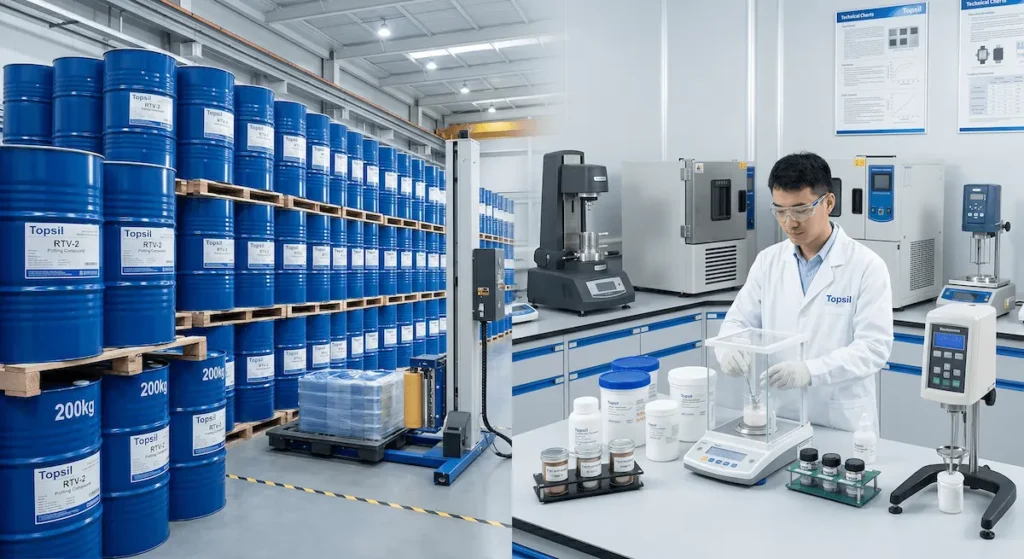
Topsil Silicone is a China-based RTV-2 silicone manufacturer with more than 15 years of experience in liquid silicone materials.
For electronics potting applications, we can help match silicone grades based on hardness, viscosity, pot life, curing speed, color, thermal conductivity, insulation needs, and production method.
Instead of sending a general sample, we prefer to understand your component structure, working environment, and potting process first. This helps reduce testing risk and improves the chance of selecting a suitable silicone potting compound for your project.
The goal is not only to send a sample.
The goal is to recommend the right sample for your real application.
Need Help Choosing Silicone Potting Compound for Your Electronics Project?
Send us your project details and request a suitable silicone potting compound recommendation.
Please include:
- Application
- Component type
- Indoor or outdoor use
- Working temperature range
- Required hardness
- Thermal conductivity requirement
- Required color
- Potting method
- Preferred pot life and curing time
- Estimated quantity
- Current material problem, if any
Request TDS, sample, and technical recommendation for your electronics potting project.