
Quick Answer
RTV-2 silicone potting compound is used in power supplies and transformers to improve electrical insulation, moisture protection, vibration damping, heat transfer and long-term reliability.
But for these applications, potting failure is often invisible at first.
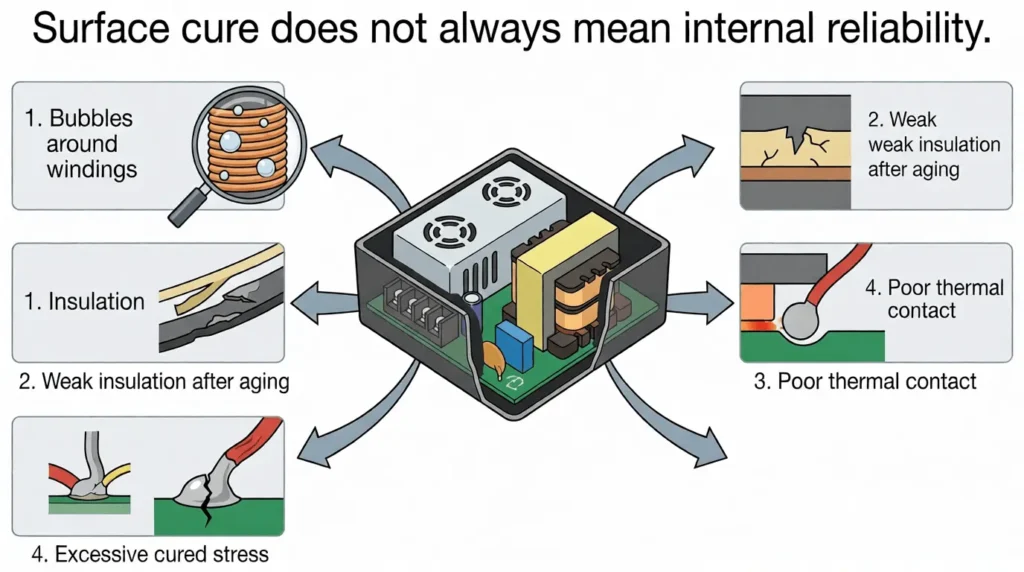
A sample may cure well on the surface, but hidden bubbles around windings, poor filling in deep gaps, weak dielectric areas, excessive cured stress or unstable A/B mixing can later appear as dielectric failure, temperature rise, transformer noise, cracking, separation or mass production defects.
For power supplies and transformers, the right RTV-2 silicone potting compound should not be selected only by hardness, thermal conductivity or price. It should be selected by how well it reduces hidden risks inside the real structure.
A practical material must balance:
- dielectric insulation
- flowability into coils and narrow gaps
- bubble control
- thermal path
- low-stress flexibility
- vibration damping
- flame-retardant requirements
- pot life and cure time
- production stability
Why Potting Failure Is Hard to See at First
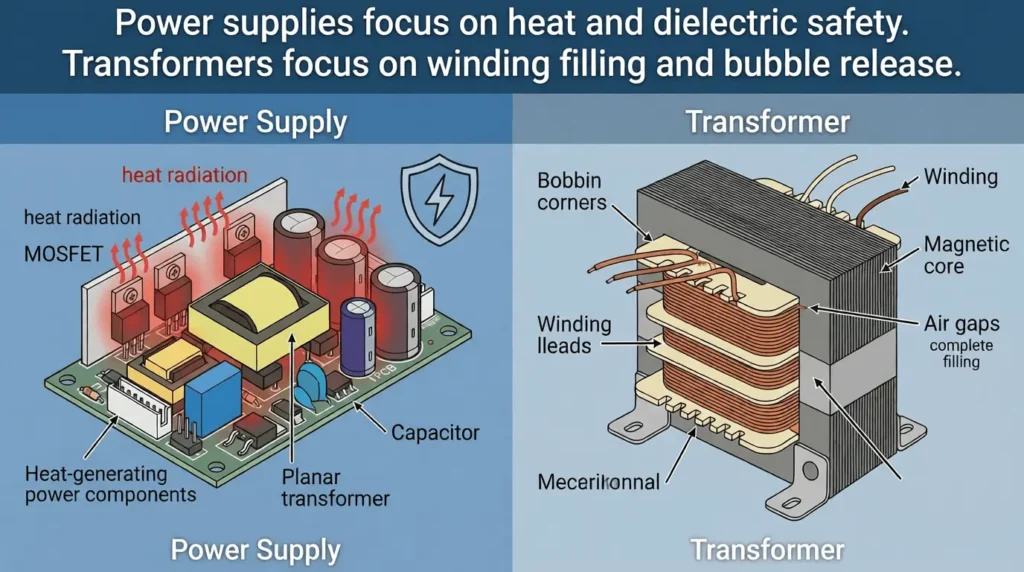
Power supplies and transformers are different from simple PCB encapsulation. Their internal structures often include coils, windings, magnetic cores, wire leads, solder joints, power components, narrow gaps and deep cavities.
This makes potting more difficult than it looks.
A small cup test may show that the material cures properly, but it cannot prove that the material will fill the real product without bubbles, voids or weak insulation points.
Common hidden risks include:
| Hidden Risk | Why It Matters |
| Bubbles around windings | May reduce insulation reliability, moisture protection and heat transfer |
| Poor filling in deep gaps | May leave weak points inside the structure |
| Weak insulation after aging | Initial dielectric strength may drop after humidity or thermal cycling |
| Poor thermal contact | Heat may remain trapped inside the module |
| Excessive cured hardness | May stress wires, solder joints and components |
| Unstable production process | Lab samples may pass, but mass production may fail |
For power supplies and transformers, material approval should include both product performance testing and production process validation.
Power Supplies vs Transformers: Different Potting Risks
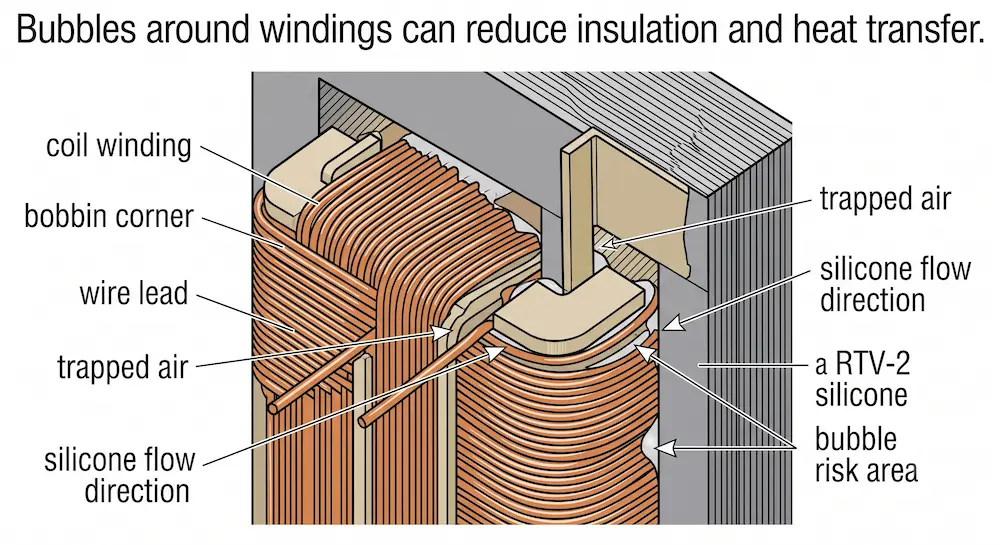
Power supplies and transformers are often discussed together, but their potting risks are not the same.
IEC 61558-2-16 for switch mode power supply units and transformers
For Power Supplies: What Matters Most?
Power supplies usually contain compact PCB layouts, transformers, MOSFETs, rectifiers, resistors, capacitors and other heat-generating components.
The main concerns are:
- dielectric insulation
- heat transfer from power components
- flame-retardant requirements
- compact housing filling
- stable dispensing
- cure time for production efficiency
- long-term reliability under electrical load
For power supplies, the potting material must protect the electronics while supporting heat management and stable production.
For Transformers: What Matters Most?
Transformers usually have coils, windings, magnetic cores, bobbins, wire leads and internal air gaps.
The main concerns are:
- penetration around windings
- bubble release inside coil gaps
- insulation between conductive areas
- vibration and noise reduction
- deep potting cure behavior
- low stress around wire leads
- moisture protection after aging
For transformers, the biggest challenge is often not surface curing. It is whether the potting material can fully fill complex internal spaces without trapping air.
| Application | Main Hidden Risk | Potting Silicone Selection Focus |
| Switching power supply | Compact layout, heat and voltage | Thermal path, dielectric strength, flowability |
| Industrial power supply | Long operation, vibration and safety | Heat resistance, insulation, flame retardancy |
| Adapter or charger | Compact housing and fast production | Stable dispensing, suitable cure speed, low viscosity |
| Transformer | Windings, coils and air gaps | Bubble release, penetration, insulation |
| Encapsulated transformer | Deep potting and vibration | Flowability, low stress, curing depth |
| Inverter / control module | High power density | Thermal transfer, dielectric safety, aging test |
| Power module | Local hot spots and component stress | Low stress, thermal path, reliable cure |
What RTV-2 Silicone Potting Compound Can Help Solve
RTV-2 silicone potting compound is normally supplied as two components. After Part A and Part B are mixed, the material flows into the housing or around components and cures into a flexible elastomer.
For power supplies and transformers, RTV-2 silicone can help with several reliability needs.
| Protection Need | How RTV-2 Silicone Helps |
| Electrical insulation | Encapsulates components and helps reduce leakage risk |
| Moisture protection | Reduces contact with humidity, dust and contamination |
| Heat management | Supports heat transfer from transformers or power components |
| Vibration damping | Helps reduce vibration from coils and transformer structures |
| Low-stress protection | Flexible silicone absorbs expansion and contraction |
| Wire and solder joint protection | Reduces stress around leads and soldered areas |
| Mechanical stabilization | Holds components in place during operation and transport |
| Production consistency | Suitable viscosity and pot life support stable potting process |
RTV-2 silicone is often selected when the product needs a balance of insulation, flexibility, moisture resistance, vibration damping and thermal cycling resistance.
It is especially useful when rigid materials may create too much stress inside the assembly.
If your project includes other electrical assemblies, see our silicone encapsulants and potting compounds for more RTV-2 potting options.
Silicone vs Epoxy vs Polyurethane for Power Supply and Transformer Potting
Epoxy, polyurethane and silicone can all be used for electrical potting. The right choice depends on the structure and performance requirements.
| Material | Strengths | Limitations | Suitable Direction |
| Silicone | Flexible, low stress, good thermal cycling, good insulation | Lower rigidity than epoxy, usually higher cost | Sensitive power electronics, transformers, thermal cycling applications |
| Epoxy | Hard, strong, good structural support | Higher stress, difficult to rework, may crack under thermal cycling | Rigid encapsulation and strong mechanical protection |
| Polyurethane | Flexible, cost-effective, good general protection | Long-term heat resistance may be lower than silicone | Cost-sensitive electronics under moderate conditions |
For power supplies and transformers, silicone is often preferred when the assembly needs low stress, vibration damping and long-term flexibility.
However, silicone is not always the best choice for every design. If the product needs very high structural rigidity, epoxy may be more suitable. If the application is cost-sensitive and the operating temperature is moderate, polyurethane may also be considered.
Deep Potting and Winding Filling: The Biggest Challenge
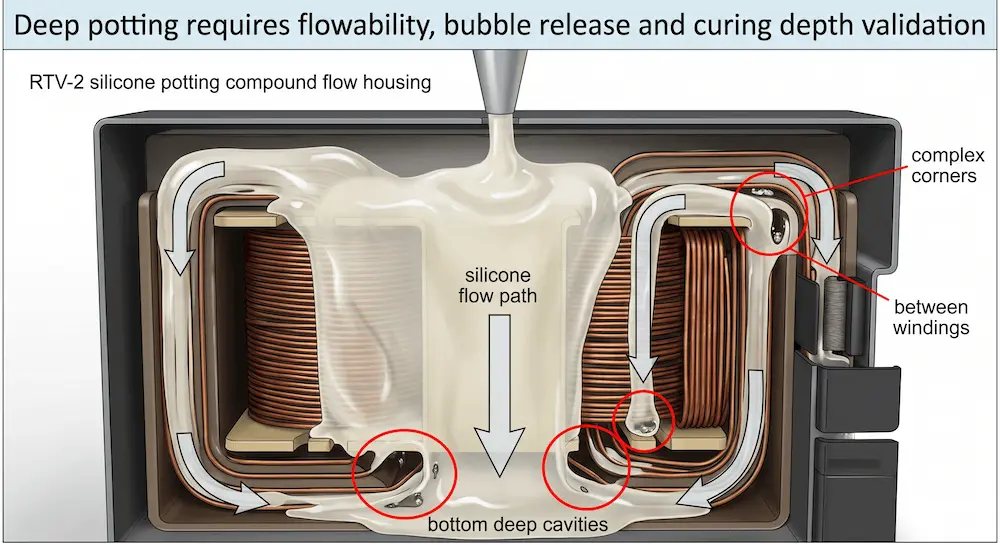
Deep potting is common in transformers, encapsulated coils and some power modules. It is also where many hidden failures begin.
When potting depth is high or the internal structure is complex, the material must flow through narrow spaces, release trapped air and cure properly inside the structure.
Why Deep Potting Needs Extra Attention
Deep potting may create several challenges:
- air trapped at the bottom of the housing
- bubbles around winding layers
- incomplete filling around bobbin corners
- longer internal cure time
- poor heat transfer if voids remain
- stress caused by thick cured material
- surface curing that looks fine while internal defects remain
What to Check
Before approving a material for deep potting or transformer potting, buyers should check:
- viscosity and flow into deep areas
- bubble release around windings
- curing depth and curing time
- temperature rise after potting
- hardness and stress after curing
- adhesion after thermal cycling
- whether vacuum potting is required
Selection tip: For transformers and deep power modules, do not approve a material only by surface appearance. Internal filling and bubble control are more important.
Manual, Vacuum or Automatic Potting: Which Process Fits?
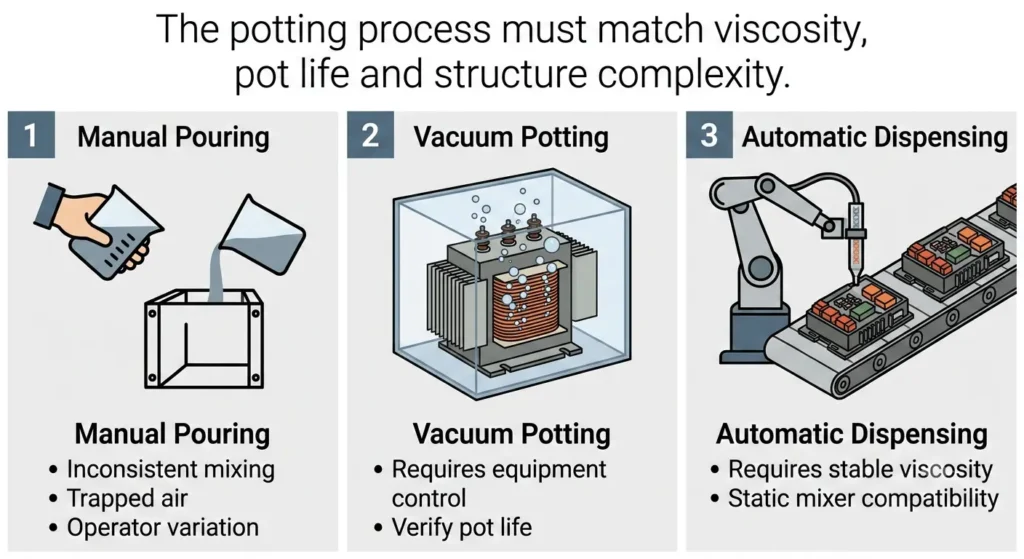
The potting process can be as important as the material itself.
A good RTV-2 silicone potting compound must match the way it will be used in production.
| Potting Process | Best For | Main Risk |
| Manual pouring | Small batch, simple housing, trial production | Inconsistent mixing, trapped air, operator variation |
| Vacuum potting | Transformers, coils, windings, deep cavities | Requires equipment and process control |
| Automatic dispensing | Mass production, stable product design | Requires stable viscosity, pot life and static mixer compatibility |
| Heat-accelerated curing | Faster production cycle | Must verify pot life, cure schedule and final properties |
For transformers with windings and deep gaps, vacuum potting may help reduce trapped air. For power supplies in mass production, automatic dispensing may improve consistency, but the material must match the equipment.
Before mass production, test the silicone under the actual potting process, not only by manual lab mixing.
For a broader electronic potting framework, read our guide on how to choose silicone potting compound for electronics.
6 Selection Factors for Real Approval
1. Dielectric Strength After Aging
Power supplies and transformers operate under voltage. The potting material must provide reliable insulation not only after curing, but also after aging.
Buyers should check:
- dielectric strength
- volume resistivity
- operating voltage
- insulation distance
- insulation after humidity aging
- insulation after thermal cycling
- effect of bubbles or voids on dielectric reliability
Selection tip: Initial dielectric data is not enough. For electrical products, insulation after aging is more important.
2. Viscosity and Bubble Release
Coils, windings and narrow cavities can easily trap air. If the silicone is too thick, it may not penetrate narrow gaps or fill complex geometry.
Buyers should check:
- viscosity before and after mixing
- flow into the real structure
- bubble release after dispensing
- vacuum degassing requirement
- potting depth and filling time
- suitability for manual, vacuum or automatic potting
Selection tip: For transformer potting, internal bubble control is more important than surface appearance.
3. Thermal Path and Temperature Rise
Power supplies and transformers generate heat during operation. Potting silicone can support heat transfer only when it forms a complete thermal path.
Common heat sources include:
- transformer windings
- MOSFETs
- rectifiers
- coils
- resistors
- power modules
If the silicone cannot fully contact the heat source or housing, or if air gaps remain, real heat transfer may be poor.
Buyers should check:
- main heat source
- potting depth
- housing material
- contact area with heat-dissipation structure
- temperature rise before and after potting
- thermal conductivity requirement
- bubble control around hot components
Buyer note: A higher thermal conductivity value may not help if voids remain inside the structure.
4. Hardness and Low Stress
Cured hardness affects both support and stress.
A harder material may provide stronger mechanical support, but it may also stress wire leads, solder joints and components during thermal expansion and contraction.
Softer silicone may help with:
- vibration damping
- stress relief around wires
- protection for solder joints
- flexibility during thermal cycling
- lower risk of cracking or separation
Selection tip: For transformers and power electronics, flexibility can be part of long-term protection.
5. Flame Retardancy and Safety Requirements
Power supplies and transformers may require flame-retardant potting materials depending on the final product standard, market requirement or customer specification.
If UL94 V-0 or another flame-retardant performance is required, buyers should ask for actual test data. The tested thickness and test condition should also be confirmed.
Before selecting a grade, clarify:
- whether flame retardancy is required
- which test level is needed
- whether test data is available
- whether the tested thickness matches the application
- whether flame retardancy affects viscosity, hardness or cost
Buyer note: For safety-related requirements, do not rely only on verbal claims. Ask for real test data before approval.
IEC 61558 safety requirements for transformers and power supply units
6. Pot Life, Cure Time and Production Stability
A material may perform well in a lab test but fail in mass production if pot life, viscosity, mixing ratio or curing speed does not match the line.
For production approval, buyers should confirm:
- mixing ratio, such as 1:1 or other ratio
- manual, vacuum or automatic potting process
- static mixer compatibility
- dispensing pressure
- pot life
- cure time before handling
- room temperature cure or heat-accelerated cure
- deep potting cure behavior
- batch-to-batch stability
Selection tip: The right RTV-2 silicone potting compound must fit both the product structure and the production process.
Common Failures and How to Reduce the Risk
| Failure or Problem | Possible Cause | How to Reduce the Risk |
| Bubbles around windings | High viscosity, poor degassing, complex coil geometry | Use suitable viscosity, consider vacuum potting and test real structure |
| Poor dielectric performance | Voids, moisture, incomplete curing, contamination | Test insulation after humidity aging and check filling quality |
| High temperature after potting | Poor thermal path, trapped air, wrong thermal grade | Test temperature rise and improve contact with housing |
| Cracking or separation | Material too hard, poor adhesion, thermal expansion mismatch | Use low-stress silicone and test after thermal cycling |
| Transformer noise remains | Poor filling, insufficient damping, unsuitable hardness | Check full filling around coils and evaluate cured hardness |
| Slow production | Cure time too long, pot life not suitable | Match pot life and cure schedule with production speed |
| Automatic dispensing instability | Viscosity mismatch, short pot life, poor static mixer compatibility | Test with actual dispensing equipment before approval |
| Sample passes but mass production fails | Lab test not representative | Validate material in real structure and production process |
A material that cures well in a small cup may still fail inside a real power supply or transformer. Testing must reflect the real structure, electrical requirement and production method.
Testing Checklist Before Approval
Before approving RTV-2 silicone potting compound for power supplies or transformers, testing should simulate the real product and process as closely as possible.
Recommended test items include:
- A/B mixing accuracy
- viscosity and flow into real structure
- bubble release around coils and windings
- curing depth and cure time
- hardness after curing
- dielectric strength
- volume resistivity
- insulation resistance after humidity aging
- temperature rise before and after potting
- thermal cycling
- vibration test
- transformer noise evaluation, if required
- flame retardancy, if required
- adhesion to housing and components
- automatic dispensing stability
- batch-to-batch consistency
The goal is not only to confirm that the silicone cures. The goal is to confirm that the material protects the product under real electrical, thermal and production conditions.
What Information Should You Send Before Asking for a Sample?
A supplier cannot recommend the right RTV-2 silicone potting compound based only on the sentence “We need silicone for power supply potting” or “We need silicone for transformer potting.”
Before requesting a quotation or sample, prepare the following details:
- Application: power supply, transformer, adapter, charger, inverter, control module, etc.
- Rated voltage and current
- Product size and potting depth
- Transformer, coil or winding structure
- Housing material
- Main heat source
- Required thermal conductivity, if specified
- Required dielectric strength
- Required hardness after curing
- Required viscosity or flowability
- Flame-retardant requirement
- Potting process: manual, vacuum or automatic dispensing
- Pot life and cure time target
- Operating temperature range
- Current material problem: bubbles, high temperature, poor cure, insulation failure, cracking, noise, etc.
- Estimated monthly or annual usage
The more clearly you describe the structure and testing requirements, the easier it is to recommend a practical grade for evaluation.
Topsil Practical Recommendation
As a 15+ years RTV-2 silicone manufacturer, Topsil usually suggests power supply and transformer buyers evaluate potting silicone from three angles:
Insulation risk: voltage, humidity exposure, insulation distance and aging requirements.
Structure filling: coils, windings, wires, solder joints, power components, narrow gaps and deep cavities.
Production process: manual pouring, vacuum potting, automatic dispensing, pot life, curing speed and mixing ratio.
For power supply and transformer applications, Topsil does not suggest selecting a material only by hardness, thermal conductivity or price. The right RTV-2 silicone potting compound should reduce hidden risks inside the structure, including bubbles around windings, insulation failure after aging, heat build-up, vibration, thermal cycling stress and mass production instability.
Not sure whether your power supply or transformer needs low-viscosity, thermally conductive, flame-retardant or low-hardness RTV-2 silicone?
Send us your voltage, winding structure, potting depth, heat source, target hardness, viscosity requirement and production method. Topsil can help recommend a practical RTV-2 silicone potting compound for testing.