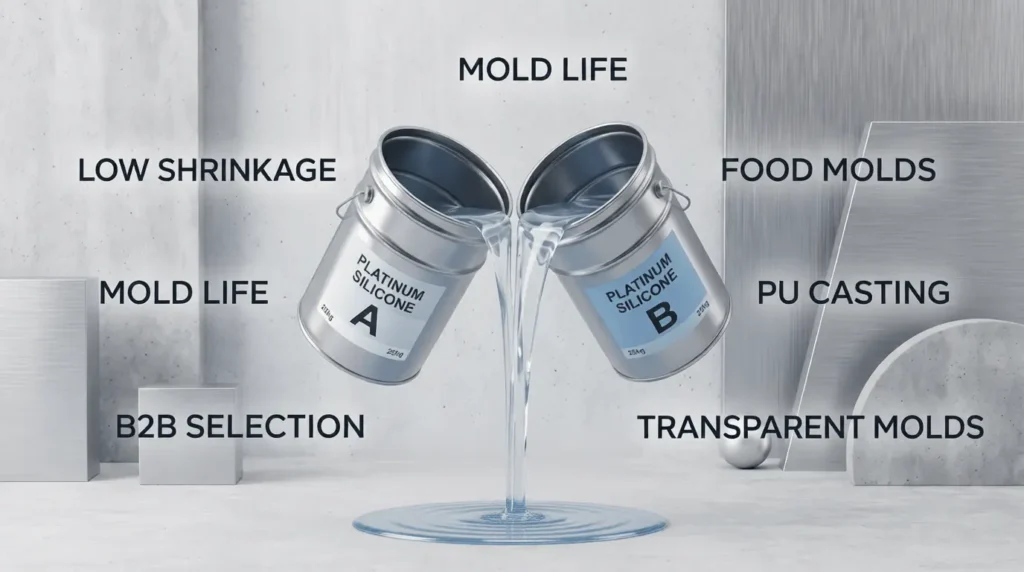

Many B2B buyers do not choose platinum cured silicone simply because it is “better.”
They choose it because mold failure, shrinkage, rejected castings, poor dimensional repeatability or food-contact risk can cost more than the silicone price difference.
Platinum cured silicone is usually more expensive than tin cured silicone. But in the right application, it can reduce production risk by offering low shrinkage, better dimensional stability, clean detail reproduction and longer mold life.
The key question is not:
“Is platinum cured silicone the best silicone?”
The better question is:
“Does my application need the performance advantages of platinum cured silicone, or would tin cured silicone be more economical?”
This guide is written for B2B buyers, mold makers, resin casting workshops, PU casting factories, food mold buyers, distributors and industrial silicone users who need a practical overview before choosing a silicone grade or supplier.
Quick Answer: What Is Platinum Cured Silicone?
Platinum cured silicone is a two-component RTV-2 silicone rubber that uses a platinum-catalyzed addition cure system. It is commonly used for mold making, resin casting, polyurethane casting, food molds, transparent cut molds and prototyping when buyers need low shrinkage, good dimensional stability, fine detail reproduction and reliable mold life.
It is usually supplied as Part A and Part B. After mixing at the correct ratio, the material cures into a flexible silicone rubber at room temperature or under controlled heating, depending on the formulation.
B2B buyers usually choose platinum cured silicone when they need:
- Lower shrinkage
- Better dimensional stability
- Longer mold life
- Cleaner detail reproduction
- Good tear resistance
- Food-contact potential
- Transparent or translucent mold options
- More consistent repeated casting performance
However, platinum cured silicone is not always necessary. For simple, low-cost and short-run molds, tin cured silicone may be the smarter choice.
3-Second Decision: Choose Platinum or Tin?
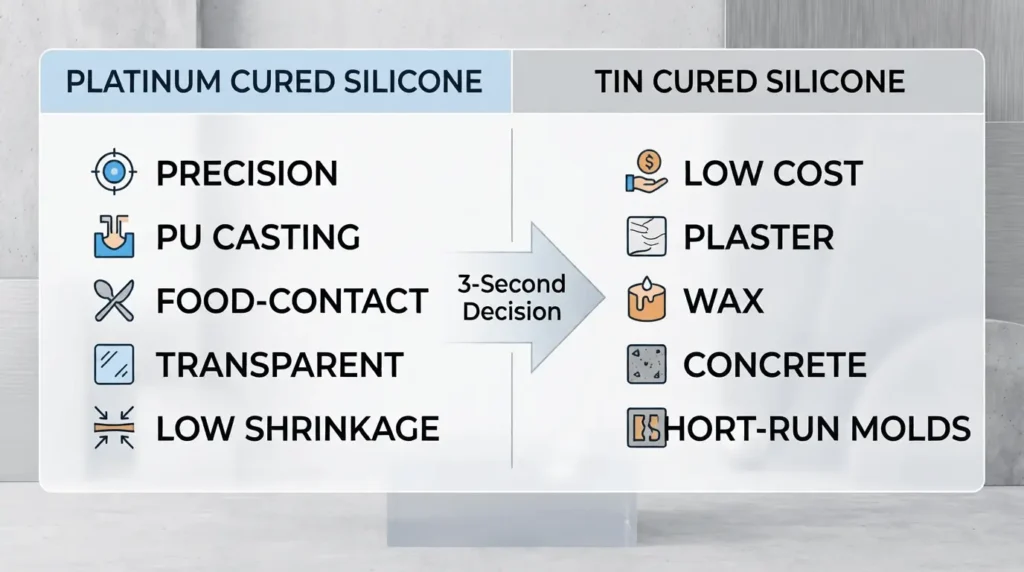
| Choose Platinum Cured Silicone When… | Choose Tin Cured Silicone When… |
| Low shrinkage matters | Lowest upfront cost matters |
| The mold must produce many accepted castings | Only a few castings are needed |
| PU casting or rapid prototyping is involved | Plaster, wax or simple decorative molds are used |
| Food-contact documents are required | No food-contact requirement exists |
| Transparent cut molds are needed | Transparency is not needed |
| Dimensional stability is important | Slight shrinkage is acceptable |
| Rejected parts are expensive | Failed parts are low-cost |
| Stable repeat production matters | The project is short-run and price-sensitive |
In simple terms:
Platinum cured silicone is not always the cheapest material per kg, but it can be the lower-risk material when mold failure or rejected castings are expensive.
How Platinum Cured Silicone Works
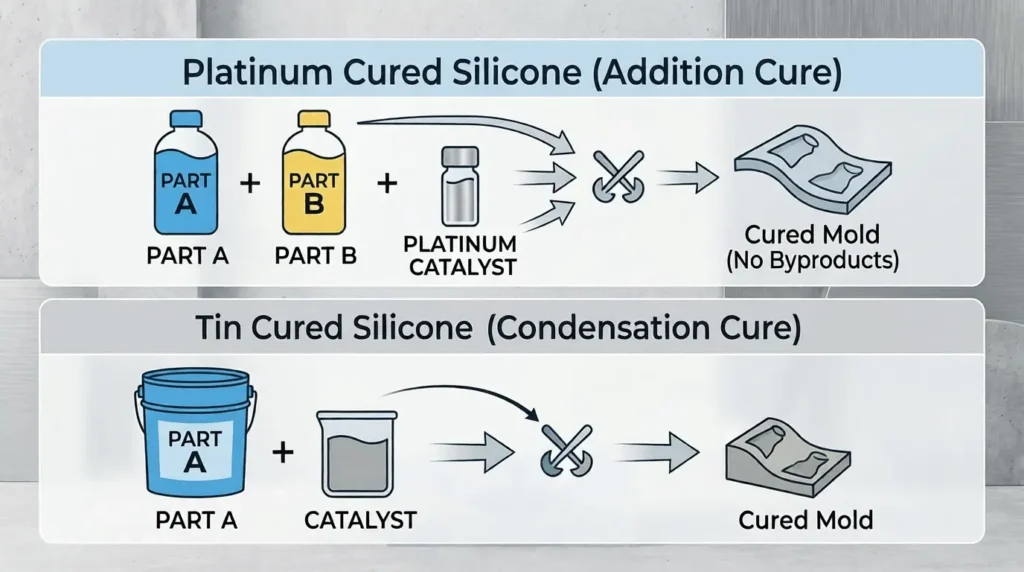
Platinum cured silicone is also called addition cure silicone. The curing reaction is activated by a platinum catalyst after Part A and Part B are mixed.
Most buyers do not need to understand the full chemistry. What matters is how the cure system affects production.
Typical features include:
- Two-component RTV-2 silicone system
- Common mixing ratios such as 1:1 or 10:1
- Room-temperature curing in many formulations
- Low shrinkage after curing
- Good dimensional stability
- Flexible Shore A hardness options
- Transparent or translucent grades available
- Better mold life in many demanding applications
Silicone rubber can be cured through different systems, including platinum-catalyzed and condensation cure systems. A general technical overview is available on Wikipedia’s silicone rubber page.
In production terms, platinum cured silicone is designed for applications where stability, accuracy and repeatability matter more than the lowest initial material price.
Platinum Cured vs. Tin Cured Silicone: Key Differences
Platinum cured silicone and tin cured silicone are both widely used for RTV-2 silicone mold making. The right choice depends on application, budget and production risk.
| Factor | Platinum Cured Silicone | Tin Cured Silicone |
| Cure system | Addition cure / platinum catalyst | Condensation cure / tin catalyst |
| Upfront price | Usually higher | Usually lower |
| Shrinkage | Usually lower | Usually higher over time |
| Mold life | Better in demanding applications | Good for general short-run molds |
| Cure inhibition | More sensitive | Usually less sensitive |
| Food-contact potential | More common in food-contact systems | Usually limited |
| Transparency | Transparent grades available | Usually translucent or opaque |
| Best-fit applications | PU casting, food molds, precision molds, transparent molds | Plaster, wax, concrete, simple resin crafts |
Tin cured silicone is not a low-quality material. It is often the right choice for general mold making, plaster, wax, concrete and short-run resin crafts.
Platinum cured silicone becomes more valuable when the application requires low shrinkage, accurate details, stable dimensions, repeated production or lower risk of mold failure.
For a deeper cost comparison, buyers should evaluate mold life and cost per accepted casting, not only price per kilogram.
Main Advantages of Platinum Cured Silicone
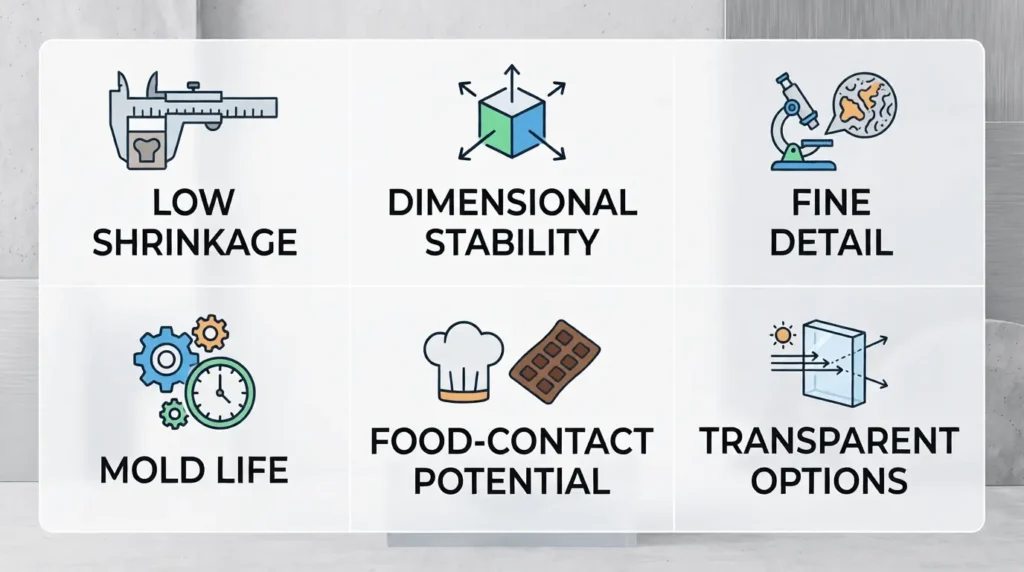
- Low Shrinkage
Low shrinkage is one of the most important reasons B2B buyers choose platinum cured silicone rubber.
For decorative crafts, slight shrinkage may not matter. But for PU prototypes, assembly parts, high-detail resin molds or industrial components, even small dimensional changes can cause problems.
Low shrinkage helps maintain:
- Part dimensions
- Surface detail
- Wall thickness
- Assembly fit
- Mold repeatability
- Customer acceptance
For precision casting, low shrinkage is not just a technical feature. It is a cost-control factor.
- Better Dimensional Stability
A silicone mold may still look usable but fail to produce accurate parts after repeated casting or storage.
Dimensional stability is important when:
- The casting must match a drawing
- The part must fit another component
- The mold will be used for repeat orders
- The buyer needs consistent production over time
- The prototype must be evaluated for functional fit
Platinum cured silicone is often preferred for applications where the mold must remain stable across multiple casting cycles.
Actual dimensional stability still depends on formulation, mold design, casting material, processing method and storage conditions.
- Fine Detail Reproduction
Platinum cured silicone can reproduce fine lines, textures, engravings and surface details when the correct grade is selected.
This makes it suitable for resin art molds, jewelry molds, figurine molds, sculpture reproduction, PU prototype molds, detailed food molds and high-detail industrial parts.
For detail reproduction, viscosity and processing method are also important. A silicone that is too thick may not flow well into fine details. A working time that is too short may not allow enough time for mixing, degassing and pouring.
- Longer Mold Life in Demanding Applications
Mold life is one of the key commercial reasons buyers consider platinum cured silicone.
A mold does not only fail when it breaks completely. It may lose value when it tears, deforms, shrinks, loses surface details or becomes difficult to demold.
Platinum cured silicone can provide longer mold life in many demanding applications, especially when the mold is used for PU casting, repeated resin casting, complex undercuts or precision parts.
However, no supplier should promise a fixed mold life without knowing the application. Actual mold life depends on silicone formulation, Shore A hardness, tear strength, elongation, casting material, part geometry, demolding method, release agent and storage conditions.
The better question is:
“How many accepted castings can this mold produce before it fails, deforms or loses accuracy?”
- Food-Contact Potential
Platinum cured silicone is commonly used in food-contact silicone systems for chocolate molds, candy molds, cake decoration molds, ice molds and bakery molds.
But this must be understood correctly:
Platinum cured silicone does not automatically mean food-grade silicone.
Platinum cure describes the curing system. Food-contact suitability depends on final formulation, cured sample testing, intended food type, contact temperature, contact time and supporting documents.
- Transparent and Translucent Options
Platinum cured silicone can be formulated as transparent or translucent silicone rubber.
Transparent platinum silicone is useful for cut molds, visual positioning, complex model separation, checking air traps, seeing the master model during cutting and precision mold-making processes.
The value of transparent silicone is not just appearance. It helps the operator control the mold-making process.
For many normal applications, translucent platinum silicone may be more cost-effective. Buyers should choose transparency only when it brings real processing value.
When Platinum Cured Silicone May Not Be Necessary
Platinum cured silicone is powerful, but it is not always required.
Tin cured silicone may be more suitable when:
- The mold is simple
- Only a few castings are needed
- The project is very price-sensitive
- The casting is plaster, wax, concrete or simple resin
- Slight shrinkage is acceptable
- Food-contact documents are not needed
- Transparent mold cutting is not required
- The workshop needs a very forgiving material for basic mold making
- The master model may cause platinum cure inhibition and the buyer does not want sealing or compatibility testing
This is important for B2B buyers.
A reliable supplier should not recommend platinum cured silicone by default. The best grade is the one that matches the application, not the one with the highest price.
Common B2B Applications and Buyer Notes
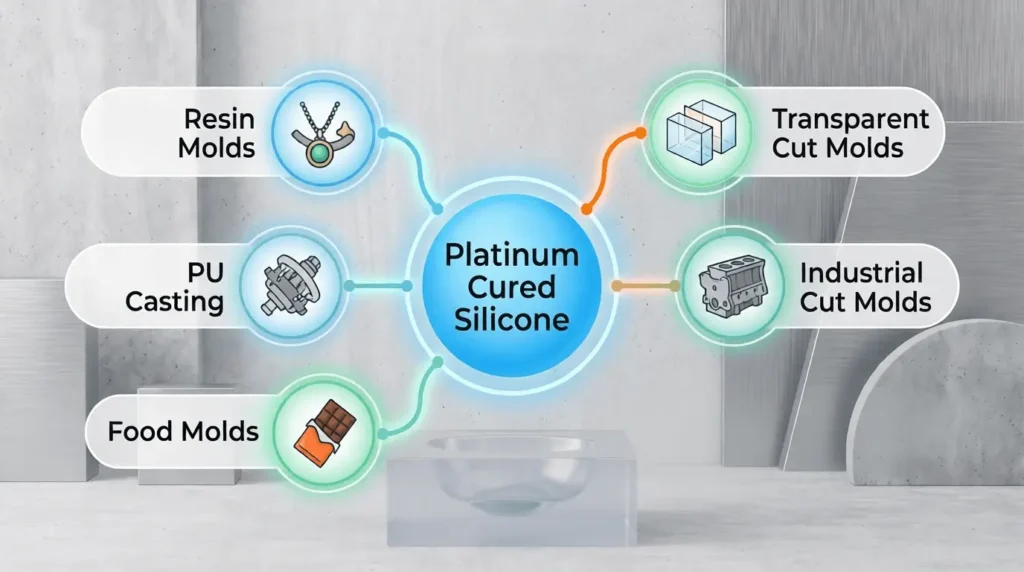
| Application | When Platinum Cured Silicone Makes Sense | Buyer Notes |
| Resin mold making | High-value epoxy parts, deep undercuts, fine textures or repeated casting | Focus on Shore A hardness, tear strength, viscosity and actual resin compatibility |
| PU casting and rapid prototyping | Precision prototypes, functional parts, repeated casting or tight dimensional requirements | Prioritize low shrinkage, tear strength, dimensional stability and cost per accepted casting |
| Food molds | Chocolate, candy, cake decoration, ice, sugar craft or bakery molds requiring food-contact documents | Confirm food type, temperature, contact time and applicable documents |
| Transparent cut molds | Complex masters, cut molds, multi-part molds or precision positioning | Choose transparency only when visual control improves the process |
| Industrial mold making | High-value parts, repeated production, long-term mold storage or customer tolerance requirements | Define accepted casting criteria before testing |
| Distributor / private label markets | Higher-value product line for mold makers, resin users or food mold customers | Check supply stability, TDS/SDS/COA, OEM packaging and technical support |
Related application pages:
- Silicone Rubber for Resin Mold Making
- Silicone for Rapid Prototyping
- Food Grade Silicone for Mold Making
- Transparent Platinum Cure Silicone
How to Choose the Right Platinum Cured Silicone
Choosing platinum cured silicone is not only about asking for a price.
B2B buyers should match the material to the actual production process.
| Selection Factor | Why It Matters | Common Buyer Mistake |
| Shore A hardness | Controls flexibility, support and demolding | Assuming harder always means more durable |
| Viscosity | Affects flow, bubble release and detail filling | Choosing low viscosity without considering mold structure |
| Working time | Determines mixing, degassing and pouring window | Choosing fast cure for a large mold |
| Demold time | Affects production speed | Ignoring whether full strength is reached |
| Tear strength | Important for undercuts and repeated demolding | Looking only at hardness |
| Elongation | Helps molds survive stretching | Ignoring complex demolding stress |
| Shrinkage | Critical for precision parts | Testing only appearance, not dimensions |
| Color / transparency | Important for cut molds and visual control | Paying for transparency when not needed |
| Food-contact documents | Required for food mold projects | Assuming platinum equals food grade |
| Cure inhibition compatibility | Important for 3D prints, clays and coatings | Skipping compatibility tests |
This table is often more useful than a simple product list.
The right silicone grade depends on how these parameters work together in the buyer’s process.
Simple Shore A Selection Guide
Shore A hardness is one of the first parameters buyers ask about. But hardness should be selected based on part geometry, demolding difficulty and support requirements.
| Shore A Range | Typical Use | Buyer Notes |
| 10A–15A | Very flexible molds, complex undercuts, delicate parts | Easy demolding but less structural support |
| 20A–25A | General resin molds, craft molds, food molds, small to medium parts | Common starting range for many mold-making applications |
| 30A–35A | Larger molds, PU casting, molds needing more support | Better shape stability but less flexible for deep undercuts |
| 40A+ | Simple shapes, large molds, applications needing strong support | May tear earlier in complex undercuts if too rigid |
Harder silicone is not always more durable. In deep undercuts, a harder silicone may tear earlier because it cannot flex enough during demolding.
Softer silicone is not always better either. If the mold is large or needs dimensional support, a very soft grade may deform.
How to Read a Platinum Silicone TDS
A technical data sheet should not be read as isolated numbers. The correct grade depends on how the parameters work together in production.
Mix Ratio
Common ratios include 1:1 and 10:1. A 1:1 ratio is often easier for manual mixing and cartridge systems. A 10:1 ratio may be used in some industrial formulations.
Viscosity
Low viscosity helps flow into fine details and can help bubbles release more easily. But lower viscosity does not automatically mean better mold life. The buyer still needs the right tear strength, hardness and working time.
Working Time
A fast cure silicone is not always better. If the mold is large or requires vacuum degassing, too short a working time can cause bubbles, incomplete filling or processing stress.
Demold Time
Short demold time improves production speed, but buyers should check whether the mold reaches sufficient strength before use.
Tear Strength and Elongation
These parameters matter when the mold has undercuts, thin sections or repeated stretching during demolding. They should be reviewed together with hardness, not separately.
Shrinkage
Shrinkage is critical for PU casting, prototypes and functional parts. For precision applications, buyers should measure actual casting dimensions during testing.
Shelf Life
Shelf life matters for distributors and workshops that keep inventory. Storage conditions also affect material performance.
A good supplier should help buyers interpret the TDS based on the application, not simply send a document without guidance.
Is Platinum Cured Silicone Food Grade?
No. Platinum cured silicone is not automatically food grade.
This is one of the most common misunderstandings among buyers.
Platinum cure describes the curing system. Food-contact suitability depends on final formulation, cured sample testing, intended food type, contact temperature, contact time and supporting documents.
Food-contact compliance is application-specific. A material that passes one test condition may not automatically be suitable for every food type, temperature or contact time.
Before choosing silicone for food molds, buyers should confirm:
- What food will contact the silicone?
- Is the food dry, water-based or oil-based?
- What is the contact temperature?
- How long is the contact time?
- Is repeated use required?
- Which market is the product sold into?
- What documents are required?
- Does the test report apply to the cured silicone material?
For U.S. food-contact applications, repeated-use rubber articles are addressed under FDA 21 CFR 177.2600. For EU markets, Regulation (EC) No 1935/2004 provides the general framework for materials and articles intended to come into contact with food.
For food mold projects, the safest approach is to discuss the final application before choosing a grade.
How to Test Platinum Cured Silicone Before Bulk Purchase
Before bulk purchasing platinum cured silicone, buyers should test it under real production conditions.
A practical testing process includes:
- Confirm the casting material and master model.
- Select one or two suitable hardness options.
- Test cure compatibility on the master surface.
- Make a small mold before making a full-size mold.
- Record room temperature, mixing ratio and working time.
- Check bubble release and flow into details.
- Record demold time and demolding difficulty.
- Produce several castings and inspect the mold after each cycle.
- Check tearing, deformation, surface detail and shrinkage.
- Compare accepted casting output, not just initial mold appearance.
For B2B buyers, the best material is not always the one that looks good after the first mold. It is the one that produces accepted castings consistently.
How to Choose a Platinum Cured Silicone Manufacturer
For B2B buyers, choosing the right manufacturer is as important as choosing the right silicone grade.
| Supplier Factor | Why It Matters | Buyer Question |
| Stable batch quality | Avoids inconsistent curing and hardness | Can you provide COA by batch? |
| Wide grade range | Supports different applications | Do you offer different Shore A hardness options? |
| Platinum and tin systems | Helps buyers choose by application, not price only | Do you supply both platinum and tin cured silicone? |
| Technical support | Reduces trial failure | Can you recommend a grade based on my application? |
| TDS / SDS / COA | Supports purchasing, safety and quality review | Can you provide complete documents? |
| Food-contact support | Needed for food mold buyers | Which documents apply to cured material? |
| Customization | Helps special processes | Can viscosity, working time or color be adjusted? |
| OEM / private label | Important for distributors | Can you support custom packaging? |
| Sample support | Enables real production testing | Can you provide samples for evaluation? |
| Communication | Reduces project delay | Do you ask application questions before quoting? |
Buyers should be cautious if a supplier only quotes the lowest price without asking about the application.
A professional supplier should ask about casting material, part size, mold structure, expected mold life, working time and performance requirements before recommending a grade.
How Topsil Supports Platinum Cured Silicone Buyers
Topsil is a 15-year RTV-2 silicone manufacturer supplying platinum cured and tin cured silicone rubber for mold making, resin casting, food molds, polyurethane casting, rapid prototyping and industrial applications.
Topsil helps buyers choose between platinum and tin cured silicone based on application risk, processing method and expected mold life — not simply based on which product has the higher price.
For simple, short-run and low-cost molds, tin cured silicone may be the better choice. For precision molds, food-contact molds, transparent cut molds, PU casting or repeated production, platinum cured silicone may reduce risk and improve mold performance.
For replacement projects, buyers can send their current TDS, target hardness, working time, casting material and expected mold life. Topsil can recommend a comparable grade for testing.
Related product: Platinum Cured Silicone Rubber For application support: RTV-2 Silicone Technical Support
What to Send Before Asking for a Sample
To get an accurate recommendation, buyers should provide:
- Casting material
- Part size
- Mold structure
- Undercuts or thin sections
- Target Shore A hardness
- Current silicone TDS if replacing a material
- Required working time
- Required demold time
- Expected castings per mold
- Whether vacuum degassing is used
- Whether food-contact documents are required
- Main problem with the current silicone
Examples:
- “We cast PU prototype parts and need 50–80 castings per mold.”
- “Our current silicone tears at deep undercuts.”
- “We need lower shrinkage for precision assembly parts.”
- “We need transparent silicone for cut molds.”
- “We need food-contact silicone for chocolate molds.”
- “We want to replace our current silicone but keep similar hardness and working time.”
The more specific the application, the more accurate the recommendation.
the application, the more accurate the recommendation.
Conclusion
Platinum cured silicone is a high-performance RTV-2 silicone system used when buyers need low shrinkage, dimensional stability, fine detail reproduction, food-contact potential, transparent mold options or longer mold life.
But it is not always the right answer for every project.
Tin cured silicone may be more economical for general-purpose, short-run and low-cost molds. Platinum cured silicone is usually worth evaluating when mold failure, shrinkage, rejected parts or inconsistent production would cost more than the material price difference.
For B2B buyers, the best silicone is not simply the cheapest per kilogram.
The best silicone is the one that produces stable, accepted parts under real production conditions.
Before sampling, prepare your casting material, part size, mold design, target Shore A hardness, working time, demold time and expected casting cycles. This allows your supplier to recommend a more accurate platinum cured silicone grade for testing.