
Quick Answer
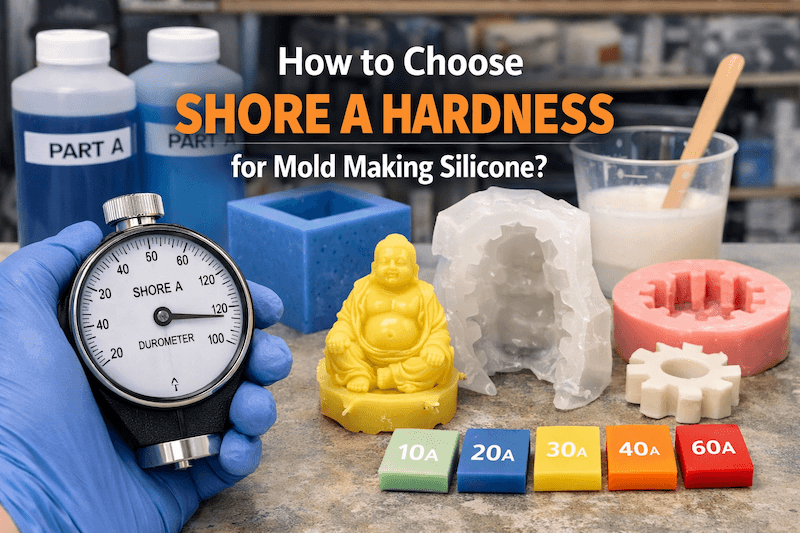
The right Shore A hardness for mold-making silicone depends on mold geometry, demolding stress, part size, and how much flexibility or shape retention the mold needs. Softer silicone usually helps with undercuts and difficult release. Firmer silicone usually helps with larger molds and better structural support. Buyers should not choose hardness alone without also checking tear strength, viscosity, and actual mold use.
In This Guide
Most Buyers Use Hardness the Wrong Way
When buyers compare silicone, Shore A hardness is often the first number they ask for.
That is normal. It is easy to compare, easy to quote, and easy to misunderstand.
The problem is that many buyers treat hardness like a universal answer:
- soft = better
- hard = stronger
That logic fails in real mold making.
Because hardness is not just about feeling.
It is about how the mold behaves when:
- It is poured,
- it holds its shape,
- it flexes,
- and it survives demolding.
Quick Selection Logic
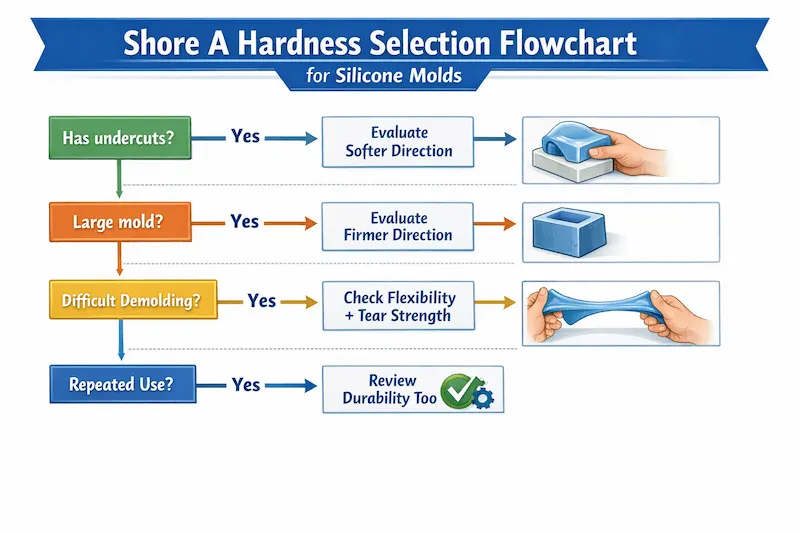
Softer silicone usually makes more sense when:
- The mold has deep undercuts
- The part is hard to release
- Flexibility matters more than body
- The mold is small or detail-sensitive
- Demolding stress is more about bending than structure
Firmer silicone usually makes more sense when:
- The mold is larger
- The mold needs more body
- Shape retention matters
- The geometry is open and not too difficult to release
- The mold should feel more self-supporting
Hardness should be reviewed carefully when:
- The mold is both detailed and difficult to demold
- The mold is large but includes thin, fragile areas
- The buyer expects repeated use and longer mold life
The Real Function of Shore A Hardness
Shore A hardness affects four practical things:
1.1 Flexibility
Softer materials flex more easily, which may help release difficult shapes.
1.2 Shape Retention
Firmer materials hold shape better, especially in larger molds.
1.3 Demolding Feel
The right hardness can make the release smoother and reduce unnecessary stress.
1.4 Mold Handling
Some molds need more bodies to stay practical during pouring, support, and production use.
That is why hardness should always be judged in the context of actual mold behavior, not just the number itself.
Need a Faster Hardness Starting Point?
Tell us your mold size, undercut level, and casting material. We’ll help you decide whether to start softer, firmer, or compare both directions.
When Softer Silicone Makes More Sense?
Softer silicone usually works better when the mold has to flex during demolding.
This is common in:
- jewelry molds
- figurine molds
- molds with narrow openings
- molds with undercuts
- molds where the cast part needs a more gentle release
A more flexible mold can reduce damage during demolding.
But here is the mistake buyers make:
They assume that if a mold is detailed, it must always use soft silicone.
That is not always true. A highly detailed mold that is also thin, large, or heavily stressed may still fail if softness is chosen without enough tear strength or support.
When Firmer Silicone Makes More Sense?
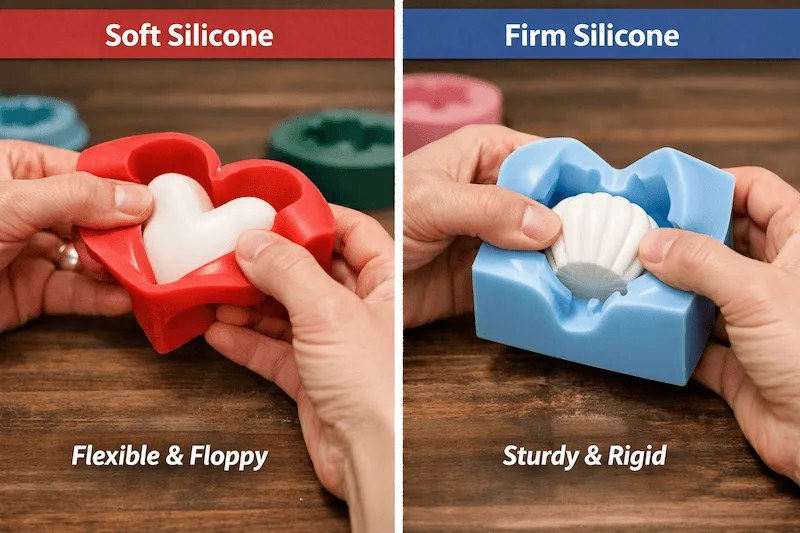
Firmer silicone usually works better when the mold needs more structure.
This is common in:
- larger molds
- certain architectural molds
- molds with a broad surface area
- molds that need more body during handling
- molds where shape retention matters more than deep flex
In these cases, a mold that is too soft may:
- collapse,
- distort,
- feel unstable,
- or become harder to use in practice.
But again, harder is not always better.
A firmer mold that has difficult undercuts may create stronger release stress and increase tearing risk if the geometry is not suited to it.
The Real Priority: Mold Geometry
The biggest factor is not the number on the TDS.
It is the shape of the mold.
Ask:
- Does the mold have undercuts?
- Will the mold stretch during demolding?
- Is the mold large or small?
- Does it need to support itself?
- Does it have thin edges or fragile sections?
- Will it be used once or many times?
These questions matter more than asking for “20A” or “30A” as a generic preference.
A large simple mold and a small complex mold should not be chosen the same way.
Demolding Stress Is the Real Test
The true test of hardness is not how the silicone feels before use.
It is what happens during release.
A mold may seem fine in the hand and still be the wrong hardness for the part.
That becomes obvious only when the cast part is pulled out and stress concentrates at:
- corners,
- thin edges,
- narrow necks,
- or locked sections.
That is why experienced mold makers choose hardness based on release behavior, not just material feel.
Hardness Does Not Work Alone
This is one of the most important things buyers miss.
A silicone can have the right hardness and still be the wrong product.
Because hardness only works properly when the rest of the formula also fits:
- tear strength
- viscosity
- cure speed
- and mold design
For example:
- A soft silicone with weak tear resistance may fail quickly
- A firmer silicone with unsuitable viscosity may still cause pouring problems
- The right hardness with the wrong mold structure can still create poor results
That is why hardness should guide selection, but not replace full evaluation.
Need Help Choosing Shore A Hardness?
Send us your mold type, size, undercut level, and demolding difficulty. We can help you shortlist a more practical RTV-2 silicone option.
Quick Application Scenarios
For jewelry and fine resin molds
Start by prioritizing flexibility and detail-friendly behavior, then confirm tear strength.
For figurines and complex art molds
Start by evaluating demolding stress first, then choose a hardness that balances flexibility and durability.
For concrete or stone molds
Start by evaluating mold size, structural body, and repeated demolding stress. Hardness should support durability, not just softness.
For prototype molds
Start by balancing shape retention, detail transfer, and practical release behavior.
The Most Common Hardness Mistakes
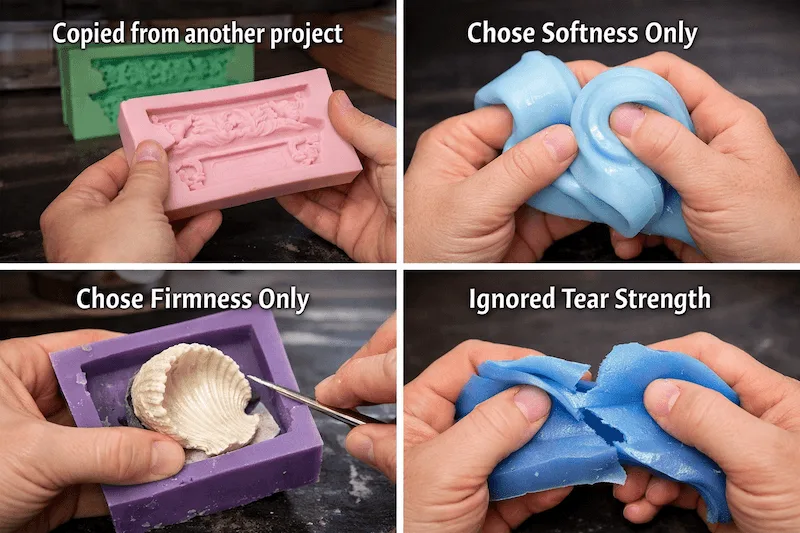
Mistake 1: Copying a hardness from someone else’s project
Different mold geometry changes everything.
Mistake 2: Choosing softness without thinking about mold support
This often leads to unstable molds.
Mistake 3: Choosing firmness without thinking about releasing stress
This often leads to harder demolding and edge damage.
Mistake 4: Treating hardness as the only important number
This causes poor decisions when tear strength or viscosity is the real issue.
FAQ
RECOMMENDED NEXT STEP
Choosing the right silicone involves more than just hardness or cure system.
Send us your application details, and we’ll map out the exact grade for your testing.
Compare RTV-2 Silicone Grades