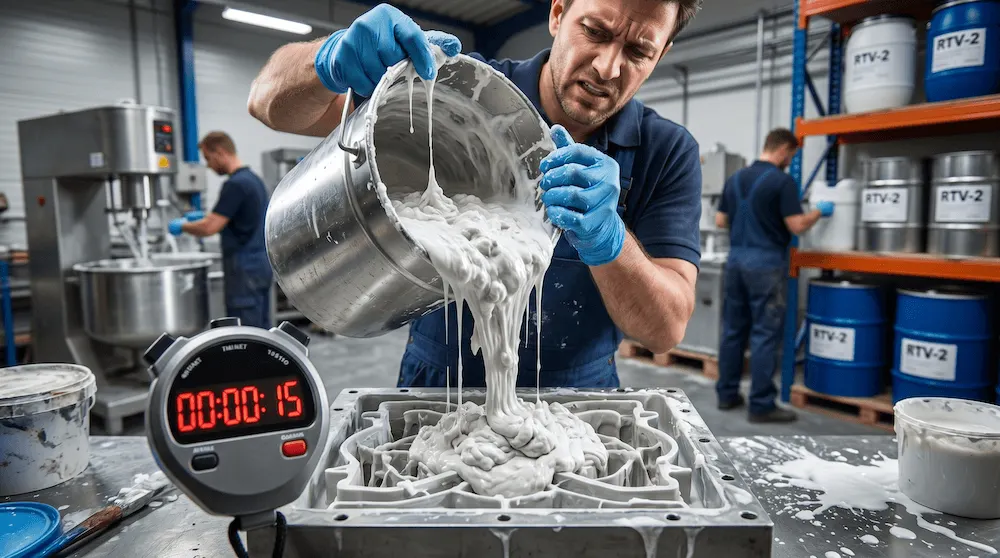

Senin RTV-2 silikon starts thickening before pouring is finished.
Vacuum degassing is not completed before the silicone begins to gel.
Large molds cannot be filled smoothly.
Fine details are not fully copied because the silicone stops flowing too early.
Operators rush the mixing process and the final mold quality becomes unstable.
If this happens, the problem is not always “bad silicone”. Very often, the pot life is too short for your real production process.
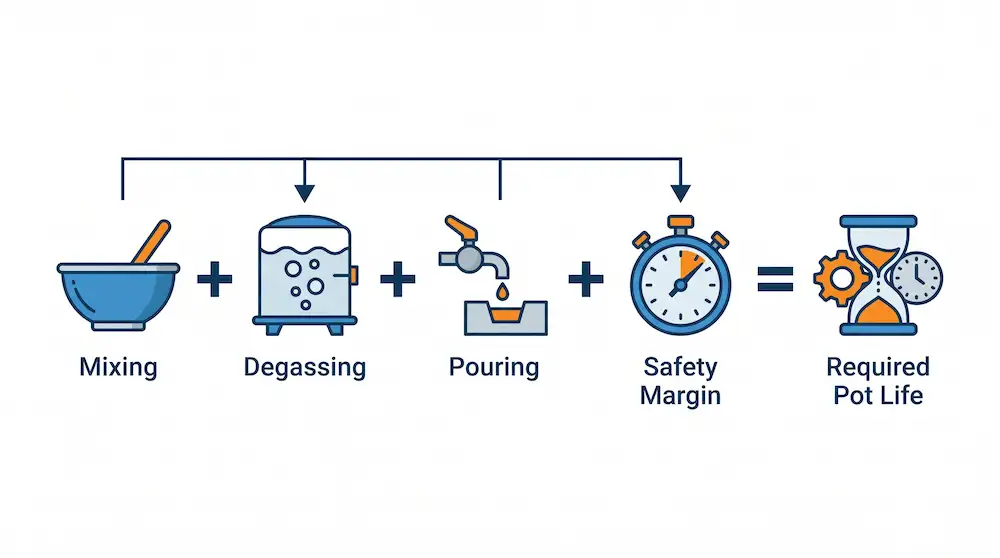
Pot life is not just a number in the TDS. It must match your actual working steps:
mixing time + vacuum degassing time + pouring or brushing time + leveling/detail flow time + safety margin
Fast curing is useful only after the silicone gives you enough working time. If the material gels before your process is finished, faster curing will only create bubbles, flow marks, waste and unstable mold quality.
This guide helps you choose the right RTV-2 silicone working time based on your real application.
Quick Answer: How Much Pot Life Do You Really Need?
The best pot life is not the fastest one.
The best pot life is the one that allows your team to finish the whole process before the silicone becomes too thick.
| Your Process | Suggested Pot Life | Why |
| Small simple mold, no vacuum | 10–20 min | Short operation time, simple structure |
| Candle, soap or craft molds | 15–30 min | Enough time for weighing, mixing and pouring |
| Small detailed resin molds | 20–40 min | Better flow into fine details |
| Vacuum degassing required | 30–45 min | Degassing uses part of the working time |
| Large concrete or gypsum molds | 30–60 min | Larger volume needs slower and more stable operation |
| Brush-on mold making | 30–60 min | Brushing and layering need longer workable time |
| Deep molds with undercuts | 30–45 min | More time for flow, leveling and air release |
| Elektronik çömlekleme | 20–60 min or adjustable | Depends on filling size and production line |
| Distributor general-purpose grade | 20–30 min | Easier for most end users to handle |
The Real Formula: Required Pot Life
Before asking for “slower silicone”, calculate your real process time first.
| Production Step | Example Time |
| Weighing and mixing | 3 min |
| Vacuum degassing | 6 min |
| Dökme | 8 min |
| Leveling and detail flow | 5 min |
| Safety margin | 5–10 min |
| Recommended pot life | 30 min or more |
Required Pot Life ≥ Mixing Time + Degassing Time + Pouring / Brushing Time + Leveling Time + Safety Margin
For example, if your vacuum degassing takes 6 minutes and pouring takes 8 minutes, a 10-minute pot life is usually not safe. Even if the silicone is technically still “workable”, it may already be too thick for smooth flow and bubble release.
What Happens When Pot Life Is Too Short?
A short pot life does not only make the silicone cure faster. It can directly affect mold quality and production stability.
| Production Problem | Neden Oluyor |
| Bubbles remain in the mold | Not enough time for vacuum degassing or slow pouring |
| Flow marks appear | Silicone starts thickening before leveling |
| Fine details are not copied well | Silicone loses flow too early |
| Mold surface is rough or uneven | Material gels before full surface wetting |
| Operators mix too quickly | Rushed operation traps more air |
| Local curing problems appear | Poor mixing caused by time pressure |
| Large mold is only partly filled smoothly | Pot life does not match mold size |
| Sample test is judged as “not good” | Working time does not match real process |
A silicone that works well for small molds may fail in large molds simply because the working time is not long enough.
Pot Life vs Cure Time: What Buyers Often Misunderstand
Many buyers say “I need fast cure”, but what they really need may be different.
| Buyer Request | What They May Actually Need |
| “I need fast cure.” | Shorter demold time, not necessarily shorter pot life |
| “The silicone cures too fast.” | Longer pot life, not slower final curing |
| “I need more time for vacuum.” | Longer pot life + suitable viscosity |
| “Production is too slow.” | Balanced pot life + acceptable demold time |
| “The mold surface has bubbles.” | Longer working time or lower viscosity |
| “The silicone is too thick before pouring.” | Longer pot life, lower viscosity or smaller mixing batch |
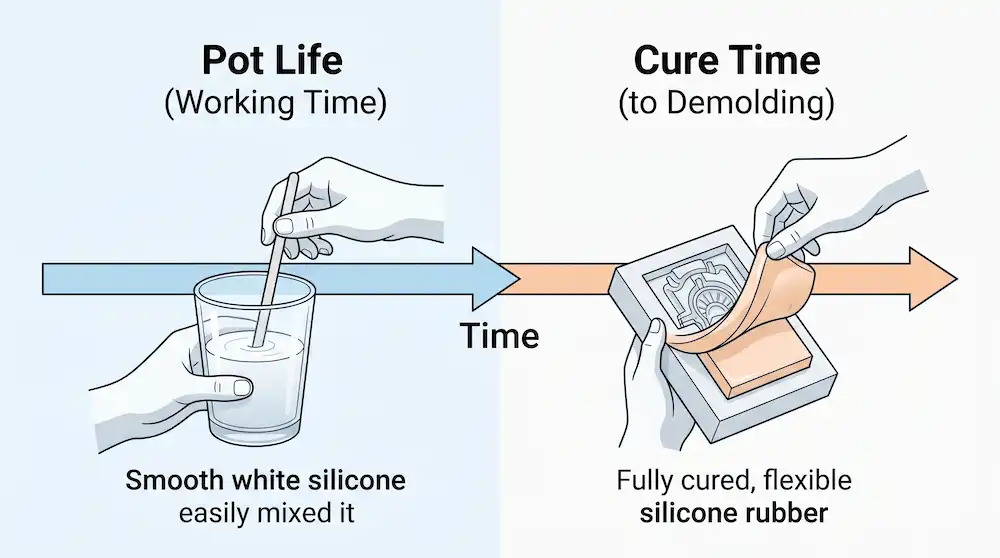
Pot life is the usable working time after mixing. Cure time is the time needed before demolding or full curing.
A good production silicone should give:
enough working time + acceptable demold time + stable final rubber performance
Related Reading: Why RTV-2 Silicone Does Not Cure Properly?
When Is Short Pot Life Good?
Short pot life is not always bad. It is useful when the operation is simple and fast.
| Short Pot Life Is Suitable When… | Example |
| Mold is small | Small craft molds |
| No vacuum degassing is needed | Simple pouring |
| Operator is experienced | Fast production workshop |
| Batch size is small | 100–500 g mixing |
| Shape is simple | No deep details or long flow path |
| Fast turnover is more important | Small mold production |
For small, simple molds, 10–20 minutes may be enough.
But for large molds, vacuum degassing, brush-on molds or detailed resin molds, very short pot life often creates more problems than benefits.
When Do You Need Longer Pot Life?
| Choose Longer Pot Life If… | Reason |
| You need vacuum degassing | Degassing consumes working time |
| Mold is large | Pouring and leveling take longer |
| Mold has fine details | Silicone needs time to flow |
| Mold has deep undercuts | Air release is slower |
| You brush silicone onto a vertical surface | Brushing and layering need time |
| Your workshop is hot | High temperature shortens pot life |
| Operators mix large batches | Large batch gives less working margin |
| You need stable repeat production | Longer working time reduces operator stress |
Longer pot life is especially important when the cost of one failed mold is high.
Vacuum Degassing: Pot Life Must Cover the Whole Window
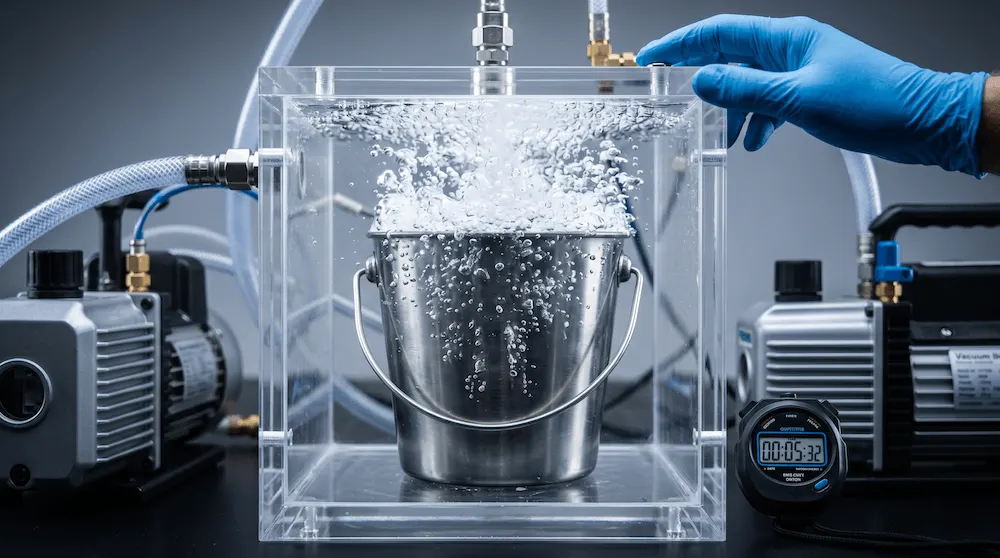
If vacuum degassing is part of your process, pot life must include all these steps:
- weighing
- mixing
- vacuum degassing
- pouring
- surface leveling
- detail flow
- safety margin
| Vacuum Process | Recommended Pot Life |
| No vacuum, small mold | 10–20 min may be enough |
| Small mold with vacuum | 20–30 min is safer |
| Detailed mold with vacuum | 30–45 min is better |
| Large batch with vacuum | 45–60 min may be needed |
| Vacuum casting or precision mold | Usually needs longer working time |
If your vacuum degassing takes 5–8 minutes, a 10-minute pot life may be too risky. The silicone may still be liquid, but it may already be too thick for smooth pouring.
Why 100g Sample Pot Life May Not Equal Production Pot Life
A common mistake is judging production performance only from a small lab sample.
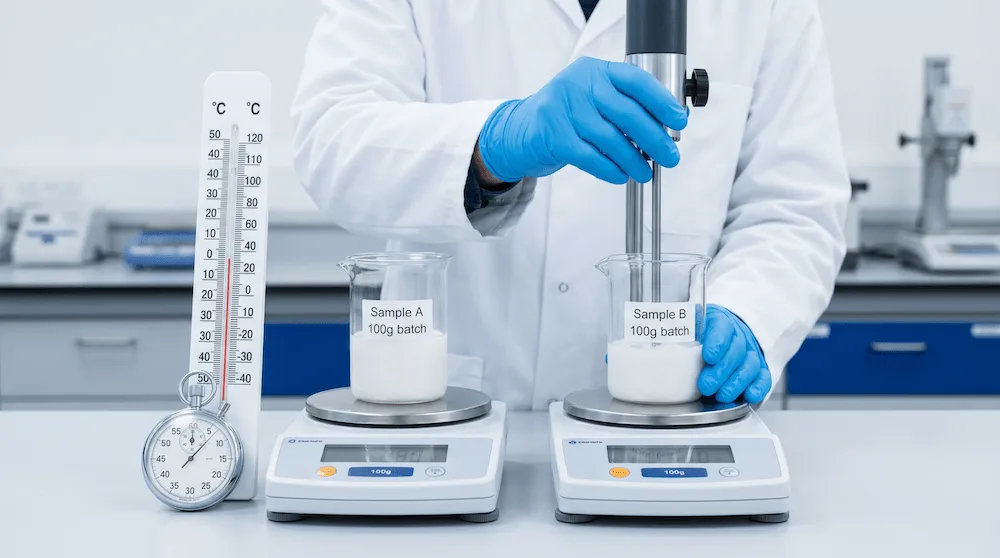
A 100g test may feel comfortable, but the same silicone may become harder to handle in production.
| Test Condition | What May Change in Production |
| 100g lab sample | 5kg or 20kg production batch |
| Low mixing heat | More heat in larger batch |
| Simple cup test | Real mold needs pouring and leveling |
| No vacuum process | Vacuum degassing uses working time |
| 23–25°C test room | Hot workshop shortens pot life |
| One skilled tester | Different operators have different speed |
For industrial buyers, pot life should be tested under conditions close to real production.
If your team mixes 5kg each time, do not rely only on a 100g cup test.
Temperature: The Same Silicone Behaves Differently in Summer and Winter
RTV-2 silicone working time is strongly affected by temperature.
| Room Temperature | Effect on Pot Life |
| Below 15°C | Pot life becomes longer, cure becomes slower |
| 20–25°C | Normal comparison condition |
| Above 30°C | Pot life becomes shorter, cure becomes faster |
| Hot summer workshop | Silicone may thicken much faster |
| Cold winter workshop | Silicone may cure too slowly |
When comparing samples from different suppliers, always test under the same temperature.
If one sample is tested at 20°C and another at 30°C, the result is not a fair comparison.
Related Reading: Silikon Erir mi? Silikonun Erime Noktası ve Isı Direnci Açıklandı
Batch Size: Larger Mixing Quantity Needs More Safety Margin
The more silicone you mix at one time, the more carefully you should choose pot life.
| Mixing Quantity | Working Time Risk |
| 100–500 g | Easier to control |
| 1–3 kg | Needs better mixing and pouring plan |
| 5–10 kg | Needs longer working margin |
| 20 kg or more | Pot life must match production process very carefully |
pot life that feels comfortable for 500g may be too short for 5kg or 20kg production.
For large batch mixing, we usually recommend adding safety margin instead of choosing a very fast catalyst.
Viscosity Also Affects the Feeling of Pot Life
Sometimes the silicone is not actually curing too fast. It is simply too viscous for the application.
| Viscosity Situation | Production Problem |
| Too high viscosity | Hard to pour, traps bubbles, poor fine-detail flow |
| Too low viscosity | Too much flow, not ideal for brush-on application |
| High viscosity + short pot life | Very difficult for detailed molds |
| Lower viscosity + suitable pot life | Easier pouring and better detail reproduction |
| Thixotropic silicone | Better for vertical brushing, not for self-leveling pouring |
If your silicone becomes difficult to pour too early, check both pot life and viscosity.
For fine details or vacuum degassing, lower viscosity with suitable pot life may perform better than simply extending working time.
How to Test RTV-2 Silicone Pot Life Correctly
To compare samples fairly, use the same test method.
| Test Item | Recommended Method |
| Sıcaklık | Test at 23–25°C or your real workshop temperature |
| Mixing quantity | Use the same amount for each sample |
| Mixing time | Keep the same mixing time |
| Start timing | Start when Part A and Part B first contact |
| Observation | Record when viscosity clearly increases |
| Process test | Include degassing and pouring, not only cup observation |
| Production simulation | Test with real mold size when possible |
Do not judge pot life only by the TDS number.
Asıl soru şu:
Can the silicone still flow, degas and level during your actual process?
Can You Make Silicone Have Long Pot Life but Still Cure Fast?
In some cases, yes. But it depends on the formulation and catalyst system.
Many buyers want:
- 30–45 min working time
- 4–6 h demold time
- iyi akış
- stable hardness
- daha az baloncuk
- consistent batch performance
This cannot always be achieved by randomly adding more or less catalyst. It requires proper formula matching.
A better target is:
long enough working time + acceptable demolding time + stable final properties
This is especially important for distributors and industrial users who need stable performance across different customers and workshops.
Can You Just Use Less Catalyst to Extend Pot Life?
For some tin cure silicone systems, reducing catalyst may extend pot life. But it may also cause new problems:
- slower cure
- sticky surface
- tamamlanmamış kürlenme
- weaker mold
- longer production cycle
- unstable batch-to-batch results
Do not randomly reduce catalyst without supplier guidance.
A better solution is to use a matched catalyst system or ask the manufacturer to adjust the working time according to your application.
Tin Cure or Platinum Cure: Which Is Better for Adjustable Working Time?
| Gereksinim | Kalay Kür Silikon | Platin Kür Silikon |
| Genel kalıp yapımı | Common choice | Also possible |
| Lower cost | Daha iyi | Daha yüksek maliyet |
| Adjustable catalyst speed | Often easier | Depends on system |
| Low shrinkage | Orta | Daha iyi |
| Food-grade mold | Usually not preferred | Better if certified |
| Precision casting | Mümkün | Often better |
| Large concrete molds | Commonly used | Usually not necessary |
| Cure inhibition risk | Daha düşük | Higher, needs surface test |
For general mold making, tin cure silicone with a suitable catalyst system is often practical.
For food molds, precision casting, PU casting or low-shrinkage applications, platinum cure silicone may be better, but the working time must still match the process.
How Topsil Helps Buyers Choose the Right Working Time
Topsil Silicone is a China RTV-2 silicone rubber manufacturer with 15+ years of production and application experience.
When a customer says “the pot life is too short”, we do not simply recommend a slower silicone. First, we ask the customer to describe the real production process.
We usually check:
- How many minutes are needed for mixing?
- Is vacuum degassing required? How long does it take?
- How many minutes are needed for pouring or brushing?
- Is extra time needed for leveling or detail flow?
- What is the mold size?
- How much silicone is mixed each time?
- What is the room temperature?
- What viscosity is currently used?
- What demold time is acceptable?
- Is there a current silicone TDS for comparison?
Based on these details, we can recommend or adjust:
- saksı hayatı
- kürlenme süresi
- catalyst speed
- Viskozite
- Shore A sertlik
- tin cure or platinum cure system
- pourable or brushable version
The goal is not simply to make the silicone slower.
The goal is to make the working time fit the real production process.
What to Send Us for Working Time Recommendation
Before asking for a slower silicone, send us your real process time.
| Information | Why We Need It |
| Current silicone TDS | To compare current pot life, cure time, hardness and viscosity |
| Mixing time | To calculate total required working time |
| Vacuum degassing time | Degassing may consume much of the pot life |
| Pouring or brushing time | Determines how much workable time is needed |
| Leveling or detail flow time | Important for large or detailed molds |
| Kalıp boyutu | Larger molds need longer working time |
| Mixing quantity each time | Larger batches need more safety margin |
| Room temperature | High temperature shortens pot life |
| Current problem | Thickening during mixing, degassing, pouring or leveling |
| Acceptable demold time | Helps balance pot life and cure time |
| Uygulama | Mold making, potting, pad printing, casting or brushing |
| Annual consumption | Helps recommend sample and supply solution |
These details help us recommend the right RTV-2 silicone working time instead of sending a random sample.
SSS
Already Using a Branded RTV-2 Silicone Grade?
Send us your current TDS, application and target hardness. Topsil can recommend 2–3 factory-direct RTV-2 silicone grades for comparison testing.