
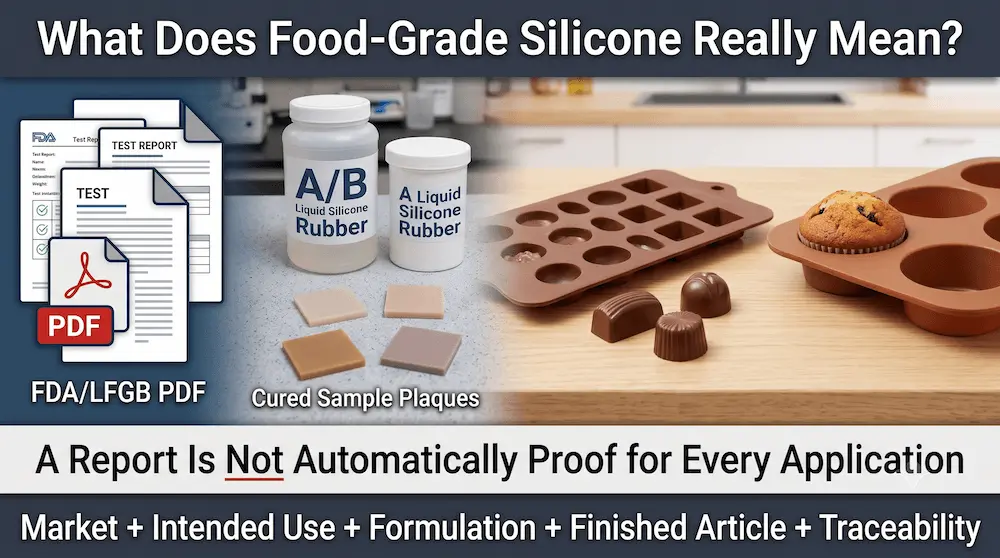

A supplier sends you a PDF labelled “FDA certificate.”
The report may be genuine. But does it cover the exact silicone grade, A/B mixing ratio, pigment, cure process, food type, contact temperature and repeated-use conditions of the product you plan to sell?
In food-contact compliance, the existence of a report is not the same as evidence that the report applies to your application.
A document prepared for an unpigmented silicone sample used at moderate temperature may not automatically support a coloured baking mold exposed repeatedly to fatty food at elevated temperature.
Gıda sınıfı silikon is not one universal grade or certificate. It is an application-specific compliance conclusion supported by the correct formulation, intended use, finished-article evidence, good manufacturing practice and traceable documentation.
This article provides general compliance guidance and is not legal advice.
Hızlı Cevap
Food-grade silicone is silicone evaluated as suitable for a defined food-contact application under the rules of the target market.
The conclusion depends on the complete formulation, cured condition, food type, contact temperature and duration, repeated-use conditions, manufacturing process and supporting documentation.
“Platinum-cured,” “FDA compliant,” “LFGB tested” and “100% silicone” describe different aspects of the material or evidence. They are not interchangeable claims. Food-contact frameworks assess defined materials or articles under stated conditions rather than granting one permanent global label for every use.
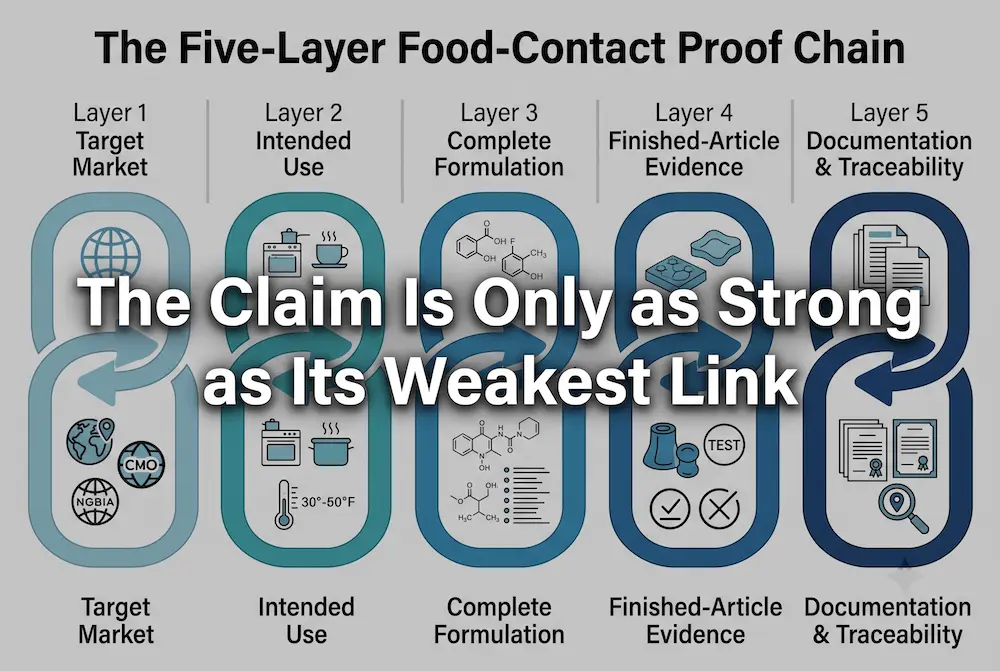
The Five-Layer Food-Contact Proof Chain
| Layer | Question to Confirm |
| 1. Target market | Is the product intended for the United States, EU, Germany or another market? |
| 2. Intended use | Which food, temperature, contact time and repeated-use conditions apply? |
| 3. Complete formulation | Which A/B grade, mixing ratio, pigment and additives are used? |
| 4. Finished-article evidence | Does the tested sample represent the cured product and real process? |
| 5. Documentation and traceability | Can the report be connected to the grade, batch and declared scope? |
A food-contact claim is only as strong as the weakest link in its evidence chain.
Use Green, Amber and Red to Review a Report
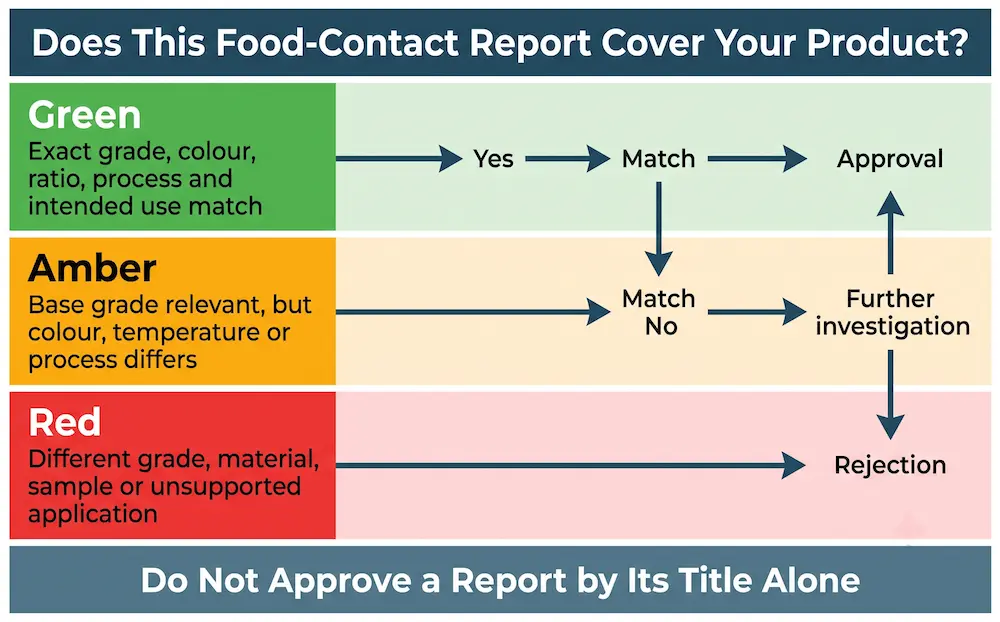
| Status | Evidence Position | Recommended Action |
| Green — Directly applicable | Grade, colour, ratio, cured condition and intended use match | Add it to the project compliance file |
| Amber — Partially applicable | Base grade is relevant, but pigment, temperature, process or final article differs | Request scope clarification and assess supplementary testing |
| Red — Not applicable | Different grade, material, sample condition or unsupported use | Do not use it as evidence for the project |
A report can be technically valid and still receive an Amber or Red status for a particular application.
What FDA 21 CFR 177.2600 Actually Covers
In the United States, 21 CFR 177.2600 addresses rubber articles intended for repeated food contact. It includes provisions concerning eligible polymers and adjuvant substances, conditions of use and extractives from finished food-contact surfaces.
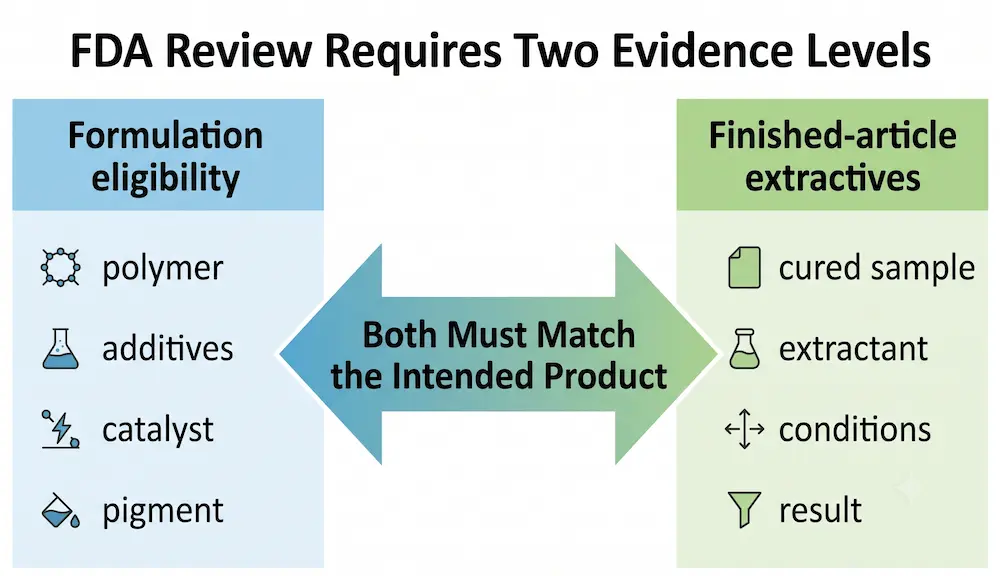
A credible review should consider two levels:
Formulation Eligibility
Are the polymers, additives, catalysts, pigments and other constituents supported under an applicable provision and used within relevant limitations?
Custom pigments may require a separate review, including relevant provisions such as 21 CFR 178.3297 for polymer colorants.
Finished-Article Extractives
Does the finished food-contact surface meet the applicable extractives requirements under the defined test conditions?
A 21 CFR 177.2600 assessment should address both formulation eligibility and applicable finished-article extractives—not merely find the word “silicone” in a regulation.
The regulation is not a programme under which FDA issues one universal certificate for every silicone grade. A PDF marketed as an “FDA certificate” is usually a laboratory report, supplier declaration or regulatory assessment for a defined sample and scope.
| Supplier Claim | Buyer’s Follow-Up Question |
| FDA approved | Which regulation and product condition support this statement? |
| FDA compliant | Which grade, colour and use are covered? |
| Tested to 21 CFR 177.2600 | Were formulation eligibility and finished-article extractives assessed? |
| Suitable for food molds | Which foods, temperatures and repeated-use conditions apply? |
Pigments and other components may have separate applicable provisions and restrictions. For example, 21 CFR 178.3297 contains conditions for certain colourants used in polymers and repeated-use rubber articles.
In the United States, 21 CFR 177.2600 addresses rubber articles intended for repeated food contact.
How EU Food-Contact Compliance Works
European compliance is not demonstrated by one generic “EU certificate.”
Regulation (EC) No 1935/2004
This framework requires food-contact materials to be manufactured under good manufacturing practice so that, under normal or foreseeable use, they do not transfer constituents in amounts that could endanger health, cause unacceptable changes in food composition or deteriorate organoleptic properties.
Traceability is also a core requirement. Business operators should be able to identify relevant upstream and downstream businesses so products can be controlled, recalled and linked to responsibility where necessary.
All EU food-contact materials are subject to the general safety and traceability principles of Regulation (EC) No 1935/2004.
Regulation (EC) No 2023/2006, as Amended
This regulation addresses quality assurance, quality control and documentation for food-contact manufacturing. GMP is not a migration test; it is the controlled system used to manufacture consistently compliant articles.
Regulation (EU) No 10/2011, as Amended
This is a material-specific measure for plastic materials and articles. It should not be presented as the complete silicone-rubber regulation. Where no harmonised EU-specific measure fully covers a material, national provisions and recognised scientific recommendations may remain relevant.
Declaration of Compliance
Specific measures may require a written Declaration of Compliance. Where no specific measure applies, Member States may retain or adopt national declaration requirements.
The legal basis and format should therefore be checked for the market and material rather than assumed to be identical for every silicone article.
Compliance responsibility is shared across the supply chain according to each operator’s role and control.
The silicone supplier controls product information and consistency. The converter controls pigment addition, mixing, curing and post-curing. The brand or market operator controls the finished-product claim and intended market.
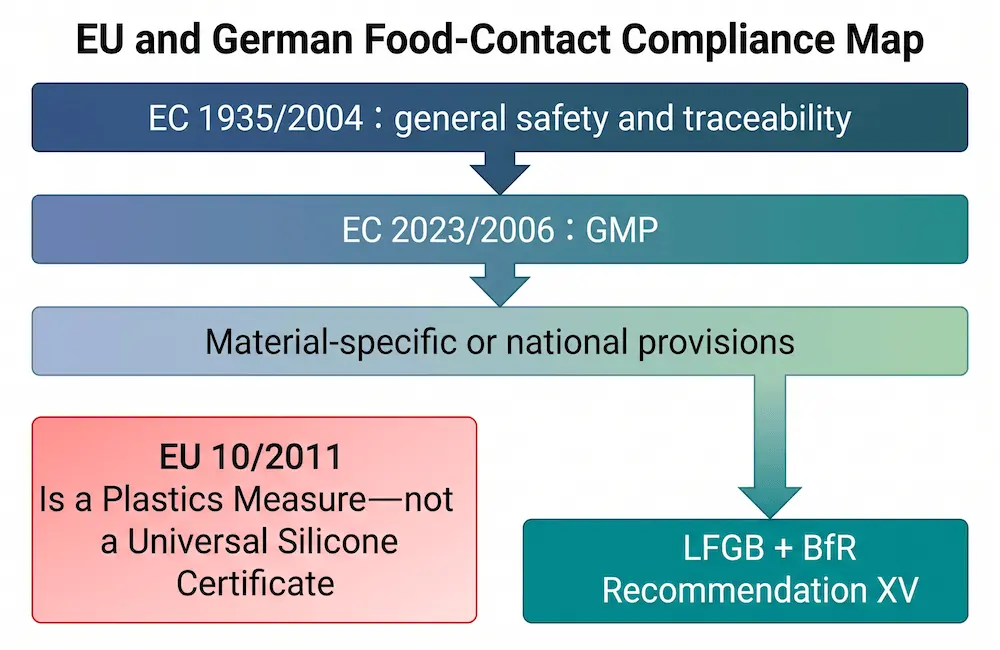
LFGB, BfR XV and “LFGB-Certified Silicone”
“LFGB certified” is common commercial shorthand. It is not the name of one universal government-issued silicone certificate.
LFGB is Germany’s Food, Consumer Products and Feed Code. BfR Recommendation XV provides scientific guidance specifically for silicones used in relevant food-contact articles.
The English BfR Recommendation XV currently available is dated 1 February 2023 and states that it is an unofficial translation; only the German version is binding. It addresses permitted starting materials and production aids and includes requirements for finished silicone elastomers.
BfR recommendations are not legal norms. They reflect the current state of science and technology for assessing materials not fully covered by harmonised specific rules.
Buyers should therefore not reduce the comparison to:
FDA is basic; LFGB is premium.
Instead, ask:
- Which law, recommendation or test programme was used?
- What sample was tested?
- Which test conditions applied?
- Does the report cover the finished coloured article?
- What limitations are stated?
Is Platinum-Cured Silicone Automatically Food-Grade?
No.
Platinum curing describes the cure chemistry. It does not prove that the complete formulation and finished article meet a specific food-contact requirement.
Suitability can be affected by:
- Base polymers
- Catalyst and inhibitor
- Fillers
- Pigments
- A/B mixing ratio
- Cure completeness
- Post-curing
- Customer-added oils or additives
BfR Recommendation XV itself permits defined materials and production aids subject to conditions and finished-product requirements; it does not treat the presence of a platinum catalyst as a complete compliance conclusion.
Platinum-cured and food-contact compliant are related concepts, but they are not synonyms.
The same caution applies to “100% silicone.” Commercially, this may mean that the product is not blended with another bulk polymer. It does not mean the formulation contains only one chemical substance or that every constituent has been assessed for the intended food contact.
Example: How to Read a Report’s Scope
Assume a report describes:
Test sample: Natural-colour platinum silicone, mixed 1:1 and cured under stated laboratory conditions.
Test conditions: Defined aqueous and fatty-food extractants under specified repeated-use conditions.
Potentially Supported
- The exact tested grade and natural colour
- The stated A/B ratio
- Comparable curing conditions
- Uses within the report’s scope
Not Automatically Supported
- Custom-coloured versions
- Customer-added pigment, silicone oil or thinner
- Another silicone grade
- Different post-curing conditions
- High-temperature baking not represented by the report
Buyers should read the sample description, methods, conditions and limitations—not only the conclusion page.
Chocolate Mold Versus Baking Mold
| Review Item | Chocolate Mold | Baking Mold |
| Colour | Natural | Pigmented |
| Food | Chocolate or confectionery | Fat-containing baking mixture |
| Maximum temperature | Insert actual project value | Insert actual oven-use value |
| Contact duration | Insert actual duration | Insert actual baking duration |
| Cure/post-cure | Insert actual process | Insert actual process |
| Existing report status | Green / Amber / Red | Green / Amber / Red |
A report supporting the chocolate mold should not automatically be assumed to support the baking mold. Colour, temperature, process and evidence scope must be reviewed.
This is an illustrative example, not a legal conclusion.
What Documents Should a Buyer Request?
Request:
- Exact grade and A/B mixing ratio
- Tested colour or pigment coverage
- Applicable regulation or recommendation
- Full report or meaningful scope
- Test-sample description
- Extractants or food simulants
- Temperature, duration and repeated-use conditions
- Cure and post-cure instructions
- Supplier statement defining limitations
- Batch traceability, COA, report date and laboratory
The legal basis of any formal Declaration of Compliance should be confirmed for the applicable market and material.
Why Evidence Scope Matters Commercially
A well-defined compliance file can:
- Shorten customer and OEM approval
- Reduce unnecessary duplicate testing
- Prevent a report for one formulation being misused for another
- Clarify whether a new colour needs more evidence
- Improve supplier-change control
- Reduce labelling and import disputes
The objective is not to collect more PDFs. It is to build an evidence package that matches the product being sold.
How Topsil Supports Food-Mold Projects
Topsil’s food-mold review begins with intended use and documentation fit rather than a blanket “food-grade” label. Its current food-mold application guidance similarly recommends defining the application, target market and documentation requirements before sampling.
For an initial review, provide:
- Target market
- Food type
- Maximum contact temperature
- Contact duration
- Repeated-use requirement
- Proposed grade, colour and final application
Topsil can clarify which documents are available for the proposed grade, explain their stated scope and identify questions that may need confirmation with the customer, testing laboratory or regulatory adviser.
Final suitability must be confirmed for the finished article and target market.