
The same gıda sınıfı silikon can release chocolate successfully yet be wrong for a repeatedly heated baking mold or hot-sugar process. The material is not necessarily defective; the performance priorities, evidence scope and validation plan have changed.
This guide is for food mold manufacturers, private-label brands, distributors and material buyers selecting liquid RTV-2 silikon. It is not a consumer comparison of finished bakeware.
Hızlı Cevap
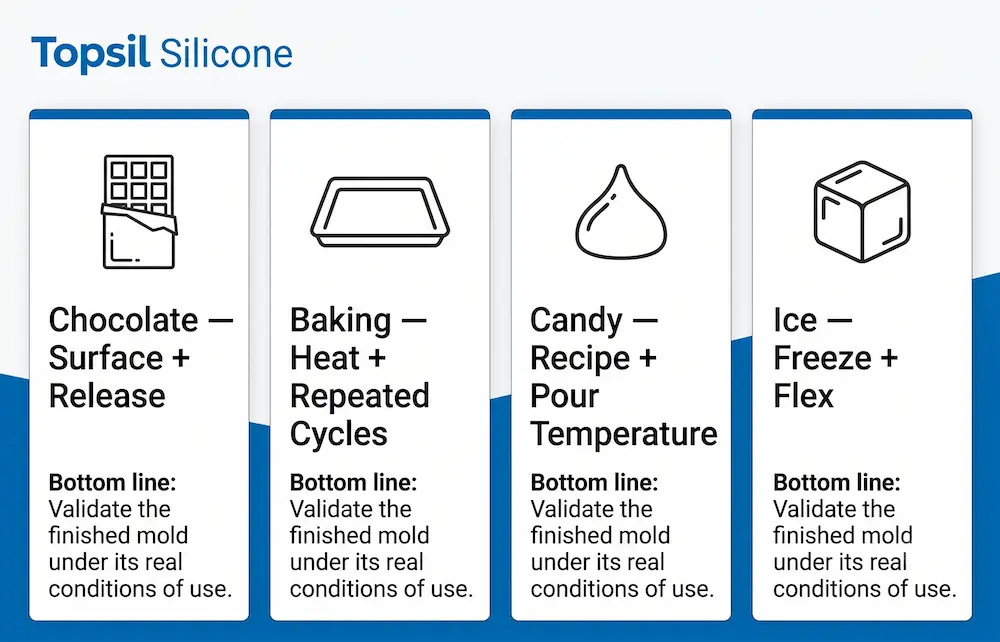
The base silicone grade may remain the same, but its performance requirements, compliance conclusion and validation plan can change with the food, temperature, contact time, repeated-use cycle, mold geometry and target market. Chocolate prioritizes surface replication and release; baking adds repeated heat; candy varies sharply by processing temperature; and ice molds require low-temperature flexibility and tear resistance.
What Changes—and What Does Not?
The fundamentals do not change. Buyers still need an identified grade, controlled A/B ratio, documented cure and post-cure, traceable production and food-contact evidence relevant to the market.
What changes is the application-specific review:
Performans: flexibility, support, tear resistance, heat exposure and release are weighted differently.
Validation: test temperature, food or recipe, contact time, cleaning and repeated-use cycles change.
Evidence: a report for one grade, color and use condition may not support another finished mold.
Platinum curing is commonly considered for professional food molds, but it describes the cure chemistry—not a universal food-contact approval. See What Does Food-Grade Silicone Really Mean? for the complete evidence chain.
Chocolate, Baking, Candy and Ice: Application Comparison
| Uygulama | What Changes Most | What the Buyer Should Validate |
| Chocolate | Surface replication, low odor, release and dimensional support | Actual chocolate process, finish, detail, release and report scope |
| Fırınlama | Oven temperature, heating time, fatty-food contact and thermal cycles | Intended recipe, maximum temperature, duration, cleaning and repeated use |
| Gummies and jellies | Sticky, water-containing or acidic recipes and narrow cavities | Actual recipe, release, cleaning and tear around cavity walls |
| Hard candy, caramel and isomalt | Higher pouring temperature and localized thermal exposure | Maximum real pouring temperature, contact time and cooling process |
| Ice | Freezing, expansion and repeated flexing | Final geometry, freeze–thaw cycles, low-temperature release and tearing |
This is a selection framework, not a claim that one hardness or silicone grade fits every mold.
Food-Grade Silicone for Chocolate Molds
Chocolate molds usually prioritize accurate surface replication, clean release, low odor and the balance between flexibility and support.
Silicone reproduces the master finish; it cannot create gloss from a matte master or correct poor tempering and cooling. Separate mold-material performance from the chocolate process.
A deep design with undercuts may benefit from softer, high-tear silicone. A large, shallow bar mold may need firmer support or an external tray.
Practical starting direction: prioritize good flow, accurate surface replication, low odor after the specified cure, sufficient tear strength and a hardness matched to cavity geometry—not simply the softest available grade.
Validate detail, appearance, release and filled-mold stability with the actual chocolate process. Confirm that evidence covers the grade, color and conditions.
Food-Grade Silicone for Baking Molds
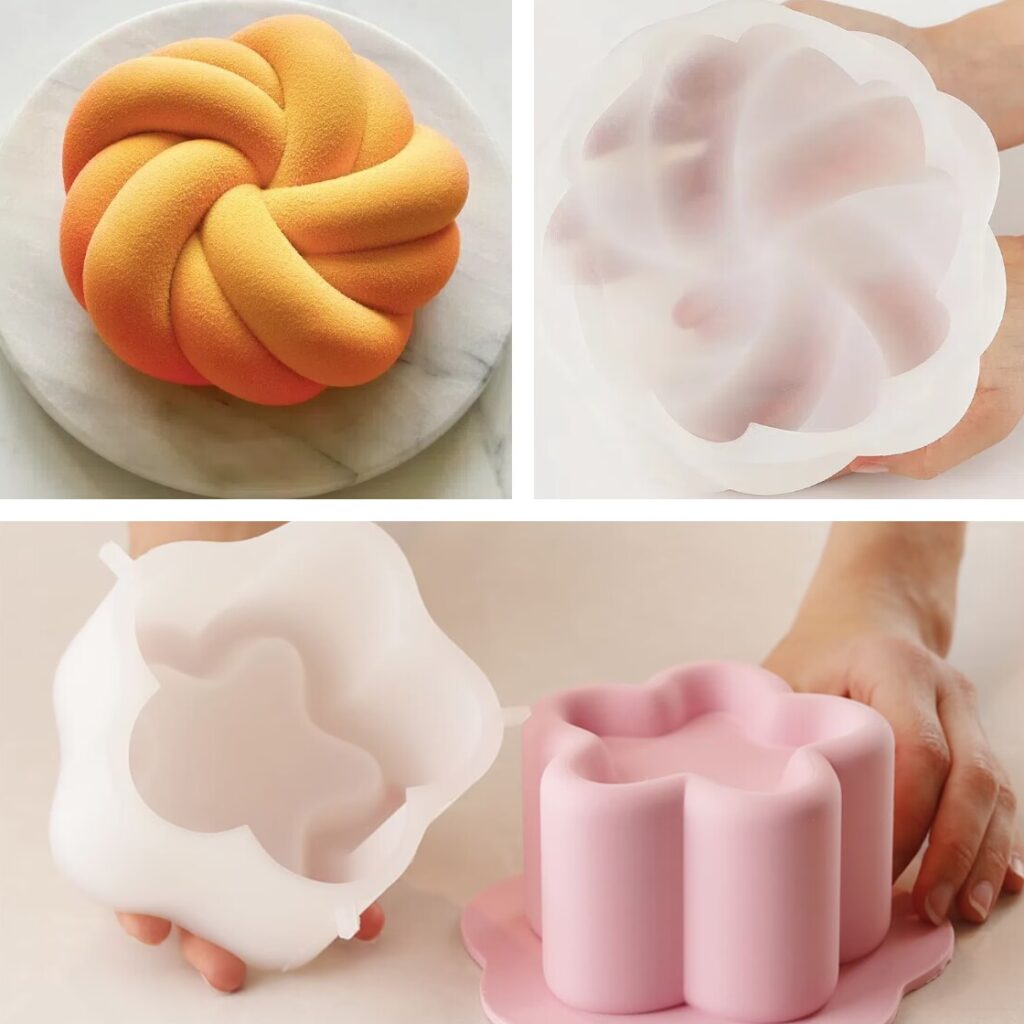
Baking introduces elevated temperature, longer contact, fat-containing recipes, repeated heating and cleaning. These conditions affect both mold performance and the scope of compliance evidence.
A maximum service temperature on a TDS does not independently prove that a finished colored mold is suitable for repeated food contact. Define the actual oven temperature, heating time, food, cleaning and expected cycles.
Thermal cycling may reveal dimensional change, surface deterioration, tearing around thin sections or altered release behavior that cannot be seen in a room-temperature sample.
Practical starting direction: consider a platinum silicone with appropriate dimensional support, tear strength, documented cure or post-cure instructions and technical data relevant to the intended heat exposure. Food-contact evidence must also be reviewed against the real baking conditions.
A pilot test should record the recipe, maximum temperature, duration, heat-and-cleaning cycles and changes in dimension, surface, odor or tear. Extra heating is not a substitute for applicable evidence.
Food-Grade Silicone for Candy Molds
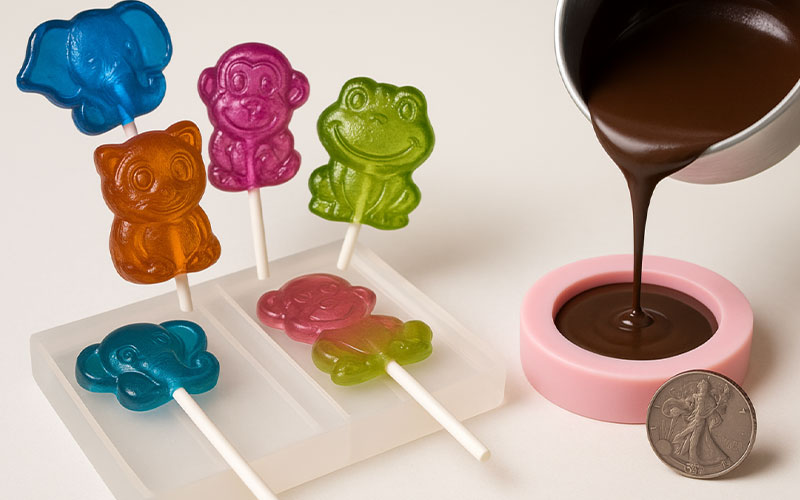
“Candy” is not one technical application. This is the category’s most important selection distinction.
Gummies and jellies may be warm, sticky, water-containing or acidic. Detail, release, cleaning and tear resistance around narrow cavity walls may dominate selection.
Caramel, hard candy and isomalt can involve different pouring temperatures and localized heat. A chocolate or gummy grade should not automatically be assumed suitable for hot sugar.
Deep cavities, narrow bridges and undercuts concentrate demolding stress. Very soft silicone may lack support; a firmer grade may stress delicate pieces.
Practical starting direction: for gummies, prioritize flexible release, tear resistance and clean detail. For hard candy, caramel or isomalt, first confirm the exact formulation, maximum pouring temperature, contact time and cooling process before selecting a grade.
Qualification requires a pilot mold made from the intended master and tested with the real recipe at the highest normal processing temperature—not candy poured into a generic sample cup.
Selection rule: There is no technically responsible way to recommend one “candy mold silicone” without knowing the candy formulation and maximum pouring temperature.
Food-Grade Silicone for Ice Molds
Ice molds replace oven heat with freezing, water expansion and repeated flexing. Silicone must remain flexible for demolding while resisting tears around cavity edges, thin bridges and decorative details.
Large cubes and complex shapes can deform an unsupported mold during filling or movement. A very soft grade may improve release but reduce dimensional support, so hardness, wall thickness, cavity spacing and any external tray should be reviewed together.
Practical starting direction: prioritize low-temperature flexibility, tear resistance at high-stress features, low odor after the specified cure and enough support to hold the filled mold level.
Use the final mold geometry for repeated freezing, thawing and demolding trials. Check for tearing, permanent deformation, surface change, practical release and potential organoleptic effects using an appropriate evaluation method. A general “freezer safe” statement cannot replace finished-mold validation.
Build a Six-Condition Application Brief
Before comparing silicone grades, define:
- Food: the exact food or formulation, including whether it is water-based, fat-containing, sugary or acidic;
- Temperature: the highest pouring, baking or contact temperature and lowest demolding temperature;
- Time and cycles: contact duration, expected reuse and heating, freezing or cleaning cycles;
- Geometry: mold dimensions, cavity depth, wall thickness, bridges and undercuts;
- Temizlik: hand washing, dishwasher use or another intended cleaning process;
- Market: the United States, European Union, Germany or another destination.
Then compare cure system, hardness, viscosity, working time, tear strength and mold support. The food-grade silicone selection guide explains these processing parameters in more detail.
Once a grade is shortlisted, verify its exact A/B ratio, color, cure and post-cure, test-report sample and stated limitations.
How Topsil Silicone Reviews a Food-Mold Project
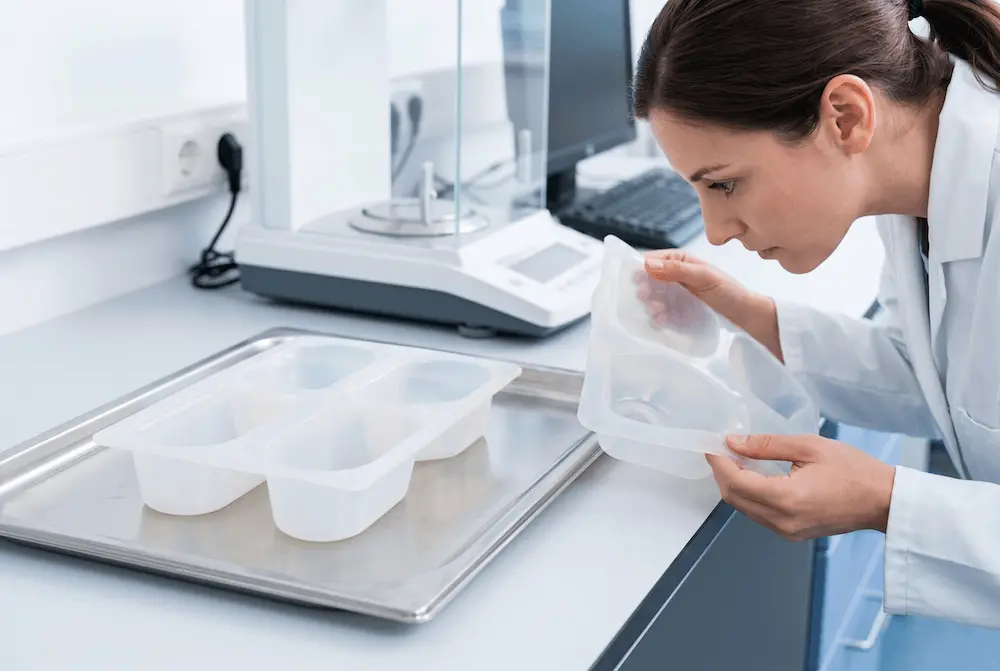
Topsil Silicone supplies liquid RTV-2 material, not finished food molds. Our role is to help manufacturers identify a starting grade and the questions to resolve before approval.
For an initial review, send the six application conditions together with the master material and required documentation. Topsil Silicone can then provide:
- a practical grade shortlist based on flexibility, support, flow and demolding requirements;
- available document scope for the proposed grade, color and target market;
- a pilot-test plan covering master compatibility, actual food process and repeated-use conditions.
This can reduce unnecessary sampling and prevent evidence for one condition being applied to another. Explore the food-mold application page or available platinum-cured RTV-2 silicone directions.
How Do Food-Contact Documents Change?
In the United States, 21 CFR 177.2600 addresses rubber articles intended for repeated food contact. It includes formulation provisions and finished-surface extractives requirements, with different provisions for aqueous and fatty foods. It also requires finished rubber articles to be thoroughly cleansed before first food contact.
FDA evaluates food-contact substances in relation to authorized or intended use. Evidence should therefore be read with its conditions and limitations. Avoid using “FDA approved silicone” as a blanket claim; identify the applicable regulation, tested sample and supported use. The FDA’s food-contact explanation provides regulatory context, while What Is FDA Silicone? explains how buyers can review 21 CFR 177.2600 evidence.
In the European Union, food-contact articles are subject to Regulation (EC) No 1935/2004 and GMP controls under Regulation (EC) No 2023/2006. Where no EU-wide material-specific measure fully covers silicone, national provisions and scientific recommendations may also be relevant. Germany’s BfR Recommendation XV is a recognized assessment reference, not a universal certificate for every finished mold.
Request the exact grade, A/B ratio, tested color, sample condition, referenced rule, test method, food simulant or extractant, temperature, duration, report limitations, TDS, SDS, batch COA and traceability information. A genuine report can still fall outside the scope of a specific application.
Can One Grade Cover All Four Applications?
Possibly—but only when the exact formulation, mechanical performance, document scope and finished mold have been evaluated for every intended use.
One grade may cover several applications. That conclusion must come from the food, temperature, time, geometry, cleaning process and market—not from a broad “food grade,” “oven safe” or “freezer safe” label.