
A printing pad manufacturer looking for a new silicone often starts with a simple request:
“Please recommend your 30 Shore silicone.”
But that specification is not enough.
A 30 Shore A silicone and a 30 Shore 00 silicone are not equivalent. Two silicones with the same Shore A sertlik can also behave differently because of their tear strength, elongation, viscosity, cure behavior and formulation.
More importantly, the silicone is only one part of the printing system.
The correct tampon baskı silikon kauçuk should be selected by matching the material to the printed part, image, pad geometry, required deformation, pad-manufacturing process and actual production problem.
Hızlı Cevap
For printing pad manufacturers, a reliable silicone selection should evaluate five connected layers:
Printing Job → Pad Design → Silicone Properties → Formulation Adjustment → Production Validation
Hardness is important, but it should never be treated as a complete specification by itself.
View Topsil silicone Pad Printing Silicone Rubber →
The Topsil silicone 5-Layer Pad Silicone Selection Framework
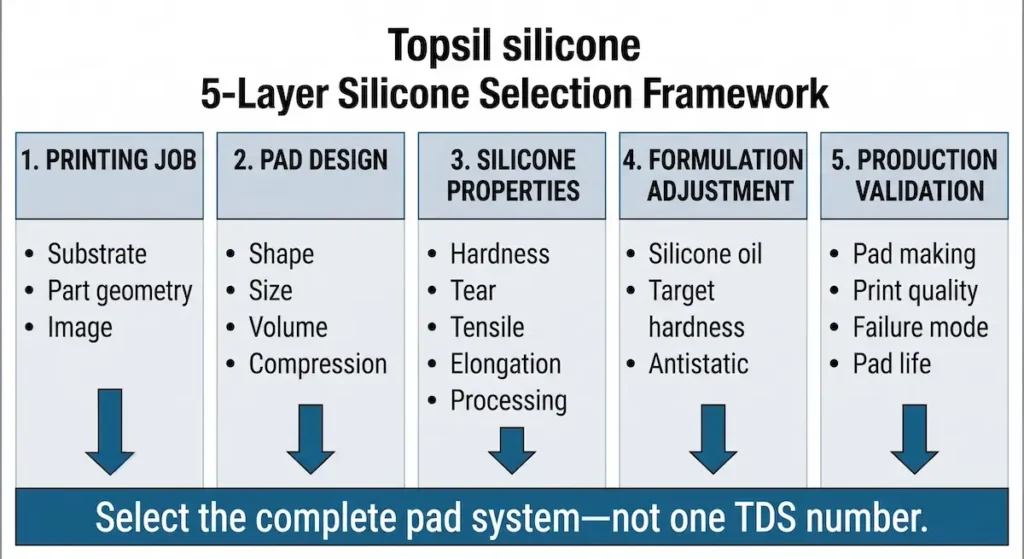
| Layer | What to evaluate | Key question |
| 1. Printing Job | Substrate, surface geometry, image | What does the pad need to print? |
| 2. Pad Design | Shape, size, volume, compression | How will the pad contact the cliché and part? |
| 3. Silicone Properties | Hardness, tear, tensile, elongation, processing | Can the material deliver the required pad behavior? |
| 4. Formulation Adjustment | Silicone oil, target hardness, antistatic requirement | Does the base formulation need to be modified? |
| 5. Production Validation | Pad making, print quality, failure mode, pad life | Does the complete system work in production? |
This is the central principle of this guide:
Do not select pad silicone from one TDS number. Select the complete pad system.
Industry specialists such as TAMPOPRINT likewise identify silicone material properties, pad shape, hardness and pad volume as interconnected factors in printing-pad performance.
What Is Pad Printing Silicone Rubber?
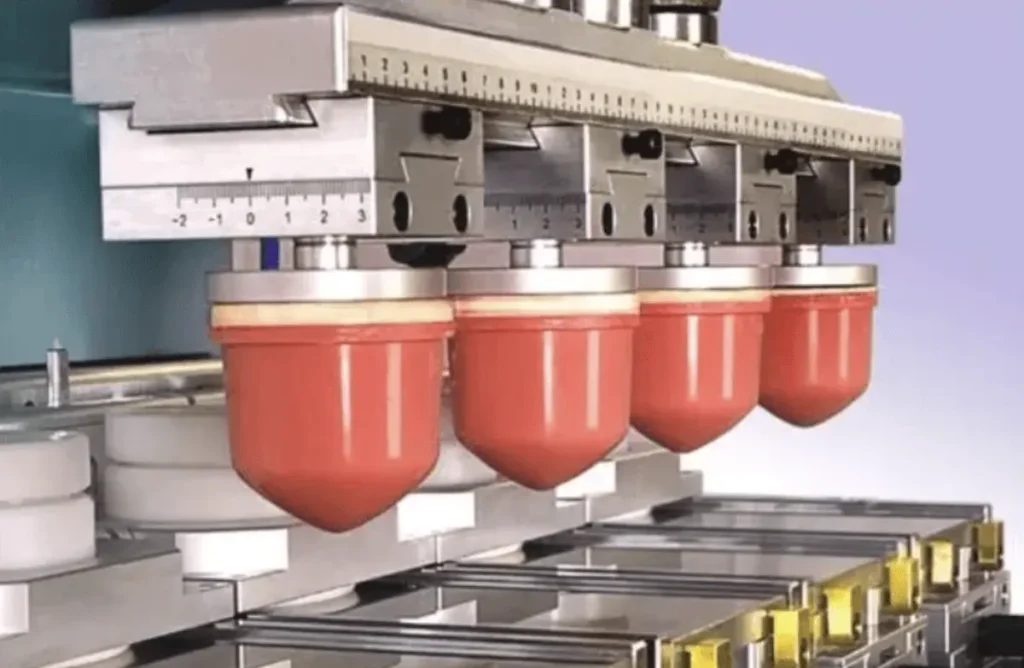
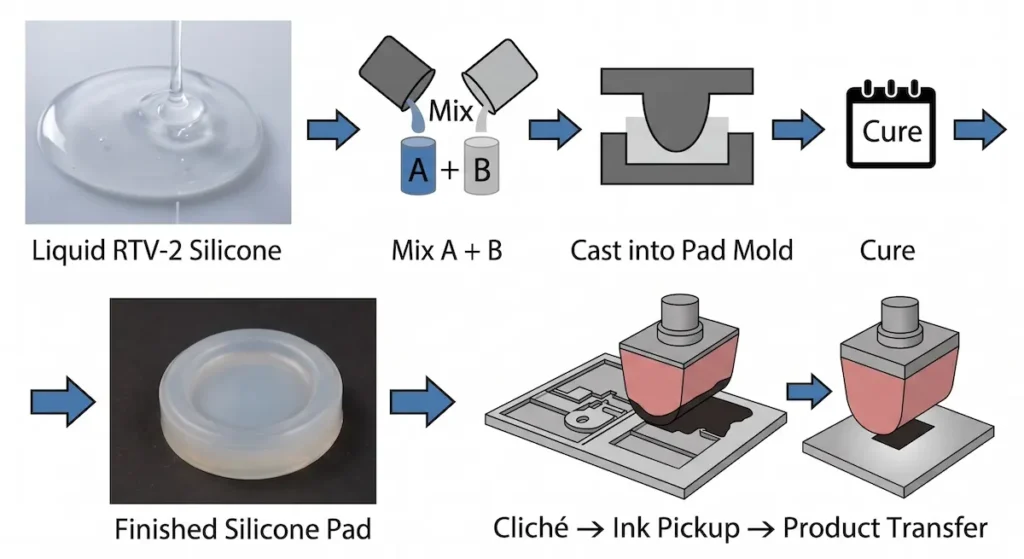
Pad printing silicone rubber is a liquid RTV silicone used to manufacture the flexible pads that transfer an ink image from the engraved printing plate—or cliché—to the final product.
Once cured into the pad shape, the silicone repeatedly goes through:
Compression → Ink Pickup → Recovery → Compression → Ink Release → Recovery
The finished pad therefore needs the right balance of deformation, dimensional stability and mechanical durability for the particular printing job.
If you first need an overview of the printing process, see:
Buyer Note: Topsil silicone supplies liquid RTV silicone raw materials for manufacturing printing pads. We do not supply finished printing pads, machines or pad printing inks.
Are You Designing a New Pad or Replacing an Existing Silicone?
This should be one of the first questions in supplier selection because the information required is different.
If you are developing a new printing pad
Start with:
- Printed substrate
- Flat, curved, recessed or irregular surface
- Image dimensions
- Fine details or large solid areas
- Proposed pad shape and dimensions
- Static-control requirement
- Expected production volume
- Required pad life
The material is being selected from the printing application backward.
If you are replacing an existing silicone
Start with:
- Current silicone manufacturer
- Current product grade
- Current TDS
- Sertlik and Shore scale
- Current silicone oil dosage
- Pad dimensions or drawing
- Printed part
- Current pad life
- Reason for changing supplier
Örneğin:
“Our current pad is hardness 30.”
still leaves several unanswered questions.
Is that Shore A or Shore 00?
Is 30 the hardness of the original silicone, or the finished pad after adding silicone oil?
What pad geometry is being used?
What is the customer actually trying to improve?
These questions should be answered before attempting to match a competing silicone.
Hardness and Pad Geometry Must Be Evaluated Together
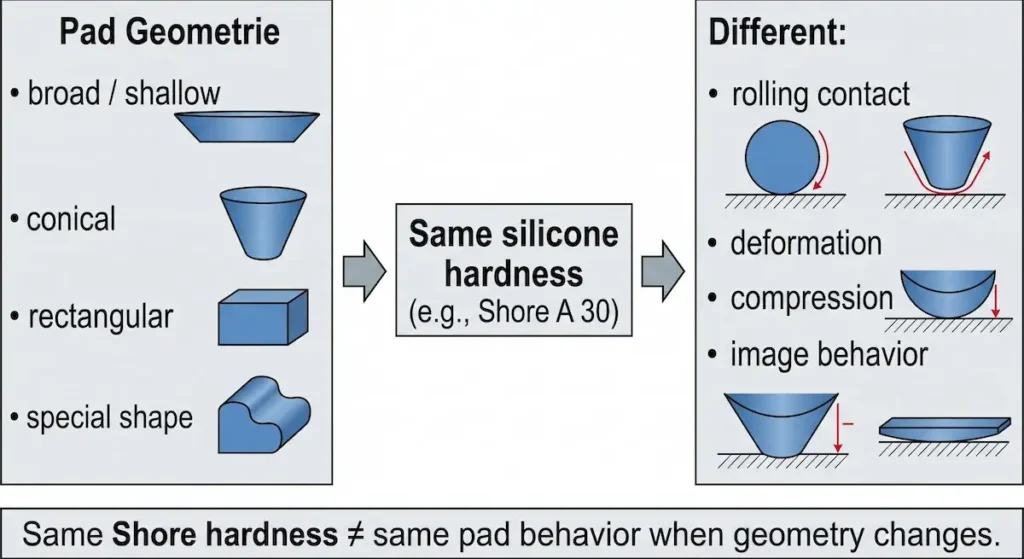
Hardness determines how strongly the cured silicone resists deformation, but it does not act independently.
In general:
More conformability ← Softer direction — Harder direction → More resistance to deformation
That is a useful tendency—not a universal selection formula.
For example, simply saying:
“Curved parts need soft silicone.”
is too simplistic.
A curved component may also require a different pad shape, greater pad volume or different compression behavior.
Likewise, a harder pad may resist deformation better, but that does not mean it can reach every recessed or irregular printing surface.
How the Printing Job Changes the Selection Question
| Printing condition | Primary concern | What should be evaluated |
| Flat surface | Controlled rolling contact | Pad shape + hardness |
| Curved surface | Conformability | Geometry + compression + hardness |
| Concave/recessed area | Access to printing zone | Pad geometry first |
| Fine text or logo | Image definition | Deformation + dimensional stability |
| Large graphic | Overall distortion | Pad volume + geometry + hardness |
| Textured surface | Contact consistency | Geometry + deformation behavior |
This is why two pads made from the same 30 Shore A silicone can behave very differently when their shape and volume are different.
Shore A 30 Is Not the Same as Shore 00 30
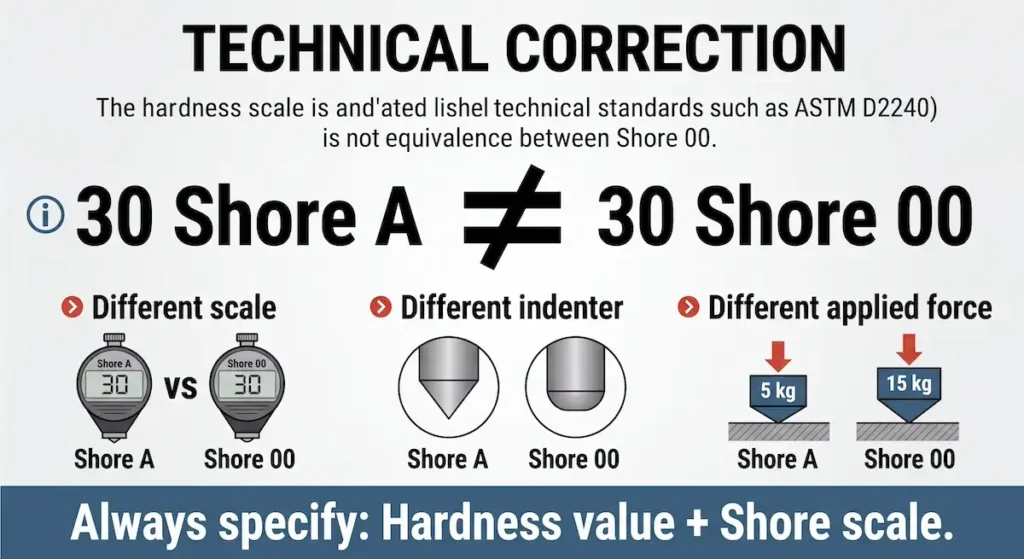
This point deserves special attention when sourcing internationally.
ASTM D2240 covers multiple durometer hardness types. Because different scales use different indenter geometries and applied forces, readings from different durometer types do değil have a simple direct relationship.
Therefore:
Never compare two “30 Shore” materials without confirming the hardness scale.
A useful specification says:
Hardness: 30 ± 2 Shore A
not simply:
Hardness: 30
This is particularly important when a printing-pad manufacturer asks a new supplier to match an existing product.
Read the TDS as a Property System
Once the printing job and pad geometry are understood, the TDS becomes useful.
But instead of asking which supplier has the “highest” number, ask how each property affects manufacturing and the finished pad.
| Mülkiyet | Neden önemli | What the buyer should confirm |
| Sertlik | Controls resistance to deformation | Value + Shore scale |
| Viskozite | Affects mixing, degassing and mold filling | Part A or mixed? At what temperature? |
| Çalışma süresi | Determines available processing window | Definition + test temperature |
| Cure time | Influences pad-production efficiency | Demold time or full cure? |
| Yırtılma mukavemeti | Relevant to demolding and localized pad damage | Test method and condition |
| Çekme mukavemeti | Part of the cured mechanical profile | Evaluate with elongation |
| Uzama | Indicates deformation capacity | Never use alone |
| Recovery behavior | Relevant to repeated printing cycles | Validate on finished pad |
This also explains why two TDS documents cannot always be compared line by line.
For example, a supplier may state:
Viscosity: 6,000 mPa·s
But is that:
- Part A viscosity?
- Mixed A+B viscosity?
- Measured at 23°C or 25°C?
- Tested using the same method as the competing product?
The same issue applies to “working time” and “cure time.”
A serious supplier comparison should normalize what was tested and under what conditions before comparing the numbers.
Topsil silicone PP-30 and AP-30: Starting Specifications
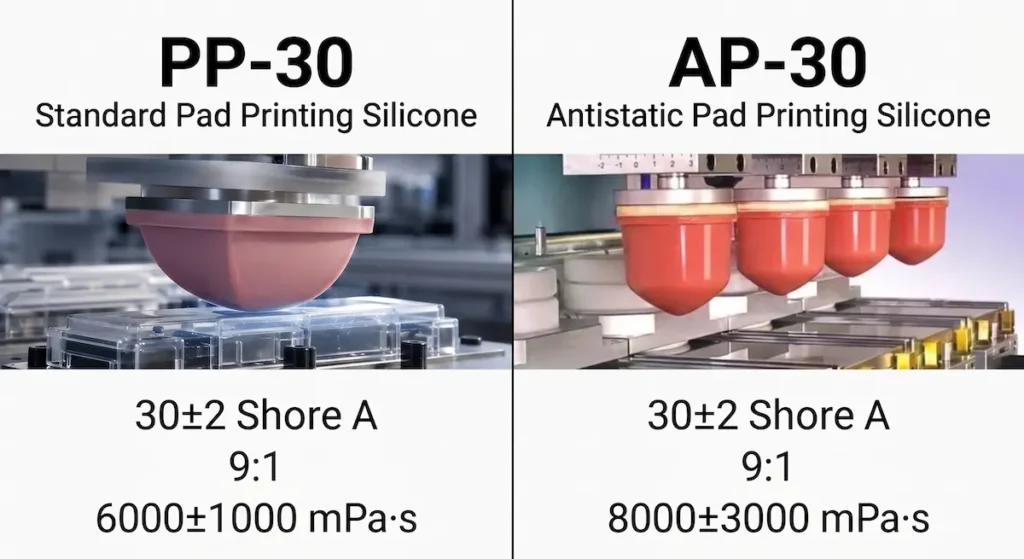
Topsil silicone currently offers two primary starting directions for pad manufacturers:
- PP-30 — standard pad printing silicone
- AP-30 — antistatic pad printing silicone
| Mülkiyet | PP-30 | AP-30 |
| Typical application | Standard printing pads | Antistatic printing pads |
| Sertlik | 30 ± 2 Shore A | 30 ± 2 Shore A |
| Mixing ratio | 9A : 1B | 9A : 1B |
| Viskozite | 6,000 ± 1,000 mPa·s | 8,000 ± 3,000 mPa·s |
| Working time at 25°C | 20–30 min | 20–30 min |
| Cure time at 25°C | 4–6 h | 4–6 h |
| Yırtılma mukavemeti | ≥20 kN/m | ≥22 kN/m |
| Çekme mukavemeti | ≥7.2 MPa | ≥7.6 MPa |
| Uzama | ≥420% | ≥420% |
View the complete Topsil silicone Pad Printing Silicone specifications →
These values are useful for shortlisting a candidate.
They do not mean every pad should be used at approximately 30 Shore A.
For many pad manufacturers, the final hardness is adjusted with silicone oil.
And this is where formulation becomes especially important.
How Silicone Oil Changes Pad Hardness: Topsil silicone Test Data
Silicone oil is commonly used in printing-pad manufacture to reduce the hardness of the cured pad.
Industry suppliers such as Elkem also describe RTV printing-pad systems whose hardness can be adjusted through silicone-oil dilution.
Topsil silicone has internal hardness-adjustment reference data using A100 silicone oil.
How the Dosage Is Calculated
The percentages below are calculated based on the total mixed weight of Part A + Part B silicone before the silicone oil is added.
Örneğin:
- Part A + Part B total mixed silicone = 10 kg
- A100 dosage = 20%
- A100 silicone oil added = 2 kg
The final formulation therefore weighs 12 kg.
Başka bir deyişle:
20% oil addition means 20% of the A+B silicone weight—not 20% of the final A+B+oil formulation.
Topsil silicone A100 Hardness-Adjustment Reference
| A100 silicone oil addition* | Approx. cured hardness |
| 10% | ~25 Shore A |
| 20% | ~19 Shore A |
| 30% | ~13 Shore A |
| 40% | ~9 Shore A |
| 50% | ~6–7 Shore A |
| 60% | ~4 Shore A |
| 70% | ~2 Shore A |
*Percentage based on the total mixed weight of Part A + Part B silicone.
What Can We Learn From This Test?
First, silicone-oil addition can change finished-pad hardness dramatically.
Second, the relationship is clearly not linear.
Moving from 10% to 20%, for example, does not produce the same hardness reduction as moving from 60% to 70%.
This means hardness adjustment should be based on actual formulation data rather than a simple assumption such as:
“Every additional 10% oil reduces hardness by X Shore A.”
It does not.
What This Test Does Not Prove
This distinction is important.
The test series above measured the resulting Shore A sertlik.
Topsil silicone has not yet measured tensile strength, tear strength and elongation at every A100 dosage shown in this table.
Therefore, we do not claim that a pad containing 30%, 50% or 70% A100 retains the original mechanical properties listed on the unmodified PP-30 or AP-30 TDS.
Hardness data demonstrates hardness change. It does not prove unchanged mechanical performance.
This is why an oil-adjusted formulation should be treated as a new pad formulation and validated accordingly.
Don’t Choose Silicone Oil Only to Reach a Shore Number
Suppose a manufacturer needs a finished pad of approximately 13 Shore A.
The Topsil silicone reference data suggests that around 30% A100, based on total A+B mixed silicone weight, may be a practical starting reference in the tested system.
But reaching 13 Shore A is not the final qualification.
The next questions are:
- Does the pad deform correctly?
- Does it recover consistently?
- Does it tear prematurely?
- Is ink pickup and release acceptable?
- Does it maintain image geometry?
- How many useful production cycles does it achieve?
The correct development sequence is therefore:
Select Base Silicone → Add Oil → Cure → Measure Hardness → Make Pad → Print → Evaluate Pad Life
not:
Add Oil → Reach Shore Number → Approve
For commercial production, the finished pad—not the hardness number—is the final product.
Standard or Antistatic Pad Printing Silicone?
Not every printing pad needs an antistatic formulation.
Antistatic silicone becomes relevant when static is an actual process issue, such as:
- Dust attraction
- Recurring electrostatic buildup
- Static-sensitive electrical or electronic parts
- Printing environments where static interferes with production
For example, WACKER ELASTOSIL® RT 402 is specifically positioned as an antistatic silicone system for printing-pad manufacture.
Topsil silicone offers AP-30 for applications where antistatic behavior is required.
View Topsil silicone Antistatic Pad Printing Silicone →
The selection principle is simple:
Use antistatic silicone to solve a real static problem—not because “antistatic” sounds like a higher-grade material.
For applications without meaningful static issues, standard pad silicone may remain the more appropriate starting point.
Addition-Cure or Condensation-Cure?
Both cure chemistries are used commercially for manufacturing printing pads.
For example, WACKER offers:
- ELASTOSIL® RT 623 A/B, an addition-curing RTV-2 silicone for printing pads
- ELASTOSIL® RT 402, a condensation-curing antistatic pad silicone
This is a useful reminder that cure chemistry should not be treated as a simple quality label.
Instead, compare the actual grade for:
- Processing behavior
- Working and cure time
- Küçülme
- Mechanical properties
- Hardness adjustment
- Static requirement
- Final printing performance
For a deeper comparison, see:
Platinum-Cure vs Tin-Cure Silicone →
How to Compare Two Pad Printing Silicone Suppliers
When qualifying a second source or replacing an existing silicone, do not compare only:
Shore hardness + price/kg
Use a consistent qualification table.
| Parameter | Current Supplier | Candidate A | Candidate B |
| Product grade | |||
| Cure type | |||
| Hardness + Shore scale | |||
| Mixing ratio | |||
| Viscosity + test condition | |||
| Çalışma süresi | |||
| Cure/demold time | |||
| Yırtılma mukavemeti | |||
| Çekme mukavemeti | |||
| Uzama | |||
| Silicone-oil compatibility | |||
| Oil-adjustment data | |||
| Antistatic option | |||
| Batch consistency | |||
| TDS/SDS/COA | |||
| Sample support | |||
| Technical matching support | |||
| Price/kg |
Then manufacture comparison pads under controlled conditions.
Whenever possible, keep the following unchanged:
- Pad mold
- Silicone-oil dosage
- Cure condition
- Cliché
- Ink
- Substrate
- Machine settings
This makes it much easier to determine whether performance changes actually come from the silicone.
Compare Cost per Usable Pad—not Only Price per Kilogram
Printing-pad manufacturers ultimately produce pads, not kilograms of liquid silicone.
A more meaningful purchasing metric is therefore:
Effective Cost per Usable Pad
Silicone cost
- Silicone oil/additives
- Pad-making labor
- Rejected pad cost
- Replacement/downtime cost
= Effective Pad Cost
For higher-volume applications, the comparison can go further:
Cost per 10,000 Acceptable Prints
A cheaper raw material may become more expensive if it creates more rejected pads or fewer usable printing cycles.
Likewise, a more expensive silicone is not automatically the better material.
The correct purchasing question is:
Which formulation delivers the required print quality and useful pad life at the best total production cost?
This is a more useful metric than comparing USD/kg alone.
A Practical Pad Printing Silicone Qualification Workflow
The complete selection process can now be reduced to ten practical steps:
Step 1 — Define the substrate
What material and surface are being printed?
Step 2 — Define part geometry
Flat, curved, recessed, textured or irregular?
Step 3 — Define the image
How large and how detailed is it?
Step 4 — Review pad design
Shape, dimensions, volume and compression behavior.
Step 5 — Establish the hardness direction
Always state the Shore scale.
Step 6 — Review the full TDS
Hardness, viscosity, working time, tear, tensile and elongation.
Step 7 — Decide whether silicone-oil adjustment is required
Use actual hardness-adjustment data as a starting reference.
Step 8 — Determine whether antistatic functionality is required
Choose standard or antistatic formulation based on the process.
Step 9 — Make controlled trial pads
Keep other variables as consistent as possible.
Step 10 — Approve based on production results
Evaluate print quality, failure mode and useful pad life.
A TDS selects the candidate. A controlled pad trial qualifies the formulation.
Frequently Asked Questions About Pad Printing Silicone
Can Topsil silicone match my existing WACKER, Elkem or other silicone?
A technical match can normally begin from the existing TDS, but final qualification requires more information.
For the most useful starting recommendation, provide:
- Current supplier and grade
- TDS
- Hardness + Shore scale
- Silicone-oil dosage
- Pad dimensions/photo
- Printed substrate
- Current problem
- Required improvement
The candidate should then be validated through a controlled pad-production and printing trial.
Need to Match Your Current Pad Printing Silicone?
If you manufacture silicone printing pads, don’t send only:
“Please quote 30 Shore silicone.”
Send Topsil silicone:
Current silicone grade + TDS + hardness/scale + silicone-oil dosage + pad photo/drawing + printed part + current problem + estimated consumption.
This allows us to identify a much more meaningful starting material for your trial.
Match My Current Pad Silicone →
Request a Trial Sample →
View PP-30 & AP-30 Technical Data →
Explore Antistatic Pad Printing Silicone →
Technical References
ASTM International ASTM D2240 — Standard Test Method for Rubber Property—Durometer Hardness Reference for durometer hardness measurement and comparison between hardness scales.
TAMPOPRINT Printing Pads Industry reference on the interaction between silicone properties, pad shape, hardness and pad volume.
Elkem Silicones for Pad Printing Industry reference for printing-pad RTV silicone and hardness adjustment using silicone oil.
WACKER ELASTOSIL® RT 623 A/B Example of an addition-curing RTV-2 silicone developed for printing-pad production.
ELASTOSIL® RT 402 Example of a condensation-curing antistatic printing-pad silicone.
About Topsil silicone
Topsil silicone supplies RTV-2 silicone rubber for pad printing, industrial mold making, casting, prototyping, electronics and other manufacturing applications.
For printing-pad manufacturers, our approach is application-driven: first understand the existing pad, formulation, printing conditions and performance target—then identify an appropriate material and formulation direction for controlled testing.