
Hızlı Cevap
To select silicone gel for HEPA and ULPA filter sealing, first screen candidates against your housing design, equipment and service requirements. Then compare supplier data under equivalent test conditions, qualify shortlisted gels on actual assemblies, and approve the material together with its production settings.
The purchasing decision starts before a sample reaches your factory. Two products described as “soft, 1:1 silicone gel” may require different dispensing settings, handling schedules or qualification work.
This guide explains how to move from competing quotations to a justified material choice. For sealing principles, application instructions and troubleshooting, use our HEPA and ULPA filter silicone gel guide.
Define What the New Gel Must Achieve
Write a short project brief before comparing grades. For a replacement material, identify what must improve and what must stay compatible: filling time, seal behavior, equipment, consumption or supply availability. For a new design, establish the intended housing interface first.
This guide concerns soft gel used at the filter-to-housing interface. Media-to-frame potting is a separate material-selection task. For a structural reference, find the Gel Seal Identification Guide for HEPA/ULPA Filters in MANN+HUMMEL’s official download library.
Separate requirements into two groups:
- Must meet: compatible sealing geometry, feasible metering, required handling schedule, specified service exposures and customer acceptance requirements.
- Can optimize: purchase price, dispensing speed, packaging convenience and process waste, within those constraints.
A low price cannot compensate for a failed mandatory requirement. Record missing information as “unconfirmed” and assign a next step. Missing evidence requires clarification; it does not automatically establish material failure.
Obtain Comparable Supplier Data Before Ordering Samples
Request the current technical data sheet, safety data sheets for both components and mixing instructions before handling or testing. Give each supplier the same project brief so the proposed materials address the same requirements.
Use this checklist to compare the responses:
| Data to request | How to use it in selection |
| A ratio and whether it is by weight or volume | Check whether your weighing or metering system can deliver it accurately. |
| Component and mixed viscosities, with test conditions | Assess equipment suitability and compare values at matching temperatures and methods. |
| Cured softness, method and specimen conditions | Compare like-for-like measurements; request clarification where scales differ. |
| Working, handling and final-cure information | Match the usable dispensing window and movement schedule to your line. |
| Mixed density | Convert channel volume into material weight for trial planning. |
| Relevant exposure reports and application limits | Identify whether mandatory service requirements have supporting evidence or need testing. |
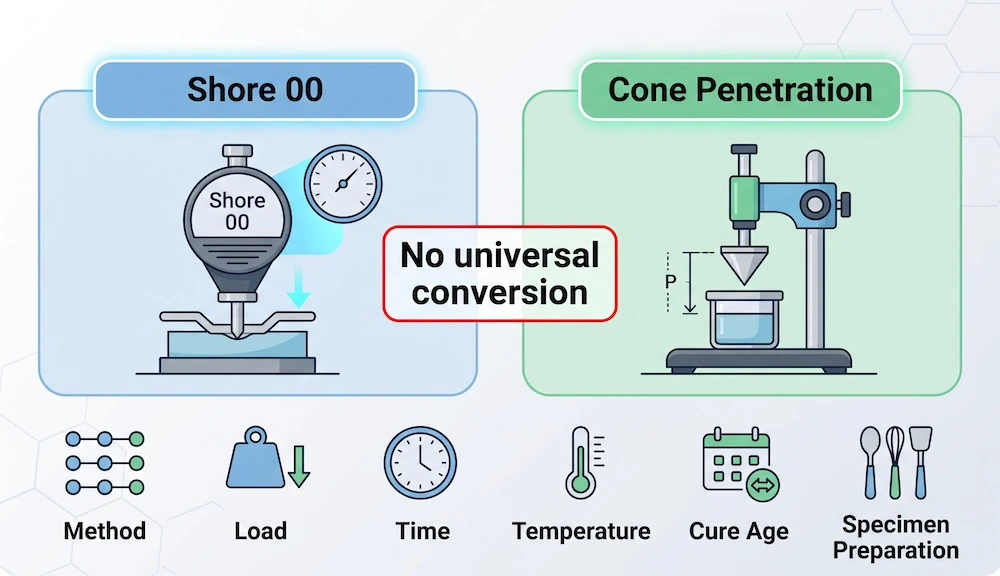
Very soft silicone gels may be unsuitable for meaningful Shore A measurement. Shore 00 or penetration testing may be more appropriate, depending on the material. WACKER explains these distinctions in its RTV silicone material and processing guidelines.
Do not apply a generic conversion between these measurements. Ask for the probe or cone, load, measurement time, temperature, cure age and specimen preparation before ranking candidates by softness.
Where documents disagree, ask the supplier to identify the revision applicable to your sample. Do not build a trial around whichever number appears most favorable.
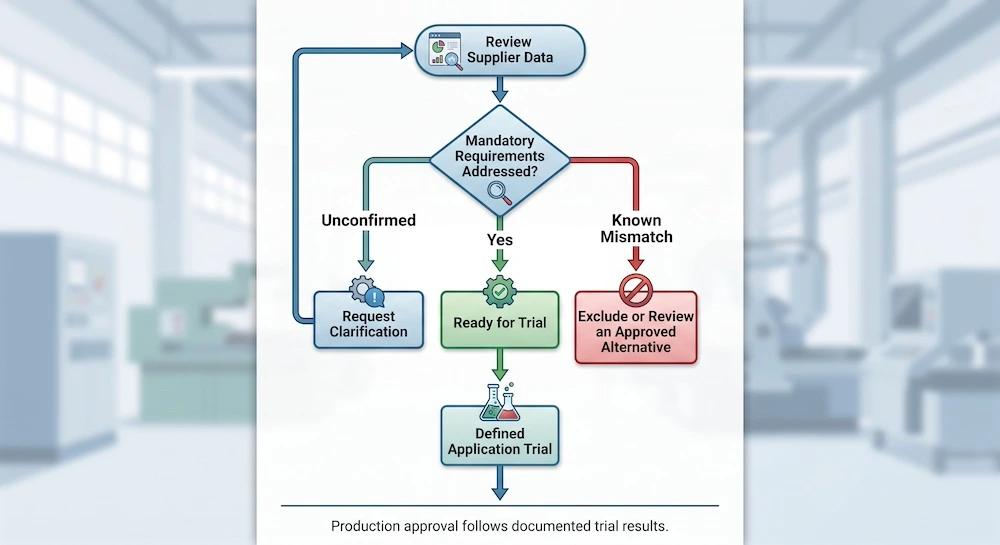
Decide Which Candidates Deserve a Trial
A useful shortlist connects each unresolved question to an action. Use the following decision table before committing equipment time and filter frames.
| Your situation | Selection action |
| The stated mixing ratio differs from your machine setup | Confirm an approved equipment adjustment or alternative grade before line testing. |
| Suppliers report softness using different methods | Arrange comparable measurements or assess samples using the same assembly procedure. |
| Filters must move during the same shift | Request handling-cure evidence at the intended temperature; final-cure data alone is insufficient. |
| Production includes frequent stops | Include pause-and-restart testing and compare purge waste. |
| Frame coatings or adjacent adhesives are unfamiliar | Include contact-cure screening before filling complete filters. |
| The application specifies chemical exposure or contamination limits | Review grade-specific evidence and agree how remaining requirements will be verified. |
Mark each candidate ready for trial, awaiting clarificationveya excluded from this project. Keep the reason beside the status so engineering and purchasing use the same shortlist.
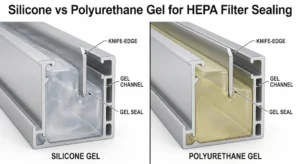
If replacing polyurethane, define the intended improvement before comparing silicone grades. Our silicone gel versus polyurethane gel comparison covers the broader material choice. A change of chemistry should have a clear project objective and qualification plan.
Design a Trial That Produces a Buying Decision
Set the test method, acceptance criteria and decision owner before dispensing. This prevents a visually attractive sample from receiving approval without evidence for the actual production requirement.
Establish a fair comparison
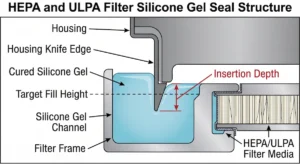
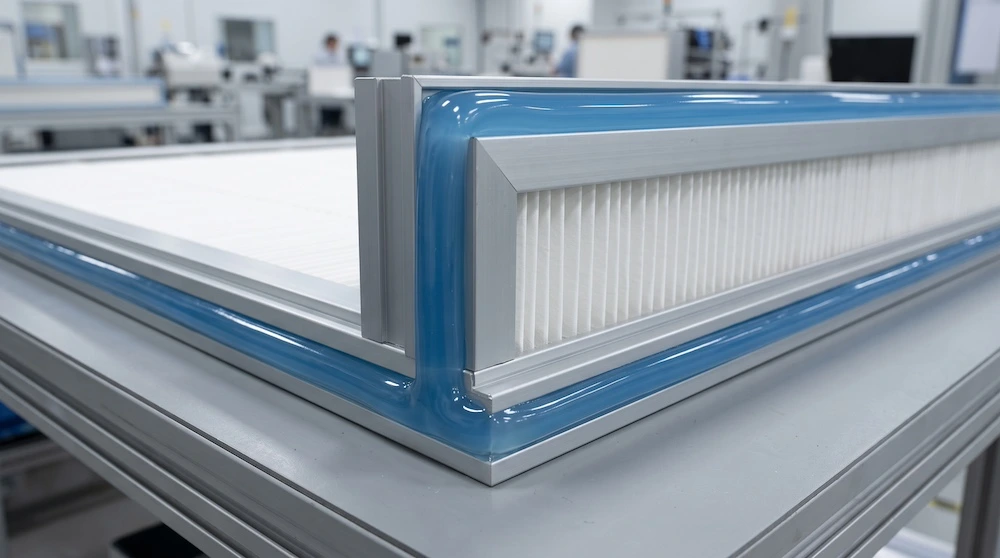
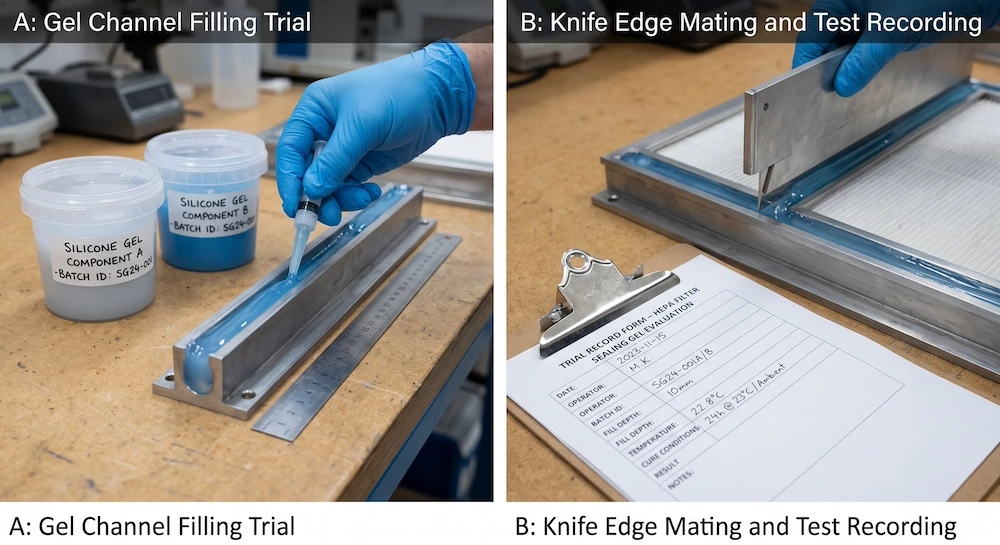
Use representative frames and mating knife edges. Control channel geometry, target fill height, insertion depth and relevant surface preparation. Allow for gel displacement during insertion instead of assuming a channel filled to its rim is appropriate.
Follow each material’s approved mixing and cure instructions. Record actual material temperature, batch and settings. Equivalent evaluation conditions do not require forcing every formulation through an identical cure schedule.
For a replacement project, include the current approved material as a reference where practical. Keep the initial comparison focused; changing the frame, dispensing process and gel simultaneously makes the cause of differences harder to identify.
Separate three approval questions
Can it run on the line? Evaluate ratio control, filling consistency, corner coverage, bubbles, restart behavior and when filters can move without disturbing the gel.
Can it form an acceptable seal? Assess cure against actual contact surfaces, knife-edge insertion, gel retention and leakage using the specified assembly procedure. Include removal and reinstallation only where the intended maintenance procedure requires them.
Can it retain performance in service? Apply the project’s relevant temperature, humidity, chemical or contamination evaluations, then repeat the required sealing checks.
Document the leakage-test method and acceptance limit for the filter and housing arrangement. Factory and installed-system tests can have different scopes; include the stages required by the project. A successful material test is one part of qualification.
Order enough material to complete the comparison
For a ten-filter trial, allow for channel filling, mixing or dispensing setup, purging and planned repeat tests. Use measured channel dimensions and mixed density for the estimate. A standard sample pack is not automatically sufficient for a particular trial.
Turn Trial Results into an Approval Decision
Conclude the trial with one of three documented outcomes:
- Approve for the defined process: mandatory criteria are met, and the material runs within an achievable operating window.
- Adjust and retest: a specific, correctable issue has been identified. State the change and the tests that must be repeated.
- Reject for this project: a mandatory requirement remains unmet within the permitted design and process constraints.
For example, if a gel meets sealing requirements but produces excessive purge waste, investigate the dispensing setup or working-time fit before purchase approval. If handling remains too slow for the required schedule, confirm whether an approved cure adjustment is practical or select another candidate.
Avoid accepting a broad “passed” statement without the associated settings. Record the approved grade, document revision, mixing basis, fill specification, temperature range, cure schedule and acceptance procedure together.
Before releasing routine purchasing, agree on supply tolerances, batch traceability, available batch documentation, remaining shelf life at delivery and notification of relevant material changes. Typical TDS values and contractual acceptance limits serve different purposes.
Compare Cost per Accepted Filter
Evaluate price after the candidates meet mandatory requirements. The purchasing unit may be kilograms, but the useful production comparison is the cost of producing an accepted filter.
Material cost per accepted filter = total gel consumed during the run × price per kilogram ÷ accepted filters produced.
Use consistent accounting for recoverable material and equipment inventory. Then consider labor, curing-space requirements, rejects, rework and any equipment changes.
For an illustrative material-only comparison, consumption of 0.32 kg at $10/kg costs $3.20 per accepted filter. Consumption of 0.28 kg at $11/kg costs $3.08. These are hypothetical figures, not TP-012 performance data or a claim that one chemistry uses less material.
The example shows why unit price needs production context. Do not reduce the approved fill level simply to improve the cost calculation.
When to Include TP-012 in Your Shortlist
Topsil Silicone TP-012 silicone gel for air filter sealing is a pourable, two-part addition-cure RTV-2 material that cures at room temperature into a very soft gel. It is available in crystal-clear or blue versions.
These characteristics make it a candidate for projects seeking a pourable gel for a compatible HEPA or ULPA sealing channel. Equipment fit, handling requirements and service conditions determine whether it should progress to your trial.
The TP-012 technical data sheet, revision 2026-08-14, lists a typical mixed density of 0.95 g/cm³ at 25°C. This provides a starting point for converting channel volume into sample weight; setup and trial losses must be added separately.
Ask for the current TDS and HEPA/ULPA sample test guidance when arranging an evaluation. Identify any special exposure or documentation requirement at the inquiry stage so it can be reviewed before the sample plan is finalized.
Get Help Selecting a Trial Grade
To start a discussion with Topsil Silicone, send:
- Your current material or the problem the new gel should solve.
- Whether you mix and dispense manually or automatically.
- A frame drawing or dimensioned photo, if available.
Get Help Selecting a Trial Grade
You can contact us before all dimensions are confirmed. We can review the available information, identify the remaining technical questions and help estimate a trial quantity once the channel details are available.