
Hızlı Cevap
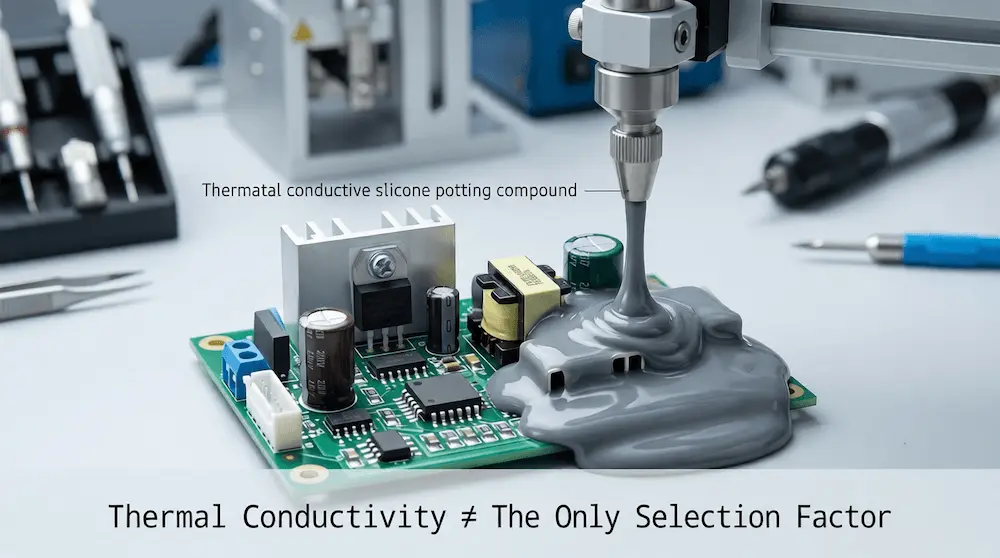
A thermally conductive silikon saksı bileşiği is used when electronic components need both heat dissipation and electrical insulation. It is commonly applied in LED drivers, power supplies, transformers, sensors, control modules, outdoor electronics and other heat-generating electronic assemblies.
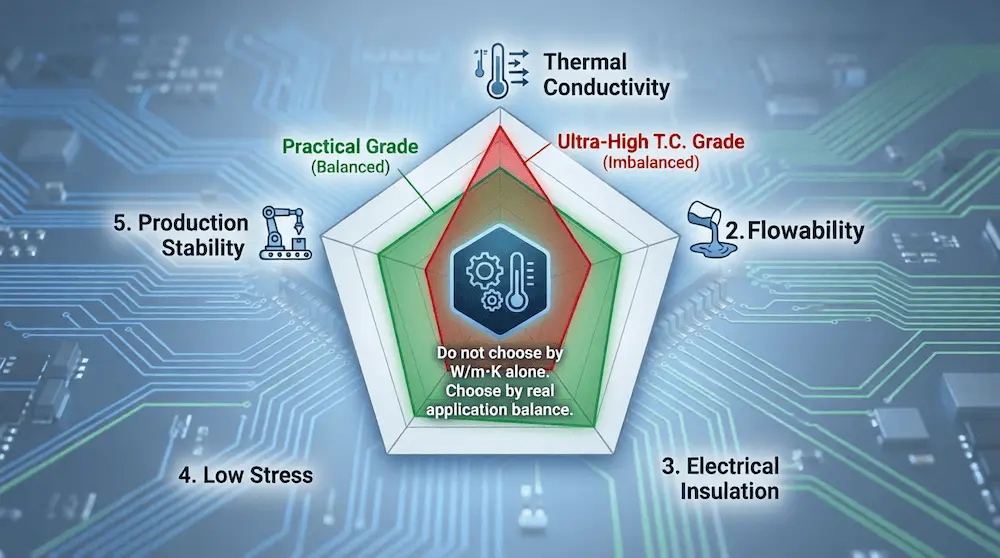
However, choosing the right material is not as simple as selecting the highest thermal conductivity value on a TDS.
In real electronic potting, the best compound must balance:
- thermal conductivity
- viscosity and flowability
- electrical insulation
- cured hardness
- low stress on components
- pot life and cure time
- bubble control
- production stability
- long-term reliability
For most applications, a material with balanced thermal transfer, good flowability and low component stress can perform better than a very high W/m·K product that is difficult to process.
Why Thermal Silicone Potting Selection Often Goes Wrong
Many buyers start with one question:
“Can you offer 1.0 W/m·K, 1.5 W/m·K or 2.0 W/m·K?”
This question is important, but it is not enough.
A thermally conductive silicone potting compound may still fail in real production if:
- it is too viscous to fill narrow PCB gaps
- bubbles remain under transformers or large components
- the cured silicone is too hard and stresses solder joints
- the pot life is too short for the dispensing process
- the cure time slows down production
- the material does not meet insulation or flame-retardant requirements
- the sample test works, but mass production becomes unstable
That is why selection should start from the real application, not from W/m·K alone.
Practical selection principle: Choose thermal silicone by balancing heat path, flowability, insulation, hardness and production process.
When Do You Need a Thermally Conductive Silicone Potting Compound?
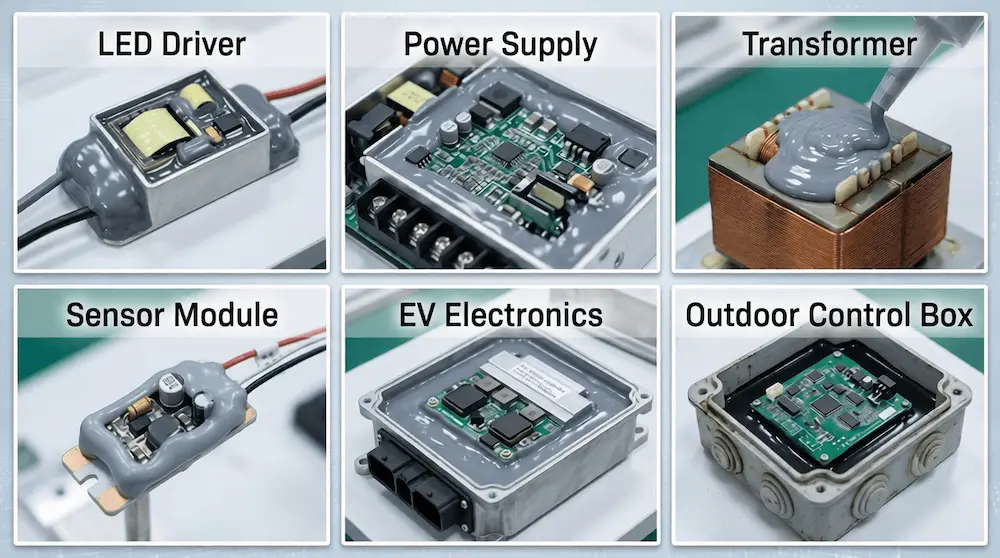
A standard RTV silicone potting compound can already provide moisture protection, electrical insulation, vibration resistance and flexible encapsulation.
If your electronic module does not generate much heat, a standard potting silicone may be enough.
A thermally conductive silicone potting compound is usually needed when the device has a clear heat source and heat must be transferred away from the components.
Common heat-generating parts include:
- LED drivers
- transformers
- power supplies
- MOSFETs
- IGBTs
- resistors
- relays
- inverters
- EV charging modules
- compact power control boards
The need becomes stronger when the module is sealed, used outdoors, exposed to continuous load or installed in a compact housing with limited air circulation.
| Uygulama | Buyer’s Real Concern | What to Check Before Sampling |
| LED driver | Heat build-up in sealed housing | Thermal conductivity, viscosity, flame retardancy, cure speed |
| Power supply | Heat, insulation and production stability | Dielectric strength, hardness, pot life, flowability |
| Transformer | Heat, vibration and electrical safety | Bubble release, insulation, hardness, potting depth |
| Sensor module | Moisture protection and low stress | Softness, adhesion, thermal need, cure condition |
| Outdoor control box | Waterproofing and temperature cycling | Weather resistance, insulation, thermal transfer |
| EV-related electronics | High power density and thermal cycling | Higher thermal conductivity, low stress, aging test |
| Solar inverter / junction box | Outdoor aging and heat dissipation | Thermal conductivity, insulation, environmental resistance |
Buyer note: If your product does not have a real heat problem, do not choose a high thermal grade only because the number looks better. It may increase cost and processing difficulty without improving actual performance.
How Thermally Conductive Silicone Potting Compound Works
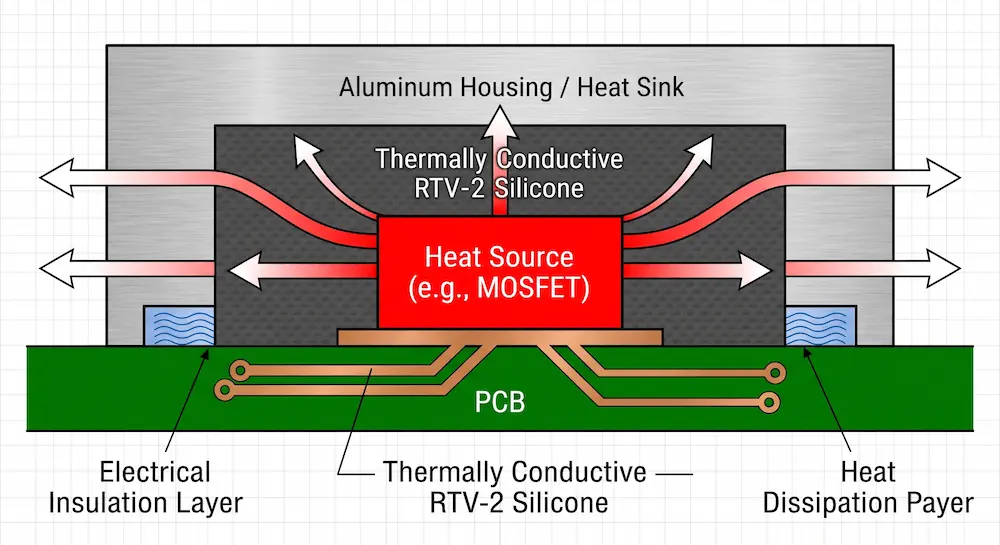
A thermally conductive silikon saksı bileşiği is usually a two-component silicone system filled with thermally conductive but electrically insulating fillers.
After Part A and Part B are mixed, the compound flows around the electronic components and cures into a flexible protective elastomer. The cured silicone helps transfer heat from the heat source to the surrounding structure, such as an aluminum housing, heat sink, metal base or enclosure wall.
At the same time, it protects electronics from:
- moisture
- dust
- vibration
- electrical leakage
- thermal shock
- mechanical stress
Compared with rigid materials, silicone can better absorb expansion and contraction caused by temperature changes. This helps reduce stress on solder joints, wires and sensitive components.
This is one of the main reasons silicone is often selected for electronic modules that need both thermal management and flexible protection.
Read More: How to Choose Silicone Potting Compound for Electronics
5 Key Factors That Decide Real Performance
1. Termal İletkenlik
Thermal conductivity is usually expressed in W/m·K. It shows how effectively the material can transfer heat.
But the required value depends on the heat source, potting thickness, contact area, housing material and target temperature rise.
| Thermal Conductivity Direction | Suitable Application | Practical Selection Logic |
| Around 0.6–1.0 W/m·K | LED drivers, small power modules, general electronics | Easier flow, lower viscosity, better processability |
| Around 1.0–1.5 W/m·K | Power supplies, transformers, sealed modules | Balanced heat transfer and production stability |
| 2.0 W/m·K or higher | High-power electronics, EV-related modules, compact power devices | Better thermal path, but viscosity and dispensing must be checked carefully |
A higher value may be necessary for high-power electronics, but it should always be verified through real temperature testing in the final device.
ASTM D5470 thermal transmission test method
2. Viscosity, Flowability and Bubble Control
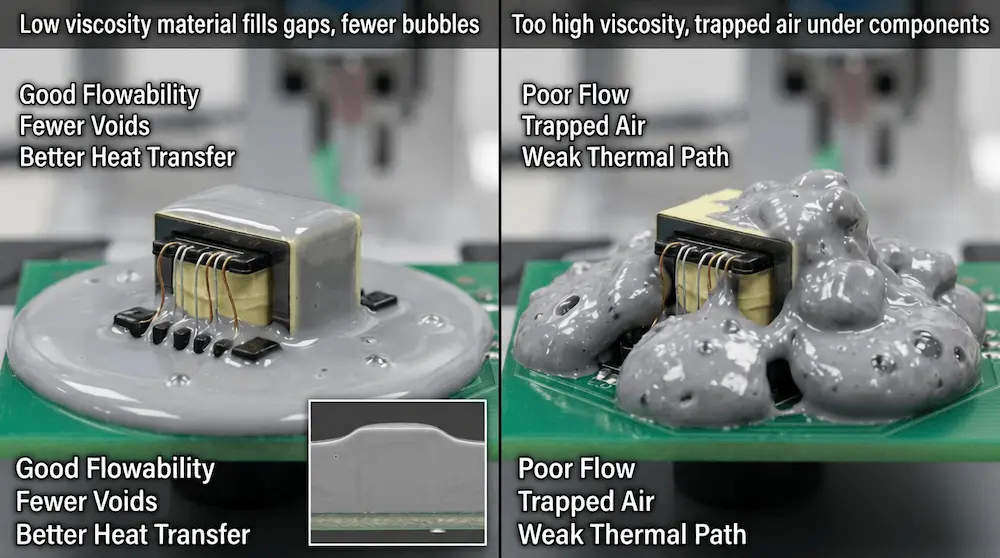
Thermal fillers increase the viscosity of silicone systems. Higher filler loading may improve thermal conductivity, but it can also make the compound harder to flow, degas and dispense.
This matters especially for:
- dense PCB layouts
- narrow gaps
- deep potting structures
- transformer encapsulation
- connector modules
- automatic dispensing lines
- vacuum potting processes
If the compound is too thick, it may trap bubbles or leave empty spaces around components. These voids can reduce insulation reliability and weaken heat transfer.
For automatic dispensing, viscosity must also match:
- static mixer
- dispensing pressure
- tube diameter
- needle size
- saksı hayatı
- production speed
Selection tip: For complex PCB assemblies, flowability can be just as important as thermal conductivity.
3. Hardness and Component Stress
Cured hardness affects how the material protects the electronics.
Softer thermal silicone is usually better for:
- sensitive components
- solder joints
- wires and connectors
- vibration resistance
- thermal cycling
- düşük stresli kapsülleme
Harder thermal silicone can provide stronger mechanical support, but it may also transfer more stress to components during heating and cooling.
If the product works in an environment with frequent temperature changes, low-stress protection is very important.
Buyer note: Do not choose a harder potting compound only because it feels stronger. For electronics, flexibility is often part of the protection.
4. Electrical Insulation and Flame Retardancy
A thermal potting material must transfer heat without sacrificing electrical safety.
IEC 60243-1 dielectric strength test method
Before approval, buyers should check:
- dielectric strength
- volume resistivity
- dielectric constant
- operating voltageinsulation distance
- moisture resistance
- aging performance
This is especially important for LED drivers, transformers, power supplies, inverters and high-voltage electronic modules.
For some enclosed electrical products, flame-retardant performance may also be required. If UL94 V-0 or a similar requirement is needed, ask for actual test data instead of relying only on verbal claims.
Selection tip: Thermal performance, insulation performance and flame-retardant requirements should be checked together, especially for power electronics. Read here: UL flammability testing
5. Pot Life, Cure Time and Production Stability
- A material with good cured properties may still fail in production if the working time does not match the process.
Before choosing a grade, confirm:
- manual potting or automatic dispensing
- batch size
- required working time
- room temperature cure or heat-accelerated cure
- handling time after potting
- time before packing or testing
- production line speed
For manual potting, a longer pot life may be easier to control. For mass production, faster curing may improve efficiency, but the pot life must still be long enough for stable dispensing.
Buyer note: The right thermal silicone potting compound must fit both the product design and the production line.
Silicone vs Epoxy vs Polyurethane for Thermal Potting
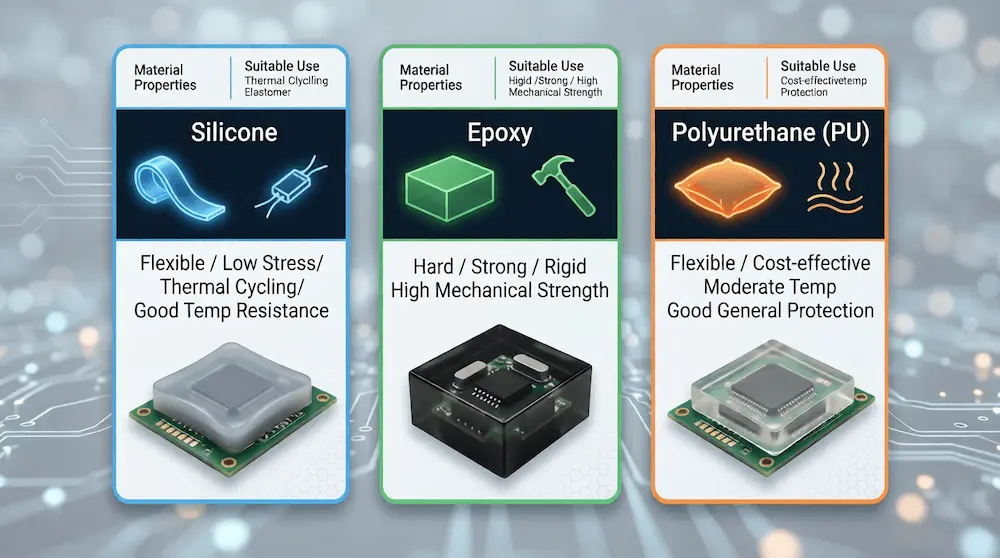
Thermal silicone is not the only potting material. Epoxy and polyurethane are also used in electronics.
Silicone is often preferred when electronics need heat dissipation, flexibility, insulation and long-term protection under changing temperatures.
Epoxy may be more suitable when high mechanical strength and rigid encapsulation are required. Polyurethane may be considered for cost-sensitive general potting applications with moderate temperature requirements.
Common Mistakes When Selecting Thermal Silicone Potting Compound
Mistake 1: Only Comparing W/m·K
Thermal conductivity is important, but it does not decide everything. If the compound cannot fill the potting area properly, the real heat transfer may be poor.
Mistake 2: Ignoring Potting Structure
A material that works in a shallow sample cup may behave differently in a deep or complex housing. Potting depth, component layout and heat path all affect final performance.
Mistake 3: Overlooking Viscosity
High viscosity may trap air under transformers, around connectors or between PCB components. This can reduce both insulation reliability and thermal transfer.
Mistake 4: Choosing Too Hard a Material
A hard material may create stress during thermal cycling. This can affect solder joints, wires and sensitive components.
Mistake 5: Forgetting Safety Requirements
For LED drivers, power supplies and enclosed electrical modules, dielectric strength and flame-retardant requirements should be confirmed before mass production.
Mistake 6: Testing Only Cure, Not Real Performance
A sample test should not only check whether the silicone cures. It should also test flowability, bubbles, temperature rise, insulation and reliability in the actual housing.
What Information Should You Send Before Requesting a Sample?
To recommend a suitable thermally conductive silicone potting compound, a supplier needs more than the target W/m·K.
Before requesting a quotation or sample, prepare the following information:
- Application: LED driver, power supply, transformer, PCB, sensor, EV module, etc.
- Product size and potting depth
- Main heat source
- Housing material: plastic, aluminum, metal, etc.
- Required thermal conductivity, if already specified
- Target temperature rise, if available
- Required hardness after curing
- Required viscosity or flowability
- Manual potting or automatic dispensing
- Pot life and cure time target
- Working temperature range
- Operating voltage and insulation requirements
- Flame-retardant requirement, such as UL94 V-0
- Color requirement: white, grey, black, translucent or other
- Current material problem, if any
- Estimated monthly or annual usage
The more clearly you describe the application, the easier it is to select a practical grade for testing.
How to Test a Thermally Conductive Silicone Potting Compound
Before approving a material, test it under conditions close to the real product and production process.
Recommended test items include:
- mixing and dispensing performance
- flowability in the actual housing
- bubble release
- curing time
- hardness after curing
- temperature rise test
- dielectric strength
- volume resistivity
- adhesion to PCB or housing
- thermal cycling
- damp heat aging
- vibration resistance
- flame-retardant testing, if required
The most important question is not only whether the material meets the TDS. The real question is whether it works reliably in your product, your process and your operating environment.
Topsil Silicone Practical Recommendation
As a 15+ years RTV-2 silicone manufacturer, Topsil Silicone usually suggests buyers evaluate thermally conductive silicone potting compound from three angles
- Material balance Does the silicone balance thermal conductivity, viscosity, hardness, electrical insulation and cure speed?
- Production process Can the material work with your manual potting, vacuum potting or automatic dispensing process?
- Product requirement What heat source, voltage, potting depth and working temperature does the electronic module have?
A high thermal conductivity value may help, but only if the compound can flow, cure and perform reliably in the real product.
If you are not sure which grade is suitable for your electronic module, send us your heat source, potting depth, target hardness, dispensing method, operating temperature and current material problem.
Topsil can help review your application conditions and recommend a practical RTV-2 silicone potting compound direction for testing.
FAQs About Thermally Conductive Silicone Potting Compound
Share your thermal conductivity target, viscosity requirement, hardness, potting depth and dispensing method. We will help check which RTV-2 silicone potting compound direction is more suitable for testing.