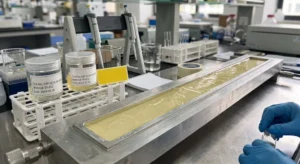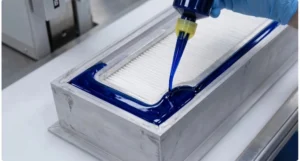
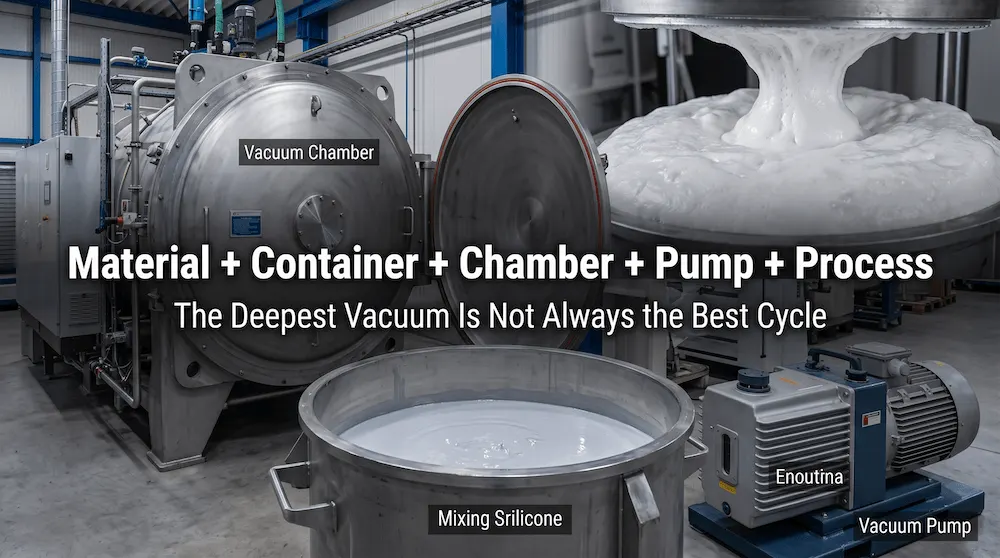

A vacuum process that works for a 2 kg laboratory batch can fail completely when the same platinum silicone is mixed in a 30 kg production batch.
The material may overflow before the target pressure is reached. Pump-down may consume too much of the working time. The chamber may remove most of the air, only for bubbles to be reintroduced during transfer and pouring.
At scale, the solution is rarely “use a stronger pump” or “apply a deeper vacuum.”
Successful production requires the silicone, container, vacuum chamber, pump, pressure profile and transfer method to work as one system.
The objective is not the deepest vacuum. It is a repeatable cycle that achieves the required bubble quality without excessive overflow, material loss, operator intervention or loss of working time.
This guide is intended for mold factories, PU casting workshops, rapid prototyping companies and industrial users moving from small-batch degassing to repeatable production.
Quick Answer: How Should Platinum Silicone Be Degassed at Scale?
Efficient platinum silicone degassing at scale requires a validated bubble-acceptance standard, sufficient container headspace, a vacuum chamber sized for temporary foam expansion, a pump selected by effective pumping speed, an absolute-pressure gauge and a controlled vacuum profile that fits within the silicone’s working time.
The process should be controlled by:
- Batch mass
- Mixed viscosity
- Material temperature
- Maximum foam rise
- Pump-down time
- Absolute pressure
- Foam-collapse behavior
- Transfer method
- Final defect rate
A fixed instruction such as “degas for three minutes” is not enough for reliable industrial production.
Production settings should preferably be recorded as absolute pressure in vacuum technology, such as mbar absolute or kPa absolute, rather than only as a percentage vacuum reading.
Six Questions to Ask Before Scaling Up
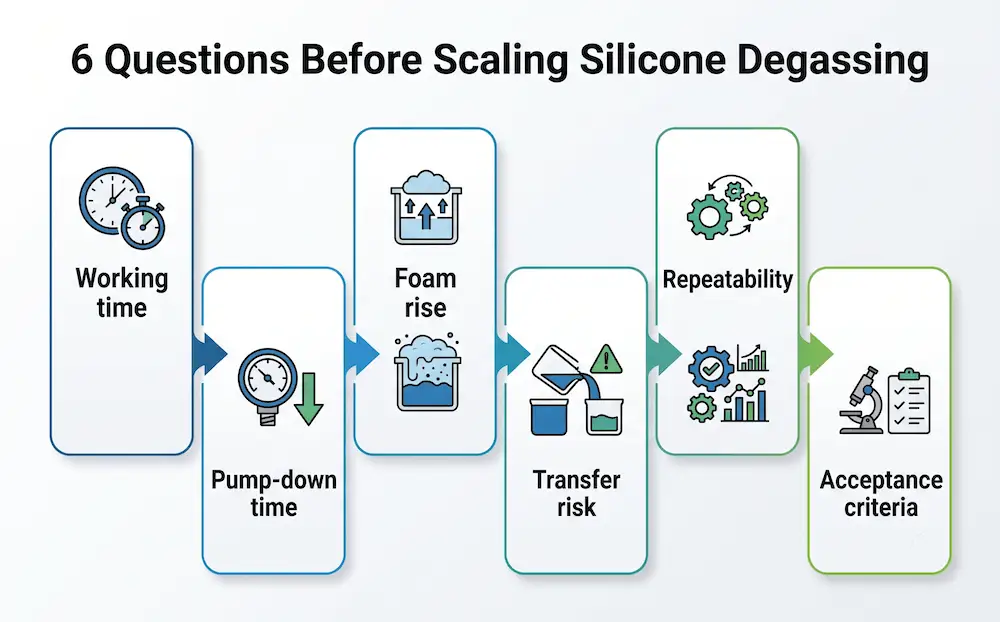
Before buying a larger chamber or pump, answer these six questions:
- How much usable working time remains after mixing?
- How long does the complete system take to reach the validated pressure?
- How high does the silicone foam rise at the maximum batch size?
- Can transfer or pouring reintroduce air after degassing?
- Can operators repeat the same temperature, pressure and timing window?
- What defect level defines an acceptable finished mold?
If these questions cannot be answered, the process is not yet ready for scale production.
Define the Bubble-Acceptance Standard First
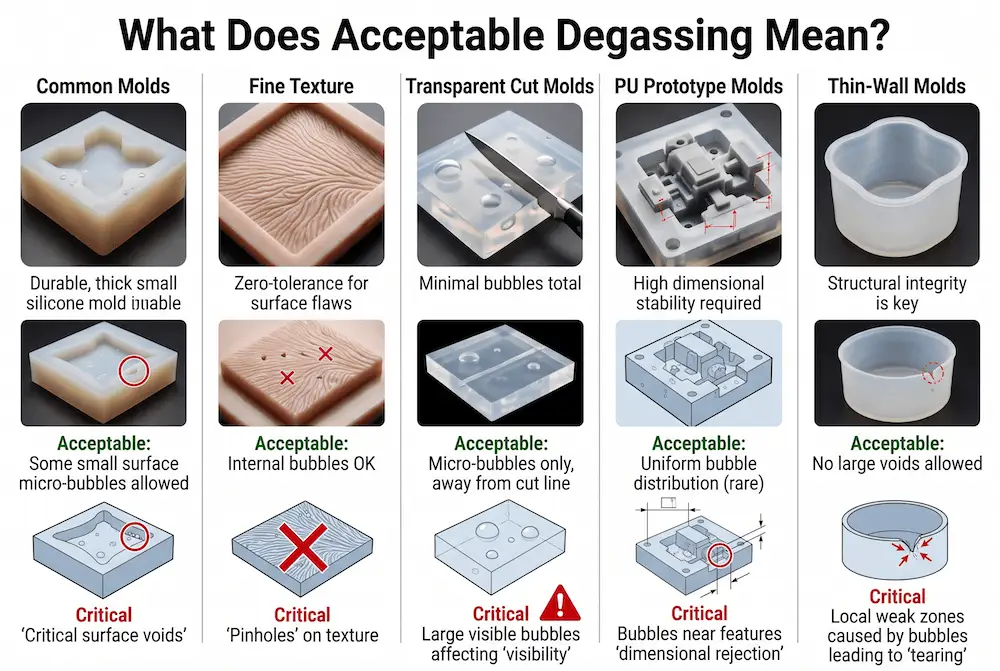
“Bubble-free” is not a precise industrial specification.
Different mold applications tolerate different levels and locations of air.
| Application | Possible Acceptance Check |
| General mold making | No visible voids in critical surface areas |
| High-detail mold | No pinholes on engraving, texture or fine features |
| Transparent cut mold | No bubbles obstructing cutting lines or master visibility |
| PU prototype mold | No voids causing dimensional or surface rejection |
| Thin-wall mold | No bubble clusters reducing local strength |
| Repeat industrial mold | Stable defect rate across multiple batches |
A clear surface does not prove that the full silicone mass is free from bubbles. Depending on the application, validation may include:
- Cured test coupons
- Cross-section inspection
- Transparent-cup observation
- Mold-surface inspection
- Casting defect rate
- Dimensional checks
- Comparison of mixed and cured density
Production settings should be approved against the final mold requirement—not only what the silicone looks like inside the chamber.
Not All Bubbles Have the Same Cause
Vacuum degassing mainly removes entrained air introduced during mixing and handling.
Entrained air commonly comes from:
- High-speed mixing
- Aggressive scraping
- Splashing
- Pumping
- Long pouring drops
- Poor filling paths
Other bubbles may be related to:
- Moisture
- Volatile contamination
- Reactions with the master or casting material
- Material deterioration
- Incorrect A/B mixing
- Cure inhibition
Applying a deeper vacuum will not correct incomplete mixing, moisture reactions or cure inhibition.
The first troubleshooting step is therefore to identify whether the defect is trapped air, reintroduced air or a chemical/process problem.
The simplified equation provides only a preliminary estimate of vacuum chamber pump-down time and must be verified using the real chamber, piping and silicone batch.
Why Laboratory Degassing Often Fails at Production Scale
- Foam volume grows beyond the available space
A larger batch produces a higher liquid level and may leave too little vertical clearance. The silicone can overflow before reaching the operating pressure.
- Pump-down consumes the processing window
- Batch temperature changes
Larger batches may receive more mixing energy and remain warmer. This can reduce viscosity but may also accelerate cure.
- Air is reintroduced after degassing
High pouring drops, splashing, narrow fittings or aggressive pumping can undo the work completed in the chamber.
- The vacuum line limits the pump
A pump with high nominal capacity may perform poorly when connected through a narrow hose, long pipe, restrictive filter or undersized valve.
- Operators follow time instead of measurable conditions
A fixed three-minute cycle may work for one batch and fail when viscosity, temperature, batch mass or pump condition changes.
Laboratory degassing is often time-based. Industrial degassing must be condition-based and repeatable.
Match the Silicone, Container, Chamber and Pump
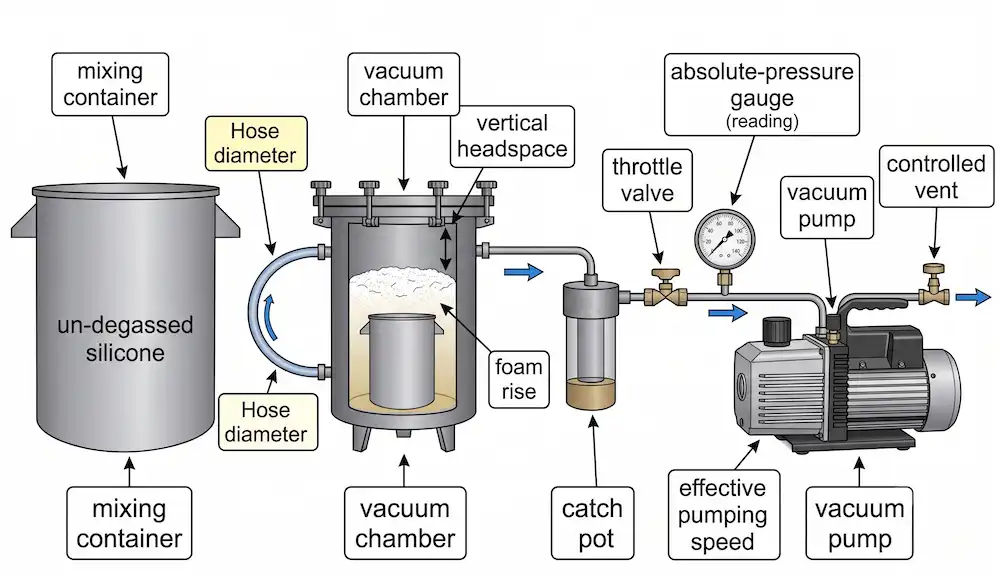
A reliable process starts by linking each equipment variable to its effect on silicone behavior.
| Equipment or Process Variable | Possible Silicone Consequence |
| Chamber too short | Foam reaches the lid or vacuum line |
| Container too full | Overflow before target pressure |
| Container too deep | Longer bubble escape path |
| Hose too narrow | Slow pump-down consumes pot life |
| Vacuum ramp too fast | Sudden foam expansion |
| Venting too fast | Splashing and surface disturbance |
| Transfer drop too high | Air reintroduced after degassing |
| Working time too short | Silicone thickens before pouring |
| Viscosity too high | Slower bubble movement |
| Poor mixing-container shape | Unmixed material remains in corners |
The best solution may therefore involve a material change, equipment change or handling change—not necessarily all three.
Choose the Right Degassing Architecture
Production scale does not always mean using a separate chamber after manual mixing.
| Degassing Approach | Best Fit | Main Limitation |
| Degas after manual mixing | Flexible small and medium batches | Uses part of the mixed-material working time |
| Pre-degas Parts A and B separately | Components containing stored or transported air | Air can be reintroduced during final mixing |
| Mix under vacuum | Larger repeat batches | Higher equipment and cleaning requirements |
| Meter-mix-dispense system | Repetitive production requiring ratio control | Requires equipment validation and maintenance |
| Vacuum casting after degassing | Complex molds with filling-related air risk | Does not correct poor A/B mixing |
| Degassed reservoir with automatic dispensing | Semi-continuous production | Requires stable storage and process control |
A separate mixer and chamber may remain the most economical solution for flexible production. A vacuum mixing vessel becomes more attractive when manual transfer, operator variation and cycle losses become significant.
Upgrade equipment when recurring labor, rejected molds, overflow loss and downtime cost more than the automation required to remove them.
Chamber and Container Setup
The chamber must accommodate:
- The mixing container
- Maximum temporary foam expansion
- Safe vertical clearance
- Vacuum fittings
- Catch pot or trap
- Convenient loading and cleaning
Do not select the chamber only by its total liter capacity. A chamber may have enough internal volume but insufficient height.
The container should provide:
- Adequate headspace
- Accessible bottom and corners
- Easy scraping and mixing
- Stable handling
- Compatibility with the chamber
- Controlled transfer after degassing
There is no universal safe fill percentage for every platinum silicone.
The maximum foam-rise ratio should be measured for each grade, batch size, temperature and mixing method.
Size the container for temporary foam volume, not only initial liquid volume.
Pump Selection: Effective Speed Matters More Than Maximum Vacuum
Many buyers compare pumps only by ultimate pressure.
For production, the more useful question is:
Can the full system reach the validated operating pressure while enough working time remains for venting, transfer and pouring?
Pump selection should consider:
- Effective pumping speed at the chamber
- Chamber and pipe volume
- Target absolute pressure
- Required pump-down time
- Batch frequency
- Continuous-duty capability
- Contamination tolerance
- Maintenance requirements
Nominal pump capacity is reduced by:
- Narrow hoses
- Long pipe runs
- Bends
- Filters
- Traps
- Valves
- Leaks
- Pump wear
Use an absolute-pressure gauge where possible. Terms such as “full vacuum” or “–0.1 MPa” can be ambiguous.
Preferred production references include:
- mbar absolute
- kPa absolute
- Pa absolute
The correct pressure remains product-specific. A deeper vacuum is not automatically more efficient.
Estimating Pump-Down Time
A simplified preliminary estimate is:
t ≈ (V ÷ Seff) × ln(P1 ÷ P2)
Where:
t= estimated pump-down timeV= chamber and connected-system volumeSeff= effective pumping speed at the chamberP1= starting absolute pressureP2= target absolute pressure
This equation estimates evacuation of a gas volume under simplified conditions.
A foaming silicone batch behaves as a dynamic gas-load system. Actual results are also affected by:
- Pressure-dependent pump performance
- Material outgassing
- Foam generation
- Hose conductance
- Leaks
- Filters
- Valve restrictions
- Pump condition
Use the calculation only for initial planning. Final equipment selection should be verified with an actual pump-down curve using the intended batch.
Use a Four-Stage Vacuum Profile
Stage 1: Controlled pull-down
Reduce pressure gradually and observe when foam begins to rise.
Stage 2: Foam-rise control
As the material expands:
- Throttle the vacuum line
- Pause pressure reduction
- Reduce pump speed
- Introduce a small controlled vent if necessary
The aim is to prevent overflow without repeatedly returning the chamber to full atmospheric pressure.
Stage 3: Validated degassing hold
After the foam rises, breaks and falls, continue to the validated operating pressure.
Hold only as long as required to achieve the approved defect level.
Stage 4: Controlled venting and transfer
Return to atmospheric pressure gradually. Transfer with low turbulence and minimize the pouring height.
The best cycle is the shortest stable cycle that achieves the acceptance standard without consuming excessive working time.
Measure the Complete Production Cycle
Vacuum hold time is only one part of the process.
The full cycle includes:
- Weighing
- Mixing
- Loading
- Pump-down
- Foam control
- Vacuum hold
- Venting
- Transfer
- Pouring
- Cleaning
Recommended KPIs include:
| KPI | What It Reveals |
| Pump-down time | Pump, leakage and line performance |
| Maximum foam height | Headspace requirement |
| Time to foam collapse | Material and mixing behavior |
| Total degassing cycle | Production throughput |
| Material temperature | Viscosity and cure variation |
| Minimum absolute pressure | Equipment repeatability |
| Overflow incidents | Container or ramp problem |
| Final defect rate | Actual process quality |
| Rejected molds | Commercial impact |
| Cleaning time | Hidden labor and downtime |
Trend these values over time. A gradual increase in pump-down time may indicate leakage, filter blockage, pump contamination or maintenance drift.
To choose a vacuum pump size, start from the required pump-down time and effective speed at the chamber—not only the pump’s ultimate pressure.
Illustrative Optimization Example
Consider a hypothetical 25 kg platinum silicone batch.
Original process
- 80 L chamber
- Short-working-time silicone
- Container filled with limited headspace
- Full vacuum applied immediately
- Repeated overflow
- Operator vents manually several times
- Total cycle approximately 12 minutes
- Some bubbles appear after pouring
Replacing the pump alone makes the foam rise faster but does not solve the problem.
Revised process
| Change | Expected Effect |
| Larger container with more headspace | Reduces overflow risk |
| Wider and shorter vacuum hose | Reduces line restriction |
| Controlled pressure ramp | Stabilizes foam rise |
| Absolute-pressure gauge | Improves repeatability |
| Defined foam-collapse endpoint | Reduces operator variation |
| Catch pot | Protects pump and vacuum line |
| Low-point pouring | Reduces re-aeration |
In this illustrative scenario, the revised process is assumed to reduce the total cycle from about 12 minutes to approximately 7 minutes while improving repeatability.
This is not a guaranteed result. Actual performance depends on silicone grade, equipment, temperature and batch conditions.
The lesson is:
A larger pump cannot correct inadequate headspace, uncontrolled pressure reduction or air reintroduced after degassing.
Troubleshooting Matrix
| Problem | Likely Cause | Check First |
| Silicone overflows | Container too full or vacuum ramp too fast | Headspace and pressure profile |
| Bubbles remain | Insufficient degassing or high viscosity | Gauge, leaks and endpoint |
| Silicone thickens in chamber | Pump-down too slow | Temperature, pump capacity and pot life |
| Bubbles return after pouring | Air reintroduced during transfer | Pouring height and flow path |
| Cycle varies between operators | Process depends on personal judgment | SOP and measurable endpoints |
| Target pressure cannot be reached | Leak or restriction | Seals, hose, valves and filters |
| Silicone enters vacuum line | Excessive foam or no trap | Fill level and catch pot |
| Pump performance declines | Contamination or overdue maintenance | Oil, filters and seals |
| Soft or uncured areas appear | Mixing or cure-inhibition problem | A/B ratio, scraping and compatibility |
Vacuum Equipment Safety
Use equipment specifically designed and rated for full vacuum.
- Do not use unverified glass, plastic containers or modified vessels.
- Inspect lids, seals, clamps and viewing windows regularly.
- Use appropriate guarding where required.
- Isolate power and vacuum before maintenance.
- Prevent silicone from entering the pump.
- Follow the chamber and pump manufacturer’s operating instructions.
Vacuum safety should be part of the production SOP, not an afterthought.
When Is Equipment Upgrading Financially Justified?
Track the annual cost of:
- Rejected molds
- Overflowed silicone
- Rework labor
- Lost production time
- Cleaning
- Pump contamination
- Operator variation
- Delayed delivery
A simple management comparison is:
Annual avoidable process cost = rejection cost + material loss + rework + downtime + contamination-related maintenance
Compare that amount with the expected equipment investment and operating cost.
The most expensive system is not automatically the best. The correct system is the one that removes enough recurring cost and variation to justify the upgrade.
Topsil silicone Scale-Up Process Review
In scale-up discussions, customers often first ask whether they need a larger pump.
In practice, the more important bottleneck may be insufficient headspace, a working time that is too short for the batch, a restricted vacuum line or air reintroduced during pouring.
For a process review, send Topsil:
- Current silicone TDS
- Mixed viscosity
- Batch size
- Working time
- Material temperature
- Chamber volume
- Container dimensions
- Pump model
- Hose diameter and length
- Current absolute pressure
- Pump-down and total cycle time
- Maximum observed foam height
- Current defect or overflow problem
- Casting material and mold application
Topsil silicone can help organize the information into a bottleneck review covering:
- Material fit
- Working-time risk
- Chamber headspace
- Pump-down performance
- Vacuum profile
- Transfer and re-aeration risk
The review can help determine whether the next trial should change the silicone grade, equipment settings or handling method.
Learn more about Topsil silicone’s platinum cured silicone for professional mold making.
For PU casting projects, visit Silicone for Rapid Prototyping.
For application support, contact RTV-2 Silicone Technical Support.