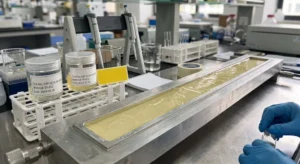
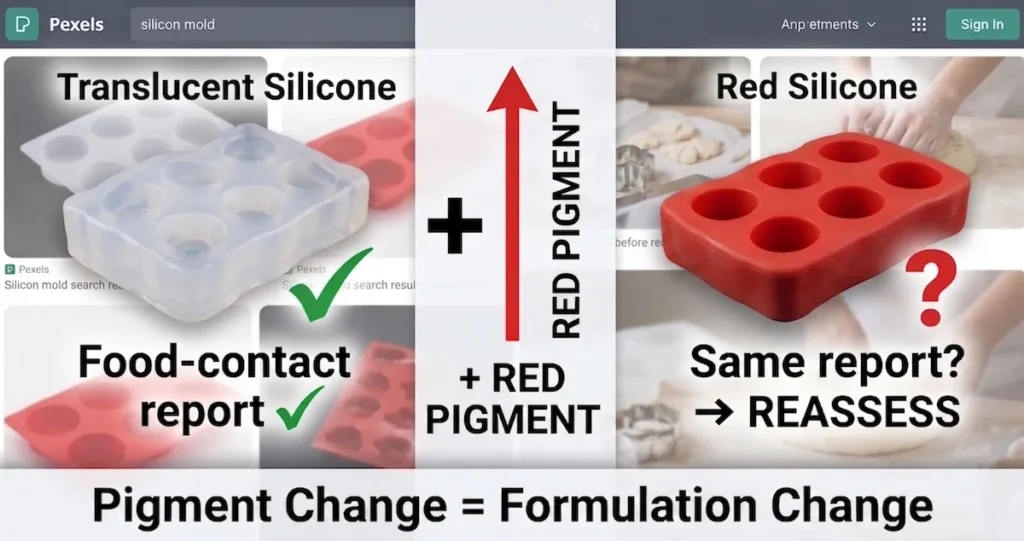

Your supplier’s translucent platinum silicone already has a food-contact test report.
You now want the same silicone in red for a reusable baking mold.
The supplier says:
“No problem. It is the same food-grade silicone—we only change the color.”
Can you rely on the original translucent-silicone report?
Not automatically.
The costly mistake is not simply choosing the wrong red pigment. It is discovering after tooling or production that the compliance evidence you approved covered the translucent formulation, not the colored formulation you are actually placing on the market.
The right rule is:
A pigment change is a formulation change—not automatically a compliance failure.
Changing color does not automatically mean the silicone is non-compliant. Nor does every shade require a complete new testing program.
But a color change should trigger a documented reassessment of what changed and whether the existing evidence still represents the finished colored silicone.
Quick Answer: Does Adding Pigment Change Food-Contact Compliance?
It can.
For U.S. repeated-use rubber articles, 21 CFR 177.2600 specifically allows colorants used in accordance with 21 CFR 178.3297. Section 178.3297, however, regulates specific colorant substances and their applicable limitations, rather than simply approving generic categories such as “red,” “blue” or “black.”
That leads to the first principle every importer should understand:
A color name is not a regulatory identity.
The real question is whether the pigment system introduced into the silicone is suitable under the applicable requirements and whether the existing evidence still covers the modified finished formulation.
The Color-Change Compliance Chain
Base Silicone → Pigment Identity → Complete Color System → Cured Article → Evidence Scope
If one link changes, review the chain before assuming the old report still applies.
| Change | Compliance Decision |
| Exact tested grade, formulation and color | Likely covered within documented scope |
| Minor shade adjustment within an already assessed color system | Confirm scope |
| New pigment or substantially different dosage | Reassess |
| New color paste, carrier or pigment supplier | Reassess |
| Changed cure behavior or processing conditions | Stronger reassessment trigger |
| New market, food type or higher-use temperature | Consider additional assessment/testing |
For the broader evidence concept behind “food grade,” read What Does Food-Grade Silicone Really Mean?.
Why the Same Base Silicone May Not Mean the Same Compliance Evidence
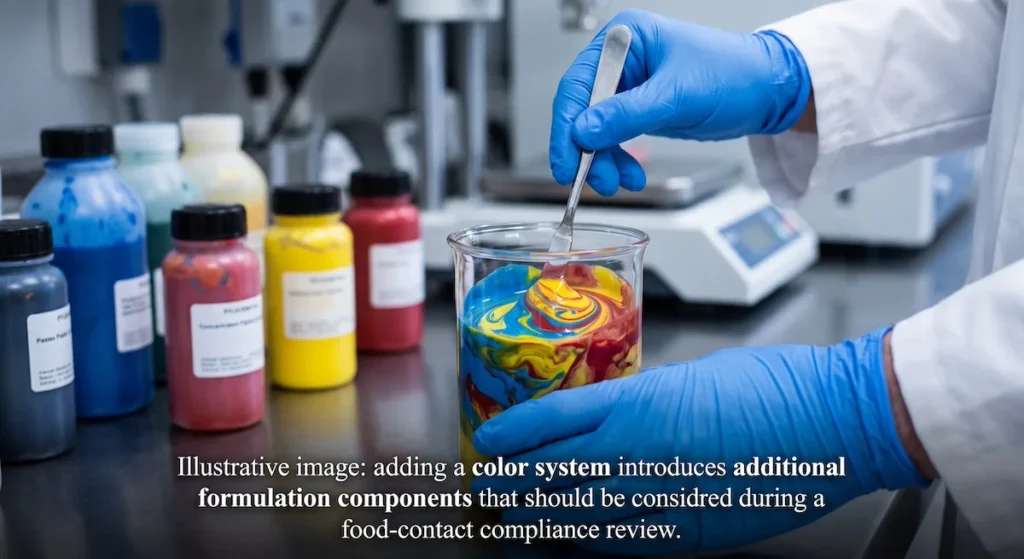
Imagine a translucent RTV-2 silicone formulation containing:
silicone polymer + crosslinker + catalyst + inhibitor + fillers + processing ingredients.
Once it becomes red, blue or black, another component enters the system:
the color system.
That color system may not be pure pigment powder. Depending on the material used by the manufacturer, it may include:
- the pigment;
- a carrier;
- dispersing components;
- processing aids;
- other ingredients in a color paste or masterbatch.
Therefore, asking:
“Is your red pigment food grade?”
does not go far enough.
Ask instead:
“What exactly is being introduced into the silicone when this color is added?”
This distinction matters because the finished food-contact material is the complete cured formulation, not an isolated pigment certificate.
A pigment supplier may provide valid food-contact documentation for its product. That still does not, by itself, establish compliance of the finished colored silicone article.
Documents are evidence. Coverage is the real question.
What FDA 21 CFR 178.3297 Tells Importers About Color
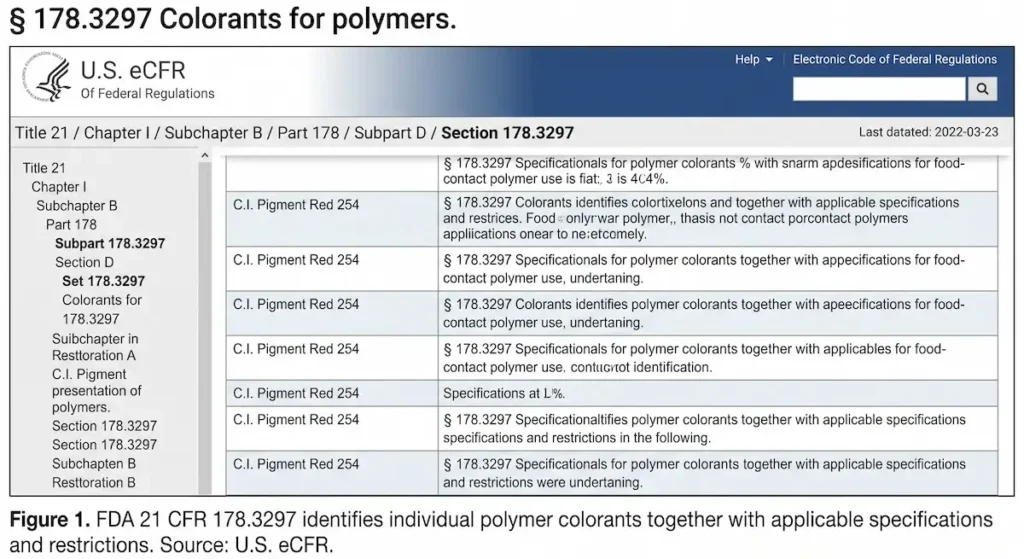
The U.S. rules provide a useful example of why “food-grade color” is too broad a description.
Under §177.2600, colorants for repeated-use rubber articles may be used in accordance with §178.3297.
Section 178.3297 then lists individual colorants together with applicable specifications and, for some substances, limits on dosage, polymer type or food-contact conditions. For example, C.I. Pigment Red 254 is listed with a maximum use level of 1% by weight of polymers and specified conditions of food contact. Chromium oxide green has separate provisions, including use in repeated-use rubber articles complying with §177.2600 subject to its stated limit.
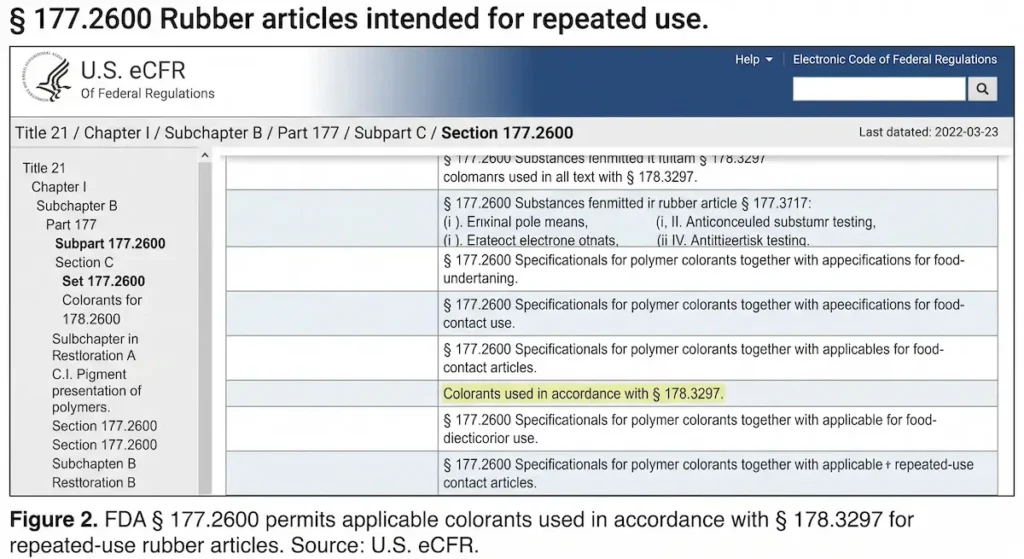
The practical lesson is not that one pigment is “better.”
It is:
FDA compliance follows the identity and permitted use of the actual colorant—not the visual appearance of the silicone.
Two red RTV-2 silicones may use different pigments.
Two black silicones may use different color systems.
And two suppliers calling their product “FDA red silicone” may therefore rely on completely different formulation evidence.
For more detail on the U.S. silicone framework, see What Is FDA Silicone? A Practical Guide to 21 CFR 177.2600.
What About EU and German Food-Contact Compliance?
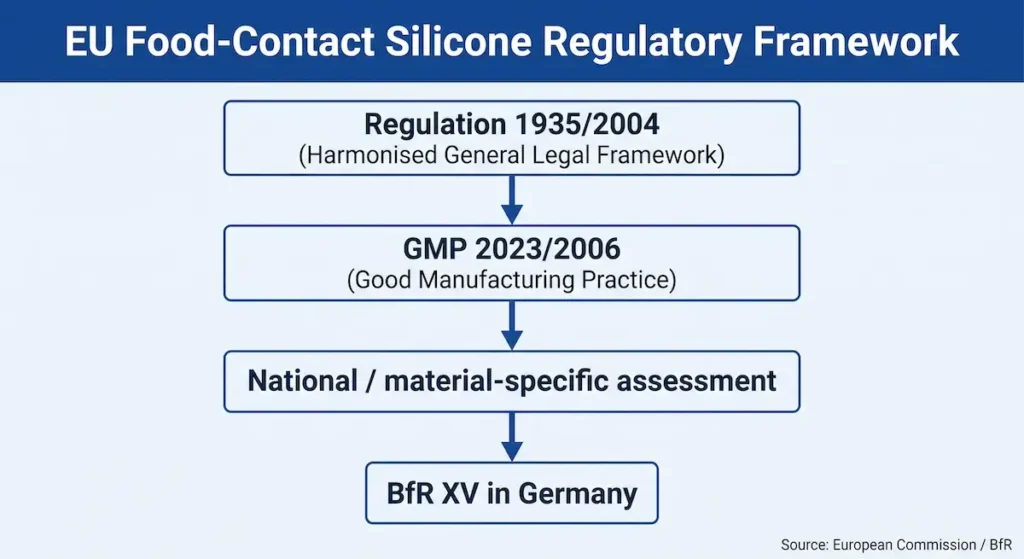
In the EU, the same general principle remains important: compliance is evaluated for the material or article placed on the market under its intended conditions of use, not merely for the uncolored base polymer.
Regulation (EC) No 1935/2004 provides the general EU food-contact framework. Food-contact materials must not release constituents into food at levels that could endanger human health or unacceptably change food composition, taste or odour. The framework also includes traceability and compliance-documentation principles.
All EU food-contact materials must also be manufactured in accordance with Good Manufacturing Practice under Regulation (EC) No 2023/2006. The European Commission specifically highlights controlled manufacturing, documented quality assurance and quality control, and selection of suitable starting materials.
Silicone currently does not have an EU-wide material-specific measure equivalent to Regulation (EU) No 10/2011 for plastics. For materials such as silicone that are not specifically harmonized at EU level, BfR states that its food-contact recommendations may continue to be used as an assessment reference.
For Germany, BfR Recommendation XV – Silicones is therefore an important technical reference for silicone food-contact materials.
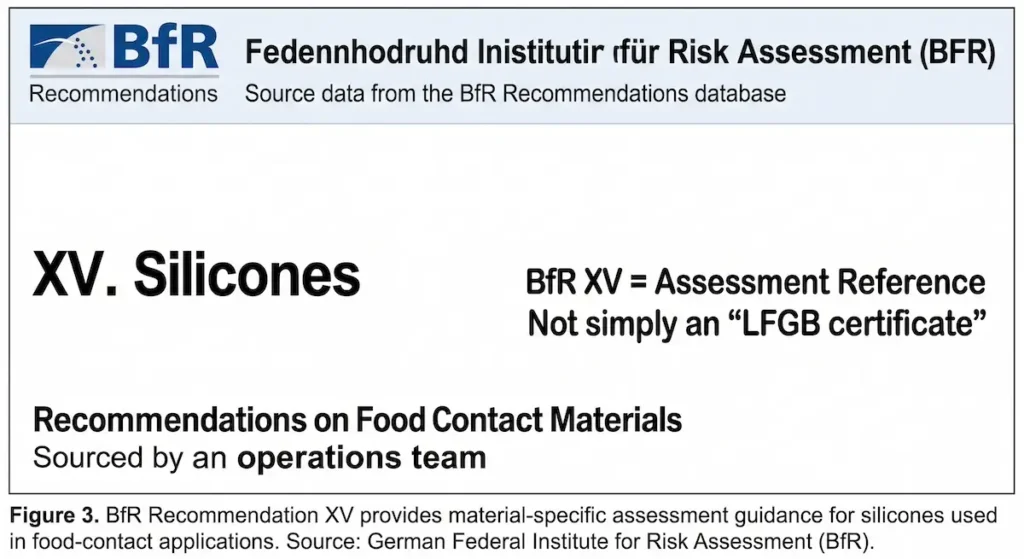
The buyer takeaway is the same:
Do not ask whether “red silicone is LFGB.” Ask whether the finished red formulation is supported for the intended German/EU food-contact application.
The 5 Questions to Ask Your Supplier After a Color Change
This is the most useful part of the review.
- What Exact Pigment Is Being Used?
Ask your supplier:
“Please identify the pigment or colorant system used for this color and provide the relevant supporting specification or compliance information.”
Where appropriate, review:
- pigment identity;
- CAS or Colour Index information;
- pigment supplier;
- applicable regulatory statement.
You do not need to become a pigment chemist.
You simply need to know what changed.
- What Is the Addition Level?
Ask:
“What percentage of the complete color system will be added to the silicone?”
Do not assume that because a substance is potentially suitable for food-contact use, its dosage is irrelevant.
FDA §178.3297 itself demonstrates that different colorants can have different maximum-use levels and conditions of use.
- Is It Pure Pigment or a Color Paste/Masterbatch?
Ask:
“Does the pigment introduce a carrier or any additional ingredients into the formulation?”
This question is often overlooked.
If the pigment is supplied as a paste or masterbatch, the compliance review should consider the complete color system, not just the headline pigment.
- Was the Tested Silicone Actually This Color?
Ask:
“Does the existing report identify this grade and colored formulation, or was the tested sample translucent?”
Then look at:
- product code;
- color/sample description;
- cure conditions;
- laboratory;
- test date;
- scope and limitations.
A valid report can still be the wrong report for your specific product.
- Does the Finished Application Still Match the Test Scope?
Ask:
“Does the existing evidence represent our actual food type, temperature, repeat-use condition and finished curing process?”
Food ultimately contacts the finished cured elastomer.
A report for a natural-colored mold used at moderate temperatures should not automatically be stretched to cover a newly pigmented baking mold under substantially different exposure conditions.
For application differences between chocolate, baking, candy and ice, see Food-Grade RTV-2 Silicone for Chocolate, Baking, Candy and Ice Molds.
Does Every New Color Require a New Food-Contact Test?
No—not automatically.
A better approach is to use a risk-based decision matrix.
GREEN — Existing Evidence May Remain Directly Relevant
Typical situation:
- same previously assessed pigment system;
- formulation remains within the documented scope;
- same cure process;
- same food-contact conditions;
- documentation explicitly supports the variation.
Action: Confirm and document the scope.
AMBER — Reassessment Required
Typical situation:
- new pigment;
- materially different dosage;
- new color paste;
- new pigment supplier;
- existing report does not clearly identify color.
Action: Review formulation and documentation before deciding whether supplemental evidence is required.
RED — Stronger Trigger for Additional Assessment or Testing
Typical situation:
- substantial formulation change;
- new destination market;
- much higher contact temperature;
- different food-contact conditions;
- altered cure/post-cure process;
- existing evidence cannot be connected to the finished colored article.
Action: Do not assume the old report is sufficient. Determine what additional assessment or testing is appropriate.
The correct rule is:
Do not automatically retest every shade—but do not automatically grandfather every new color into an old report.
Real Example: From Translucent Silicone to Red Baking Molds
Consider a buyer sourcing 1:1 platinum-cured RTV-2 silicone for reusable baking molds.
The translucent silicone is already supported by food-contact documentation.
The customer now requests a custom red version for repeated contact with fat-containing baking mixtures at elevated oven temperatures.
Should the supplier simply send the same report?
Start with the Color-Change Compliance Chain:
Base silicone: unchanged.
Pigment: new substance introduced → identify it.
Color system: determine whether a carrier or additional ingredients are added.
Dosage: confirm the actual addition level.
Curing: confirm that the colored formulation cures under the same specified conditions.
Existing report: determine whether the tested specimen was translucent or contained the actual red color system.
Intended use: confirm whether the existing evidence represents the relevant repeated high-temperature food-contact scenario.
The conclusion may be that the base silicone remains a suitable starting material.
But that is not the same as concluding:
“The translucent report automatically proves every red baking mold is covered.”
For buyers developing professional food molds, Topsil’s Food Mold Application Guide provides a broader application-selection framework.
6 Red Flags When a Supplier Says “All Colors Are Food Grade”
Be cautious if the supplier:
- Claims one report automatically covers every color.
- Cannot identify the pigment or color system.
- Provides a pigment certificate but cannot connect it to the final silicone formulation.
- Changes pigment suppliers without any documented review.
- Provides a report describing only “silicone sample” without a clear grade or color.
- Cannot tell you whether the tested specimen was translucent or actually pigmented.
These issues do not automatically prove non-compliance.
They indicate that the supplier has not yet demonstrated whether the evidence actually follows the formulation being sold.
Good compliance control manages formulation changes—not just document files.
FAQ
Final Rule for Importers
When your silicone changes color, do not ask only:
“Is this pigment food grade?”
Ask:
“What changed in the formulation, and does our existing food-contact evidence still represent the finished colored silicone we intend to sell?”
Before requesting a custom colored food-contact RTV-2 silicone, send your supplier five details:
required color + destination market + food type + maximum use temperature + required compliance documents
This gives the technical team enough context to evaluate both material fit and documentation fit before sampling or production begins.
If you are developing colored silicone for chocolate, baking, candy, ice or other reusable food molds, contact Topsilsilicone’s food-mold technical team to review the intended application and available documentation before finalizing the formulation.