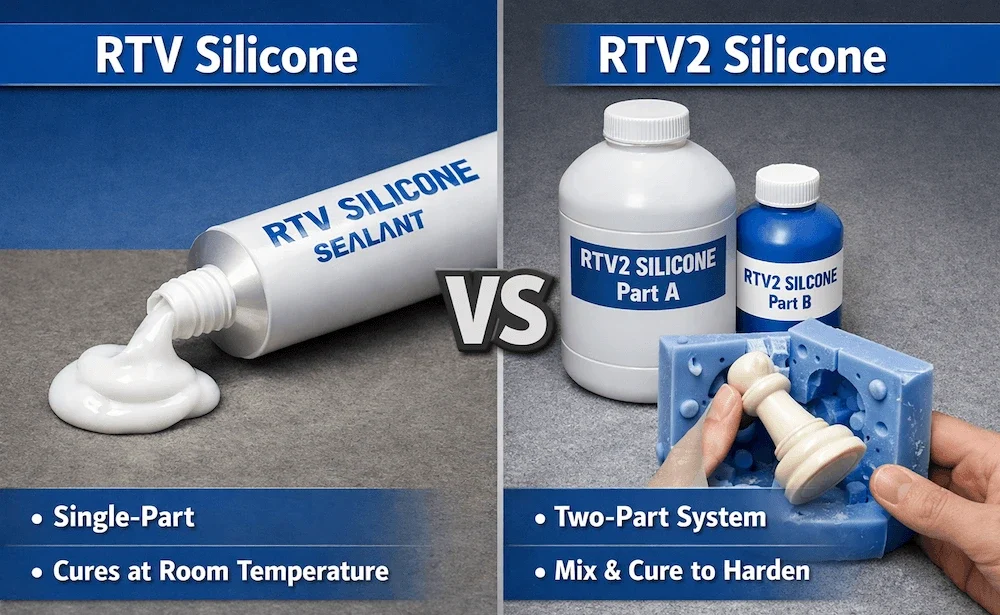

On an automated industrial assembly line or within a high-spec manufacturing bay, selecting the wrong elastomer architecture isn’t just a minor inconvenience—it’s an expensive production line shutdown.
While casual DIY hobbyists know Room-Temperature Vulcanizing (RTV) silicone simply as standard hardware-store caulk squeezed to seal a shower tile, design engineers and B2B procurement managers treat RTV silicone as a critical sealing, potting, and high-precision mold-making asset.
Understanding the mechanical and chemical cross-linking gulf between standard One-Component RTV (RTV-1) and Two-Component RTV (RTV-2) systems dictates whether your finished components pass rigorous field-vibration tests or suffer catastrophic line recalls. Let’s break down the industrial physics of both chemistries to find your exact manufacturing match.
The Fundamentals: What is Silicone?
Silicone is an inorganic polymer built on a synthetic backbone of alternating Silicon and Oxygen atoms (the siloxane bond), rather than the Carbon-Carbon backbones found in standard organic rubbers. This distinct atomic configuration endows silicone with its signature industrial properties: exceptional thermal stability, chemical inertness, high dielectric insulation resistance, and permanent UV/weathering flexibility.
Related Reading: Silicone vs TPE differences
Depending on the manufacturing process and thermal requirements, industrial silicones split into distinct operational branches:
- High-Temperature Vulcanizing (HTV) Silicone: Requires high heat and mechanical compression molding to cross-link.
- Liquid Silicone Rubber (LSR): Formulated for automated, high-speed injection molding machines.
- Room-Temperature Vulcanizing (RTV) Silicone: Cures completely at ambient room temperatures without specialized ovens.
One-Component RTV (RTV-1): The Moisture-Cure Sealant
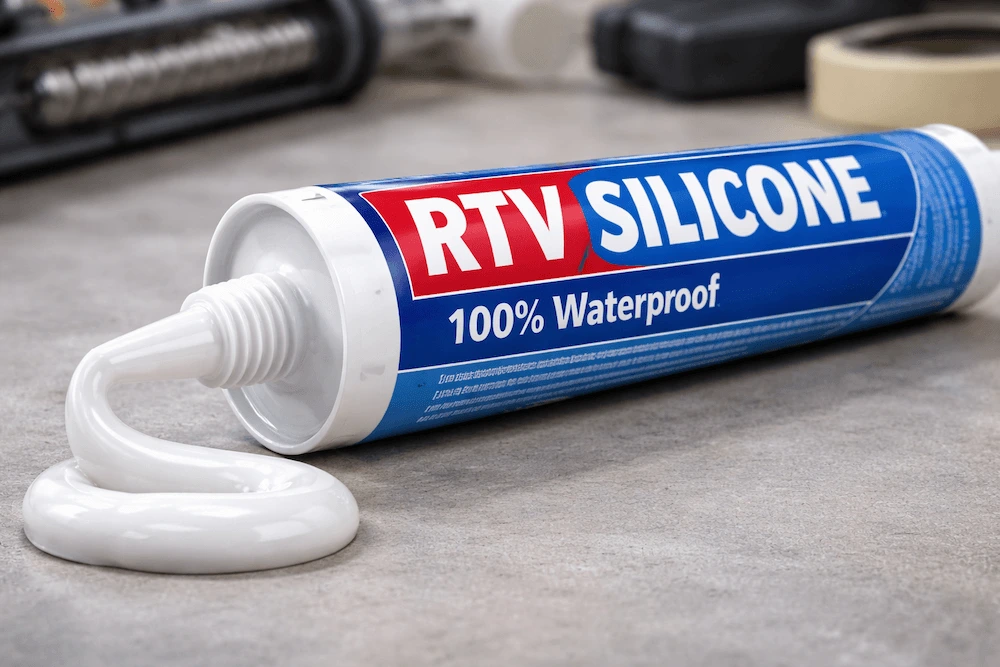
Standard RTV silicone is a single-component system (RTV-1) pre-packed in airtight cartridges or squeeze tubes. It is engineered for immediate, zero-prep application directly from the nozzle.
The chemical trick of RTV-1 is its moisture-cure mechanism. The liquid rubber remains stable inside the sealed tube, but the moment it is squeezed out, it grabs ambient humidity from the surrounding air to trigger its cross-linking reaction. It cures from the outside inward, forming a tough, skin-like protective barrier within minutes.
The Engineering Catch (The Depth of Cure Limit):
Because RTV-1 relies entirely on atmospheric moisture seeping into the rubber mass, it suffers from a strict depth of cure limit (typically capped at 6mm or 1/4 inch). If you pour or squeeze RTV-1 into a deep, enclosed electronic housing or a thick block mold, the center of the silicone will remain a wet, sticky paste indefinitely because moisture cannot penetrate the cured exterior skin.
Two-Component RTV (RTV-2): The Deep-Section Mass-Cure System
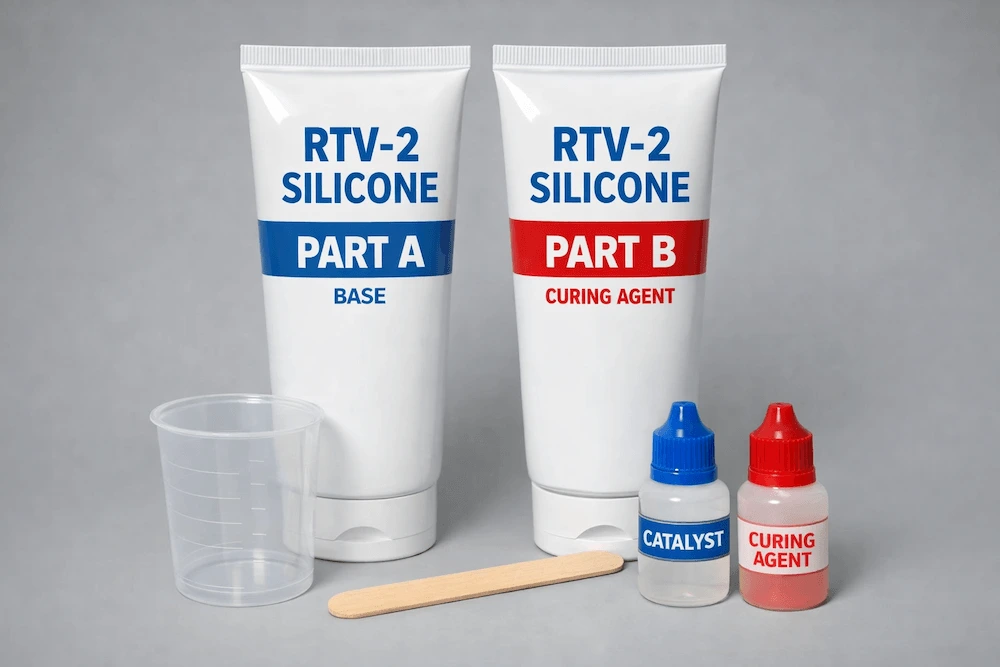
RTV-2-Silikon is a two-part commercial system comprised of a liquid base (Part A) and a chemically engineered catalyst or curing agent (Part B). Unlike single-part sealants, RTV-2 remains completely inert and liquid in storage until the two components are mechanically mixed in a precise weight or volume ratio.
Once mixed, RTV-2 undergoes a uniform mass-cure chemical reaction. It does not care about atmospheric moisture, nor does it cure from the outside in. The cross-linking reaction occurs uniformly throughout the entire mass simultaneously, making it completely independent of thickness boundaries.
This moisture-independent reaction is why RTV-2 is the undisputed king of deep-section electronics potting compound applications and industrial-grade mold-making. It replicates microscopic textures—down to fine tool markings and laser engravings—with zero dimensional drift.
Still not sure which silicone grade fits your application?
Tell us your casting material, target hardness, working time, and expected use. Topsil will help recommend a suitable RTV-2 silicone grade for sample testing.
Engineering Comparison: RTV-1 vs. RTV-2 Silicone
| Technical Parameter | One-Component RTV (RTV-1) | Two-Component RTV (RTV-2) |
| Curing Mechanism | Moisture-driven (Requires outside-in atmospheric humidity) | Chemical cross-linking (Independent mass-cure upon A+B mixing) |
| Max Cure Thickness | Strictly limited to < 6mm (1/4 inch) depth | Unlimited thickness depth; cures evenly through the core |
| Production Speed Control | Fixed by ambient climate; non-adjustable | Fully adjustable pot life and cure rates via catalyst dosing |
| Volatile Byproducts | Releases corrosive acetic acid (acetoxy) or neutral alcohols | Zero volatile outgassing in premium addition-cure systems |
| Tooling Requirements | Zero prep; standard caulking gun or manual nozzle | Requires digital scales, thorough mixing, and vacuum degassing pumps |
| Long-Term Storage | Opens tubes skin over and degrade rapidly from air exposure | Separated parts feature a stable, long-term warehouse shelf-life |
| Regulatory Clearances | General commercial and industrial construction grades | Available in certified lebensmittelechtes Silikon and medical-grade lots |
Application Matching Matrix: Selecting for the Mission
Specify One-Component RTV (RTV-1) When:
- The task is perimeter sealing or gasketing: Ideal for bonding glass panes, sealing industrial oven doors, or forming thin, automated form-in-place gaskets (FIPG).
- The cross-section is ultra-thin: The total sealant thickness stays safely under the 6mm barrier, ensuring rapid, complete vulcanization.
- Immediate field maintenance is required: No measuring, zero mixing equipment on the shop floor, and zero pot-life mixing anxiety.
Specify Two-Component RTV (RTV-2) When:
- Manufacturing production molds: The mold requires large volumes of rubber to be poured over stones, candles, or industrial prototypes, and requires a stable platinum cure or tin cure system.
- Executing deep-section encapsulation: Potting delicate printed circuit boards (PCBs), junction boxes, or heavy power modules where air and moisture are completely sealed out.
- High-fidelity replication is mandatory: Capturing ultra-fine details and maintaining strict dimensional tolerances without linear shrinkage distortions.
- Strict compliance rules apply: Sourcing materials for automated medical components, baby products, or high-purity food processing gaskets.
Technical RTV Selection FAQs
What is the difference between “Acetoxy” and “Neutral-Cure” RTV-1 sealants?
This is a critical distinction for electrical engineers. Acetoxy RTV-1 releases acetic acid (a pungent vinegar odor) as it grabs moisture to cure. This acid will chemically attack and corrode copper traces, silver solder points, and microchip legs on a circuit board. For electrical assemblies, you must explicitly specify a Neutral-Cure (Alkoxy or Oxime) RTV-1 system, which vents non-corrosive alcohol vapors during vulcanization.
Can an RTV-2 silicone suffer from curing issues if mixed manually?
Yes. Because RTV-2 relies on perfect chemical dispersion, manual mixing can introduce two distinct line failures: unmixed sticky streaks caused by failing to scrape the container walls, or excessive air entrapment. For high-volume automated lines, utilizing an automated meter-mix-dispense machine eliminates human dosing errors.
Final Procurement Alignment
For simple perimeter adhesion, exterior weatherproofing, and thin gasket touch-ups, One-Component RTV delivers massive speed and tooling savings. But when your project transitions into deep-pour encapsulation, high-precision component tooling, or certified regulatory production, Two-Component RTV-2 is the only engineering foundation that guarantees uniform chemical stability.
Are you optimizing an automated dispensing line or setting up a new molding pilot run? Contact TOPSIL’s chemical application team today to request targeted material data sheets and arrange tailored RTV sample kits for your engineering verification trials.
RECOMMENDED NEXT STEP
Choosing the right silicone involves more than just hardness or cure system.
Send us your application details, and we’ll map out the exact grade for your testing.
Compare RTV-2 Silicone Grades