
A common question from printing-pad manufacturers is:
“We need a softer printing pad. How much silicone oil should we add?”
Die bessere Frage ist:
What finished-pad hardness are you trying to achieve?
Silicone oil can soften compatible pad-printing silicone, but there is no universal percentage that produces the same Shore hardness in every formulation.
The practical approach is:
Target Hardness → Tested Starting Point → Controlled Trial → Finished-Pad Validation
Schnelle Antwort
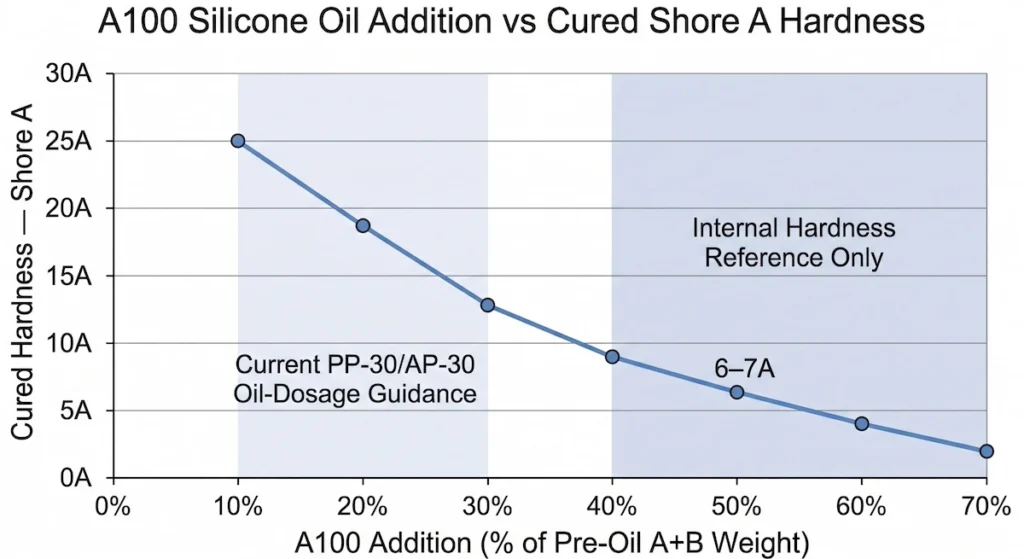
In a Topsil silicone internal pad-silicone test system, A100 silicone oil produced the following cured Shore A hardness results:
| A100 addition* | Approx. cured hardness | Status |
| 10% | ~25 Shore A | Within current PP-30/AP-30 oil-adjustment guidance* |
| 20% | ~19 Shore A | Within current PP-30/AP-30 oil-adjustment guidance* |
| 30% | ~13 Shore A | Upper end of current PP-30/AP-30 guidance* |
| 40% | ~9 Shore A | Internal hardness reference only |
| 50% | ~6–7 Shore A | Internal hardness reference only |
| 60% | ~4 Shore A | Internal hardness reference only |
| 70% | ~2 Shore A | Internal hardness reference only |
*A100 dosage is calculated against the total mixed weight of Part A + Part B silicone before the oil is added.
*The hardness values come from an internal pad-silicone test system. The status column refers to Topsil silicone’s current PP-30/AP-30 oil-adjustment range, and should not be interpreted as confirmation that every hardness point above was measured specifically on PP-30 or AP-30.
For PP-30/AP-30, current standard production guidance is:
Up to 30% silicone oil for hardness adjustment.
View PP-30 & AP-30 Pad Printing Silicone
Test Scope — Read Before Using the Data
Silicone oil: A100 Dosage basis: Pre-oil total mixed A+B silicone weight Measured property: Cured Shore A hardness Purpose: Internal hardness-adjustment reference Not measured across the complete series: Tensile strength, tear strength and elongation
This is formulation-specific test data, not an industry-wide silicone-oil-to-hardness conversion chart.
The dataset shows how hardness changed in the tested system. It does not establish that the original mechanical properties remain unchanged after silicone-oil dilution.
How Is Silicone Oil Percentage Calculated?
For the dosage convention used in this guide:
Silicone Oil Dosage (%) = A100 Weight ÷ Total Mixed A+B Silicone Weight × 100
The important point is that the percentage is calculated from the silicone weight before the oil is added.
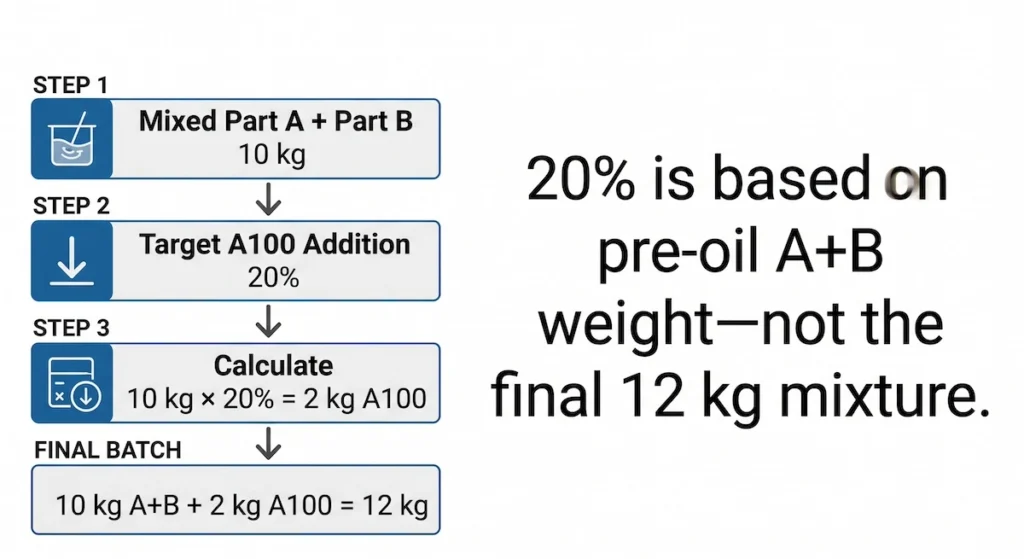
Example: 20% A100 for 10 kg of A+B Silicone
If:
Part A + Part B = 10 kg
and you want:
20% A100
then:
10 kg × 20% = 2 kg A100
Final mixed weight:
10 kg A+B + 2 kg A100 = 12 kg
So “20% A100” does nicht mean that oil is 20% of the final A+B+oil mixture.
It means:
A100 weight equals 20% of the original mixed A+B silicone weight.
Quick A100 Dosage Calculator
| Mixed A+B silicone | 10% A100 | 20% A100 | 30% A100 |
| 1 kg | 0.1 kg | 0.2 kg | 0.3 kg |
| 5 kg | 0.5 kg | 1.0 kg | 1.5 kg |
| 10 kg | 1.0 kg | 2.0 kg | 3.0 kg |
| 20 kg | 2.0 kg | 4.0 kg | 6.0 kg |
| 50 kg | 5.0 kg | 10.0 kg | 15.0 kg |
For the full pad-making process:
How to Make Silicone Pads for Pad Printing
Start With the Target Finished-Pad Hardness
Do not begin with:
“Let’s add 20% oil.”
Begin with:
“What finished hardness do we need?”
Within the currently used adjustment range, the internal test provides three useful reference points:
10% A100 → ~25 Shore A
20% A100 → ~19 Shore A
30% A100 → ~13 Shore A
For example, if your target is around 20 Shore A, the 20% test point provides a logical starting level for a controlled trial.
The important word is starting.
The tested data helps narrow the trial range; the actual cured formulation determines the final hardness.
Don’t choose the oil percentage first. Start with the target finished-pad hardness.
If your existing pad is specified using Shore 00 rather than Shore A, confirm the hardness scale before attempting to match it.
Pad Printing Pad Hardness: Shore A vs Shore 00
What If Your Target Falls Between Two Tested Points?
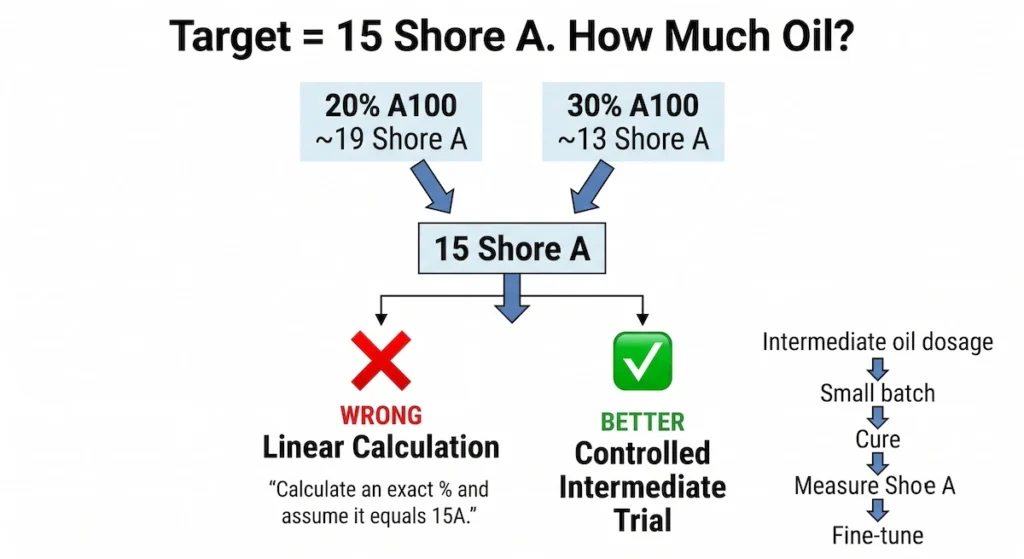
Suppose you need approximately:
15 Shore A
but your nearest tested reference points are:
20% A100 → ~19 Shore A 30% A100 → ~13 Shore A
Tun Sie das nicht
Calculate a mathematically precise intermediate percentage and assume it will produce exactly 15 Shore A.
That assumes a perfectly linear relationship.
Do This Instead
Choose an intermediate oil level as a trial point, make a small batch, cure it under controlled conditions and measure the actual hardness.
Warum?
Because the final result can be influenced by:
- Base silicone formulation
- Silicone-oil characteristics
- Cure system
- Mixing uniformity
- Cure conditions
- Hardness measurement conditions
Use the test curve to define a trial range—not to create false precision.
Elkem also describes silicone oil as a means of adjusting printing-pad RTV hardness through varying oil levels rather than presenting one universal conversion equation.
Elkem — Silicones for Pad Printing
What Else Can Change When Silicone Oil Is Added?
Silicone oil changes the overall formulation, not only the Shore number.
Viskosität
In compatible pad-silicone systems, silicone oil may reduce viscosity as well as hardness. Industry technical guidance from CHT also describes this behavior in suitable printing-pad formulations.
Allerdings, viscosity was not measured in the Topsil silicone hardness dataset presented here. That statement is based on broader industry formulation guidance rather than this specific internal test series.
Mechanical Properties
Tensile strength, tear strength and elongation were not measured across the complete A100 dosage series.
Therefore:
Do not assume that the original TDS mechanical properties remain unchanged after silicone-oil adjustment unless the adjusted formulation has been tested.
For significant hardness adjustments, the finished pad should be validated as a complete formulation.
Can You Add More Than 30% Silicone Oil?
The internal dataset above includes A100 levels from 40% to 70%, and the observed Shore A hardness continued to decrease.
But:
Measured hardness data is not the same as production approval.
For PP-30/AP-30, current standard production guidance remains:
Up to 30% A100 for hardness adjustment.
Above this range, additional formulation validation is needed because the internal series did not fully characterize mechanical integrity, printing stability or long-term pad performance.
This creates a practical decision point:
If you need substantially more than 30% oil to reach the target hardness, don’t automatically keep increasing the oil level. Ask whether the base silicone itself is the right starting material.
Oil Adjustment or a Softer Base Silicone?
Silicone oil is useful for adjusting hardness, but it should not compensate indefinitely for an unsuitable base grade.
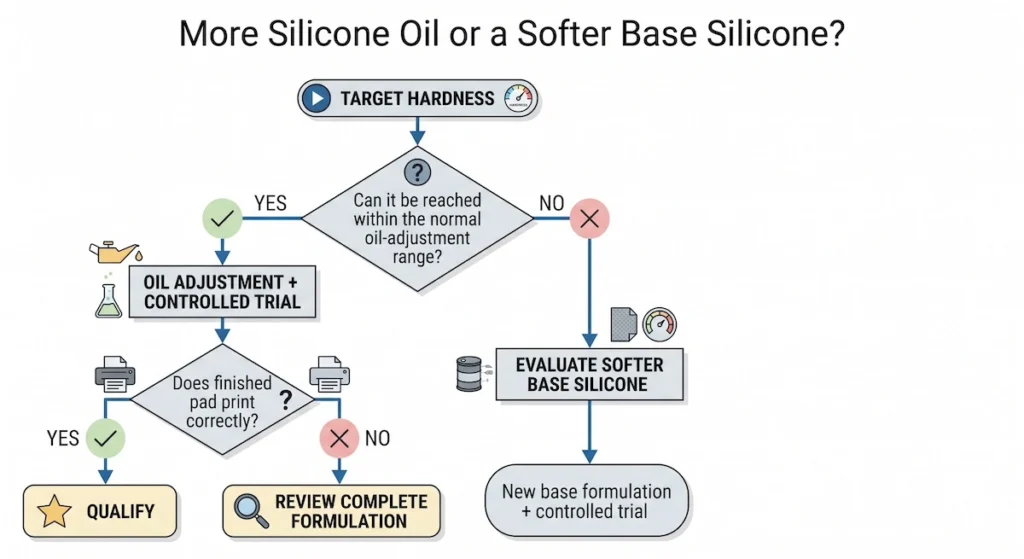
| Situation | Better starting direction |
| Small hardness correction within the normal adjustment range | Adjust silicone oil |
| Target is close to an existing tested point | Run a controlled oil trial |
| Target routinely requires more than 30% oil | Evaluate a softer base silicone |
| Correct Shore hardness is reached but printing performance is poor | Reconsider the complete formulation |
| Every batch requires very high dilution | Evaluate a better-matched base grade |
This is an important distinction for manufacturers replacing an existing silicone.
Matching a Shore number is useful, but the final objective is:
a pad formulation that can be produced consistently and prints correctly.
For broader grade selection:
Complete Pad Printing Silicone Selection Guide
How Should You Validate a New Oil Dosage?
Once a starting dosage has been selected, validate it systematically rather than moving directly into full production.
Step 1 — Define the Target
Record the intended:
- Finished hardness and Shore scale
- Pad geometry
- Printed substrate
- Main printing requirement
Step 2 — Select a Starting Oil Level
Choose the nearest relevant tested reference.
Step 3 — Make a Small Controlled Batch
Record the actual A+B weight, A100 weight and catalyst configuration.
Step 4 — Cure Under Consistent Conditions
Keep temperature and cure conditions comparable between trials.
Step 5 — Measure the Finished Hardness
Use an appropriate durometer rather than judging softness only by hand.
Step 6 — Make and Print-Test the Pad
Evaluate:
- Ink pickup
- Ink release
- Image stability
- Pad deformation
- Visible defects
Step 7 — Fine-Tune
If necessary, adjust the oil level incrementally from the measured result.
The target is not simply a Shore number. The target is a finished pad that performs correctly.
Silicone Oil Adjustment Record
A simple record makes successful formulations repeatable.
| Artikel | Production record |
| Silicone grade / formulation | |
| Batch number | |
| Operator / date | |
| Total A+B weight | |
| A100 weight | |
| Calculated dosage | |
| Catalyst configuration | |
| Cure temperature / time | |
| Hardness measured after | |
| Finished Shore hardness | |
| Pad / application | |
| Print result | |
| Remarks |
This is particularly useful when scaling trials to production, comparing formulations, troubleshooting hardness variation or qualifying a second supplier.
Häufig gestellte Fragen
Need a Starting Formulation for a Specific Pad Hardness?
If you are developing a new printing pad or replacing an existing silicone supplier, send Topsil silicone:
Current silicone grade + base hardness and Shore scale + current oil dosage + target finished hardness + A+B batch size + pad geometry + printed application + current performance issue
We can use this information to identify a practical starting formulation for controlled testing rather than relying on an arbitrary oil percentage.