Silicone for Jewelry Mold Making

Jewelry molds need more than softness. If your project depends on fine detail, clean release, easy mold cutting, and stable performance over repeated use, start by matching silicone to master complexity, mold-cutting method, and production needs.
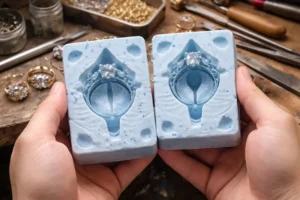
silicone-for-jewelry-mold-making

Choose by Jewelry Mold Need, Not by Generic Mold Silicone Claims

For jewelry mold making, the right silicone is not simply the softest or easiest-to-cut option. A mold for a highly detailed master behaves differently from a mold used repeatedly in workshop production. The correct grade depends on what your mold needs most: sharper detail, stronger cut zones, cleaner release, or more stable repeat use.

Fine-detail masters

Start with detail fidelity + clean release

Moldes de corte complejos

Start with tear resistance + mold-cut stability

Small-part precision molds

Start with edge definition + repeatability

Repeat-use production molds

Start with durability + consistent mold behavior

What Jewelry Mold Buyers Should Prioritize?

Detail Fidelity

If the mold cannot reproduce fine lines, edges, and small surface changes cleanly, the master value is already lost.

Resistencia del molde cortado

Jewelry molds are often cut and opened. A mold that cuts easily but tears too fast will not stay useful in production.

Repeat Stability

For real workshop use, the better grade is usually the one that stays stable through repeated opening, release, and production handling.

Why Jewelry Molds Commonly Fail?

In many jewelry projects, the real problem is not “bad silicone” in general. The issue is usually a grade mismatch. A silicone may feel soft and easy to cut, but still be the wrong choice if it cannot hold detail or survive repeated opening.
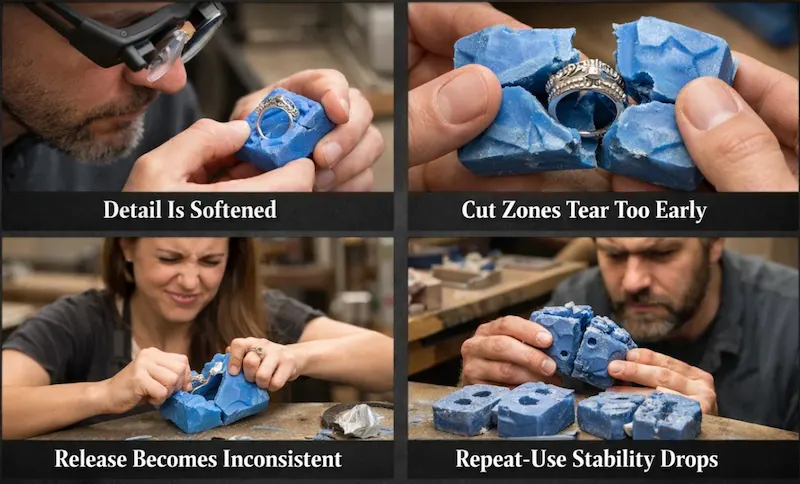
Most jewelry mold problems show up in one of these ways:

Detail Is Softened

The mold reproduces the shape, but not the sharpness needed for fine work.

Las zonas de corte se desgarran demasiado pronto

The mold opens well at first, then weak areas begin to fail.

Release Becomes Inconsistent

The mold works for early pulls, then starts to feel less clean and predictable.

Repeat-Use Stability Drops

The mold is usable, but its consistency falls after repeated handling and production use.

Un error común en el mundo real

Many buyers ask for the softest silicone first because they want easier cutting and opening. But a jewelry mold that cuts easily is still the wrong mold if it loses edge quality or tears too early after repeated use.
That is why jewelry mold silicone should be matched to detail fidelity + cut-mold strength + repeat-use behavior, not chosen like a general craft mold material.

Una forma mejor de elegir el grado

Before choosing a silicone grade, do not start with “Which hardness do you have?” Start with what the mold must do in real jewelry production.

For Fine-Detail Masters

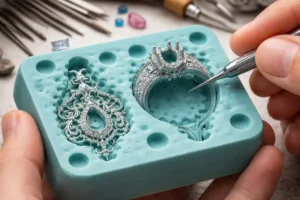
If the master includes engraving, sharp edges, fine lines, or delicate surface transitions, detail fidelity matters first. A mold that releases easily but softens the master is still the wrong mold.

Para moldes de corte complejo

Si el molde se va a cortar y abrir repetidamente, lo primero que importa es la resistencia al desgarro. El grado incorrecto suele ser el que resulta fácil de cortar una vez, pero pierde resistencia demasiado rápido con el uso.

For Small-Part Precision Work

If the mold is small but detail-critical, edge definition and clean release usually matter earlier than broad claims like “soft” or “easy.”

Reproducción deficiente de los detalles

Si la silicona no captura el patrón correctamente, el molde acabado puede perder patrones nítidos, texturas o detalles de la superficie.

Aplicaciones típicas

Fine-detail jewelry masters
Small-part precision molds
Repeat-use workshop molds
Cut-and-open jewelry molds
Custom jewelry mold production
Jewelry master reproduction for small-batch use

Need a Better Silicone Grade for Jewelry Mold Making?

Send us your master type, detail level, whether the mold will be cut, and whether the mold is for one-off or repeat use. We’ll help you narrow down a more suitable RTV-2 silicone direction.

Preguntas frecuentes

What matters more for jewelry molds: detail reproduction or tear resistance?

That depends on the mold. Fine-detail masters usually require better fidelity first, while cut molds and repeated-use molds often require stronger tear resistance first.

Is the softest silicone always better for jewelry molds?

No. A softer silicone may feel easier to cut or open, but it can still be the wrong choice if the mold loses stability, tears too early, or reduces repeat-use quality.

What causes jewelry molds to fail after a few good uses?

In many cases, the first few uses do not reveal the real weakness. The problem often appears later as cut-zone tearing, weaker opening behavior, or reduced repeat stability.

What should I prioritize for repeat-use jewelry molds?

For repeated use, cut-mold durability, consistent release, and overall stability usually matter earlier than first-pass convenience.

Can you recommend a suitable grade for my jewelry mold project?

Yes. Share your master type, detail level, whether the mold will be cut, and how often it will be used, and we can help you review a more practical starting direction.

Póngase en contacto con nosotros hoy mismo, recibirá una respuesta en 24 horas.

Sus datos serán estrictamente confidenciales.

Este es Evan, el Gerente de Topsil Silicone. Le felicitamos por haber encontrado un proveedor profesional. Pls enviar su consulta, nos pondremos en contacto con usted dentro de 24 horas.

Goma Topsil Silicone Libro electrónico

Si aún desea saber más sobre nuestros productos, podemos enviarle un catálogo electrónico detallado.