
Silicone Rubber for Concrete & Stone Molds
Concrete and stone molds need more than general-purpose silicone. If your main problem is early tearing, large molds losing body, or deep textures that are hard to demold, start by choosing the right balance of tear strength, durability, and mold support.
- 높은 인열 강도
- Better Mold Body
- Built for Repeated Demolding
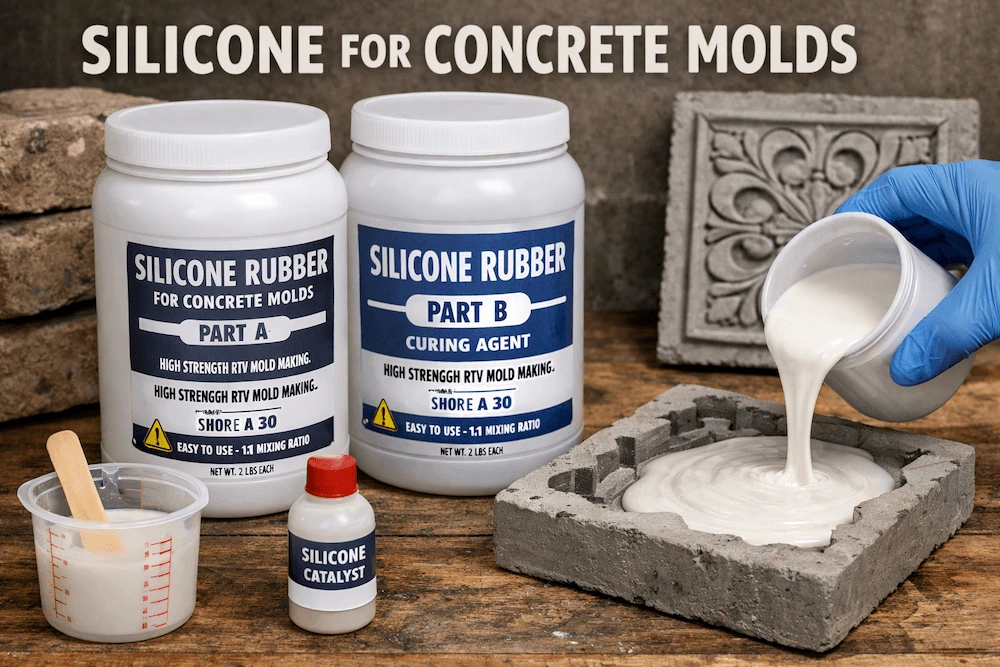
Choose by Mold Behavior, Not by Price Alone
For concrete and stone mold making, the cheapest silicone is not always the lowest-cost choice. A grade that tears early, loses body, or wears down too quickly will usually cost more in remakes, downtime, and unstable production.
성적을 선택하기 전에 이 빠른 로직을 사용하세요:
Large mold, shallow texture
Start with mold body and support
Small or medium mold, deep texture
Start with tear strength and release behavior
Repeated production mold
Start with durability and mold life
Large mold with deep texture
Choose a grade that balances body + tear resistance
What Concrete Mold Buyers Should Prioritize?
인열 강도
If the mold stretches during release or includes sharp texture, low tear strength usually causes early failure. This is often the first property buyers underestimate.
Mold Body
Large molds often fail not because the silicone is weak overall, but because the grade is too soft to hold shape well during handling, pouring, and repeated demolding.
내구성
In repeated production, the better grade is usually the one that lasts longer and stays more stable over time, not the one that only looks cheaper per kilogram.
Why Concrete & Stone Molds Fail Early?
Most failed concrete molds break down in one of these ways:
Many failed concrete molds are not caused by “bad silicone” in general. In real projects, the problem is often grade mismatch. The silicone may be easy to pour, but not strong enough for the actual mold size, release stress, or production rhythm.
01
Edge Tearing
The mold releases, but stress concentrates at thin or sharp zones.
02
Loss of Body
Large molds feel too soft, unstable, or difficult to handle.
03
짧은 금형 수명
The mold works at first, then performance drops quickly under repeated demolding.
04
Texture Wear
Fine surface detail weakens over time and repeated use.
현실에서 흔히 저지르는 실수
A large architectural texture mold often does not fail because the silicone is too weak overall. It often fails because the grade is too soft for the mold size while still facing repeated demolding stress.
That is why concrete mold silicone should be matched to mold size + texture depth + production frequency, not chosen by softness or price alone.
등급을 선택하는 더 나은 방법
Before choosing a silicone grade, answer these four questions:
- How large is the mold?
- How deep is the texture?
- 디몰딩은 얼마나 어렵나요?
- How many times will the mold be used?
If your mold is large, body matters more. If your mold is deeply textured, release behavior matters more. If your mold is used repeatedly, durability matters more. If your mold only needs 2-3 times, choose the economical grade that can meet your requirements; if you need 100~300times, and the mold is large and textured, do not chase one extreme property, balance both.
This is why concrete and stone mold silicone should not be selected as a general decorative mold material. The right grade depends on mold size, texture depth, release difficulty, and expected mold life.
일반적인 애플리케이션
Artificial stone molds
Decorative concrete texture molds
Stone veneer molds
Custom textured casting molds for repeated production
Architectural restoration molds
Wall panel and surface pattern molds
Need a More Durable Silicone for Concrete or Stone Molds?
Send us your mold size, texture depth, release difficulty, and expected production frequency. We’ll help you narrow down a more suitable RTV-2 silicone starting point.
자주 묻는 질문
What hardness is best for concrete molds?
There is no single best hardness for every concrete mold. The right choice depends on mold size, texture depth, release difficulty, and how much structural body the mold needs.
Do concrete molds usually need higher tear strength than resin molds?
In many cases, yes. Concrete and stone molds often face heavier demolding stress and more repeated-use pressure than general resin molds.
Why do large concrete molds sometimes feel too weak?
This usually happens when the silicone is too soft for the mold size, or when flexibility was prioritized without enough structural support and body.
Can you recommend a grade for artificial stone or stone veneer molds?
Yes. Share your mold size, pattern depth, release difficulty, and production plan for a more practical grade recommendation.
방법 문서



탑실은 고성능 RTV-2 실리콘 고무를 제공합니다. 백금에서 주석 경화 실리콘에 이르기까지 고객이 적합한 소재를 선택할 수 있도록 지원합니다.
© 탑실리콘 모든 권리 보유 2025