
Excessive shrinkage in tin-cure RTV-2 silicone leads to out-of-tolerance molds and costly casting errors. While minor contraction is inherent to the condensation-cure process, it can be controlled. This guide shares actionable technical strategies to minimize shrinkage and lock in precise dimensions.
Quick Answer: How to Minimize Tin-Cure Silicone Shrinkage
- Catalyst Precision: Keep the curing agent ratio strictly within the manufacturer-recommended range (typically 2% to 3%). Over-catalyzing exponentially increases cross-linking density and subsequent shrinkage.
- Environmental Control: Cure molds in a climate-controlled environment with stable temperature (22°C–25°C) and relative humidity (45%–55%) to ensure steady byproduct evaporation.
- Strategic Layering: When building thick brush-on molds, allow each thixotropic layer to partially cure and vent byproducts evenly before applying the next coat.
- Upgrade the System: For high-precision projects requiring less than 0.1% dimensional tolerance, bypass condensation systems entirely and upgrade to a Topsil Platinum-Cure (addition-cure) silicone.
The Chemical Mechanism Behind Tin-Cure Shrinkage
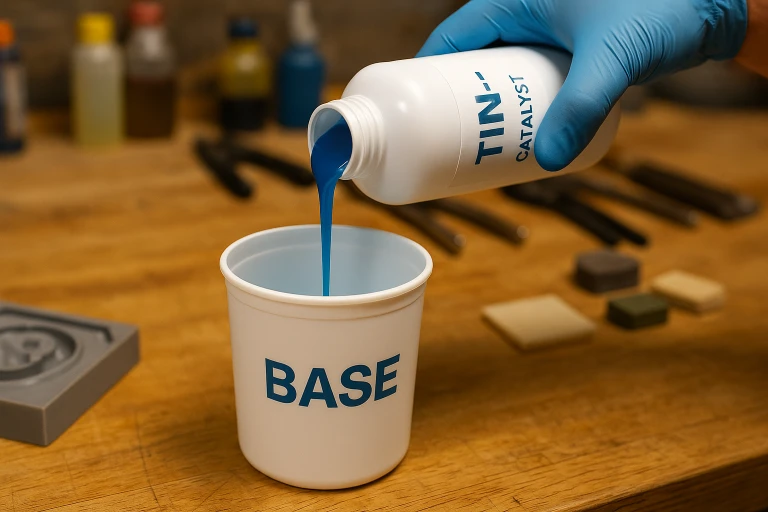
To control shrinkage, it is vital to understand why it occurs. Tin-cure RTV-2 silicone operates on a condensation-curing mechanism.
When the base rubber (Part A) reacts with the tin catalyst (Part B), a cross-linking chemical reaction occurs. This reaction generates a low-molecular-weight volatile byproduct—typically ethanol (alcohol). As this alcohol byproduct slowly evaporates from the matrix during and after the solidifying phase, the loss of mass forces the silicone polymer network to contract.
[Part A: Base] + [Part B: Tin Catalyst] ──> [Solid Silicone Matrix] + [Volatile Alcohol Byproduct (Evaporating)]Dimensional Variance: Tin-Cure vs. Platinum-Cure
- Tin-Cure (Condensation): Typically exhibits a linear shrinkage rate of 0.3% to 0.5%. This is driven entirely by byproduct evaporation.
- Platinum-Cure (Addition): Exhibits a linear shrinkage rate of less than 0.1%. Because addition-curing systems release absolutely zero volatile byproducts during cross-linking, the mass remains completely stable.
5 Industrial Strategies to Control and Reduce Shrinkage
1. Maintain Strict Catalyst Ratios
The curing agent is highly reactive. A common field error is “over-catalyzing”—adding extra Part B to force a faster demolding time.
Excessive catalyst triggers rapid, aggressive cross-linking. This forces the polymer chains to lock together too tightly and drives rapid byproduct expulsion, causing the volumetric contraction to spike beyond standard specifications. Always use a digital scale to measure ratios by weight, keeping the catalyst accurately within the 2% to 3% window.
Need the right RTV-2 silicone grade?
If you are facing tearing, bubble, or curing issues, send us your application details. Topsil will recommend the perfect grade for testing.
2. Manage Ambient Curing Conditions
The evaporation rate of the reaction byproducts heavily dictates final mold dimensions.
- High temperatures accelerate both the chemical reaction and evaporation, leading to high localized stress and structural warping.
- Low humidity strips moisture from the air, which can disrupt the condensation reaction balance.
For critical bulk supply casting or industrial reproduction molding, always cure the RTV-2 silicone in a designated room maintained at a stable 22°C to 25°C with a constant relative humidity of 50%.
3. Implement Even Thixotropic Layering
For large architectural restoration projects or vertical 콘크리트 몰드 제작, silicone is often applied via brushing or troweling.
Applying one massive, thick layer traps the alcohol byproducts deep within the core of the silicone wall, creating internal stress profiles. Instead, apply the material in multiple, consistent thin coats. This allows the volatile elements from each thin layer to escape efficiently and uniformly, ensuring even shrinkage throughout the entire cross-section.
4. Avoid Aggressive Fast-Cure Additive Accelerators
While industrial deadlines often tempt production managers to utilize chemical cure accelerators to achieve fast turnaround times, these additives come with a dimensional penalty.
Rapid curing prevents the polymer matrix from relaxing and adapting to the master model as it cures. The resulting internal stresses showcase themselves as localized dimensional shrinkage and premature tearing under demolding loads. If speed is required, evaluate switching to a fast-setting addition-cure system rather than over-stressing a condensation system.
5. Control Post-Cure Environmental Exposure
A tin-cure silicone mold can continue to experience micro-shrinkage for several days or even weeks after the initial demold. This is caused by the slow, continuous migration of residual byproducts out of the rubber matrix.
To lock in final tolerances, allow the mold to rest for 24 to 48 hours post-demolding before introducing it to aggressive casting materials (such as highly exothermic polyurethane or polyester resins), which can induce thermal and chemical shock.
Material Comparison: Selecting for Dimensional Stability
Choosing the correct RTV-2 grade prevents sampling failures before testing even begins. Below is the technical breakdown of how different silicone formulations manage shrinkage:
| Formulation Category | Average Linear Shrinkage | Primary Industrial Application Fit | Key Sourcing Benefit |
| Topsil Industrial Tin-Cure (Standard) | 0.3% – 0.4% | General mold making, architectural gypsum molding, soap & wax production. | Excellent cost-to-performance ratio; high tear resistance. |
| Topsil Low-Shrinkage Tin-Cure (Premium) | 0.2% – 0.3% | Complex GFRC casting, large scale architectural restoration, and concrete molds. | Extended mold life with strict tolerance retention under repeated use. |
| Topsil Precision Platinum-Cure | < 0.1% | Polyurethane prototyping, precision engineering parts, optical and electronics potting. | Absolute zero-shrinkage matrix; maximum batch-to-batch consistency. |
Summary for Sourcing Managers
Controlling shrinkage in tin-cure RTV-2 silicone is an engineering balance of process control and material chemistry. By enforcing precise measurement ratios, stabilizing curing room environments, and eliminating aggressive chemical acceleration, distributors can prevent downstream customer complaints regarding warped or out-of-tolerance cast parts.
If your downstream applications cannot tolerate standard condensation shrinkage profiles, the most efficient solution is upgrading your baseline to an addition-cure system.
RECOMMENDED NEXT STEP
Grade issue or processing error?
Send your data, photos, and target hardness. We’ll find the cause and recommend the right RTV-2 grade.
Send Problem Details