
A quality silicone mold shouldn’t tear after just a few castings. Early failure isn’t just about “poor quality”—it’s a clear sign that your silicone grade, mold design, and processing are mismatched. This guide breaks down why molds fail and how to maximize your mold life.
Quick Answer: How to Prevent Early Mold Tearing
Material Selection: Choose an RTV-2 grade with higher tear strength, adequate elongation, and the appropriate Shore A hardness for your specific casting material.
Mold Design: Increase mold wall thickness, and eliminate or round off sharp undercuts and high-stress points on the master design.
Process Control: Always apply a compatible release agent, and demold slowly in the correct direction to minimize mechanical stress.
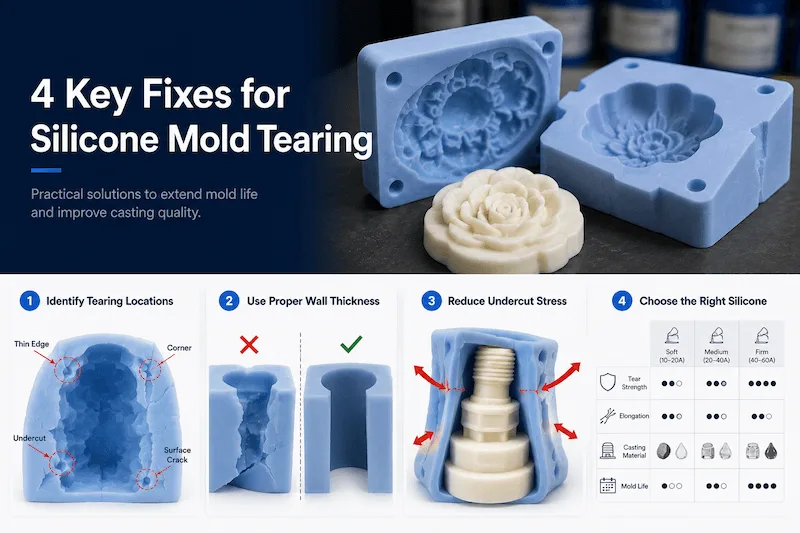
First, Identify Where the Mold Tears
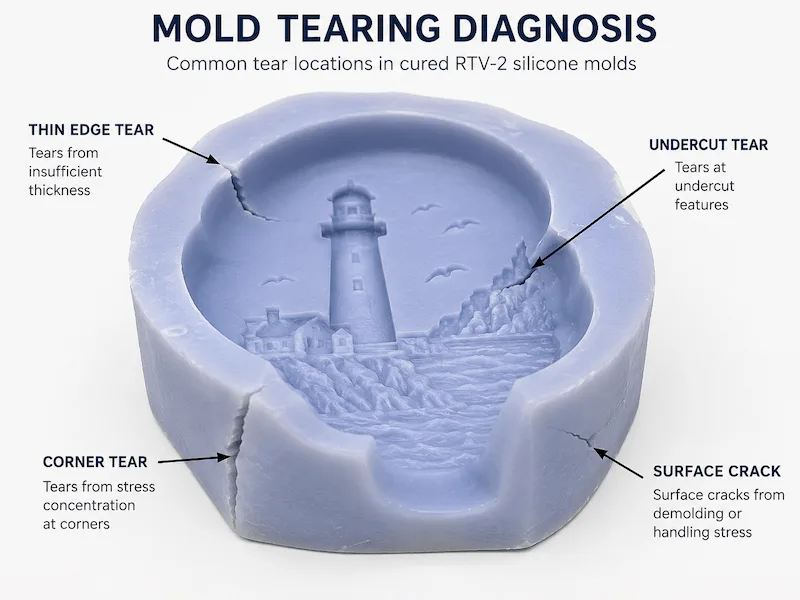
Before changing the silicone grade, check where the mold tears.
Different tearing locations usually point to different causes.
| Tearing Problem | 가능한 원인 | 최고의 솔루션 |
| The tear starts at the thin edges | The mold wall is too thin | Increase wall thickness or use higher tear strength silicone |
| Silicone too hard or the detail area too thin | Demolding stress too high | Modify mold design, add cuts, or use softer/high-elongation silicone |
| Tear happens around the undercuts | Stress concentration | Round sharp corners or reinforce weak areas |
| Mold surface cracks after repeated casting | Casting material or heat damages silicone | Check casting material compatibility and mold release |
| Tears start from sharp corners | Silicone is too hard, too weak, or has poor release | Use a proper release agent and test compatibility |
| Small details break off | Use a better release agent and more suitable hardness | Use softer silicone with good tear strength |
| Mold becomes brittle over time | Wrong silicone type or harsh casting material | Select a silicone grade suitable for repeat casting |
| Use a better release agent and a more suitable hardness | Poor release or chemical compatibility issue | Mold sticks to the casting material |
The key question is not only:
“Why did the mold tear?”
더 좋은 질문은:
“Where did the tearing start, and what stress caused it?”
2.1 Low Tear Strength Is a Major Cause of Early Mold Failure
Tear strength is one of the most important properties for silicone mold life.
A silicone mold may feel flexible, but if its tear strength is low, small cuts can grow quickly during demolding. Once a tiny crack starts, repeated pulling can make it tear deeper and faster.
This is especially important for molds with:
- 딥 언더컷
- Fine details
- Thin mold walls
- Complex shapes
- 반복적인 디몰딩
- Rigid casting materials
- Heavy castings
- Manual pulling during release
For simple molds, standard tear strength may be enough.
For production molds or complex molds, high tear strength is much more important.
If your mold always tears from the same weak point, the problem may not be only the operator. The silicone grade may not have enough tear resistance for that mold design.
2.2 Wrong Shore Hardness Can Make Demolding More Difficult
Shore hardness affects how the mold bends, stretches, and releases the casting.
If the silicone is too hard, it may not flex enough around undercuts. This increases demolding stress and can cause tearing at corners, edges, or detailed areas.
If the silicone is too soft, it may deform too much, especially in large molds or heavy castings. This can reduce dimensional stability and make the mold easier to damage during handling.
General guide:
| 금형 요구 사항 | Better Hardness Direction |
| 딥 언더컷 | Softer silicone with good elongation |
| Fine details | Medium-soft silicone with high tear strength |
| Large molds | Medium hardness with better support |
| Heavy castings | Medium to higher hardness, depending on mold design |
| Rigid casting materials | Good tear strength and release performance |
| Flexible demolding needed | Lower hardness with high elongation |
The best hardness is not always the softest or hardest option.
The best hardness is the one that balances flexibility, dimensional stability, tear strength, and demolding safety.
2.3 Thin Mold Walls Tear Faster
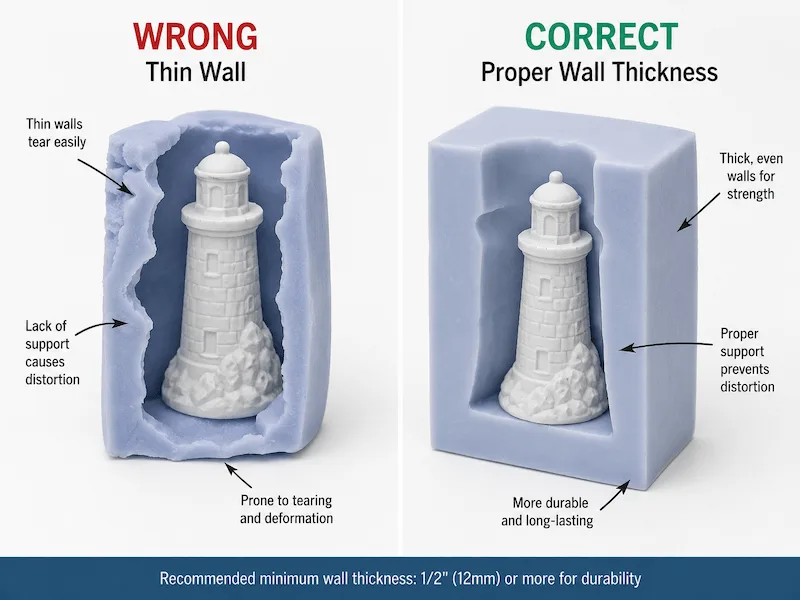
Many silicone molds tear early because the rubber layer is too thin.
A thin mold wall may save on silicone costs at the beginning, but it often increases failure risk. When the mold is stretched during demolding, the thinnest areas take the highest stress.
Common weak areas include:
- 엣지
- 코너
- Deep details
- Narrow connection points
- 얇은 입술
- Around embedded parts
- Areas near cut lines
To improve mold life:
- Increase silicone wall thickness.
- Reinforce weak zones.
- Avoid very thin lips around the mold opening.
- Add a support shell for large or soft molds.
- Do not cut too close to fine details.
- Design the mold for safe demolding, not only for material saving.
For production molds, saving a small amount of silicone can lead to a much higher cost if the mold fails early.
2.4 Undercuts Create High Demolding Stress
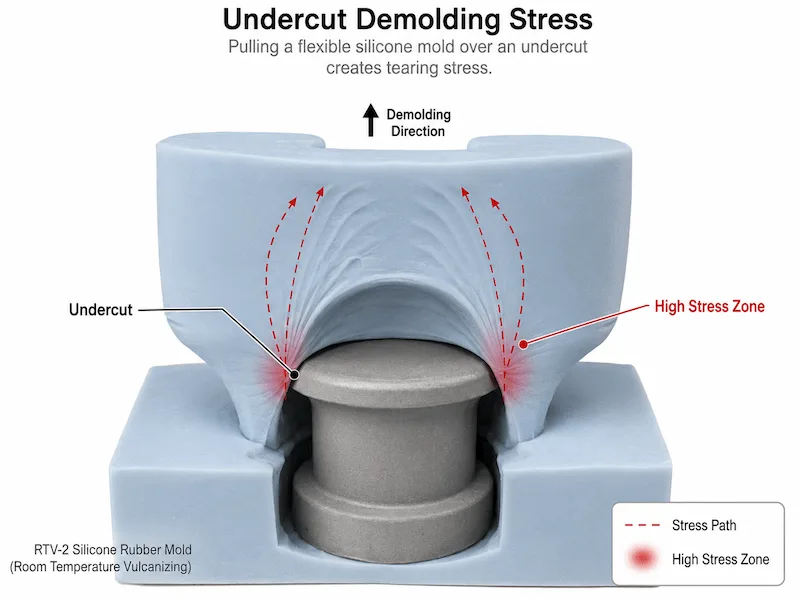
Undercuts are one of the most common reasons silicone molds tear.
A silicone mold must stretch over the undercut during demolding. If the undercut is deep, sharp, or rigid, the mold may tear even if the silicone quality is good.
Undercut-related tearing usually happens:
- At the deepest lock point
- Near sharp corners
- Around complex relief patterns
- Around holes or protrusions
- During forced demolding
- After several repeated castings
To reduce tearing from undercuts:
- Use softer silicone with good elongation.
- Choose higher tear strength silicone.
- Add proper mold cuts.
- Use a two-part or multi-part mold design.
- Apply a suitable release agent.
- Demold slowly in the correct direction.
- Avoid pulling the mold aggressively.
If a mold has serious undercuts, changing silicone alone may not solve the problem. Mold structure also needs to be improved.
2.5 Sharp Corners Cause Stress Concentration
Sharp corners are dangerous for silicone molds.
When the mold is pulled, stress concentrates at sharp corners and small cuts. This makes tearing start more easily.
This often happens in molds for:
- Resin parts
- Concrete products
- 장식 패널
- Figurines
- Prototype parts
- 산업용 구성 요소
- Jewelry or detailed models
To reduce tearing:
- Round sharp edges on the master when possible.
- Add a radius to the mold design.
- Avoid unnecessary sharp internal corners.
- Use a higher tear strength silicone.
- Brush silicone carefully into sharp details.
- Reinforce thin areas around corners.
A small radius can make a big difference in mold life.
2.6 Poor Demolding Technique Can Damage the Mold
Even good silicone can tear if demolding is too aggressive.
Common demolding mistakes include:
- Pulling too fast
- Pulling in the wrong direction
- Forcing the mold over undercuts
- Using sharp tools to remove castings
- Demolding before the casting is fully ready
- Not using a release agent when needed
- Twisting thin mold sections too much
Better demolding practice:
- Demold slowly and evenly.
- Release edges first.
- Avoid sudden pulling.
- Support thin areas by hand.
- Follow the designed release direction.
- Use compressed air carefully if suitable.
- Apply a compatible mold release for difficult castings.
If the mold tears only during demolding, the key issue is usually demolding stress, release performance, hardness, or mold design.
Need the right RTV-2 silicone grade?
If you are facing tearing, bubble, or curing issues, send us your application details. Topsil will recommend the perfect grade for testing.
2.7 Wrong or Missing Release Agent Can Shorten Mold Life
Some users believe silicone molds never need a release agent. That is not always true.
For certain casting materials, repeated demolding without a release agent can increase friction, surface damage, and tearing risk.
A release agent may be needed when casting:
- Polyurethane resin
- 에폭시 수지
- Polyester resin
- 콘크리트
- 석고
- Wax blends
- Filled resin systems
- Materials with strong surface adhesion
A proper release agent can reduce pulling force and protect the mold surface. However, the release agent must be compatible with both the silicone mold and casting material.
Too much release agent may affect surface detail or finishing. Too little release agent may increase mold damage.
For production molds, release performance should be tested before bulk casting.
2.8 Casting Materials Can Damage Silicone Over Time
Some molds tear early because the casting material attacks or stresses the silicone surface.
This is especially common when casting:
- Aggressive resins
- Exothermic materials
- Filled systems
- Abrasive concrete mixtures
- Large resin castings
- Materials that generate heat during curing
- Materials requiring a strong demolding force
Even if the first few castings look good, repeated exposure may reduce mold life.
Possible signs include:
- The mold surface becomes rough
- Mold loses flexibility
- Small cracks appear
- Details become damaged
- Demolding becomes harder
- Mold tears after repeated casting
To improve mold life:
- Choose silicone compatible with the casting material.
- Use a suitable mold release.
- Avoid overheating.
- Allow casting materials to cure properly before demolding.
- Clean the mold gently.
- Store molds correctly after use.
A silicone mold used for wax may last differently from one used for polyurethane, epoxy, concrete, or filled resin.
Application matters.
2.9 Silicone Grade Selection Matters More Than Many Users Think
Not all RTV-2 silicone rubber is designed for the same mold application.
A grade that works well for simple craft molds may fail quickly in detailed production molds. A silicone that is soft enough for demolding may not have enough dimensional stability for large parts. A hard silicone may hold shape well but tear around undercuts.
When selecting RTV-2 silicone for mold making, do not only check Shore hardness.
You should also check:
- 인열 강도
- 신장
- 인장 강도
- 점성
- 근무 시간
- 경화 시간
- 수축
- 금형 크기
- 주조 재료
- Master design
- Demolding difficulty
- 예상 금형 수명
For complex molds, tear strength and elongation are often more important than buyers expect.
The right grade should match both the casting material and the demolding stress.
2.10 Platinum-Cure vs Tin-Cure Silicone: Which Is Better for Mold Life?
Both platinum-cure and tin-cure silicone can be used for mold making, but they are not always chosen for the same reasons.
주석 경화 RTV-2 실리콘
주석 경화 실리콘 is widely used for general mold making. It is often cost-effective and suitable for many applications such as resin, gypsum, concrete, wax, crafts, and decorative molds.
For standard molds, tin-cure silicone can be a practical choice. However, mold life still depends on tear strength, hardness, mold design, release agent, and casting material.
플래티넘 큐어 RTV-2 실리콘
백금 경화 실리콘 is often selected for lower shrinkage, better dimensional stability, and high-precision mold applications. It can be suitable for precision mold making, rapid prototyping, selected food mold applications, and projects requiring better long-term accuracy.
However, platinum-cure silicone can be sensitive to cure inhibition from certain materials, including some sulfur-containing clays, amines, tin compounds, latex, uncured 3D printing resin, and incompatible release agents.
If the silicone is not fully cured, the mold can become weak and tear more easily.
So the choice is not simply “tin-cure or platinum-cure.”
더 좋은 질문은:
Which silicone system fits the mold design, casting material, expected accuracy, and demolding conditions?
2.11 Why New Silicone Molds Sometimes Tear During the First Demolding
If a silicone mold tears during the first demolding, the issue is usually serious.
Possible causes include:
- The silicone grade is too weak for the undercut.
- The Shore hardness is not suitable.
- The mold wall is too thin.
- No release agent was used.
- The master has sharp edges.
- The silicone did not cure completely.
- The mold was demolded too early.
- The mold design locks the casting too tightly.
- The cut line was placed in a weak position.
If the mold tears on the first use, do not only blame the silicone. Review the full process from master design to curing time and demolding direction.
A first-demolding tear usually means the mold was not designed for safe release.
2.12 Why Silicone Molds Tear After Several Castings
If the mold works at first but tears after several cycles, the cause may be different.
Common reasons include:
- Repeated stress at the same weak point
- Casting material is slowly damaging the silicone
- Insufficient release agent
- Thin mold walls
- Abrasive fillers in the casting material
- Heat buildup from resin curing
- Wrong cleaning method
- Poor mold storage
- Low tear strength for repeat production
In this case, you need to check both the silicone performance and the production process.
다음 질문을 해보세요:
- How many castings did the mold complete before tearing?
- Did the tear start from the same area each time?
- What casting material was used?
- Was mold release used every time?
- Was the mold cleaned after each casting?
- Was the casting material hot during curing?
- Was the mold stretched heavily during demolding?
Mold life is not only a material number.
It is the result of the silicone grade, mold design, casting material, and demolding process.
RTV-2 Silicone Mold Tearing Troubleshooting Checklist
Before choosing a new silicone grade, check these points.
금형 설계
- Are there deep undercuts?
- Are there sharp corners?
- Is the mold wall too thin?
- Are weak areas reinforced?
- Is the cut line placed safely?
- Is a support shell needed?
실리콘 등급
- Is the tear strength high enough?
- Is the elongation suitable?
- Is the Shore hardness correct?
- Is the viscosity suitable for the mold details?
- Is the curing system suitable for the master material?
- Is the grade designed for repeat casting?
Demolding Process
- Is the release agent used when needed?
- Is the casting fully cured before demolding?
- Is the mold pulled too aggressively?
- Is the demolding direction correct?
- Are sharp tools damaging the mold?
캐스팅 재료
- Is the casting material aggressive?
- Does it generate heat during curing?
- Does it contain abrasive fillers?
- Does it stick strongly to silicone?
- Is it compatible with the selected silicone mold?
Mold Life Expectation
- Is this a one-off mold or a production mold?
- How many castings are expected?
- Is surface detail more important than mold durability?
- Is dimensional stability required?
- Is easy demolding more important than high hardness?
실리콘 등급을 변경해야 하는 경우
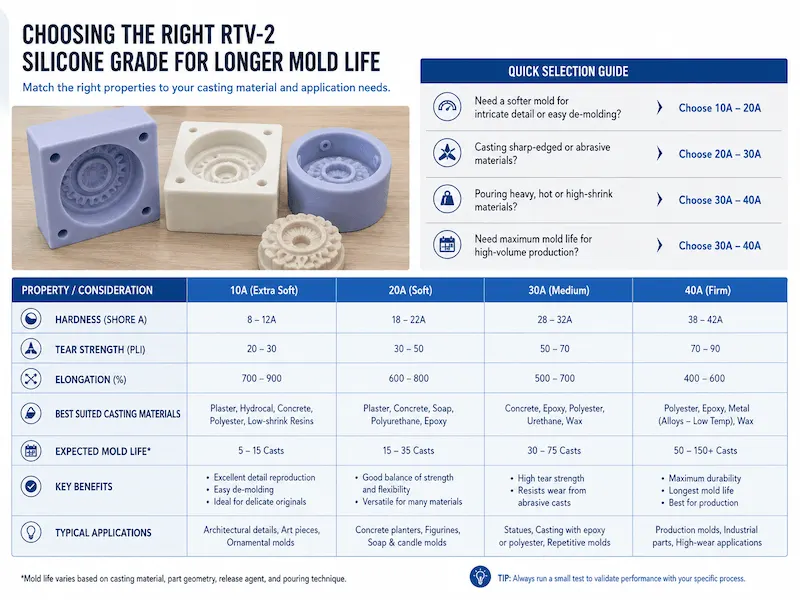
You may need to change the RTV-2 silicone grade if:
- The mold tears from undercuts.
- Thin details break easily.
- The mold tears during the first demolding.
- The mold loses strength after only a few castings.
- The silicone feels too hard to release safely.
- The silicone is too soft and deforms during handling.
- The tear always starts from the same weak point.
- The casting material is more aggressive than expected.
- The current grade was selected only by hardness, not by tear strength.
For difficult molds, you should not select silicone by Shore hardness alone.
A better recommendation is needed:
- 금형 크기
- Master shape
- Undercut depth
- 주조 재료
- Target hardness
- 예상 금형 수명
- Demolding difficulty
- Required detail reproduction
- 주석 경화 또는 백금 경화 선호도
A silicone supplier should help you match the grade to the application, not only provide a product list.
Conclusion: Early Mold Tearing Is Usually a Matching Problem
Silicone molds tear early when the material, mold design, and casting process are not properly matched.
If the mold tears at thin edges, improve the wall thickness and tear strength.
If it tears around undercuts, reduce demolding stress or use a more flexible grade.
If it tears after repeated casting, check the casting material, release agent, and mold life requirements.
If it tears during the first demolding, review the mold design, hardness, curing, and release method.
The solution is not always “use a harder silicone” or “use a softer silicone.”
The real solution is to match:
tear strength + hardness + elongation + mold design + casting material + demolding process.
That is how you improve mold life and reduce failed molds.
자주 묻는 질문
RECOMMENDED NEXT STEP
Grade issue or processing error?
Send your data, photos, and target hardness. We’ll find the cause and recommend the right RTV-2 grade.
Send Problem Details