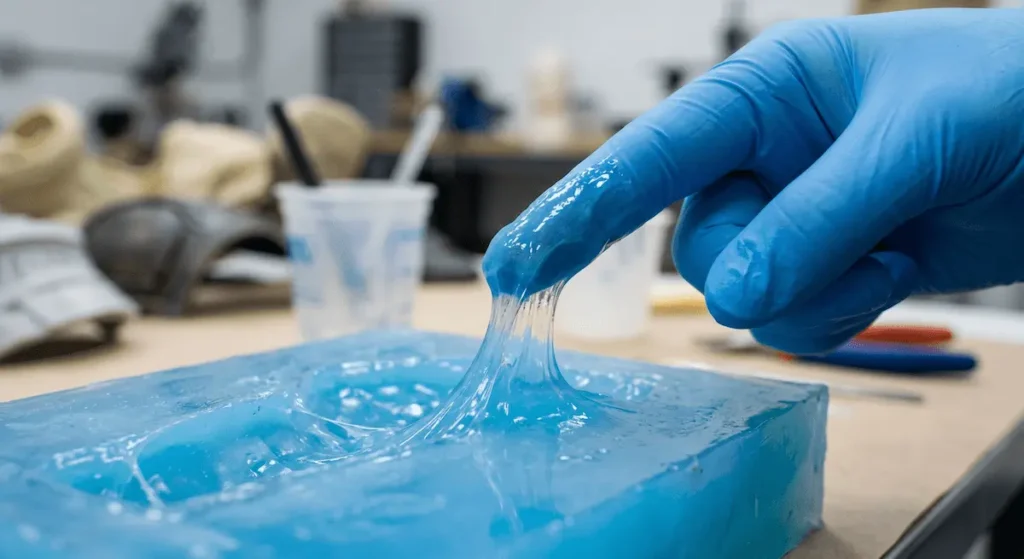

Is your RTV-2 silicone still sticky after 24 hours?
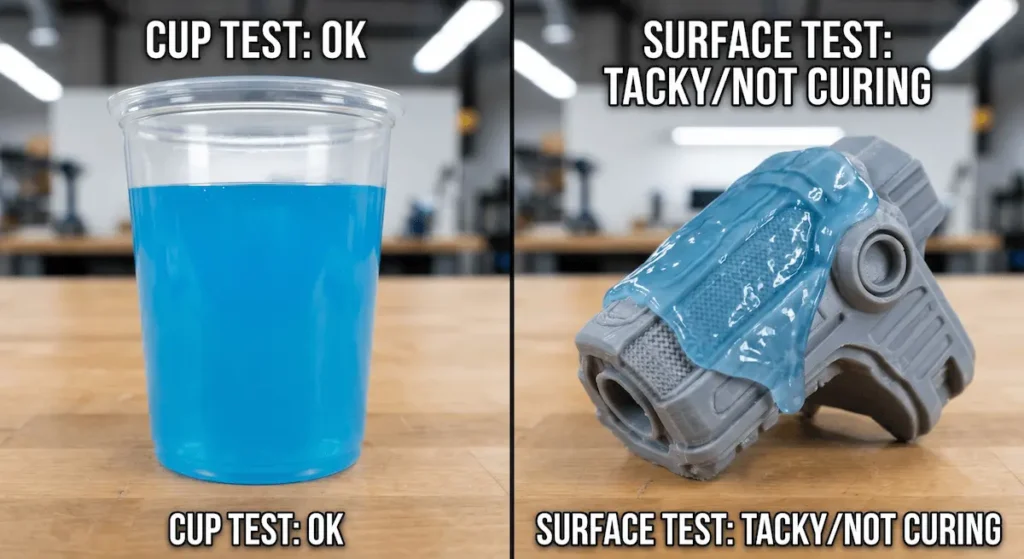
Does it cure in the mixing cup but stay tacky on the master model?
Does only one area remain soft while the rest of the mold cures normally?
Before you blame the silicone itself, check the curing system, mixing ratio, room temperature, model surface and possible contamination. In many cases, RTV-2 silicone curing failure is caused by wrong operation, cure inhibition, low temperature or an unsuitable cure system, not simply poor material quality.
This guide helps you quickly identify the real reason and choose the right RTV-2 silicone for your application.
Quick Answer: 7 Reasons Why RTV-2 Silicone Does Not Cure Properly
If the silicone cures normally in a clean cup but fails on the model surface, the problem is usually not the silicone batch itself. It is more likely related to the master model, release agent, coating or surface contamination.
Quick Answer: 7 Reasons Why RTV-2 Silicone Does Not Cure Properly
| 문제 | Most Likely Cause | More Common In |
| Silicone stays sticky after 24 hours | Wrong mix ratio, low temperature or poor mixing | Tin cure and platinum cure |
| Silicone cures in the cup but not on the model | Cure inhibition or surface contamination | Platinum cure |
| Some areas cure, some areas stay soft | Uneven mixing or local contamination | Tin cure and platinum cure |
| Cure time is much longer than the TDS | Low room temperature or slow catalyst system | Tin cure |
| Silicone cures too fast before pouring | Too much catalyst or wrong catalyst speed | Tin cure |
| Surface remains tacky | Incompatible release agent, coating or master model | Platinum cure |
| Final rubber is weak or oily | Wrong ratio, expired material or unsuitable grade | Tin cure and platinum cure |
First Question: Are You Using Tin Cure or Platinum Cure Silicone?
RTV-2 silicone rubber mainly has two cure systems: tin cure and platinum cure. The curing failure reasons are different.
| 치료 시스템 | Also Called | 일반적인 사용 | Common Curing Risk |
| 주석 경화 실리콘 | Condensation cure silicone | General mold making, resin molds, gypsum, concrete, craft molds | Wrong catalyst ratio, low temperature, poor mixing |
| 플래티넘 경화 실리콘 | Addition cure silicone | Food molds, precision molds, PU casting, wax casting, low-shrinkage molds | Cure inhibition from model surface, 3D resin, sulfur, latex, amines or contamination |
So before solving the curing problem, confirm this first:
Is it a tin cure operation issue, or a platinum cure inhibition issue?
Fast Diagnosis Table
| What Happened? | What It Usually Means | What to Do Next |
| Silicone does not cure in the mixing cup | Ratio, mixing, catalyst, temperature or material issue | Recheck weighing, mixing and room temperature |
| Silicone cures in the cup but not on the model | Surface inhibition or contamination | Test on another clean surface |
| Only some areas remain sticky | Poor mixing or local surface contamination | Mix again and check tools/model surface |
| Silicone cures too slowly | Low temperature or slow catalyst | Test again at 23–25°C |
| Silicone cures too fast | Catalyst too fast or too much catalyst | Use slower catalyst or adjust formulation |
| Platinum silicone fails on 3D printed part | Inhibition from resin surface | Use barrier coating or test another cure system |
This table is the fastest way to avoid random sample testing.
1. Wrong Mixing Ratio
RTV-2 silicone is a two-component material. If Part A and Part B are not mixed in the correct ratio, the silicone may stay sticky, cure slowly or remain weak after curing.
For tin cure silicone, catalyst ratio directly affects pot life and curing speed.
| Catalyst Situation | Possible Result |
| Too little catalyst | Slow cure, sticky surface, incomplete curing |
| Too much catalyst | Very short pot life, weaker final rubber, shorter mold life |
| Uneven catalyst distribution | Local soft spots or tacky areas |
| Estimated by eye instead of weighed | Unstable results from batch to batch |
For platinum cure silicone, especially 10:1 systems, accurate weighing is very important. A small mistake in Part B may affect the final curing result.
Recommendation: Always weigh both components accurately according to the TDS. Do not estimate the ratio by eye.
2. Poor Mixing
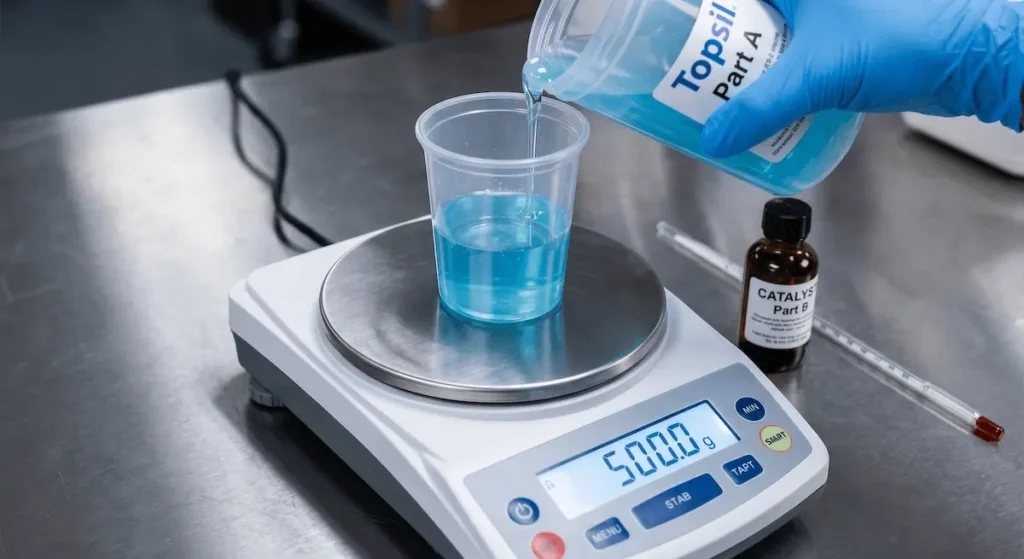
Poor mixing is one of the most common causes of local curing failure.
Typical signs include:
- one area cures while another area stays soft
- streaks in the mixed silicone
- tacky corners or bottom areas
- uneven hardness after curing
- silicone looks cured outside but remains soft inside
When mixing RTV-2 silicone, scrape the sidewall and bottom of the container carefully. For larger batches, mix slowly and thoroughly to reduce bubbles while still ensuring full dispersion.
Recommendation: For important mold making or potting projects, mix once, transfer to a second clean container, and mix again. This helps reduce unmixed material on the container wall.
3. Low Room Temperature
RTV-2 silicone cure time is strongly affected by temperature. If the supplier’s TDS is tested at 23–25°C but your workshop is only 10–15°C, the silicone can cure much slower than expected.
| Room Temperature | Possible Effect |
| Below 15°C | Cure may become very slow |
| 20–25°C | Normal test and production condition |
| Above 30°C | Pot life becomes shorter and curing becomes faster |
This is especially important for tin cure silicone. A material that cures in 4 hours at 25°C may take much longer in a cold workshop.
Recommendation: When comparing silicone samples, test them under the same temperature and mixing conditions. Otherwise, the comparison may be misleading.
4. Wrong Catalyst Speed
Some tin cure silicone systems can use standard, fast or very fast catalysts. If the catalyst speed does not match your production process, curing problems may happen.
| 애플리케이션 | Better Catalyst Choice |
| Small molds, fast production | Fast catalyst |
| Large molds | Standard or slower catalyst |
| Winter production | Faster catalyst may be needed |
| Vacuum degassing required | Avoid catalyst that is too fast |
| Large batch mixing | Longer pot life is safer |
A very fast catalyst may be useful for small molds, but it may create problems for large molds because the silicone can thicken before pouring or degassing is finished.
Recommendation: Choose pot life and cure time according to your real operation, not only according to the fastest possible curing speed.
5. Platinum Cure Inhibition
If platinum cure silicone cures in the cup but stays sticky on the model surface, the most likely reason is 치료 억제.
Platinum cure silicone may be inhibited by:
- sulfur-containing clay
- some 3D printing resins
- latex rubber
- amine-containing materials
- some adhesives or paints
- tin cure silicone residue
- certain release agents
- contaminated gloves or tools
- oil, solvent or uncured coating on the model surface
This problem is very common when customers use platinum silicone on 3D printed masters, painted models or unknown surface materials.
| Symptom | Possible Cause |
| Cup sample cures normally, model surface stays tacky | Surface inhibition |
| Only contact surface does not cure | Incompatible model material or coating |
| Certain areas remain sticky | Local contamination |
| Silicone fails only on 3D printed part | Resin inhibition |
Recommendation: Before making a full mold, apply a small amount of mixed silicone on the master model and check whether it cures normally. This simple surface test can save material, time and cost.
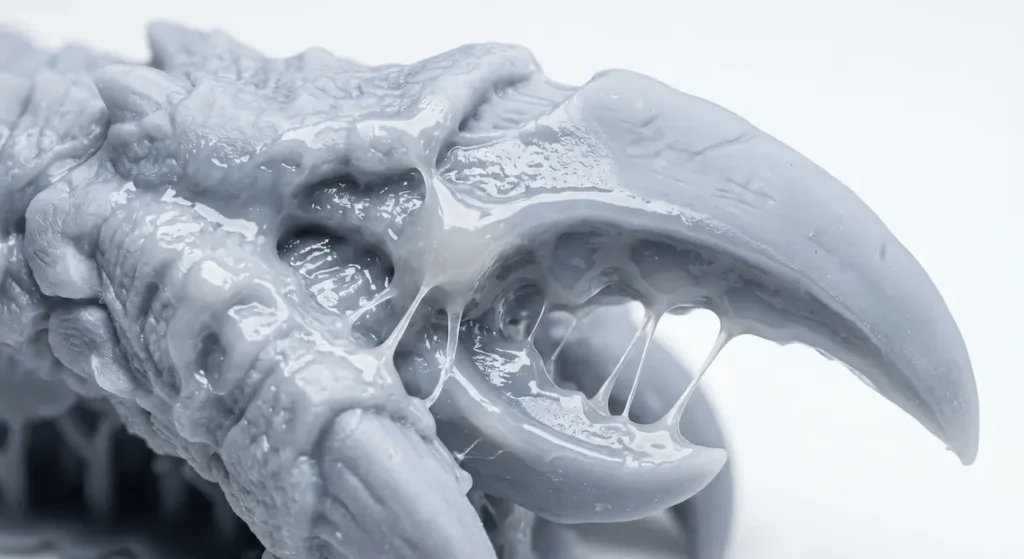
6. Incompatible Release Agent or Coating
Release agents can help demolding, but not every release agent is compatible with every RTV-2 silicone system.
Too much release agent, uncured coating, solvent residue or incompatible spray may cause surface tackiness or incomplete curing.
| Issue | Possible Result |
| Too much release agent | Sticky surface or poor detail reproduction |
| Solvent not fully evaporated | Surface curing problem |
| Incompatible coating | Silicone does not cure on contact surface |
| Uneven release agent | Local tacky spots |
Recommendation: Use a release agent confirmed to be compatible with your silicone system. For platinum cure silicone, always test on a small area first.
7. Expired Material or Contaminated Tools
If the silicone or catalyst has been stored for too long, exposed to moisture, or not sealed properly, curing performance may become unstable.
Also check whether the tools are contaminated by resin, oil, solvent, tin catalyst or other chemicals.
Before testing again, confirm:
- Is the silicone within shelf life?
- Was the catalyst bottle tightly sealed?
- Were the mixing tools clean and dry?
- Were latex gloves used?
- Was the same tool used for tin cure and platinum cure silicone?
- Was the silicone stored under recommended conditions?
Recommendation: Do not mix silicone base and catalyst from different suppliers unless compatibility is confirmed.
Three Simple Tests Before You Change Silicone Supplier
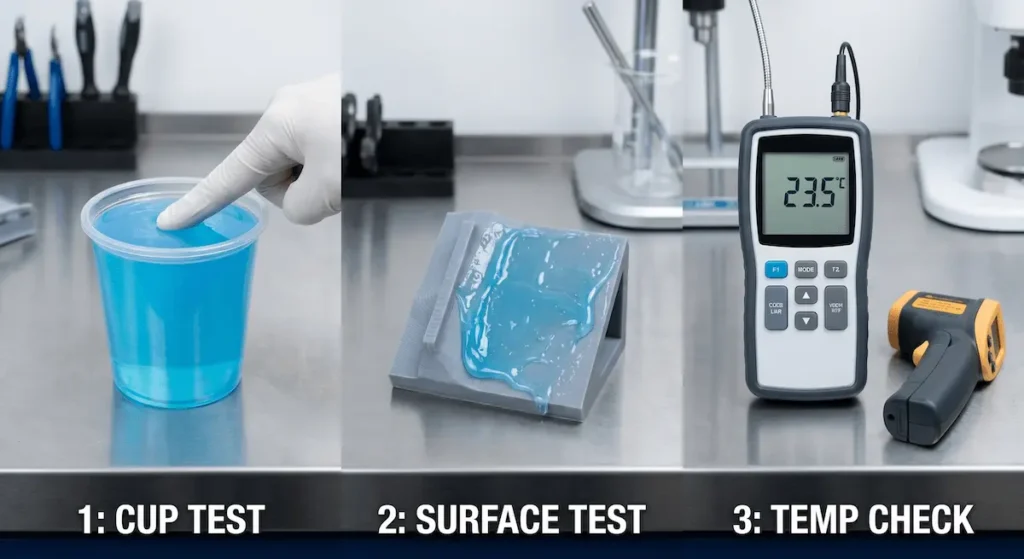
Test 1: Cup Test
Mix a small amount of silicone in a clean cup according to the TDS.
| Result | Meaning |
| It cures normally | Silicone itself is probably OK |
| It does not cure | Check ratio, catalyst, temperature, mixing or shelf life |
| It cures much slower than expected | Check room temperature and catalyst speed |
Test 2: Surface Test
Apply a small amount of mixed silicone on the master model.
| Result | Meaning |
| Cup cures, surface does not cure | Surface inhibition or contamination |
| Both cure normally | Full mold making can continue |
| Only some areas fail | Local contamination or uneven coating |
This test is especially important for platinum cure silicone.
Test 3: Temperature Check
Test the same silicone at 23–25°C and compare it with your workshop condition.
If the silicone cures normally at 25°C but slowly in your workshop, the issue is likely temperature-related.
How to Choose the Right RTV-2 Silicone After a Curing Problem
Do not choose silicone only by price. The cure system, hardness, viscosity, pot life and curing speed must match your application.
| 애플리케이션 | Better Choice | Key Point |
| 일반 금형 제작 | 주석 경화 실리콘 | Cost-effective and easier to use |
| Candle, soap and craft molds | 주석 경화 실리콘 | Flexible demolding and simple operation |
| Concrete or gypsum molds | 주석 경화 실리콘 | Tear strength, support and longer pot life |
| Food contact molds | 플래티넘 경화 실리콘 | Food-grade compliance if required |
| PU casting | 플래티넘 경화 실리콘 | Low shrinkage and better dimensional stability |
| Wax casting or precision molds | 플래티넘 경화 실리콘 | Fine detail and low shrinkage |
| 3D printed master model | Test first | Risk of platinum cure inhibition |
| 전자 포팅 | Potting-grade silicone | Flowability, insulation and stable cure |
If you have repeated curing problems, the solution may not be “try another random silicone”. It may be choosing the correct cure system and matching the grade to your operation.
Tin Cure or Platinum Cure: Which One Should You Choose?
| 요구 사항 | 주석 경화 실리콘 | 플래티넘 큐어 실리콘 |
| Lower cost | Better choice | 더 높은 비용 |
| General molds | Good choice | Also possible |
| Low shrinkage | Medium | 더 나은 |
| Food-grade application | Usually not preferred | Better if certified |
| Easy operation | 더 쉬움 | More sensitive to inhibition |
| Precision reproduction | Medium | 더 나은 |
| Large concrete molds | Common choice | Usually not necessary |
| 3D printed model | Lower inhibition risk | Must test first |
For general molds, tin cure silicone is often practical and cost-effective.
For food molds, precision molds, low-shrinkage molds and high-value PU or wax casting, platinum cure silicone may be the better option.
How Topsil Silicone Helps Buyers Troubleshoot RTV-2 Silicone Curing Problems
Topsil Silicone is a China RTV-2 silicone rubber manufacturer with 15+ years of production and application experience. When a customer tells us “the silicone does not cure”, we do not immediately recommend a random grade.
We usually ask the customer to check:
- Did the silicone cure in a clean cup?
- Did it fail only on the master model surface?
- What is the cure system: tin cure or platinum cure?
- What is the mixing ratio?
- What is the room temperature?
- What is the master model material?
- Was any release agent, coating, paint or resin used?
- What is the target application and mold size?
- What pot life and cure time are needed?
- Is there a current TDS for comparison?
With this information, we can judge whether the issue is caused by operation, inhibition, temperature, wrong catalyst speed or unsuitable silicone grade.
What to Send Us for Grade Recommendation
If you are facing RTV-2 silicone curing problems, please send us the following information:
| Information | Why We Need It |
| Current silicone TDS | To compare hardness, viscosity, pot life and cure time |
| Photos or videos of the problem | To identify sticky surface, soft spots or inhibition |
| Cure system | Tin cure and platinum cure have different risks |
| Mix ratio | Wrong ratio is a common cause |
| Room temperature | Low temperature slows curing |
| Master model material | Helps check inhibition risk |
| Release agent or coating used | May affect surface curing |
| 애플리케이션 | Mold making, potting, pad printing or casting |
| Annual consumption | Helps recommend sample and supply solution |
These details help us recommend a suitable RTV-2 silicone grade instead of sending a random sample.
자주 묻는 질문
Still Not Sure Why Your RTV-2 Silicone Failed to Cure?
Topsil can help check whether the curing problem comes from the cure system, surface inhibition, operation method or wrong silicone grade, and recommend a suitable tin cure or platinum cure RTV-2 silicone for your application.