
A common inquiry we receive from printing-pad manufacturers is:
“We need hardness 30. Can you supply the same?”
Before recommending a silicone, Topsil silicone needs to clarify something much more important than the price:
30 on which hardness scale?
A 30 Shore A silicone is not the same as a 30 Shore 00 pad. And even after the scale is confirmed, there is another question:
Is “30” the hardness of the original silicone—or the finished printing pad after silicone oil has been added?
These distinctions matter when selecting a new material or qualifying a second supplier.
Quick Answer: Is Shore A the Same as Shore 00?
No. Shore A and Shore 00 are different durometer hardness scales, and the same numerical value should not be treated as the same hardness.
ASTM D2240 covers different durometer types with different indenter geometries and applied forces. Because of these differences, measurements from different durometer types do not have a simple direct relationship.
For printing-pad silicone, the safe approach is:
Confirm the scale → confirm what was measured → understand the printing conditions → validate the finished pad.
That is the basis of the Topsil silicone Hardness Matching Protocol.
ASTM D2240 — Standard Test Method for Rubber Property—Durometer Hardness
The Topsil silicone Hardness Matching Protocol
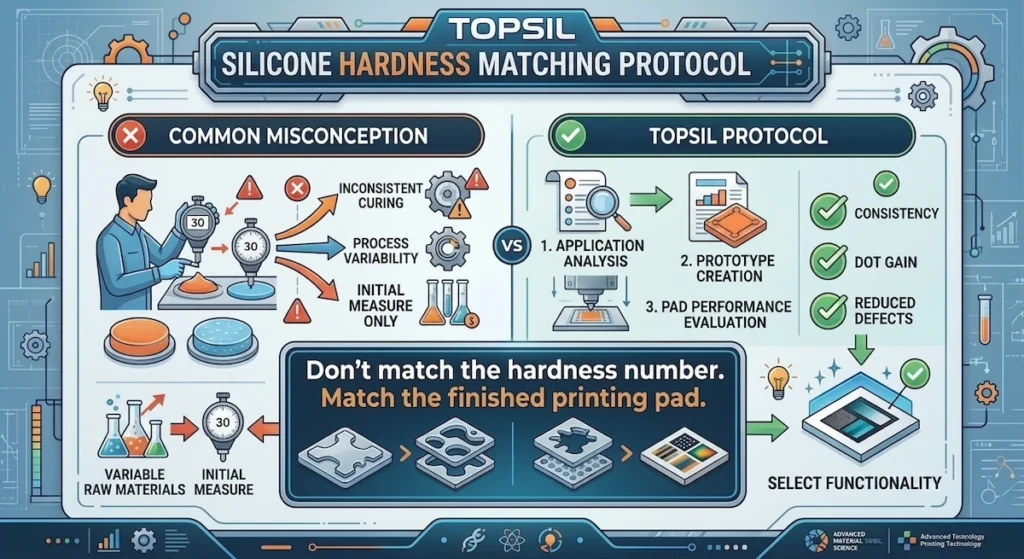
When matching an existing printing-pad silicone, we recommend four checks before selecting a replacement grade.
| Шаг | What to confirm | Почему это важно |
| 1. Identify the scale | Shore A, Shore 00, 00 Si or another system | The same numerical value on different scales is not equivalent |
| 2. Identify what was measured | Base silicone or finished oil-adjusted pad | Silicone oil may significantly change final hardness |
| 3. Understand the printing context | Pad geometry, image, machine force, substrate | Hardness does not act independently |
| 4. Validate the finished pad | Measure, print and compare pad performance | The actual printing trial qualifies the material |
This avoids a common sourcing mistake:
Matching the hardness number instead of matching the finished printing pad.
For the broader silicone-selection process, see:
Topsil silicone Pad Printing Silicone Rubber →
Shore A vs Shore 00: What Does the Number Actually Mean?
Shore hardness is an indentation measurement.
A durometer presses a specified indenter into the elastomer under defined conditions. In general:
Lower reading → softer material
Higher reading → firmer material
But the number is meaningful only when the hardness scale is known.
This is particularly important in pad printing because different suppliers use different systems.
For example, Inkcups publishes finished silicone printing pads using Shore 00 hardness classifications.
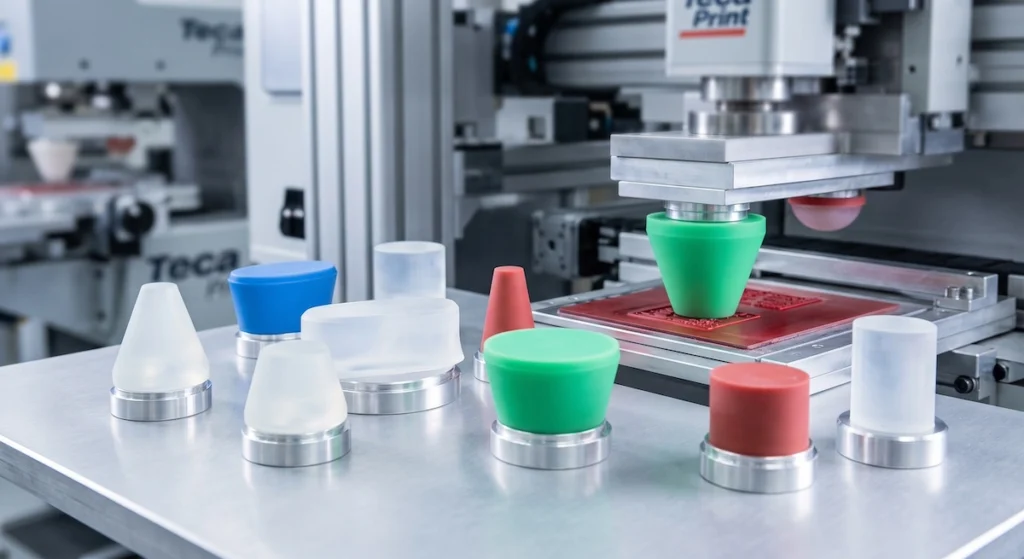
Teca-Print uses a 00 Si designation for its printing pads. This should not automatically be assumed to be identical to every other “00” measurement system; the actual supplier test method should be confirmed.
By comparison, Topsil silicone currently specifies its PP-30 and AP-30 pad-printing silicone grades at:
30 ± 2 Shore A
View PP-30 and AP-30 technical data
These numbers therefore cannot simply be compared side by side.
Is 30 Shore A Equal to 30 Shore 00?
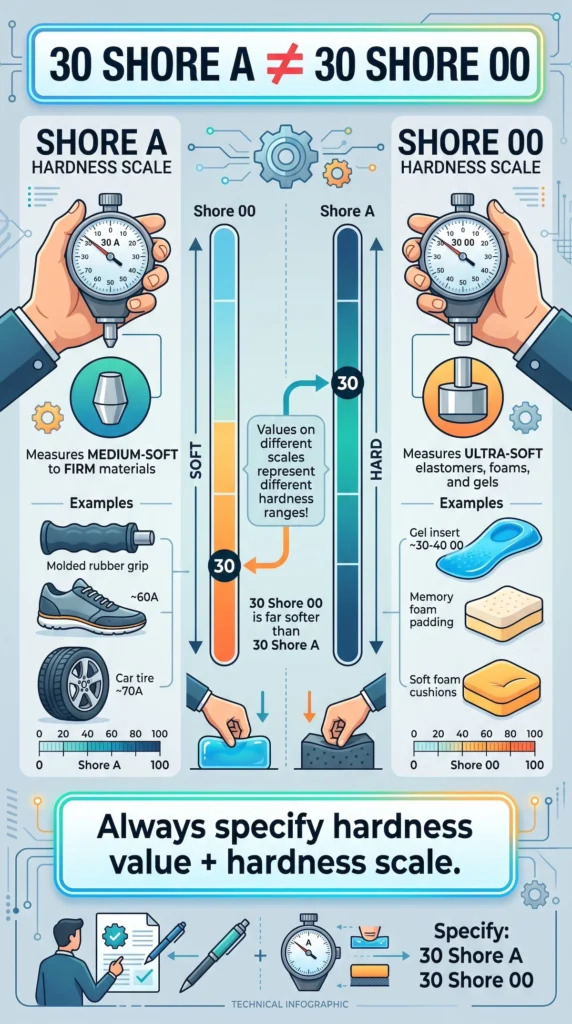
No.
“30” is only half of the specification.
A proper hardness specification should be written as:
30 ± 2 Shore A
rather than simply:
Hardness: 30
The scale is essential.
Can You Convert Shore A to Shore 00?
Not reliably with a simple formula for supplier qualification.
Approximate hardness-comparison charts are widely available and can be useful for visualizing relative softness. But ASTM D2240 explains that different durometer types use different indenters and applied forces, so their measurements do not have a simple direct relationship.
That means an online conversion chart may be useful for:
- Rough orientation
- Understanding different hardness ranges
- Early technical discussion
But it should не be used as:
- A purchase-order specification
- A QC acceptance criterion
- Proof that two silicone grades are equivalent
- A final supplier-replacement decision
If Two Suppliers Use Different Scales
| Situation | Risky approach | Better approach |
| Supplier A uses Shore A, Supplier B uses Shore 00 | Convert online and order | Request comparable measurement or trial |
| Customer says “hardness 30” | Assume the scale | Ask which scale |
| Existing pad says “50 Shore” | Match the number | Confirm test system and finished-pad condition |
| Supplier uses a proprietary scale | Assume it equals ASTM Shore 00 | Ask for test method or comparative data |
| Direct comparison is unavailable | Guess an equivalent | Make and measure a trial pad |
A hardness number without its scale is an incomplete specification.
Are You Comparing Base Silicone Hardness or Finished-Pad Hardness?
Once the scale is confirmed, the next question is:
What exactly was measured?
This matters because many printing-pad manufacturers adjust hardness by adding silicone oil.
For example, a liquid silicone may start at:
30 Shore A
After Parts A and B are mixed, silicone oil may be added to produce a much softer finished pad.
So if a buyer says:
“Our current pad is 13 Shore A.”
that could mean either:
- The original silicone grade itself is approximately 13 Shore A, or
- A harder base silicone was softened to approximately 13 Shore A after oil addition.
Those are not the same formulation.
When replacing an existing supplier, the most useful information is therefore:
Base silicone grade + original hardness + silicone-oil dosage + final cured-pad hardness
This tells the supplier how the pad was actually formulated—not just how it feels after curing.
What Determines How Firm a Printing Pad Can Be?
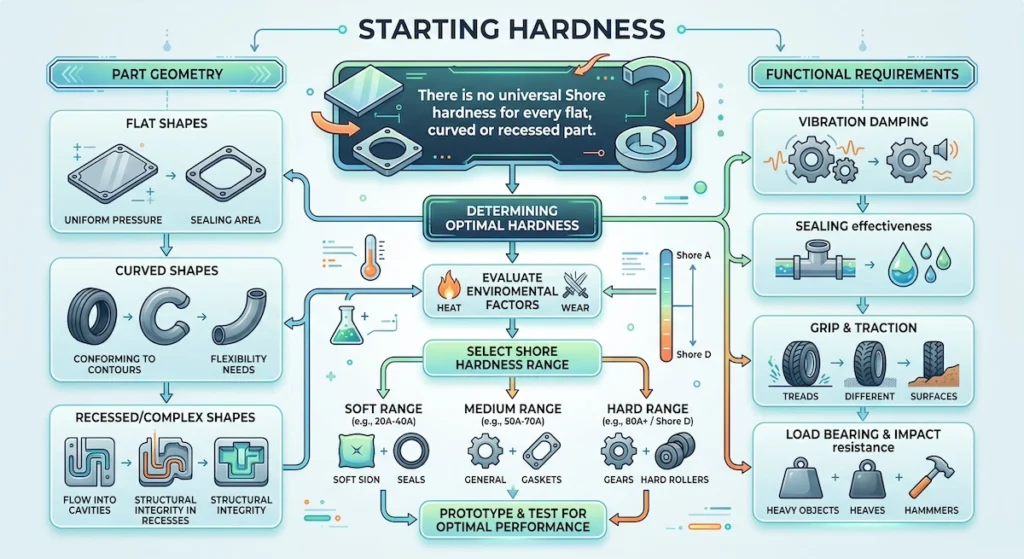
The question is not simply:
“Soft pad or hard pad?”
Лучше задать вопрос:
How firm can this pad practically be without creating another problem?
Four factors normally define the starting direction.
Pad and Part Geometry
Curved, recessed and irregular surfaces may require greater conformability.
But making the silicone softer is not always the first solution.
Pad shape, angle, size and volume can be equally important. A poor pad geometry does not automatically become suitable simply because softer silicone is used.
Image Requirements
Where the geometry permits, a firmer pad may resist deformation more effectively and help maintain image stability.
This can become important for:
- Fine lettering
- Small details
- Registration-sensitive graphics
- Larger images where distortion becomes noticeable
Machine Compression Capability
A firmer or larger pad generally requires sufficient machine force to compress correctly.
If the machine cannot deform the pad sufficiently, increasing hardness can reduce effective contact rather than improve printing.
Substrate Pressure Tolerance
Thin, fragile or pressure-sensitive parts may limit the usable pad force.
The practical selection logic therefore becomes:
Pad Geometry + Image Requirement + Machine Force + Substrate Tolerance → Starting Hardness → Printing Trial
Both Inkcups and Teca-Print emphasize that hardness needs to be considered together with variables such as pad geometry, machine capability, image dimensions and substrate conditions.
Practical Rule
Where pad geometry, available machine force and substrate tolerance permit, a firmer pad may help reduce deformation and improve image stability.
But this is a direction for testing—not a universal rule.
How Silicone Oil Changes Finished-Pad Hardness
Silicone oil is commonly used with compatible pad-printing silicone systems to reduce cured hardness.
Elkem also describes printing-pad RTV silicone systems whose hardness can be adjusted using different amounts of silicone oil.
Topsil silicone has conducted internal hardness-adjustment testing using A100 silicone oil.
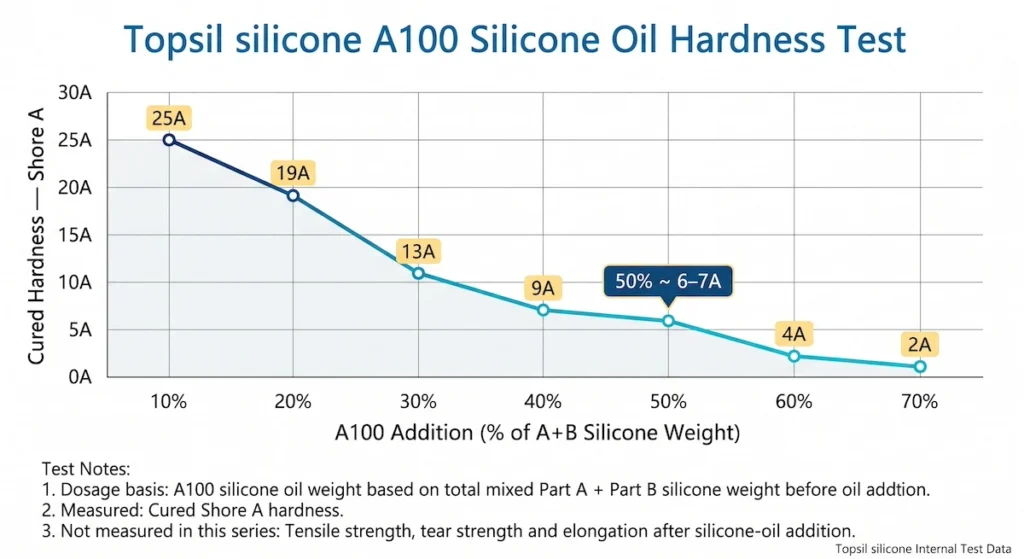
Topsil silicone A100 Hardness-Adjustment Reference
| A100 silicone oil addition* | Approx. cured hardness |
| 10% | ~25 Shore A |
| 20% | ~19 Shore A |
| 30% | ~13 Shore A |
| 40% | ~9 Shore A |
| 50% | ~6–7 Shore A |
| 60% | ~4 Shore A |
| 70% | ~2 Shore A |
*A100 dosage is calculated based on the total mixed weight of Part A + Part B silicone before silicone oil is added.
Dosage Example
If:
Part A + Part B = 10 kg
and the target A100 addition is:
20%
then:
A100 silicone oil added = 2 kg
and the final batch weight becomes approximately:
12 kg
What Does the Topsil silicone Test Tell Us?
It provides two useful observations.
Silicone oil can significantly reduce cured hardness
In this tested system, increasing A100 progressively reduced Shore A hardness.
The relationship is not linear
Each additional 10% of A100 did не reduce hardness by the same number of Shore points.
Например:
10% → ~25 Shore A 30% → ~13 Shore A 50% → ~6–7 Shore A
Therefore, avoid rules such as:
“Every 10% silicone oil reduces hardness by X Shore A.”
Actual formulation data is more useful.
If a manufacturer is targeting approximately 13 Shore A, for example, about 30% A100 was a useful reference point in this tested Topsil silicone system.
It should be treated as a starting reference, not a universal formulation guarantee.
Topsil silicone Internal Test Scope
For transparency, this dataset should be understood within its tested scope.
| Test item | Available information |
| Silicone oil | A100 |
| Dosage basis | Total mixed Part A + Part B silicone weight |
| Hardness measurement | Берег А |
| Назначение | Internal hardness-adjustment reference |
| Tensile strength after each oil dosage | Not tested |
| Tear strength after each oil dosage | Not tested |
| Elongation after each oil dosage | Not tested |
Therefore, Topsil silicone does не claim that the original mechanical properties of the base silicone remain unchanged after large amounts of silicone oil are added.
Hardness data proves hardness change. It does not prove unchanged mechanical performance.
For production qualification, the oil-adjusted pad should be evaluated as a complete formulation.
Should Pad Hardness Be Measured Before or After Adding Silicone Oil?
Ideally, record both.
Сайт base silicone hardness helps identify the original raw material.
Сайт finished-pad hardness after silicone-oil adjustment tells you what is actually running on the printing machine.
For supplier matching, the second value is often especially important.
A useful technical record therefore includes:
Base grade → Base hardness → Oil dosage → Finished hardness
This makes future supplier replacement much easier than keeping only one hardness number.
How Should You Qualify a Replacement Pad Silicone?
Matching the Shore number is only the beginning.
After identifying a candidate material:
- Use the same pad mold where possible.
- Keep silicone-oil dosage controlled.
- Use comparable cure conditions.
- Measure finished-pad hardness.
- Run the same ink, cliché and substrate.
- Keep machine settings as consistent as practical.
- Compare print quality and failure mode.
- Record useful pad life.
This is particularly important when changing suppliers.
If the new silicone, oil level, pad geometry, ink and machine pressure are all changed at the same time, it becomes very difficult to know why performance improved—or deteriorated.
Scale identifies the number. Formulation explains the number. Controlled printing qualifies the replacement.
For the complete pad-silicone selection process, read:
Pad Printing Silicone Rubber: Complete Selection Guide →
How Should You Request a Pad Silicone Match?
Compare these two inquiries.
Incomplete Request
“Need hardness 30 silicone. Please quote.”
There is not enough information to make a reliable recommendation.
Useful Technical Request
Current silicone: Brand / grade Current hardness: 50 Shore 00 Measured on: Finished printing pad Silicone oil dosage: 15% Pad design: Conical Printed substrate: Curved ABS housing Изображение: 35 × 20 mm Current problem: Image distortion Goal: Improve stability while maintaining proper contact
This gives a silicone supplier enough context to identify a meaningful starting grade.
Hardness Matching Checklist
When asking Topsil silicone to review an existing pad formulation, send:
- Current silicone supplier and grade
- Current TDS
- Hardness value
- Hardness scale
- Whether hardness is base or finished-pad value
- Silicone-oil dosage
- Finished-pad hardness
- Pad photo, dimensions or drawing
- Printed substrate
- Main performance problem
View Topsil silicone PP-30 & AP-30 Pad Printing Silicone →
Ask Topsil silicone Technical Support →
Часто задаваемые вопросы
Match Your Current Pad Silicone With Less Guesswork
If you are qualifying a second source or replacing an existing printing-pad silicone, Topsil silicone can review your current formulation and application before recommending a starting grade.
Send us:
Current silicone grade + TDS + hardness scale + base/final hardness + silicone-oil dosage + pad details + printed part + current performance issue.
Match My Current Pad Silicone →
View PP-30 & AP-30 Pad Printing Silicone →
Ask Topsil silicone Technical Support →
Learn How Pad Printing Works →
Technical References
ASTM International — ASTM D2240
Standard reference for rubber durometer hardness and the limitations of comparing readings obtained using different durometer types.
Inkcups — Pad Printing Pads
Industry reference showing the use of Shore 00 for finished printing pads and explaining how pad hardness interacts with machine compression, pad geometry and the printed substrate.
Teca-Print — Printing Pads
Industry reference showing the use of a 00 Si hardness designation and the importance of considering part geometry, image size and machine force when selecting printing-pad hardness.
Elkem — Silicones for Pad Printing
Industry reference confirming that printing-pad RTV silicone hardness can be adjusted through silicone-oil dilution.