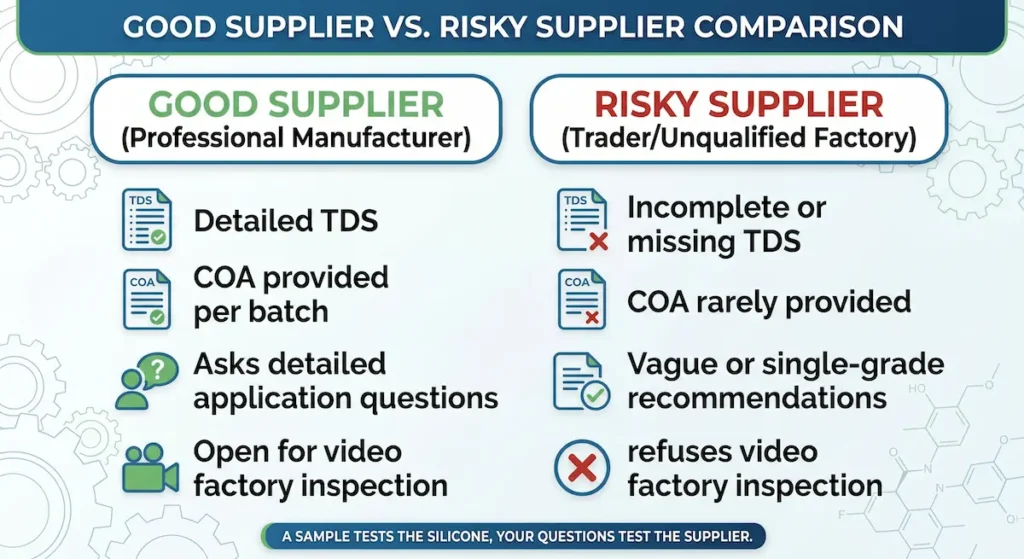

Do not test a random RTV-2 silicone sample before you test the supplier.
A sample can look good in a small cup. But it does not prove bulk consistency, formulation control, technical support, export documentation, or long-term repeat order stability.
Many buyers lose time not because the sample fails, but because the supplier was never qualified enough to be tested.
For distributors, mold-making material suppliers, private-label brands, and industrial users, the real risk often appears after sampling:
- The sample works, but the bulk order behaves differently.
- The TDS looks good, but the supplier cannot explain the data.
- The price is attractive, but batch quality is unstable.
- The supplier says “factory,” but cannot answer production questions.
- The first order is acceptable, but repeat orders have different viscosity, pot life, or curing speed.
- The distributor receives customer complaints, but the supplier cannot provide technical support.
A sample tests the silicone.
Your questions test the supplier.
This guide explains how to verify a China RTV-2 silicone rubber supplier before sampling, so you can reduce sourcing risk, avoid wasting test time, and choose a supplier that can support stable long-term business.
Quick Answer: How Do You Verify a China RTV-2 Silicone Rubber Supplier Before Sampling?
Before requesting RTV-2 silicone rubber samples from a China supplier, verify these key points:
- Is the supplier a real manufacturer or only a trader?
- Can they provide a clear TDS, SDS, and COA?
- Do they understand your application before recommending a grade?
- Can they explain viscosity, Shore hardness, working time, curing time, tear strength, and shrinkage?
- Can they control sample-to-bulk consistency?
- Can they customize hardness, viscosity, pot life, curing time, or packaging?
- Can they support technical troubleshooting after testing?
- Does their price make sense compared with performance and quality risk?
- Can they support export documents, packaging, labels, and repeat orders?
A good RTV-2 silicone supplier should not only send samples.
They should help you choose the right grade before sampling.
Why a Good Sample Does Not Prove a Good Supplier
A sample is only one piece of evidence.
It does not automatically prove that the supplier can deliver stable bulk quality.
In RTV-2 silicone sourcing, many problems appear after sampling:
- Bulk viscosity is different from the approved sample.
- Working time becomes shorter or longer in mass production.
- Curing time changes under different temperatures.
- Hardness is not stable between batches.
- The catalyst system is inconsistent.
- The supplier cannot provide COA for each batch.
- The same grade code gives different performance in repeat orders.
- The supplier cannot explain why the mold has bubbles, tearing, inhibition, or curing problems.
- The distributor cannot answer customer complaints because the factory gives no technical support.
For one-time small users, a sample may be enough.
For distributors, private-label brands, mold-making workshops, and industrial buyers, sample approval is only the beginning.
Asıl soru şu:
Can this supplier keep the same quality stable after your customer approves the product?
China RTV-2 Silicone Supplier Verification Scorecard
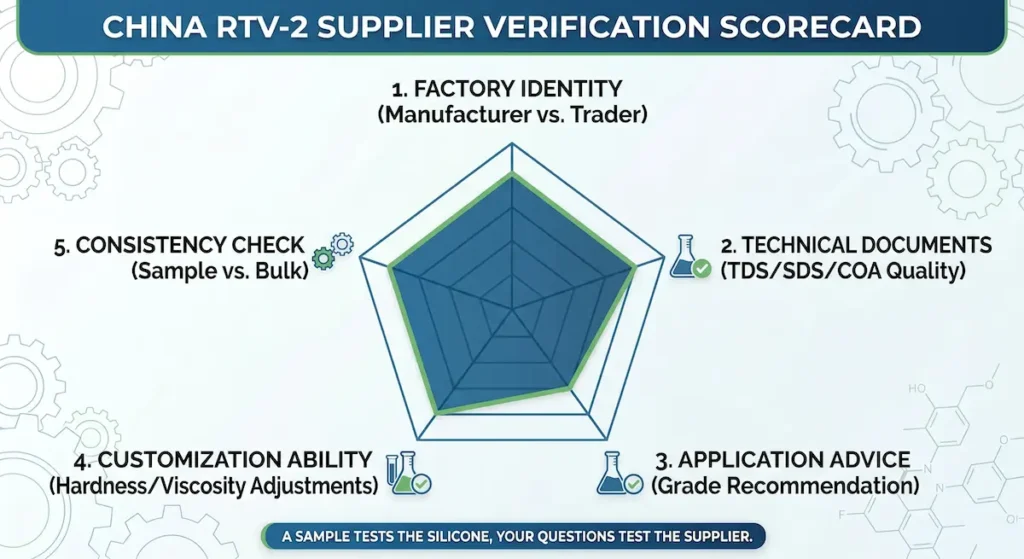
Use this scorecard before requesting samples.
If a supplier fails several of these checks, do not rush into sampling.
Sampling should confirm a qualified supplier.
It should not be used to discover whether the supplier is reliable.
1. Verify Whether the Supplier Is a Real Manufacturer
The first step is to check whether the supplier is a real RTV-2 silicone rubber manufacturer or only a trading company.
A real manufacturer usually has stronger control over:
- Formulation
- Raw material selection
- Production process
- Batch inspection
- Hardness adjustment
- Viscosity adjustment
- Working time and curing time control
- Technical troubleshooting
- Repeat order consistency
A trading company may still be useful in some cases, but the risk is higher if they cannot control formulation, production schedule, quality inspection, or technical support.
Şu soruları sorun:
- Are you a manufacturer or trading company?
- Where is your factory located?
- How many years have you produced RTV-2 silicone rubber?
- What are your main product categories?
- Do you produce both tin-cure and platinum-cure silicone?
- Can you adjust hardness, viscosity, working time, or curing time?
- Can you provide factory photos or production videos?
- Can you support video factory inspection?
- Do you keep retained samples for each production batch?
A real supplier should not be afraid of reasonable factory verification.
2. Check Whether They Understand Your Application
Many suppliers can quote RTV-2 silicone rubber.
Fewer suppliers can recommend the right grade.
Before sampling, check whether the supplier understands your application.
A professional supplier should ask about:
- Kalıp boyutu
- Ana malzeme
- Döküm malzemesi
- Hedef Shore sertliği
- Gerekli çalışma süresi
- Required curing time
- Viscosity preference
- Vacuum degassing availability
- Demolding difficulty
- Undercuts or fine details
- Beklenen kalıp ömrü
- Current problem with existing silicone
If a supplier recommends a product before understanding your application, the sample may only be a guess.
For concrete molds
The supplier should ask about mold size, concrete weight, texture depth, undercuts, wall thickness, support shell, and expected mold life.
For resin molds
The supplier should ask about resin type, surface details, bubbles, demolding difficulty, tear strength, and release agent.
For food molds
The supplier should ask about curing system, compliance documents, final application, temperature conditions, and food-contact requirements.
For rapid prototyping
The supplier should ask about dimensional stability, shrinkage, viscosity, curing speed, and casting material compatibility.
For pad printing pads
The supplier should ask about hardness, ink type, pad shape, print pattern, oil resistance, rebound, and printing cycles.
For electronics potting
The supplier should ask about viscosity, hardness, insulation, thermal requirements, flame retardancy, curing conditions, and repairability.
Good silicone selection is not product matching by name.
It is application matching by performance.
3. Review the TDS Before Sampling
A professional RTV-2 silicone supplier should provide a Technical Data Sheet before sending samples.
A useful TDS should include:
- Product code
- Cure system
- Mixing ratio
- Görünüş
- Viskozite
- Shore sertliği
- Çalışma süresi
- Kürlenme süresi
- Çekme mukavemeti
- Yırtılma mukavemeti
- Uzama
- Küçülme
- Density
- Recommended application
- Storage condition
- Shelf life
- Test temperature or test conditions
- Revision date
A TDS does not need to be complicated, but it should be clear, consistent, and relevant to the application.
Red flags in a TDS include:
- No viscosity data
- No working time
- No curing time
- No test temperature
- No product code
- No company name
- No revision date
- Same data used for different grades
- Unrealistic tear strength or elongation
- Data that conflicts with the supplier’s email
- No explanation of test conditions
If the TDS is weak, the sample risk is higher.
A beautiful sample without reliable technical data is not enough for B2B sourcing.
4. Check SDS, COA, and Compliance Support
For distributors and industrial buyers, documents are part of supplier quality.
Before sampling, ask whether the supplier can provide:
- TDS
- SDS / MSDS
- COA
- Product label information
- Shelf life statement
- Packing details
- REACH confirmation if needed
- RoHS statement if needed
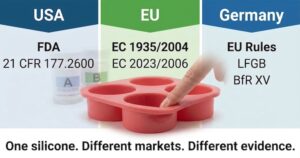
- FDA or food-contact letter if the application requires it
- Export invoice and packing list
- Batch number information
Not every application needs every document.
But the supplier should be honest and clear about what they can provide.
Be careful if a supplier says every product is:
- “FDA approved”
- “medical grade”
- “food grade”
- “same as famous brand”
- “certified for all applications”
without showing suitable documents.
For distributors, weak documents can create problems later when customers ask for technical files, safety data, or compliance confirmation.
5. Confirm Sample-to-Bulk Consistency
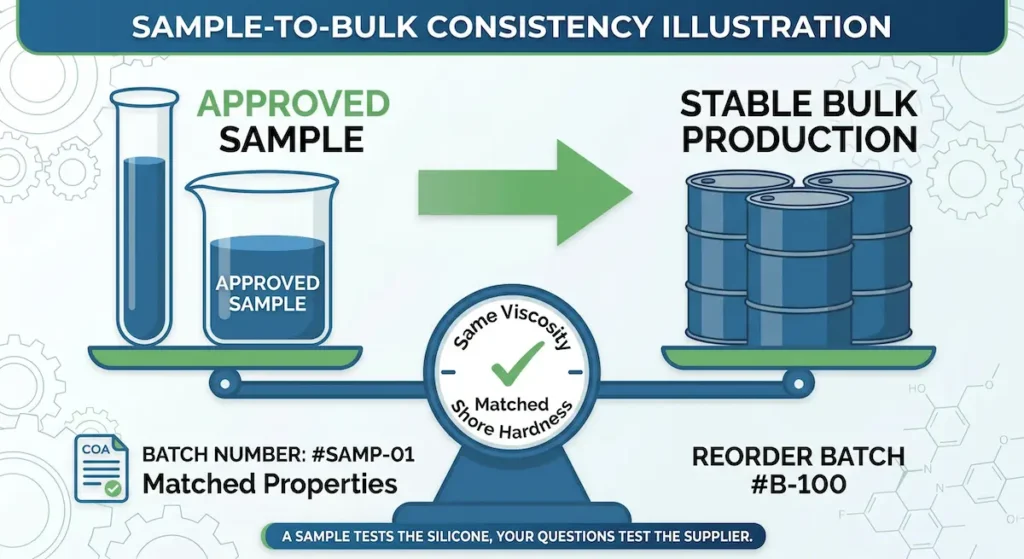
This is one of the most important checks.
Many buyers only test the sample. But the real business depends on repeatable bulk quality.
A good RTV-2 silicone sample should represent regular production, not only a specially prepared lab sample.
Before sampling, ask:
- Is this sample from regular production?
- Will the bulk order use the same formulation?
- Can the same specification be repeated in future batches?
- Can you provide COA for each shipment?
- What properties do you test before shipment?
- What is your normal tolerance for hardness?
- What is your normal tolerance for viscosity?
- How do you control working time and curing time?
- Do you keep retained samples for each batch?
- Can you provide a pre-shipment sample from the bulk batch if needed?
For distributors, sample-to-bulk consistency is critical.
Your customer will not blame the China factory first.
They will blame your brand.
6. Verify Customization Ability
RTV-2 silicone buyers often need more than a standard grade.
Common customization requirements include:
- Shore hardness adjustment
- Viscosity adjustment
- Daha uzun çalışma süresi
- Faster curing time
- Slower curing time
- Color adjustment
- Mixing ratio preference
- Higher tear strength
- Daha düşük büzülme
- Softer silicone
- Higher flow
- Thixotropic version
- Private label packaging
- Special kit size
A professional manufacturer should be able to explain what can be adjusted and what trade-offs may happen.
Örneğin:
- Extending working time may also extend curing time.
- Lowering viscosity may affect mechanical strength.
- Softer silicone may need better tear strength for undercuts.
- Faster curing may reduce processing time for large molds.
- Changing hardness may affect elongation and demolding performance.
A weak supplier may say “yes” to everything.
A professional supplier will explain both possibilities and limitations.
That difference matters.
7. Test Their Technical Troubleshooting Ability
A reliable RTV-2 silicone supplier should help after the sample is tested.
Before sampling, ask how they handle technical problems.
A good supplier should be able to discuss issues such as:
- Bubbles in silicone molds
- Early mold tearing
- Cure inhibition
- Sticky or uncured surface
- Short working time
- Slow curing
- High viscosity
- Zayıf akış
- Demolding difficulty
- Küçülme
- Surface defects
- Batch difference
- Storage problems
- Wrong mixing ratio
Ask one or two practical questions before sampling.
Örneğin:
- If bubbles appear on the mold surface, how would you diagnose the cause?
- If the mold tears after several castings, what information do you need from us?
- If the curing time is different from the TDS, what test conditions should we check?
- If platinum-cure silicone does not cure against a 3D printed master, what may cause it?
A supplier’s answer will show whether they only sell silicone or truly understand applications.
If they cannot explain problems before sampling, they may not help when your customer complains later.
8. Compare Price by Total Cost, Not Only Unit Price
Low price is attractive, especially when buying from China.
But the cheapest RTV-2 silicone is not always the lowest-cost material.
A very low price may come with hidden risks:
- Weak tear strength
- High shrinkage
- Unstable viscosity
- Short shelf life
- Inconsistent curing speed
- Poor batch control
- Low-cost raw materials
- Incomplete documents
- Weak technical support
- Sample different from bulk order
For distributors and industrial buyers, the real cost includes:
- Failed tests
- Customer complaints
- Returns
- Lost brand trust
- Delayed projects
- Technical support time
- Replacing defective batches
- Losing repeat orders
A cheap sample can become expensive if the bulk quality is unstable.
The better question is not:
“Who gives the lowest price?”
Daha iyi bir soru:
“Which supplier gives the lowest risk per successful order?”
9. Verify Packaging and Distributor Support
If you are a distributor, private-label brand, or retailer, packaging is not a small detail.
Before sampling, check whether the supplier can support your business model.
Ask whether they can provide:
- 1 kg kits
- 5 kg kits
- 20 kg or 25 kg pails
- 200 kg drums
- Neutral packaging
- Private label packaging
- Custom labels
- Carton packing
- Pallet packing
- Batch number printing
- Shelf life labels
- Mixed SKU shipments
- Repeat label consistency
A supplier suitable for bulk industrial users may not automatically be suitable for distributors.
For distributor business, the supplier should support not only the silicone formula, but also the product presentation, documentation, and repeat packaging consistency.
10. Check Export Experience and Shipping Support
International sourcing is not only about product quality.
Export experience also matters.
Before sampling, ask:
- Have you exported RTV-2 silicone to our region before?
- Which courier do you usually use for samples?
- Can you provide commercial invoice and packing list?
- Can you provide SDS for shipping if required?
- How do you pack Part A and Part B?
- What is the shelf life?
- What are the storage conditions?
- Can you support sea shipment for bulk orders?
- Can you support pallet packing?
- Can you handle mixed product shipments?
Good export support can reduce customs delays, document confusion, leaking packages, and communication problems.
A reliable supplier should understand both production and delivery.
Different Buyers Should Verify Different Risks
Not all buyers have the same risk.
A good supplier should understand the risk behind your business type.
If the supplier gives the same answer to every buyer, they may not understand your market.
10 Questions to Ask Before Requesting RTV-2 Silicone Samples
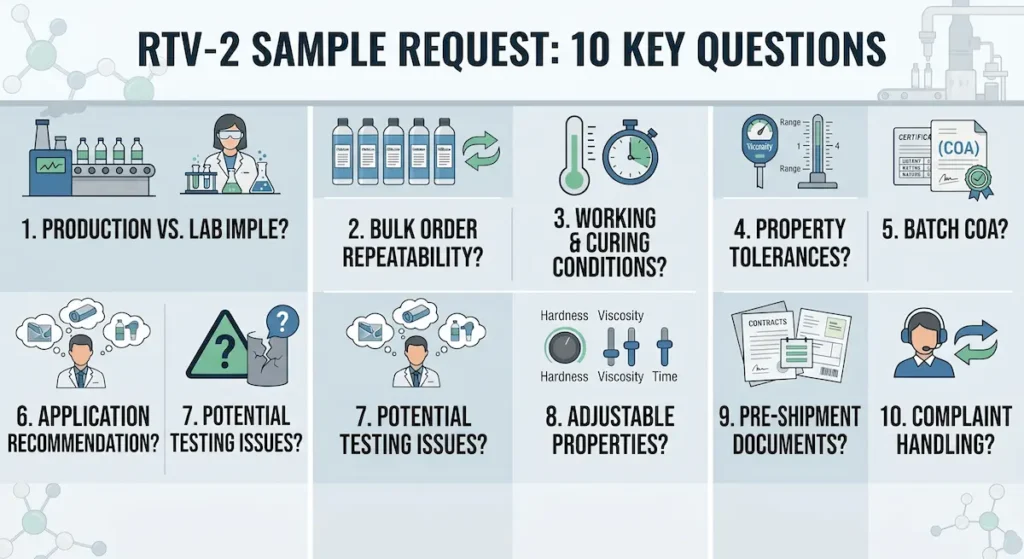
Use these questions before asking for samples.
- Is this sample from regular production or lab preparation?
- Can the same specification be repeated in bulk orders?
- What is the test temperature for working time and curing time?
- What is the normal tolerance for viscosity and hardness?
- Can you provide COA for each batch?
- Which grade do you recommend for my application, and why?
- What problems may happen during testing?
- Can hardness, viscosity, working time, or curing time be adjusted?
- What documents can you provide before shipment?
- How do you handle technical complaints after the customer tests or buys?
These questions are simple, but they quickly separate serious manufacturers from weak suppliers.
A sample tests the product.
These questions test the supplier.
Red Flags Before Sampling
Be careful if the supplier:
- Cannot confirm whether they are a factory
- Avoids factory verification questions
- Provides no TDS or SDS
- Uses the same TDS for many different grades
- Recommends a product without asking about your application
- Claims every grade is suitable for every use
- Claims all products are food grade without documents
- Offers a very low price but weak data
- Cannot explain viscosity, hardness, working time, or curing time
- Cannot provide COA for bulk shipment
- Cannot explain sample-to-bulk consistency
- Says “same as famous brand” without performance data
- Changes product names frequently
- Gives inconsistent answers
- Pushes samples before technical discussion
- Has no clear packaging or labeling support
- Cannot support troubleshooting after testing
One red flag may not mean the supplier is bad.
But several red flags together mean you should verify carefully before spending time on samples.
When You Should Not Request a Sample Yet
Do not request a sample yet if:
- Your own application details are not clear.
- The supplier cannot recommend a grade with reasons.
- The TDS is missing or incomplete.
- The supplier does not understand your casting material.
- The supplier cannot confirm whether the sample matches bulk production.
- The supplier refuses basic factory verification.
- The supplier gives a very low price but no technical support.
- The supplier cannot provide required documents.
- You do not know what property you want to test.
- The supplier only pushes price and delivery time.
Sampling should be the next step after supplier qualification, not the first step.
How to Make RTV-2 Silicone Sampling More Meaningful
Once the supplier passes basic verification, make the sample test more useful.
Before testing, confirm:
- Product code
- Cure system
- Mixing ratio
- Test temperature
- Working time definition
- Curing time definition
- Recommended degassing method
- Recommended mold release if needed
- Expected Shore hardness
- Application limits
- Saklama koşulları
- Sample batch information
During testing, record:
- Mixing behavior
- Flow and viscosity feeling
- Pot life
- Degassing performance
- Bubble condition
- Curing speed
- Final hardness
- Tear resistance
- Demolding performance
- Surface detail reproduction
- Shrinkage or deformation
- Casting material compatibility
After testing, compare your test results with the TDS.
If there is a difference, ask the supplier to help analyze:
- Test temperature
- Mixing ratio
- Mixing method
- Sample storage
- Degassing condition
- Mold material
- Döküm malzemesi
- Cure inhibition possibility
- Measurement method
A good supplier will welcome technical feedback.
A weak supplier will only ask when you will place an order.
What a Reliable China RTV-2 Silicone Supplier Should Provide
A reliable RTV-2 silicone supplier should provide more than a sample and a price.
They should support:
- Application analysis
- Grade recommendation
- TDS
- SDS
- COA availability
- Sample plan
- Testing guidance
- Customization options
- Packaging options
- Export documents
- Batch consistency control
- Repeat order stability
- Technical troubleshooting
For serious B2B sourcing, the supplier’s value is not only the silicone material.
It is their ability to help you select, test, approve, reorder, and troubleshoot the right RTV-2 silicone rubber with stable performance.
Conclusion: Verify the Supplier Before You Verify the Sample
A good RTV-2 silicone sample is important.
But a good sample alone does not prove a good supplier.
Before sampling from a China RTV-2 silicone rubber supplier, verify their factory identity, application knowledge, technical documents, batch consistency, customization ability, troubleshooting support, packaging ability, and export experience.
The right supplier should not only send silicone.
They should help you reduce testing risk, choose the right grade, solve application problems, and support stable repeat orders.
Do not test a random sample before you test the supplier.
Before You Request a Sample, Let Us Help You Choose the Right Grade
Instead of testing a random RTV-2 silicone sample, send us your application details first.
We can help you check the right cure system, hardness, viscosity, working time, curing time, tear strength, and testing direction before sampling.
Lütfen paylaşın:
- Your application
- Kalay-kür veya platin-kür tercihi
- Hedef Shore sertliği
- Required viscosity
- Gerekli çalışma süresi
- Required curing time
- Döküm malzemesi
- Mold size or product size
- Current problem with existing silicone
- Target packaging
- Expected order quantity
- Required documents
Our team can help recommend a suitable RTV-2 silicone grade for your testing.
Send your application details and avoid testing the wrong silicone.