
Quick Answer
The viscosity matters more when your main challenge is capturing fine detail, improving flow, and reducing pouring difficulty. High tear strength matters more when your main challenge is difficult demolding, repeated mold use, thin sections, or early mold tearing. In real mold making, neither property wins by default. The right priority depends on mold geometry, release stress, and how long the mold needs to last.
In This Guide
Most Buyers Ask the Wrong Version of This Question
Many buyers ask:
Should I choose low-viscosity silicone or high-tear-strength silicone?
That sounds logical, but it hides the real issue.
The better question is:
What is the actual failure risk in this mold?
Because a silicone that pours beautifully can still be the wrong choice if the mold tears after a few cycles.
And a silicone with excellent tear strength can still be the wrong choice if it does not flow well enough to capture the detail you need.
That is why this is not a chemistry question first. It is a mold-behavior question.
Quick Decision Guide
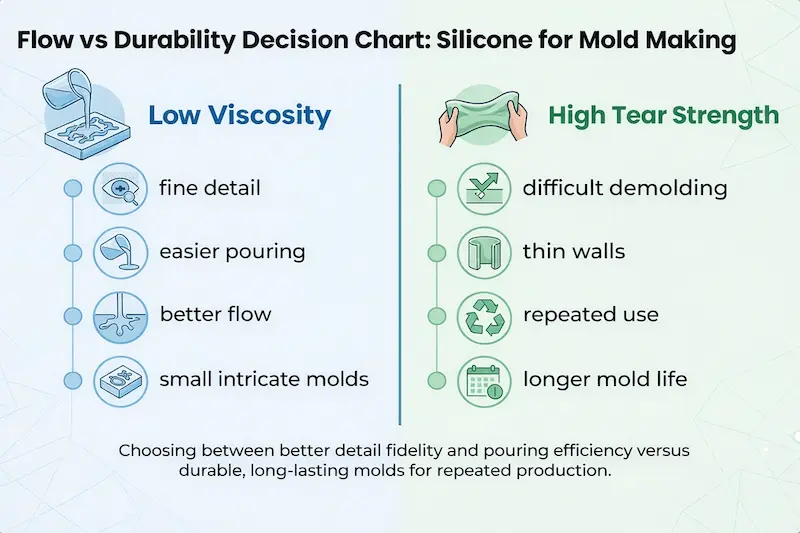
Prioritize low viscosity first when:
- The mold has very fine detail
- The master surface is highly textured
- The silicone must flow into narrow areas
- The main problem is trapped air or incomplete wetting
- The mold is relatively easy to demold
Prioritize high tear strength first when:
- The mold has thin walls or sharp edges
- Demolding stretches the mold heavily
- The part has undercuts or locking geometry
- Repeated production matters
- The main problem is mold tearing, not pouring
Compare both carefully when:
- The mold is detailed and hard to demold
- You need both clean detail and commercial mold life
- The mold is used in repeated small-batch production
- Failure costs more than the material price
The Biggest Buying Mistake
The biggest mistake is trying to optimize only one property.
Many buyers think like this:
- “Lower viscosity must be better because it flows better.”
- “Higher tear strength must be better because it lasts longer.”
Both statements are incomplete.
A mold-making silicone is not chosen by extreme numbers. It is chosen by which weakness you cannot afford.
If the mold fails because detail is missing, low viscosity matters more.
If the mold fails because the edges tear on demold, tear strength matters more.
That is how you should think about this decision.
1. Why Buyers Want Low Viscosity Silicone
Low-viscosity silicone is attractive because it is easier to pour and usually reaches detail more easily.
That is especially useful in:
- jewelry molds
- miniature molds
- texture-heavy masters
- decorative resin molds
- small parts with narrow recesses
Low viscosity can help reduce:
- poor wetting
- incomplete filling
- some bubble-related issues during pouring
- excessive manual effort in fine-detail molds
That is why many buyers start by asking for the “thinnest” silicone.
But that is also where mistakes begin.
Because low viscosity helps you get into the details. It does not automatically help you survive the demold.
2. Why Buyers Need High Tear Strength More Than They Think
Tear strength is often ignored until the first mold fails.
That failure usually looks like this:
- thin edges split during release
- narrow sections tear around the cavity
- Sharp decorative zones break down first
- The mold performs well at the start, then drops quickly
This is especially common in:
- figurine molds
- deep pendant molds
- molds with narrow necks
- molds with sharp undercuts
- Repeated-use production molds
In those cases, the buyer often says:
“The silicone poured well, but the mold didn’t last.”
That is a tear-strength problem much more often than a viscosity problem.
3. When Low Viscosity Matters More
Low viscosity should usually move to the top of your decision list when:
The mold is small and detail-critical
If the project depends on tiny textures or intricate detail, poor flow becomes a bigger risk than tearing.
The master is hard to wet
If silicone does not flow smoothly across the pattern, you may lose accuracy before mold life even becomes relevant.
The demolding stress is relatively low
If the mold shape is simple and release is easy, you can afford to prioritize flow more aggressively.
The mold is for limited or occasional use
If the mold does not need long repeat life, flow quality may be the more important buying decision.
In short:
If the mold’s biggest risk is bad detail capture, viscosity comes first.
Need the right RTV-2 silicone grade?
If you are facing tearing, bubble, or curing issues, send us your application details. Topsil will recommend the perfect grade for testing.
4. When High Tear Strength Matters More
Tear strength should usually move to the top of your decision list when:
The mold stretches during release
If the mold must flex hard to release the part, strength matters more than elegant pouring.
The mold has thin stress zones
Thin walls and sharp edges are where molds fail first.
The mold is used repeatedly
Commercial or repeated-use molds should not be chosen like hobby molds.
Mold remake is expensive
If failure causes time loss, missed orders, or customer delay, durability becomes a business issue, not just a material issue.
In short:
If the mold’s biggest risk is early damage during use, tear strength comes first.
5. The Right Priority Depends on Mold Type
This is where buyers should stop thinking in general terms and start thinking in use cases.
For jewelry and miniature resin molds
Start by looking at viscosity and detail transfer first, then confirm tear strength.

For figurine molds and complex art molds
Start by looking at demolding stress and tear strength first, then balance flow.
For open-face decorative molds
Viscosity may matter more if release is easy and detail is important.
For repeat-use commercial molds
Tear strength often deserves more weight because failure cost is higher.
For molds with both deep detail and difficult release
Do not chase one property. Shortlist balanced grades and test accordingly.
6. What Buyers Often Misdiagnose
This is one of the most useful things to understand.
“My mold has bubbles, so I need lower viscosity.”
Maybe. But sometimes the real problem is pouring method, not viscosity alone.

“My mold tore, so I need the strongest silicone possible.”
Maybe. But sometimes the real problem is mold design or hardness mismatch, not just tear strength.
“This silicone looks perfect on paper.”
Maybe. But if the property that matters most is not the one failing in real use, the TDS can mislead you.
The better approach is to identify: What is causing failure in this mold first?
Not: What number looks best in the brochure?
7. A Better Buying Rule
Before choosing between low viscosity and high tear strength, ask:
- Is my main risk poor detail capture or early mold tearing?
- Will the mold be used once, or repeatedly?
- Is the mold difficult to release?
- Is the design small and intricate, or large and stress-heavy?
- Is this a hobby mold, a small-business mold, or a production mold?
If you answer those honestly, the selection becomes much clearer.
Final Answer
Low viscosity matters more when detail capture, flow, and wetting are the main concerns.
High tear strength matters more when release stress, thin sections, repeated demolding, and mold life are the bigger risks.
Most buyers should not chase the lowest viscosity or the highest tear strength in isolation.
They should choose based on what the mold is most likely to fail from.
That is how better mold choices are made.
FAQ
RECOMMENDED NEXT STEP
Grade issue or processing error?
Send your data, photos, and target hardness. We’ll find the cause and recommend the right RTV-2 grade.
Send Problem Details