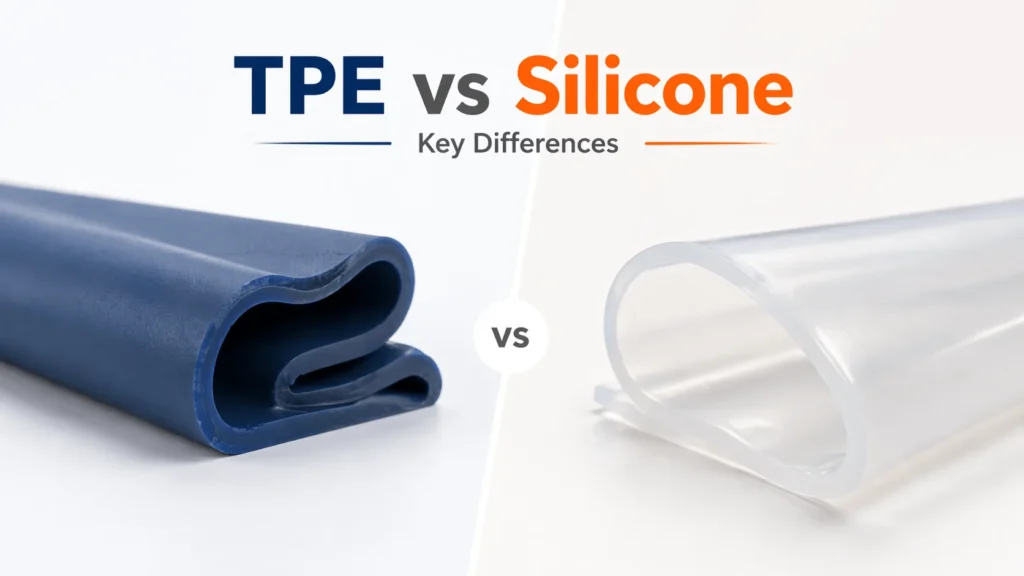

When comparing TPE vs silicone, the best material is not the one with the most advantages on paper. It is the one that fits the real demands of the application. Both materials are flexible and widely used in industrial and consumer products, but they differ in heat resistance, reprocessability, durability, chemical stability, cost, and manufacturing fit.
In general, TPE is often chosen when lower cost and thermoplastic-style processing matter more. Silicone is more often selected when the application requires broader temperature resistance, stronger long-term stability, and more reliable performance under demanding conditions.
TPE vs Silicone: Quick Comparison
| Feature | TPE | Silicone |
| Material type | Thermoplastic elastomer | Crosslinked elastomer |
| Reprocessability | Can be reheated and reprocessed | Cannot be remelted like TPE |
| Heat resistance | More limited | Better high- and low-temperature performance |
| Durability | Good in many applications | Often better in harsh or long-life conditions |
| Chemical stability | Depends on grade | Often stronger overall stability |
| Overmolding | Often easier with common plastics | More specialized processing route |
| Cost | Usually lower | Usually higher |
| Typical applications | Cost-sensitive parts, soft-touch overmolds, general-use products | High-performance parts, demanding environments, medical or food-grade uses |
In broad terms, TPE is usually valued for cost efficiency and reprocessability, while silicone is more often chosen for thermal performance and long-term reliability.
What Is TPE?
TPE stands for thermoplastic elastomer. It combines rubber-like flexibility with the processing advantages of thermoplastics. One of its biggest advantages is that it can be reheated and reprocessed, thereby supporting manufacturing efficiency and reducing production waste.
Because of this, TPE is often used in applications where cost, soft-touch performance, and thermoplastic processing flexibility are important.
What Is Silicone?
Silicone is an elastomer known for stable performance in more demanding environments. It is often chosen where heat resistance, cold resistance, chemical stability, and long service life matter more than reprocessing efficiency.
Unlike TPE, silicone does not behave like a remeltable thermoplastic after curing. That difference affects not just material behavior, but also manufacturing strategy and long-term product performance.
It also helps to understand the difference between RTV and RTV-2 silicone and between platinum-cured and tin-cured silicone when evaluating different silicone systems.
TPE vs Silicone: Key Differences

Heat Resistance
If temperature is a major design factor, silicone usually has the advantage. It is more commonly used where parts must handle higher heat, low temperatures, or repeated thermal cycling. TPE can still perform well in moderate environments, but it is generally more limited as conditions become more severe. See more information at Silicone Melting Temperature.
Reprocessability and Processing
This is one of the clearest differences between the two materials. TPE can be reheated and processed again, which supports certain production workflows and can help with material efficiency. Silicone cannot simply be remelted and reused after curing.
Chemical Stability
Both materials can offer useful chemical resistance, but silicone is often treated as the more stable option in demanding environments. The right choice depends on the actual media, temperature, and exposure time, but silicone is often easier to justify when long-term reliability is a priority.
Hardness and Feel
Both TPE and silicone can be soft and flexible, but they are not always selected for the same reasons. TPE is often attractive in soft-touch or overmolded consumer products, while silicone is more often chosen because of how it performs over time and under more demanding service conditions.
If hardness is an important part of material selection, it is also worth understanding the difference between Shore A and Shore D.
Cost
TPE usually has the cost advantage. If both materials can meet the technical requirement, TPE may be the more economical solution. Silicone typically costs more, but the extra cost can make sense when the application demands better thermal stability, durability, or long-term consistency.
Overmolding and Bonding
TPE is often easier to use in applications involving overmolding onto common plastics. Silicone has its own strong use cases, but the processing route is usually more specialized. This means the choice between TPE and silicone is not only about raw properties, but also about manufacturing fit.
TPE vs Silicone Durability
Durability is more than just initial toughness. It includes aging resistance, environmental stability, repeated-use performance, and how consistently the material performs over time.
TPE can work well in many general-use products, especially where conditions are moderate and service life expectations are not extreme. Depending on the formulation, it may also offer useful abrasion, tear, or solvent resistance in certain cases.
Silicone, however, is more often chosen when durability is critical to product reliability. It is commonly favored for applications that involve repeated stress, temperature cycling, cleaning, or longer service life requirements. A practical way to view the difference is this: TPE may be durable enough for many products, but silicone is more often selected when performance over time matters more than short-term material savings.
TPE vs Silicone Safety and Compliance
Safety should not be judged by the material name alone. Both TPE and silicone are broad material categories, and actual suitability depends on formulation, additives, processing, and the standards required by the final application.
The same is true for medical-grade comparison. Medical-grade TPE vs silicone is a valid topic, but the decision depends on the specific grade and compliance target, not simply on whether the base material is called TPE or silicone. In many cases, silicone is favored where sterilization, temperature resistance, and long-term stability are important. TPE can also be suitable in medical applications, especially where thermoplastic processing or cost targets matter more.
TPE vs Silicone: Pros and Cons

TPE Pros and Cons
👍 TPE is often lower in cost, easier to reprocess, suitable for many thermoplastic workflows, and useful in soft-touch or overmolded designs.
👎 TPE is generally more limited in high-temperature or long-life applications and may not offer the same long-term stability expected from silicone in harsher environments.
Silicone Pros and Cons
👍 Silicone is widely chosen for stronger temperature resistance, better long-term durability, and more stable performance in demanding environments.
👎 Silicone usually costs more and does not offer the same reprocessing flexibility as TPE.
Is TPE Better Than Silicone?
Not in a universal sense. TPE is better when lower cost, easier reprocessing, and thermoplastic-style production are the main priorities. Silicone is better when the part must withstand heat, repeated use, longer service life, or more demanding environmental exposure.
The better material depends on the application, not the headline claim.
Silicone vs TPE: How to Make the Right Choice

The best way to choose between TPE and silicone is to start with the real application. Ask whether the part will face high heat, long-term use, repeated cleaning, harsh chemicals, or demanding environmental conditions. If the answer is yes, silicone is often easier to justify.
If production efficiency, lower cost, and thermoplastic processing are more important, TPE may be the better fit. In short, TPE is often chosen for manufacturing flexibility and cost control, while silicone is more often selected to reduce performance risk in tougher applications.
When to Choose TPE
Choose TPE when lower cost matters, when reprocessing within production is useful, when overmolding onto common plastics is part of the design, or when the application does not require high heat resistance or long-term performance in harsh conditions.
When to Choose Silicone
Choose silicone when the application involves higher temperatures, wider thermal swings, longer service life, repeated-use stress, stronger environmental exposure, or stricter medical- or food-grade expectations.
For buyers evaluating specific silicone systems, our platinum-cured silicone and tin-cured silicone pages provide more direct product-level guidance.
TPE vs Silicone for Rapid Prototyping

When comparing TPE vs silicone for rapid prototyping, the better choice depends on what the prototype is expected to prove.
If the goal is faster iteration, lower cost, and easier thermoplastic-style processing, TPE may be the more practical option. It can work well for early-stage design validation, fit checks, and soft-touch prototype development.
Silicone is often the better choice when the prototype needs to be closer to final-use performance. This is especially true when heat resistance, flexibility, chemical stability, or long-term material behavior are important to the evaluation.
FAQs About TPE vs Silicone
Is TPE cheaper than silicone?
In many cases, yes. TPE is often the lower-cost option.
Is silicone more durable than TPE?
In demanding or long-life applications, silicone is often favored for durability.
Can TPE replace silicone?
Sometimes. In cost-sensitive or moderate-performance applications, TPE may be a practical substitute. In more demanding environments, silicone is often the safer choice.
Which material is better for high-temperature applications?
Silicone is usually the better choice when high-temperature resistance is important.
Final Thoughts
TPE vs silicone is not really a question of which material is better in general. It is a question of which one is better for the conditions you actually have. TPE is often the smarter option for cost-driven, reprocessable, thermoplastic-friendly applications. Silicone is often the better choice for heat, durability, stability, and higher-performance use cases.
If the application depends on long-term reliability rather than the lowest initial cost, silicone will often justify its place.