

A mold making silicone product line can fail in two ways: too few grades or too many confusing grades.
If you stock only one universal silicone, customers may complain about tearing, bubbles, shrinkage, difficult demolding, or poor mold life.
If you stock too many grades too early, your catalog becomes hard to explain, your sales team becomes confused, and your inventory pressure increases.
For distributors, the goal is not to carry every silicone grade.
The goal is to build a focused RTV-2 silicone range that is easy to sell, easy to test, and easy to expand.
This guide explains how distributors, importers, and private label buyers can build a practical mold making silicone product line without making the catalog too narrow or too complicated.
The Goal Is Not More SKUs, But a Sellable Product Range
A strong product line is not always a large product line.
For mold-making silicone distributors, a good range should answer three questions:
- Can customers quickly understand which grade to choose?
- Can the sales team explain the difference between grades?
- Can the distributor expand the range after real market feedback?
A sellable product line should cover common applications first, then add premium or specialty grades only when the market needs them.
A practical starting range usually includes:
- A daily-selling tin-cure silicone
- A softer grade for easier demolding
- A higher tear strength grade for tougher molds
- A platinum cure grade for premium applications
- A clear or translucent option for differentiation
This structure is easier to explain than a long list of similar grades.
Start with Customer Applications
Before choosing silicone grades, distributors should first define their target customers.
Different mold makers need different silicone performance.
| Customer Type | What They Usually Need |
| Resin mold makers | Good flow, easy demolding and fine detail reproduction |
| Concrete / GRC / GFRC mold makers | Higher tear strength, mold support and durability |
| Craft and model makers | Easy processing, moderate hardness and cost control |
| Food mold product makers | Selected platinum cure options and document support |
| Professional mold studios | Low shrinkage, dimensional stability and repeat performance |
If your customers mainly make small resin molds, they may care about flowability, detail reproduction, and easy demolding.
If your customers make large concrete molds, they may care more about tear strength, hardness, mold support, and mold life.
If your customers make precision molds or select food mold products, platinum cure silicone may become part of your premium product line.
A distributor should not choose silicone grades only from a supplier’s price list.
The product line should start from real customer applications.
Recommended Mold Making Silicone Product Line Structure
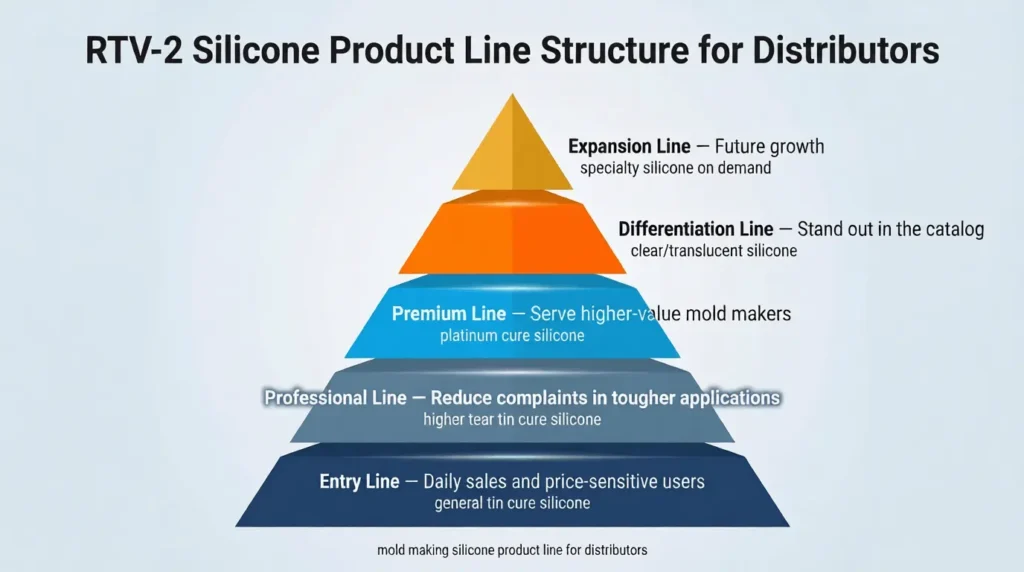
A clear product line makes selling easier.
Here is a practical structure for mold making silicone distributors:
| Product Line Layer | Purpose | Suggested Grade Type |
| Entry Line | Daily sales and price-sensitive users | General tin cure silicone |
| Professional Line | Reduce complaints in tougher applications | Higher tear tin cure silicone |
| Premium Line | Serve higher-value mold makers | Platinum cure silicone |
| Differentiation Line | Stand out in the catalog | Clear or translucent silicone |
| Expansion Line | Future growth | Specialty silicone only when needed |
This structure helps distributors avoid two common problems:
- A product line that is too simple to serve different customers
- A product line that is too complicated to sell clearly
A good mold making silicone product line should be simple at the beginning and expandable later.
What Grades Should Distributors Test First?
A distributor does not need to test 15 or 20 grades at the beginning.
Too many samples slow down evaluation and make comparison difficult.
A better first step is to test 3–5 carefully selected grades.
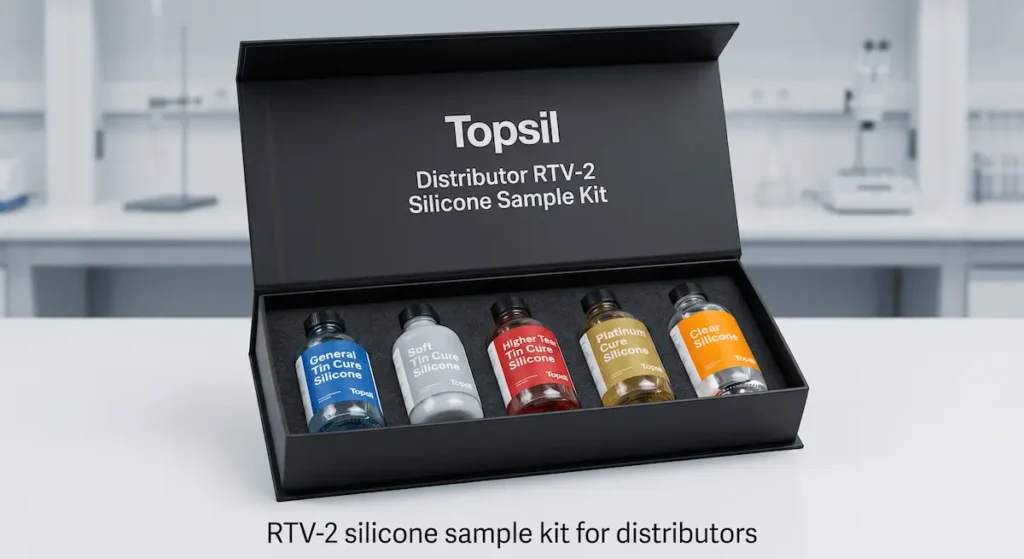
A practical distributor sample kit may include:
| Test Grade | Why It Matters |
| General Tin Cure Silicone | Covers daily mold making needs |
| Soft Tin Cure Silicone | Helps with easier demolding and detailed molds |
| Higher Tear Tin Cure Silicone | Useful for larger molds, deeper textures or tougher demolding |
| Platinum Cure Silicone | Premium option for lower shrinkage and better dimensional stability |
| Clear / Translucent Silicone | Differentiated product for precision or premium positioning |
This gives the distributor enough range to understand market demand without creating unnecessary complexity.
After sample testing, distributors can move to small trial orders, then regular stock orders.
Tin Cure Silicone: Your Daily-Selling Base Line
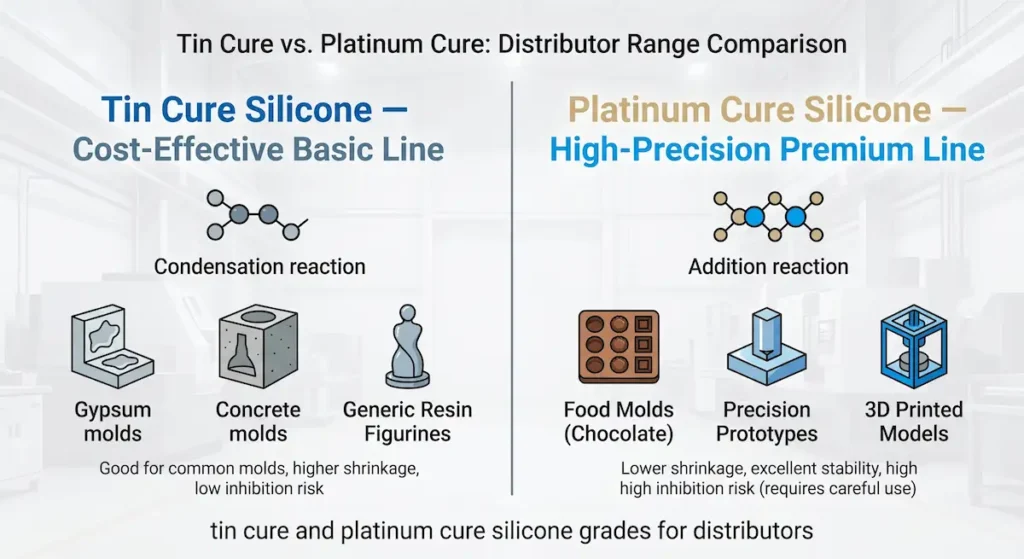
For many distributors, tin-cure silicone is the practical starting point.
Tin cure silicone is commonly used for general mold making because it is cost-effective, easy to process, and suitable for many common applications.
Typical applications include:
- Resin molds
- Gypsum molds
- Wax molds
- Concrete molds
- Craft molds
- Model making molds
- General industrial mold making
For distributor selling, tin-cure silicone can be divided by hardness and performance:
- Softer grades for easier demolding
- Medium hardness grades for general mold making
- Higher tear strength grades for larger or more demanding molds
However, tin-cure silicone is not suitable for every project.
For applications requiring lower shrinkage, better dimensional stability, or selected food mold use, platinum cure silicone may be a better option.
Platinum Cure Silicone: Your Premium Upgrade Line
Platinum cure silicone should not be positioned only as “more expensive silicone.”
It should be positioned as a premium upgrade line for customers who need:
- Lower shrinkage
- Better dimensional stability
- Fine detail reproduction
- Premium mold performance
- Selected food mold applications
- Precision or prototype mold projects
- Clear or translucent appearance
For distributors, platinum cure silicone creates a higher-value product option.
It also helps serve professional users who are not only looking for the lowest price.
However, platinum-cure silicone should be sold with proper technical guidance.
Some materials may cause cure inhibition, such as sulfur-containing clay, certain 3D printing resins, amines, organotin residues, or contaminated tools.
A distributor sales team should understand this point before recommending platinum cure silicone to customers.
Add Specialty Grades Only When the Market Needs Them
Specialty silicone grades can expand a distributor’s catalog, but they should not be added too early.
Examples include:
- Pad printing silicone
- Silicone gel
- Electronic potting silicone
- Insoles silicone
- Specialty large mold silicone
These products can bring new customer segments, but they should be added only after the core mold making silicone range has been validated.
A better sequence is:
- Start with core mold making grades
- Test with selected customers
- Confirm which applications create repeat demand
- Add specialty grades based on real inquiries
- Move to stock only after market validation
A focused product line usually sells better than a large but confusing catalog.
Common Mistakes Distributors Should Avoid
1. Stocking Only One Universal Grade
One grade cannot fit every application.
Small resin molds, large concrete molds, detailed molds, and precision molds may need different hardness, tear strength, viscosity, and cure systems.
2. Choosing Grades Only by Price
Low price may look attractive, but wrong grade matching can create customer complaints.
For distributors, the real cost is not only the purchase price.
It also includes failed tests, mold damage, returns, and lost customer trust.
3. Adding Too Many SKUs Too Early
A large catalog can look professional, but it may also create inventory pressure and confuse customers.
Start with a focused range. Expand only after customer testing and feedback.
4. Ignoring Tear Strength and Viscosity
Hardness is important, but it is not enough.
Tear strength affects mold life.
Viscosity affects flow, bubble release, and processing.
A good distributor product line should consider more than Shore A hardness.
5. Selling Platinum Cure Silicone Without Explaining Inhibition Risk
Platinum cure silicone can offer excellent performance, but cure inhibition should be explained clearly.
This helps reduce failed tests and customer misunderstanding.
6. Discussing Private Label Before Product Validation
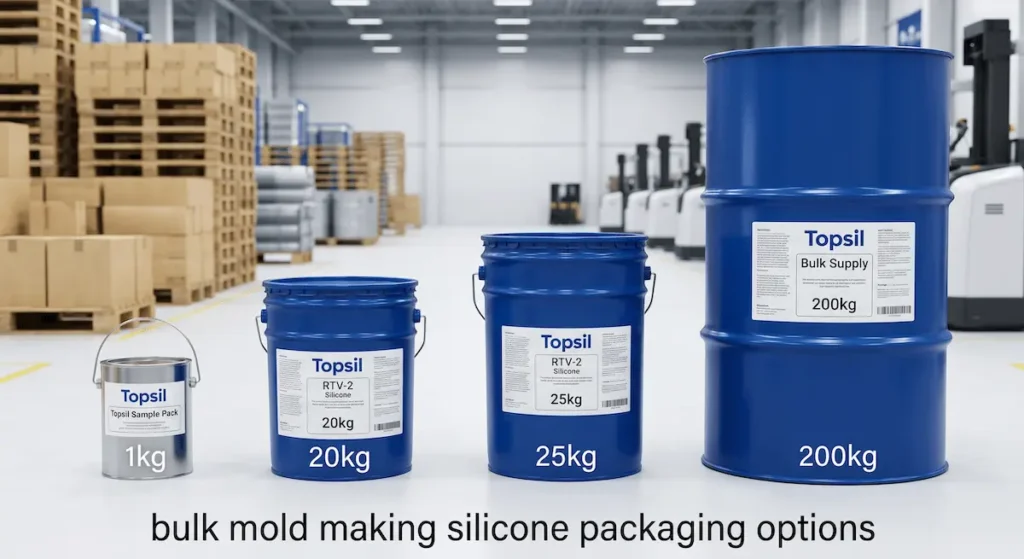
Private label can be valuable for qualified distributors, but performance validation should come first.
Packaging and labels should be discussed after the distributor confirms product performance, market demand, and expected quantity.
What to Send Before Asking for a Distributor Grade List
Before asking a supplier to recommend grades, distributors should prepare some basic information.
This helps avoid random samples and makes grade matching more accurate.
Useful information includes:
- Target market
- Main customer applications
- Current product range
- Required hardness range
- Preferred packaging
- Expected order quantity
- Tin cure or platinum cure preference
- Current grade or supplier data, if available
- Common customer problems, such as tearing, bubbles, or curing issues
With this information, a supplier can recommend a more practical testing range.
Building a Mold Making Silicone Range?
Send us your target market, current product range, and main customer applications. Topsil can recommend 3–5 suitable RTV-2 silicone grades for distributor testing.