
Choosing the right potting compound for an electronic assembly is far more than just pouring insulation goo over a circuit board. The material you select dictates the entire life expectancy of your product. It directly affects dielectric insulation, mechanical defense, thermal dissipation, and how your assembly handles structural stress under harsh working conditions.
Epoxy, polyurethane, and silicone represent the three heavyweights of the encapsulation world. There is no single “best” potting compound—only the correct material formulation for your specific operating environment.
Quick Comparison: The Shop-Floor Cheat Sheet
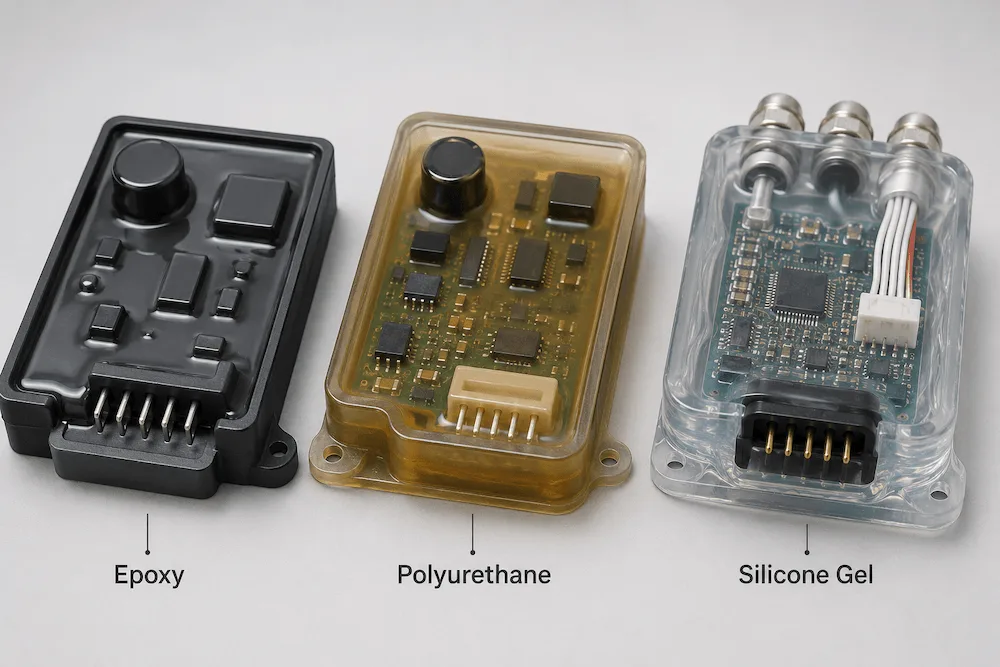
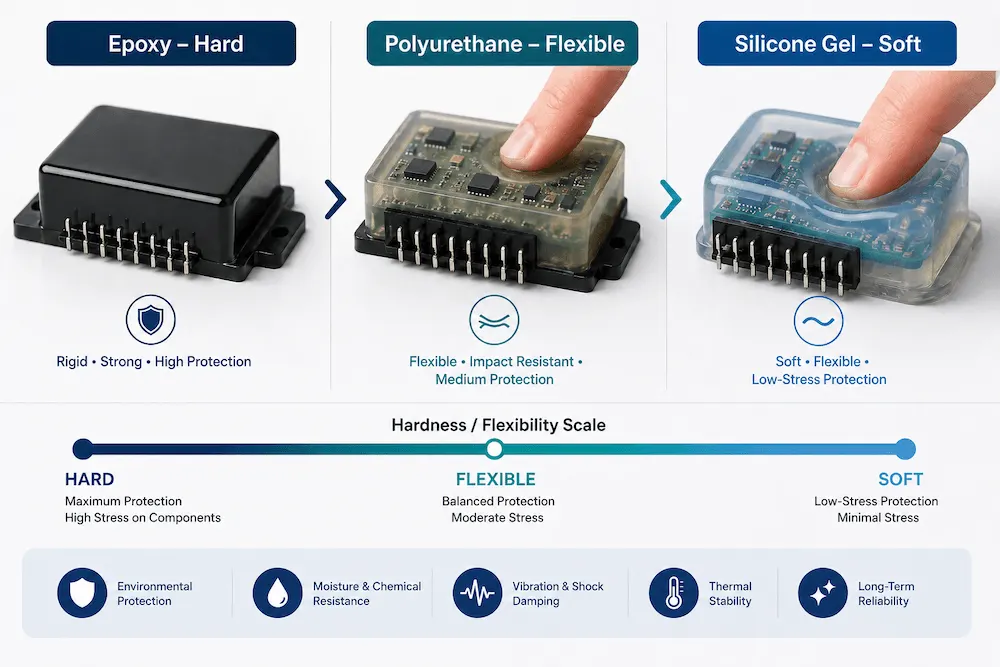
| 재료 유형 | 치료 후의 일반적인 느낌 | Undisputed Champion Of | The Hidden Kryptonite | Best-Fit B2B Applications |
| Epoxy Compound | Rock-hard, rigid glass-like armor | High mechanical impact resistance & structural bonding | High curing shrinkage; permanent, non-reworkable encapsulation | Heavy-duty power transformers, switchgears, structural industrial modules |
| Polyurethane (PU) | Flexible rubber to semi-rigid plastic | Cost-effective moisture barriers & low-temperature cushioning | Vulnerable to hydrolysis (moisture degradation) at high operating heat | Automotive sensors, cable harness joints, general consumer electronics |
| Silicone / Silicone Gel | Ultra-soft elastomer to self-healing gel | Unmatched thermal stability (-50°C to 200°C+) & zero stress on delicate parts | Lower mechanical tear strength compared to rigid epoxy | Electric Vehicle (EV) battery packs, sensitive MEMS sensors, microelectronics |
1. Epoxy Potting Compound: The Heavy Mechanical Armor
Epoxy resins cure into an incredibly dense, rock-hard protective shell. When your product is bound for brutal industrial environments where it might get bashed, dropped, or exposed to aggressive chemical solvents, epoxy is your go-to defense system. It offers incredible adhesion to copper, aluminum, and FR4 boards, making it nearly impossible for anyone to tamper with or reverse-engineer your intellectual property.
The Engineering Catch:
Epoxy is a rigid material, and that rigidity comes with a severe price tag: Curing Shrinkage and CTE Mismatch. * As epoxy cross-links, it shrinks physically by 1% to 3%. This shrinkage can exert enough localized pressure to literally snap tiny surface-mount resistors or break fragile solder joints right on the line.
- Furthermore, epoxy has a high Coefficient of Thermal Expansion (CTE). When your electronics heat up during operation, the metal components and the hard epoxy expand at wildly different rates. This thermal “wrestling match” inside the module often results in internal delamination, trace snapping, or body cracking.
- Finally, epoxy is non-reworkable. If a single micro-component fails inside the block, the entire module is scrap.
2. Polyurethane (PU) Potting Compound: The Flexible Middleground
Polyurethane serves as the cost-efficient middle ground between hard epoxy and premium silicone. It cures into a tough, rubbery, or semi-rigid state, offering exceptional impact dampening and low-temperature flexibility. This makes PU highly popular for potting automotive sensors, exterior cable assemblies, and outdoor junction boxes that face constant vibration and physical jolts.
The Engineering Catch:
Polyurethane’s primary weakness is Hydrolysis and Thermal Limitation. * Standard PUs struggle heavily when pushed past 120°C continuous exposure. Under sustained high heat, the polymer chain can suffer from thermal reversion—literally turning back into a sticky, gummy liquid.
- More importantly, if your assembly operates in a hot, humid environment, moisture can chemically attack the polyurethane chains (hydrolysis), causing the potting layer to degrade, lose its electrical resistance, and crack open over time. For high-heat, high-moisture applications, PU should be bypassed.
3. Silicone Potting Compounds & Silicone Gels: The Zero-Stress Thermal King
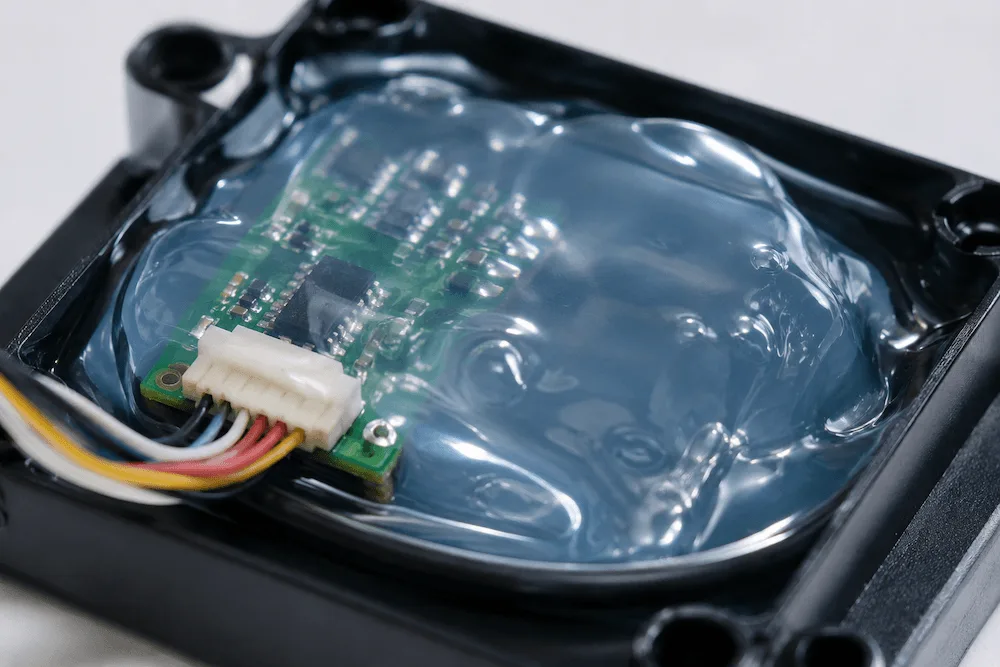
Silicone potting compounds and self-healing silicone gels occupy the premium tier of electronic encapsulation. Unlike epoxy or PU, silicone maintains its soft, elastic cushion across a massive temperature spectrum—safely operating from -50°C up to 200°C+ without hardening in the freezing cold or breaking down in scorching heat.
Silicone gels take stress relief a step further. They cure into a jelly-like, self-healing mass with almost zero mechanical tension.
Why High-Spec Lines Specify Silicone Gel:
- Zero Component Stress: Because the gel remains incredibly soft, it dampens high-frequency vibrations and handles massive thermal cycles smoothly. As components expand and contract, the silicone gel simply deforms and recovers, exerting zero stress on delicate bond wires, fragile microchips, or sensitive sensors.
- Superior Reworkability (Re-enterable): If a component fails or a quality control test requires board access, you can easily cut away or gouge out the silicone gel with a tool, replace the chip, and pour fresh liquid silicone right back into the cavity. The new silicone will bond seamlessly to the old layer.
- Flawless Hydrophobic Sealing: Silicone is naturally hydrophobic. It rejects water molecules entirely, providing an airtight moisture seal for junction boxes, deep-sea marine connectors, and heavy-duty automotive electronics.
The Purchasing Protocol: How to Choose in 4 Questions
Before signing off on a bulk material order, your engineering and procurement teams should align on these four operational filters:
- What is the Thermal Reality? If your operating temperatures routinely spike past 130°C (like in EV powertrains or LED drivers), drop polyurethane immediately. You need the thermal stability of silicone.
- Are the Components Fragile? If your board features tiny ceramic capacitors, glass-bodied diodes, or microscopic MEMS sensors, rigid epoxy will likely crush them during thermal cycling. Specify an ultra-low-stress silicone gel.
- Does the Unit Need to be Serviced? If you are potting high-value assemblies that may require warranty repairs or diagnostic testing, epoxy is a permanent death sentence. Silicone gel allows clean, cost-effective reworkability.
- What is the Curing Exotherm Limit? Epoxies can release significant heat (exotherm) while curing in thick sections. If your electronic components are sensitive to sudden temperature spikes during production, a room-temperature vulcanizing (RTV) silicone system is the safest engineering path.
Technical Potting FAQs
What is the exact difference between an ordinary silicone sealant and an electronics-grade silicone potting gel?
Never pour standard hardware-store silicone sealant onto an electronic board. Ordinary sealants are often “acetoxy” systems—they release acetic acid (vinegar smell) during cure, which will instantly corrode copper traces and delicate silver solder joints. Electronics-grade silicone gels are neutral-cure (alkoxy or platinum-catalyzed additive) systems that release zero corrosive byproducts, ensuring total safety for live circuits.
Does silicone potting compound provide flame retardancy?
Yes, high-tier electronic silicone compounds are formulated to meet UL 94 V-0 standards. When exposed to fire, they will self-extinguish within seconds, preventing fire propagation along the circuit board or power module.
How does moisture affect polyurethane vs. silicone during production?
Polyurethane is highly sensitive to moisture before it cures. If your factory has high humidity, the isocyanate in wet PU will react with moisture in the air, creating carbon dioxide gas bubbles that leave your potting layer full of weak, porous voids. Silicone is far more forgiving on the factory floor, ensuring a solid, dense, bubble-free fill.
Final Procurement Recommendation
When structural armor and low cost are your primary drivers, 에폭시 is your ideal baseline. When you need a flexible rubber boot for low-temperature outdoor cables, 폴리우레탄 provides a balanced fit.
However, if your project involves high-performance microelectronics, intense thermal cycling, sensitive sensors, or modules that demand field repairability, Silicone Gels and Silicone Potting Compounds are the only engineering choices that guarantee long-term reliability.
Contact TOPSIL’s application team today to request high-purity silicone gel data sheets and arrange material samples for your next pilot run.