
Your product has passed tooling, pilot production and customer approval. Then a restricted-substance question, an extractables concern or a new customer specification forces you to reconsider one silicone component.
The price difference may be modest. The real cost of changing late can include process redevelopment, repeat testing, obsolete inventory and delayed market access.
For founders, CPOs and strategic procurement teams, the better question is no longer:
Which silicone meets today’s specification?
It is:
Which material route is least likely to become a qualification liability during the product lifecycle?
Quick Answer
Platinum-cured silicone is not universally required by law. Regulations usually control substances, exposure and finished-product performance rather than prescribing one cure system.
However, stricter controls on cyclic siloxanes, documented corrections involving specific peroxide-cured medical tubing, greater scrutiny of extractables and rising customer documentation expectations are changing the economics of silicone selection.
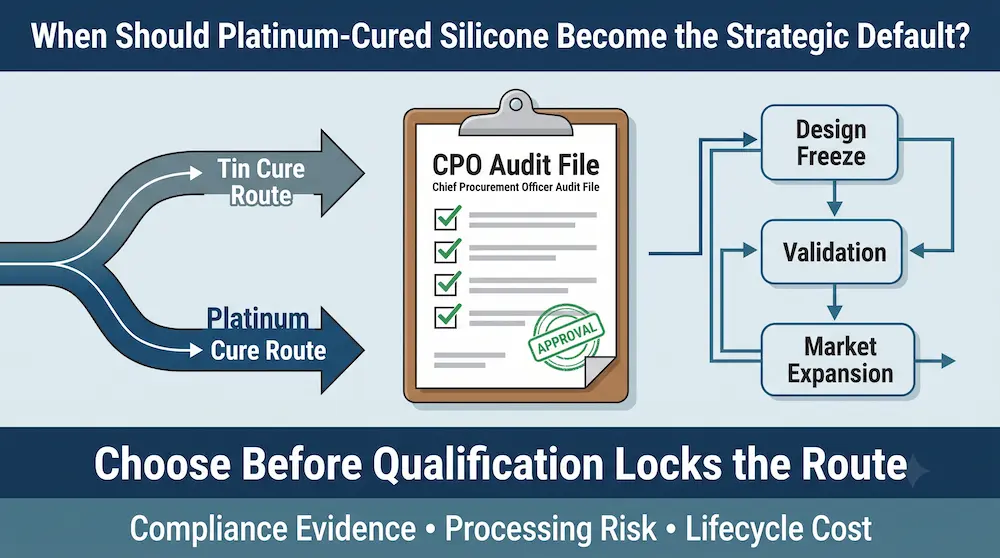
In high-scrutiny projects, platinum cure can become the strategic default when validating it early costs less than defending or replacing another system later.
Platinum cure may become commercially necessary long before it becomes legally mandatory.
Scope Note: Not All Platinum Silicones Are Interchangeable
“Platinum-cured silicone” includes different material families, such as:
- RTV-2 room-temperature liquid silicone
- LSR injection-molding silicone
- HCR high-consistency silicone
- Extrusion-grade silicone compounds
These materials differ in processing, equipment, formulation and end use.
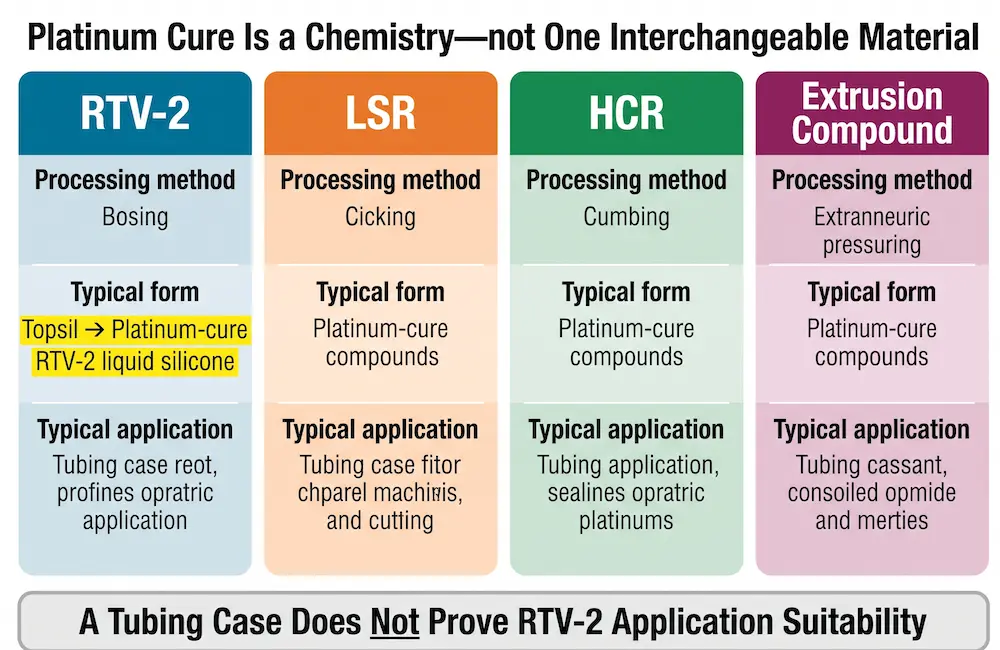
The examples in this article illustrate wider cure-chemistry trends; they do not mean that RTV-2 mold silicone can replace extrusion-grade tubing compounds.
Topsil’s focus here is platinum-cure RTV-2 liquid silicone for mold making, casting and selected development applications.
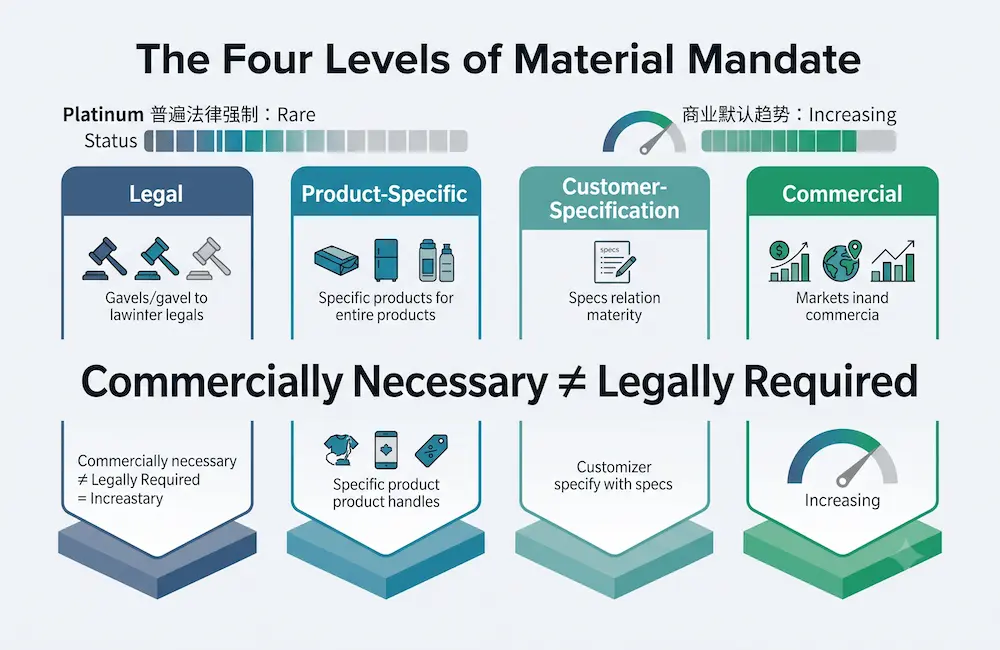
What Does “Mandatory” Really Mean?
| Level | Meaning | Current Position of Platinum Cure |
| Legal mandate | A regulation explicitly requires a cure system | Rare; do not claim this broadly |
| Product-specific mandate | A risk finding or validation result forces a change | Documented in certain dialysis tubing cases |
| Customer-specification mandate | An OEM or brand requires platinum cure | Increasing in selected high-scrutiny projects |
| Commercial mandate | Another system creates greater testing, explanation or switching costs | The most important 2026–2030 trend |
A material can therefore become the practical market ticket without being named in a regulation.
The cure label alone is not evidence. A defensible decision still depends on grade-specific composition, residuals, processing, finished-product evidence and change control.
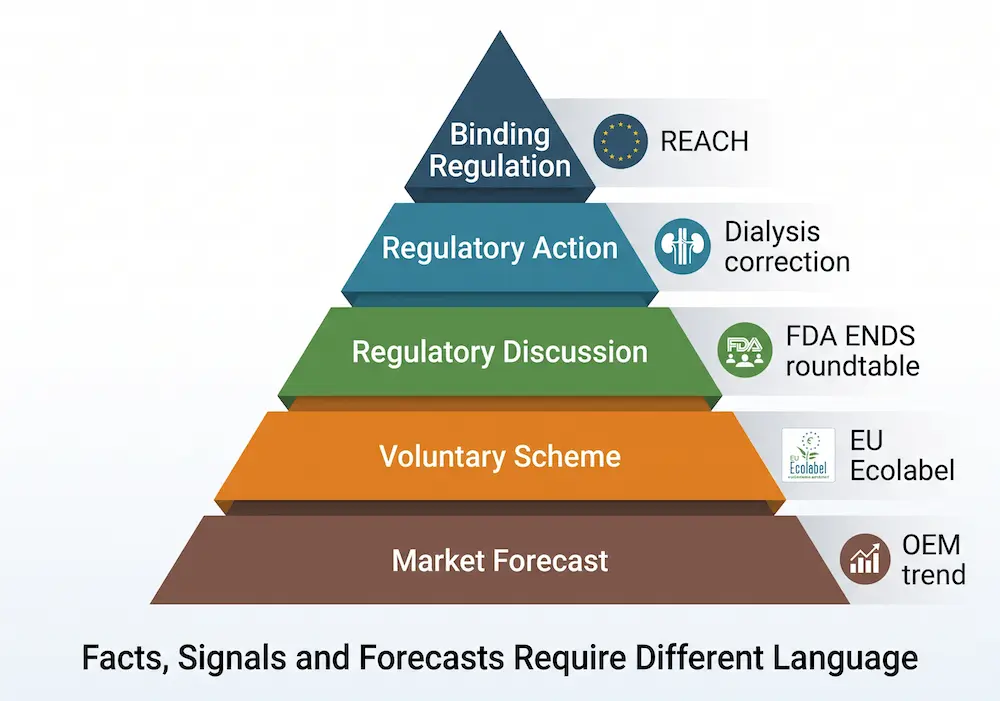
Read Every Signal at the Correct Evidence Level
Not every regulatory or market signal carries the same weight.
| Evidence Level | Example | What It Can Support |
| Binding regulation | EU restriction of D4, D5 and D6 | A legal compliance requirement |
| Regulatory action | Correction of affected dialysis equipment | A documented product-specific material issue |
| Regulatory discussion signal | FDA meeting material on ENDS extractables | Questions applicants may be expected to investigate |
| Voluntary scheme | EU Ecolabel supplier declarations | Rising documentation expectations, not universal market entry |
| Market forecast | More OEMs preferring controlled platinum systems | A strategic inference, not a legal fact |
Signal 1: D4, D5 and D6 Are Raising the Documentation Bar
Commission Regulation (EU) 2024/1328 expanded the REACH Annex XVII restrictions on the cyclic siloxanes D4, D5 and D6. The regulation contains concentration thresholds, implementation dates, sector-specific provisions and derogations.
It does not require platinum cure. It also does not prove that every platinum-cured grade is automatically low in D4, D5 or D6.
Commission Regulation (EU) 2024/1328 expanded the REACH Annex XVII restrictions concerning D4, D5 and D6.
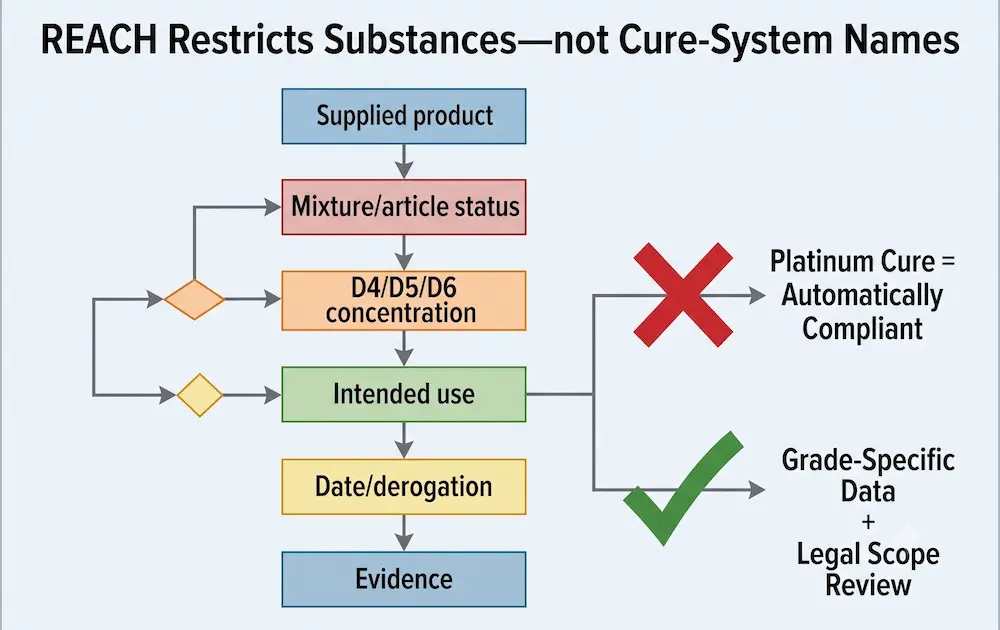
Residual cyclic content may depend on:
- Polymer manufacture and devolatilisation
- Raw-material purity
- Complete formulation
- Production control
- Lot-to-lot consistency
Legal treatment may also differ between uncured A/B mixtures and finished cured articles. Buyers should confirm how the provision applies to the exact product supplied.
The future-ready procurement question is therefore not only:
Is this material platinum cured?
It is:
Can the supplier provide grade-specific cyclic-siloxane and volatile-content evidence that fits the product and target market?
Signal 2: Cure Chemistry Has Triggered a Real Product Correction
FDA reported that certain dialysis equipment used silicone tubing manufactured with a chlorinated peroxide initiator that could result in non-dioxin-like PCBAs and PCBs.
Fresenius offered to update affected machines to platinum-cured silicone tubing. Baxter has also transitioned certain affected components while investigating related risks.
This product-specific material change must be interpreted narrowly.
It does not show that:
- Every peroxide-cured silicone is unsafe
- Tin-cured RTV-2 silicone has the same issue
- Platinum cure automatically eliminates every extractables risk
- Topsil RTV-2 grades are intended for dialysis tubing
The strategic lesson is that cure chemistry can enter the final product’s risk profile. Discovering this after qualification is more disruptive than evaluating alternatives earlier.
FDA update on toxic-compound exposure in dialysis systems
Fresenius hemodialysis machine correction
Signal 3: The Focus Is Moving Toward the Finished Component
At a February 2026 FDA roundtable on electronic nicotine delivery system applications, presentation materials discussed product-specific extractables and leachables from components and container-closure materials, including parts in direct contact with e-liquid.
The materials also stated that the presentation was not a formal expression of FDA policy.
This is a regulatory discussion signal—not a platinum-cure requirement.
It illustrates a broader qualification question:
What can migrate from the exact cured component into the real contact medium under actual use conditions?
For an RTV-2 buyer, “platinum cured,” “food grade” or “low odour” cannot replace evidence for the exact grade, pigment, cure and application.
Where Is the Market Signal Strongest?
| Application Area | Current Signal | Relevance to Platinum Cure |
| Medical extrusion tubing | Documented correction involving a specific chlorinated peroxide system | Strong cure-chemistry signal, but not an RTV-2 application |
| Reusable personal-care products | Voluntary supplier declarations and chemical controls | Documentation expectations are rising; material form must be assessed separately |
| Fluid-contact components | Greater extractables and leachables scrutiny | Platinum may be a candidate, but product-specific evidence remains necessary |
| Food, skin-contact and precision RTV-2 molds | Customer documentation, low odour, low shrinkage and process consistency | Relevant to Topsil, but not universally regulated to platinum |
| General industrial molds | Performance, mold life and total cost | Platinum should compete on application value, not fear of regulation |
EU Ecolabel documentation for reusable menstrual cups includes a silicone-supplier declaration. Because the scheme is voluntary, it is a documentation signal rather than a universal legal requirement.
When Platinum Should—and Should Not—Be the Default
Platinum cure deserves early evaluation when:
- Low shrinkage or dimensional stability matters
- Low odour, transparency or controlled residues are important
- The product may face food, skin, liquid or premium-brand scrutiny
- The customer requests cyclic-siloxane, migration or change-control information
- A long product lifecycle makes future requalification expensive
It should not be selected merely because it sounds cleaner or more advanced.
Another cure system may remain the better choice when:
- The application is a general industrial mold with no regulated contact
- The master contains sulfur, amines, tin residues or other inhibition risks
- The current system is stable, well documented and already validated
- The project is highly price-sensitive and gains little lifecycle benefit
- Switching would create more validation risk than it removes
Platinum Default Decision Scorecard
| Decision Factor | Lower Strategic Pressure | Higher Strategic Pressure |
| Product exposure | General industrial use | Food, skin, liquid or healthcare-related environment |
| Evidence position | Current data answer customer questions | Residual, migration or composition gaps remain |
| Cost of future change | Simple process and short validation | Tooling, testing and customer reapproval are extensive |
| Product lifecycle | Short campaign or prototype | Multi-year platform or global launch |
| Supplier control | Stable specification and change notification | Limited formulation visibility or weak change control |
Recommended Decision
Retain the current system: Low exposure, sufficient evidence and low future-change cost.
Dual-qualify platinum: Uncertainty exists, but an immediate switch is not justified.
Make platinum the default candidate: High exposure, long lifecycle and rising evidence demands.
Run a formal change-impact assessment: The product is already validated and switching may affect performance or compliance.
Use Product Gates, Not an Arbitrary Three-Year Calendar
Gate 1: Before Material Selection
Define the silicone family, process, contact conditions, markets and evidence before tooling limits the options.
Gate 2: Before Design Freeze
Run parallel trials comparing:
- Processing window
- Cure-inhibition sensitivity
- Mechanical properties
- Shrinkage
- Post-cure requirements
- Documentation gaps
Gate 3: Before Validation
Lock the:
- Grade
- Colour
- Mixing ratio
- Cure conditions
- Product specification
- Batch-traceability requirements
- Change-notification agreement
Gate 4: Before Market Expansion
Recheck market requirements, supplier changes and second-source strategy.
Evidence prepared for one colour, process or market should not be extended automatically.
What Should an RTV-2 Buyer Request?
Ask for:
- Exact grade, silicone family and manufacturing site
- TDS, SDS, COA and controlled specification
- D4, D5, D6 or volatile data where relevant and available
- Pigment, additive, cure and post-cure coverage
- Applicable migration, food-contact or biological evidence
- Change-notification and batch-traceability policy
Do not ask only for “a platinum certificate.”
Ask what the available evidence actually covers.
How Topsil Silicone Supports Material-Route Reviews
Topsil Silicone manufactures platinum-cure RTV-2 liquid silicone for mold making, casting and selected development applications.
The tubing and fluid-contact examples illustrate wider qualification risks; they are not applications claimed for Topsil silicone’s RTV-2 grades.
For an initial comparison, provide:
- Required silicone form and processing method
- Current cure system
- Final application and contact conditions
- Target market
- Required hardness, viscosity and working time
- Customer or regulatory document requirements
- Expected order volume
Topsil silicone can compare the processing characteristics and currently available documentation of a proposed platinum-cure RTV-2 grade with the customer’s present material route.
The product manufacturer remains responsible for final material selection, testing and regulatory acceptance.
Not sure whether to retain, dual-qualify or switch? Send the current grade, application, master material and processing requirements through RTV-2 silicone technical support.