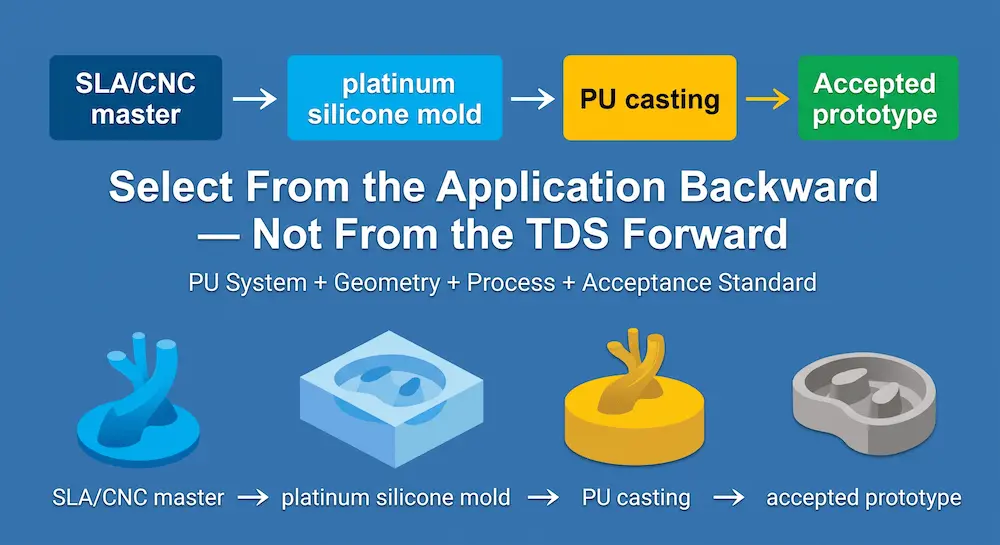

Two platinum silicones can both be listed as Shore A 25 and still perform very differently in the same polyurethane casting project.
One may release deep undercuts easily but deform around a large flat housing. Another may provide better dimensional support but tear along a thin cut line. A third may look excellent on its technical data sheet but remain sticky against an inadequately prepared SLA-printed master.
This is why silicone selection should not begin with the largest tear-strength number or the lowest viscosity.
It should begin with four questions:
- What may damage the mold?
- Where is the mold most likely to fail?
- What must the operator complete before the silicone begins to gel?
- What defines an acceptable polyurethane casting?
The right platinum silicone is selected from the polyurethane system, part geometry and production process backward—not from the silicone TDS forward.
A poor match can lead to cure inhibition, difficult demolding, cut-line tearing, dimensional rejection, premature mold replacement or repeated sample trials.
إجابة سريعة
The choice between the two chemical systems comes down to your primary production driver:
Choose علاج القصدير if your priority is Volume & Budget: Requires maximum raw material cost-efficiency for large-scale, forgiving geometries (like architectural concrete or plaster) on a busy shop floor.
Choose بلاتينيوم كيور if your priority is Technical Precision: Requires near-zero shrinkage (<0.1%), long-term library storage without warping, or strict هيئة الغذاء والدواء/LFGB compliance for skin and food contact.
Quick Answer: What Platinum Silicone Is Best for PU Vacuum Casting?
The best platinum silicone for polyurethane vacuum casting is a low-shrinkage RTV-2 grade whose usable working time and mixed viscosity fit the complete mold-making process, and whose hardness, tear strength and elongation match the part geometry and local demolding stress.
Buyers must also confirm compatibility with:
- The actual polyurethane system
- Master material and surface preparation
- وكيل الإفراج
- Mold-support design
- Vacuum degassing process
- Dimensional tolerance
- Required number of acceptable castings
There is no universally best Shore hardness or mold-life number for every PU casting project.
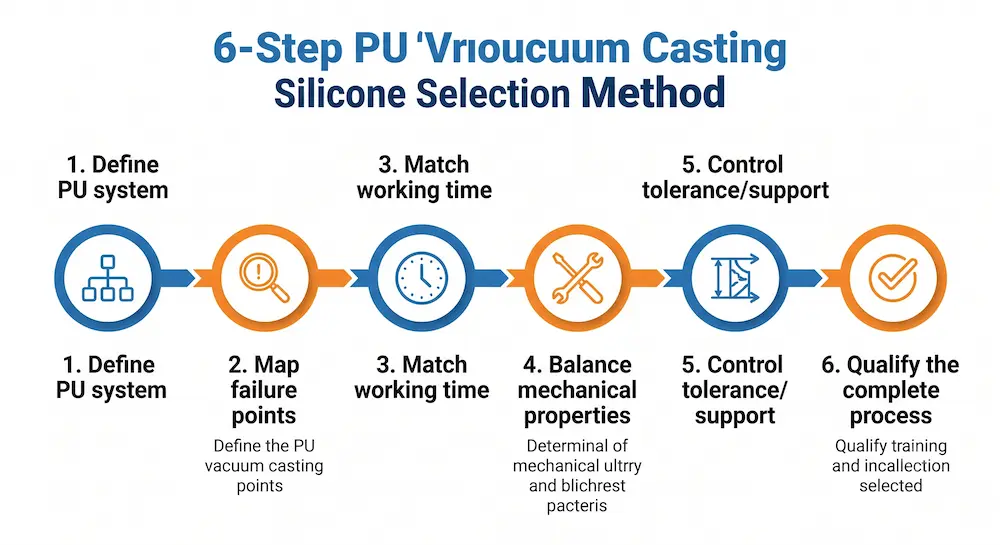
The 6-Step Platinum Silicone Selection Method
| Step | Main Decision |
| 1 | Define the PU system and accepted-part requirement |
| 2 | Map part geometry and likely mold-failure points |
| 3 | Match the complete processing window |
| 4 | Balance hardness, tear strength and elongation |
| 5 | Control dimensional stability, mold support and visibility |
| 6 | Qualify the master, silicone and PU resin together |
Step 1: Define the PU System and Accepted-Part Requirement
Do not choose the silicone before identifying what will be cast into it.
Polyurethane systems can differ in:
- Rigidity
- Cure speed
- Exotherm
- Filler content
- Surface adhesion
- الانكماش
- Release-agent requirements
- Abrasiveness
- Demold time
تشمل التطبيقات الشائعة ما يلي:
- Rigid PU resin
- Flexible PU elastomer
- PU foam
- Filled or reinforced polyurethane
- Clear PU resin
- Fast-curing or high-exotherm PU
- Pigmented or specialty PU
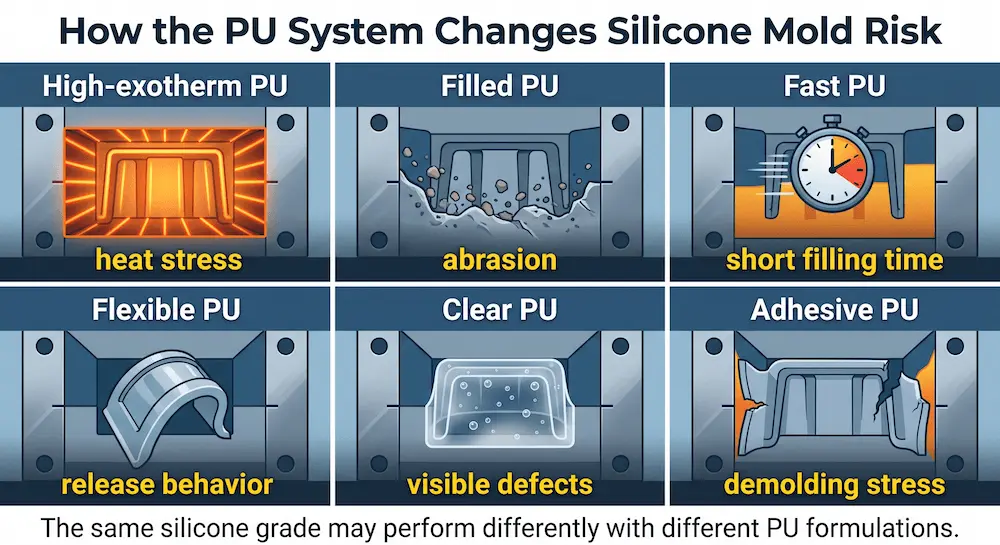
The PU system changes the stresses placed on the mold.
| PU Characteristic | Possible Mold Effect | What to Evaluate |
| High cure exotherm | Faster surface ageing or deformation risk | Mold thickness, cooling interval and trial performance |
| Filled PU | Increased abrasion | Surface durability and demolding method |
| Fast-curing PU | Short filling window | Gate, vent and pouring design |
| Flexible PU | Different release behavior | Adhesion and mold flexibility |
| Clear PU | Surface defects are more visible | Mold finish and bubble control |
| Strongly adhering PU | Greater demolding stress | Release agent and compatibility trial |
Before requesting a silicone sample, define:
- PU type
- Part quantity
- Surface standard
- Dimensional tolerance
- Demold requirement
- Expected casting cycle
- What counts as an accepted part
Do not ask only, “How many castings will the mold produce?”
اسأل:
How many acceptable castings can the mold produce before its surface, dimensions or release performance fall below the project requirement?
Step 2: Map Part Geometry and Likely Mold-Failure Points
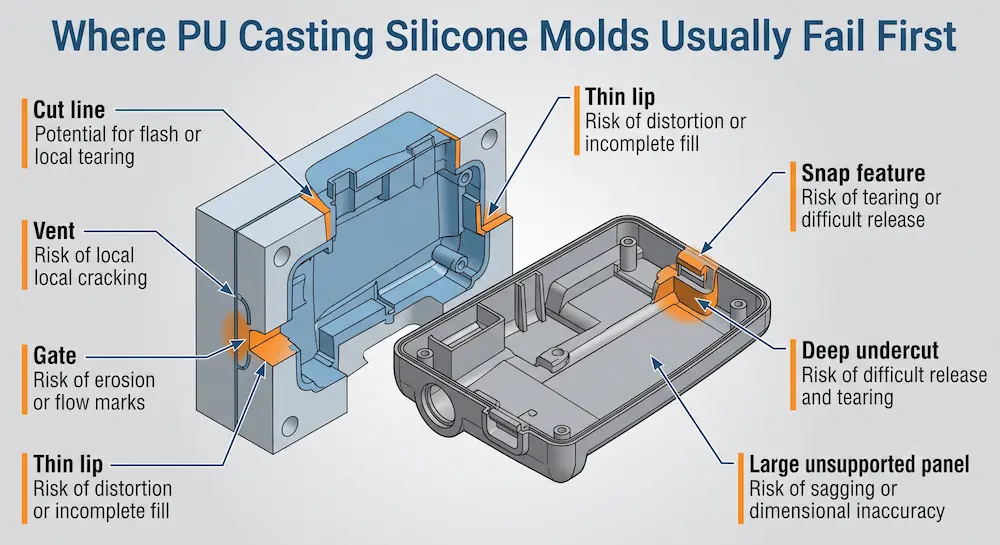
Silicone molds rarely fail uniformly.
Failure normally begins at a local feature such as:
- Cut line
- Gate
- Vent
- Thin lip
- Sharp corner
- Deep undercut
- Snap feature
- Unsupported large panel
Map these risks before choosing hardness.
| الميزة | Likely Risk | Selection or Design Direction |
| Deep undercut | High demolding strain | Greater flexibility with strong tear balance |
| Thin rib or vent | Local tearing | Avoid excessive hardness and undersized sections |
| Large flat housing | Mold deformation | Medium hardness plus mother-mold support |
| Tall narrow core | Bending | Better shape retention and external support |
| Complex cut mold | Cut-line propagation | Tear resistance and controlled cut design |
| Snap feature | Concentrated release stress | Flexible mold, suitable split line and trial release |
Harder does not automatically mean longer mold life. Softer does not automatically mean easier production.
A softer silicone may release complex parts more easily but deform around a large housing. A harder silicone may hold dimensions better but concentrate stress around undercuts.
Material selection cannot compensate indefinitely for poor mold design.
Silicone grade, cut-line design, mold thickness, vents, gates and mother-mold support must be reviewed together.
For large flat surfaces, improving the support shell may be more effective than selecting a much harder silicone.
Step 3: Match the Complete Processing Window
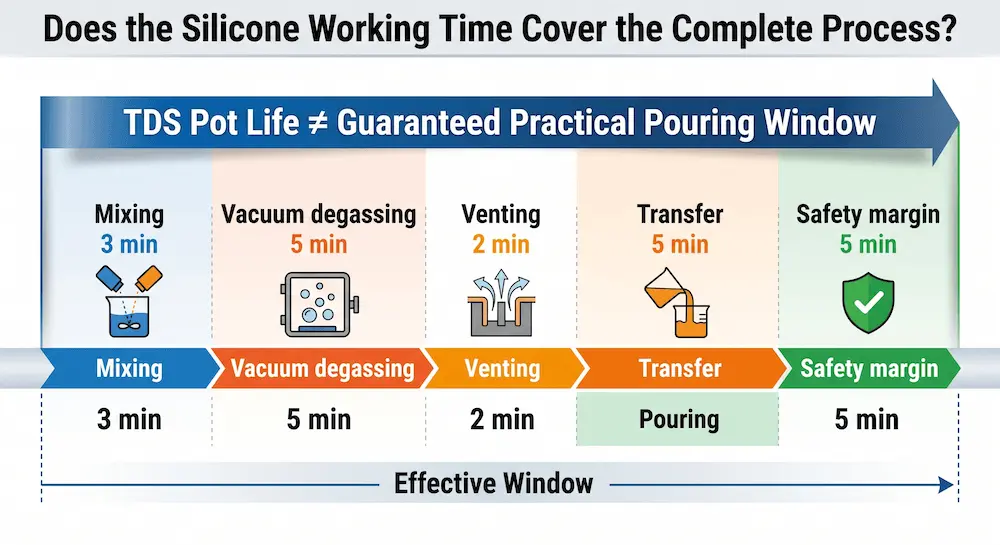
Working time must cover the complete mold-making process.
The practical requirement is:
Mixing + vacuum degassing + venting + transfer + pouring + validated safety margin must remain within the usable working time.
Illustrative example:
| Process Step | Example Time |
| الخلط | 3 minutes |
| Vacuum degassing | 5 minutes |
| Venting and unloading | 2 minutes |
| Transfer and pouring | 5 minutes |
| Safety margin | 5 minutes |
| Required working window | Approximately 20 minutes |
This example is not a universal rule.
Actual usable working time depends on:
- Workshop temperature
- Batch size
- Material temperature
- Silicone viscosity
- Mixing energy
- Vacuum equipment
- حجم القالب
- Operator variation
The working time stated on a TDS may not equal the customer’s practical pouring window. The material may become too viscous for accurate filling before it reaches the supplier’s formal pot-life endpoint.
A shorter-working-time grade may suit:
- Small molds
- Simple geometry
- Fast manual pouring
- Small batches
A longer-working-time grade is usually safer for:
- Large molds
- Vacuum degassing
- Complex mold boxes
- Controlled low-turbulence pouring
- Multiple operators
- Larger batch sizes
The safety margin should be validated through real trials rather than treated as a fixed number for every project.
Step 4: Balance Hardness, Tear Strength and Elongation
Do not rank mechanical properties independently.
صلابة الشاطئ A
Indicates how soft or firm the cured silicone is. It affects flexibility and shape support but does not directly predict mold life.
قوة التمزق
Indicates resistance to crack propagation. It is especially important around cut lines, vents, gates and thin mold sections.
الاستطالة
Indicates how far the silicone can stretch before breaking. High elongation may support difficult demolding but does not replace tear strength.
Tensile strength
Provides useful laboratory comparison, but a mold rarely fails like a perfect tensile-test specimen.
In PU الصب بالتفريغ, failure usually starts at a local stress concentration—not across a uniform laboratory sample.
| Failure Location | Possible Cause | Do Not Judge By |
| Cut-line tearing | Stress concentration or unsuitable hardness | Elongation alone |
| Vent damage | Section too thin or poor demolding direction | Shore A alone |
| Gate damage | Repeated cutting or local pulling | Tensile strength alone |
| Panel distortion | Insufficient mold support | Shrinkage alone |
| Snap-feature cracking | Undercut and split-line design | Highest tear number alone |
When comparing grades, review:
- الصلابة
- قوة التمزق
- الاستطالة
- Test method
- Thin-section geometry
- Cut design
- Demolding method
The highest TDS value is not automatically the safest production choice.
Step 5: Control Dimensional Stability, Support and Visibility
Low silicone shrinkage is valuable, especially for:
- Assembly housings
- Engineering enclosures
- Snap-fit parts
- Mating components
- Functional prototypes
- Parts produced to drawings
However, final PU part accuracy depends on the complete tolerance stack:
- Master accuracy
- Silicone shrinkage
- Mold deformation
- Mother-mold support
- PU shrinkage
- Casting temperature
- Post-curing
- Demolding stress
- Measurement timing
Low silicone shrinkage removes one source of dimensional error; it does not eliminate the complete tolerance stack.
For precision projects, measure:
- The master
- The cured silicone mold
- The first PU casting
- Later castings after repeated use
When transparency adds value
Transparent platinum silicone may improve:
- Cut-line planning
- Master positioning
- Gate and vent placement
- Internal bubble inspection
- Multi-part mold assembly
- Transparent PU casting
But transparency is a process feature, not a direct measure of mold life.
For a simple open mold, translucent silicone may be fully adequate.
Choose transparency when it solves a real production problem—not because it appears more premium.
Step 6: Qualify the Master, Silicone and PU Resin Together
A TDS can identify a candidate. It cannot approve the application.
This is especially important with SLA and DLP printed masters.
The prepared master surface may include:
- Printed resin
- Residual monomer
- Cleaning solvent
- Post-cure condition
- التمهيدي
- الطلاء
- Sealing coating
- وكيل الإفراج
Platinum-cure inhibition can cause:
- Sticky contact surfaces
- Local soft areas
- Uncured silicone
- Surface damage
- Complete mold failure
Compatibility approval applies to the complete prepared surface system, not only the underlying printed resin.
A practical test sequence is:
- Wash and post-cure the master correctly.
- Allow the master to stabilize.
- Apply the intended primer, coating or release agent.
- Test a small hidden area.
- Cure a silicone patch against the real prepared surface.
- Produce a representative mold section.
- Cast the actual PU resin.
- Check release, surface quality and dimensions.
A successful test on one SLA resin does not automatically prove compatibility with another resin, coating or release system.
silicone production with 3D-printed tools
When Platinum Silicone May Not Be Necessary
Platinum silicone is often preferred when the project requires:
- Low shrinkage
- Dimensional repeatability
- Transparent molds
- Complex undercuts
- High-quality prototype surfaces
- More demanding mold life
However, it is not automatically the most economical option for every PU project.
A suitable tin-cure silicone may still be commercially reasonable when:
- The part geometry is simple
- Only a few castings are required
- Dimensional tolerance is not critical
- Transparency is unnecessary
- Budget is the main constraint
- The master creates platinum-cure compatibility risk
The decision should be based on total project cost and accepted-part requirements—not the assumption that the more expensive cure system is always better.
PU Vacuum Casting Selection Matrix
| Project Requirement | Prioritize | Avoid Deciding By |
| Deep undercuts | Flexibility, tear balance and split-line design | Hardness alone |
| Large housing | Shape support and mother mold | Tear strength alone |
| Fine detail | Mixed viscosity and flow | Part A viscosity |
| Large batch | Usable working time | Fast demold time |
| Precision part | Low shrinkage and mold stability | Silicone shrinkage alone |
| Transparent cut mold | Visibility and cut control | Clarity alone |
| SLA or DLP master | Complete surface-system compatibility | Post-cure time alone |
| Repeated PU casting | Accepted casting count | Supplier cycle promise |
Illustrative Risk Comparison
Consider a rigid PU enclosure with:
- SLA-printed master
- 350 × 220 mm dimensions
- Large flat panels
- Screw bosses
- Snap features
- Vacuum degassing
- Tight assembly requirement
| Candidate | Why It May Work | What Must Be Proven |
| Shore A 15 | Easier release around snap features | Flat-panel deformation and support |
| Shore A 25 | Balanced starting point | Cure compatibility and cut-line durability |
| Shore A 40 | Strong shape support | Release around snaps and local tearing |
Shore A 25 may be the first grade selected for testing, but it is not automatically the final answer.
- Shore A 15 may work with better mother-mold support.
- Shore A 40 may work with improved split-line design.
- Shore A 25 may still fail if the SLA surface inhibits cure or the working time is too short.
This is an illustrative comparison, not a universal grade recommendation.
Sample Qualification Sheet
Project information
Record:
- PU resin type
- Master material
- Surface preparation
- Part dimensions
- Deepest undercut
- Critical features
- Quantity target
- Dimensional tolerance
Silicone process
Record:
- Silicone grade and batch
- Mixed viscosity
- وقت العمل
- Mixing method
- Vacuum degassing time
- Pouring time
- Demold time
- Room and material temperature
Approval results
Evaluate:
- Cure compatibility
- Detail reproduction
- Bubble defects
- Release from undercuts
- Mold deformation
- Critical dimensions
- Cut-line condition
- Tear location
- Surface deterioration
- Accepted casting count
The objective is not merely to prove that the silicone cures.
It is to prove that the mold produces acceptable PU parts under the real production process.
Compare Cost per Accepted Casting
A lower silicone price does not always mean a lower production cost.
Use:
Cost per accepted casting = total mold-making cost ÷ accepted PU castings
Total mold-making cost may include:
- سيليكون
- Master preparation
- صندوق القالب
- Labor
- Vacuum processing
- Mother mold
- Process loss
- Failed mold cost
- Downtime
A more expensive silicone can be commercially better if it reduces mold replacement, dimensional rejection and repeated trials.
Topsil silicone Technical Note
In replacement projects, customers often begin by requesting the same Shore hardness as their existing material.
In practice, the more important difference may be:
- Usable working time
- Local tear behavior
- Mold support
- SLA surface compatibility
- Transfer and degassing process
For a grade-selection review, send Topsil:
- Current silicone TDS
- PU resin type
- Master material
- Part dimensions
- Critical undercuts
- Target working time
- Mold design
- Dimensional tolerance
- Required casting quantity
- Current failure problem
Topsil silicone can help organize the information into a risk-based selection review and recommend which platinum silicone direction should be tested first.
Explore Topsil’s سيليكون معالج بالبلاتين for professional mold making.
For rapid prototyping applications, visit السيليكون للنماذج الأولية السريعة.
For hardness selection, see the Shore A Hardness Guide.
For SLA and DLP surface risks, review Platinum Silicone Cure Inhibition.
For application support, contact RTV-2 Silicone Technical Support.
الأسئلة الشائعة
What Shore hardness is best for PU vacuum casting?
There is no universal best hardness. Deep undercuts usually need greater flexibility, while large flat parts require more support. Hardness must be evaluated with tear strength, mold design and demolding stress.
Can platinum silicone cure against an SLA master?
It may, but the complete prepared surface must be tested. Printed resin, post-curing, primer, coating and release agent can all affect platinum-cure compatibility.
How many PU castings can one silicone mold produce?
The number depends on PU chemistry, heat, geometry, release method, mold support and acceptance criteria. Measure mold life by accepted castings, not a fixed supplier promise.
Should I use platinum or tin silicone for PU casting?
Platinum silicone is generally preferred for low shrinkage, transparency and demanding prototype work. Tin-cure silicone may still be suitable for simple, low-volume and cost-sensitive projects.