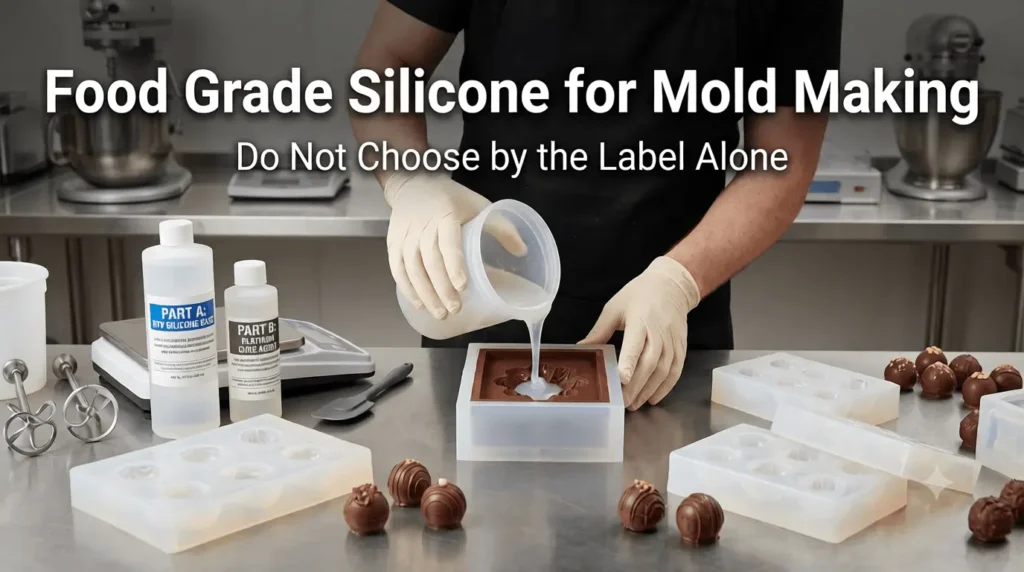

Many buyers lose time and money because they choose silicone only by the words “food grade.”
But food mold making requires more than a food-grade label. You must check the cure system, food-contact documents, Shore A hardness, viscosity, pot life, master model compatibility and real use conditions.
Food grade silicone is not the same as food mold ready silicone.
A suitable food mold silicone should be:
- supported by food-contact documents
- usually based on platinum cure RTV-2 silicone
- low odor after proper curing
- soft enough for demolding
- strong enough to hold shape
- suitable for the intended temperature and food-contact condition
- compatible with the master model surface
- tested under real mold-making conditions
Food grade silicone should not be chosen by the label alone. A professional buyer should verify documents, confirm platinum cure suitability, and match Shore A, viscosity and pot life to the actual food mold application.
Quick Answer: What Silicone Is Best for Food Mold Making?
For most professional food mold applications, the better direction is platinum cure RTV-2 silicone with suitable food-contact documents, proper Shore A hardness, good flow, enough working time and real application testing.
Do not ask only:
“Is this food grade?”
Pregunta:
“Is this silicone suitable for my food mold type, target market, master model, production process and required compliance documents?”
Buyer Says vs Real Need
| Buyer Says | Real Need May Be |
| “I need food grade silicone.” | Need food-contact documents + correct cure system |
| “I need FDA silicone.” | Need a clear FDA-related compliance basis, not a vague claim |
| “I need very soft silicone.” | Need easy demolding, but must avoid deformation |
| “I need silicone for chocolate molds.” | Need low odor, soft platinum cure silicone and good detail reproduction |
| “I need baking mold silicone.” | Need heat-use suitability and food-contact documentation |
| “My silicone stays sticky.” | May be platinum cure inhibition on the master surface |
| “I want one grade for all food molds.” | Different molds may need different Shore A and viscosity |
| “Supplier says food grade.” | Buyer still needs documents and sample validation |
This is why professional buyers should evaluate both compliance and mold performance.
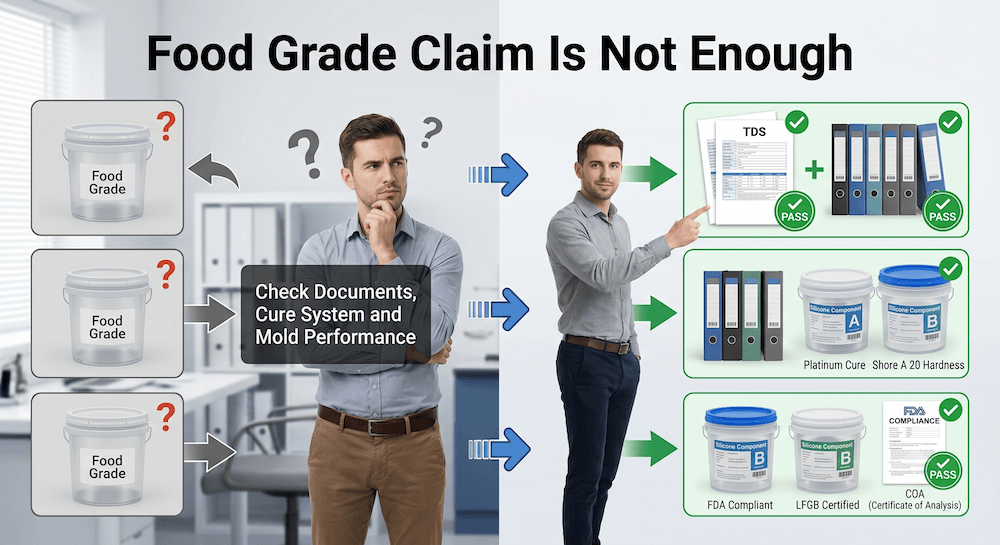
Choose by Food Mold Application
Different food molds should not always use the same silicone grade.
| Aplicación | Main Buyer Concern | Suggested Direction | What to Confirm |
| Chocolate molds | Easy release, fine details, low odor | Platinum cure, Shore A 10–20 | Odor, detail reproduction, demolding |
| Candy molds | Flexibility, repeated use | Platinum cure, Shore A 10–25 | Food-contact documents and mold life |
| Fondant molds | Fine patterns and soft release | Soft platinum cure silicone | Detail depth and tear resistance |
| Cake decoration molds | Small details and easy demolding | Shore A 10–20, good tear strength | Detail reproduction |
| Baking molds | Heat use and repeated food contact | Platinum cure silicone with heat data | Intended temperature and documents |
| Ice cube molds | Low odor and flexible release | Soft platinum cure silicone | Low-temperature demolding |
| Large food molds | Shape support | Orilla A 20-30 | Mold size and wall thickness |
| Distributor / private label line | Broad customer needs | 10A / 20A / 30A sample kit | Documents, packaging and stable supply |
The best food mold silicone is not always the softest one. It should balance easy demolding, shape stability, detail reproduction, low odor and food-contact documentation.
Food Grade Does Not Mean Food Mold Ready
A silicone material may be described as food grade, but buyers still need to confirm whether it is suitable for their actual food mold application.
Por ejemplo:
- A chocolate mold needs flexibility, low odor and fine detail reproduction.
- A baking mold needs heat-use suitability.
- A large food mold needs better shape support.
- A private label brand needs clear documents and stable batch quality.
- A distributor needs a product range that covers different end users.
Food mold buyers should not rely only on marketing wording.
A better purchasing question is:
“Can you provide the documents and technical data to support this silicone for my intended food-contact mold application?”
Platinum Cure Is Preferred, but Documents Still Matter
For food mold making, platinum cure silicone is usually the better direction. It is commonly selected because it can offer lower odor, lower shrinkage and better suitability for high-quality food mold applications.
However, platinum cure alone does not prove food-contact compliance.
| Artículo | Silicona de curado con estaño | Silicona de curado platino |
| Fabricación de moldes en general | Common and cost-effective | Also suitable |
| Food mold direction | Usually not the first choice | Usually preferred |
| Odor | May be stronger | Normalmente inferior |
| Contracción | Más alto | Baja |
| Coste | Baja | Más alto |
| Cure inhibition risk | Baja | Higher, needs surface test |
| Document requirement | Still needed if claimed for food use | Still needed for food-contact use |
Silicona de estaño is widely used for general mold making such as concrete, resin, craft and industrial molds. But for chocolate, candy, fondant, baking and other food mold applications, platinum cure silicone is usually the more professional direction when food-contact documents are required.
Important note
Not all platinum cure silicone is automatically food grade. Buyers should still ask for suitable documents and validate the silicone under real application conditions.
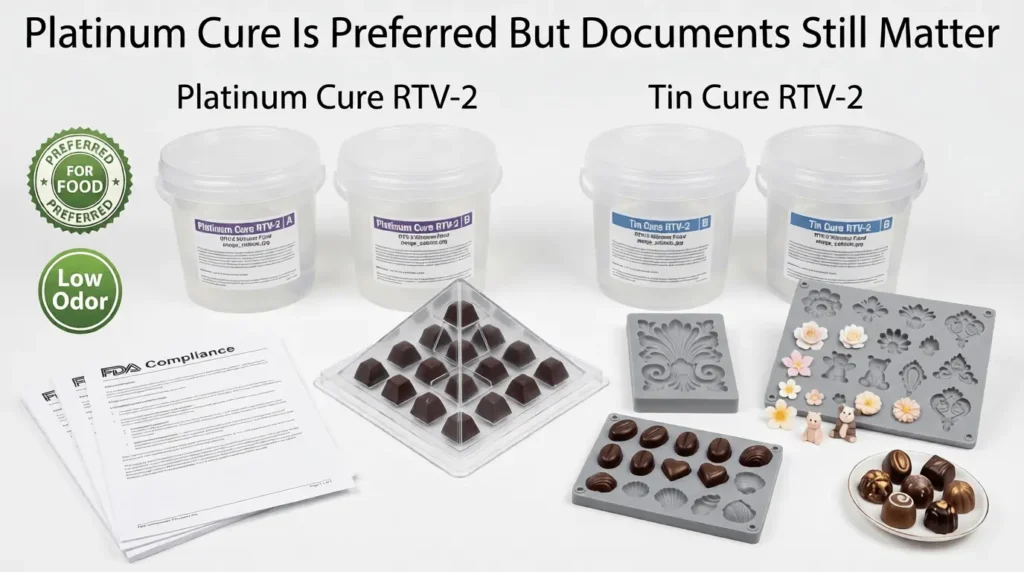
Image 3 — Platinum Cure vs Tin Cure
Image File Name: platinum-cure-vs-tin-cure-food-grade-silicone.jpg Image Alt Text: Platinum cure vs tin cure silicone for food mold making Image Text Overlay: Platinum Cure Is Preferred But Documents Still Matter
Image Caption: For food mold making, platinum cure silicone is usually preferred, but buyers still need food-contact documents and application testing.
How to Choose Shore A Hardness
Dureza Shore A affects flexibility, demolding and mold support.
Soft silicone helps release chocolate, candy, fondant and detailed shapes. But if the silicone is too soft, large molds may deform.
| Dureza Shore A | Better For | Risk If Wrong |
| Shore A 5–10 | Very soft molds, deep details, delicate shapes | May deform easily |
| Shore A 10-20 | Chocolate, fondant, candy, cake decoration molds | Not ideal for large molds |
| Orilla A 20-30 | General food molds and larger food molds | Demolding may be harder for fine undercuts |
| Shore A 30+ | Large molds needing stronger support | May be too stiff for small details |
Practical selection
Choose Shore A 10–20 for small detailed food molds, chocolate molds, fondant molds and cake decoration molds.
Choose Shore A 20–30 for larger food molds that need better shape support.
Choose a softer high-tear grade if the mold has deep undercuts or delicate details.
The best Shore A depends on mold size, food weight, detail depth and demolding difficulty.
How to Choose Viscosity and Pot Life
A silicone can have the right documents but still fail if viscosity and pot life do not match the mold-making process.
Viscosity affects flow, bubble release and detail reproduction.
Pot life affects how much time the operator has for mixing, vacuum degassing and pouring.
| Mold-Making Process | Better Silicone Direction |
| Small detailed mold | Low / medium viscosity |
| Chocolate or fondant mold with fine texture | Good flow + enough working time |
| Large food mold | Medium viscosity + longer pot life |
| Vacuum degassing required | Low / medium viscosity + sufficient pot life |
| Brush-on prototype mold | Thixotropic version, if needed |
| Complex master model | Good-flow first layer |
If the silicone is too thick, it may not flow into small letters, patterns or deep details.
If the pot life is too short, the silicone may thicken before pouring is completed.
For food mold making, choose viscosity and pot life based on the real operation process, not only the TDS number.
Low Odor, Heat Use and Post-Cure: Do Not Ignore Real Use Conditions
Food mold buyers often care about odor, heat resistance and repeated use.
Before bulk purchase, confirm:
- Is the cured silicone low odor after proper curing?
- Will the mold be used for room-temperature food, freezing or baking?
- What temperature and duration are required for the intended application?
- Does the supplier recommend additional curing or post-curing?
- Has the silicone been tested under the real use condition?
- Will the mold contact oily, sugary, cold or hot food?
Do not assume one food grade silicone fits all food mold applications.
For baking molds, the buyer should confirm both heat-use data and food-contact documentation.
For chocolate, fondant and candy molds, demolding, odor and detail reproduction may be more important.
Master Model Compatibility: Test Before Full Mold Making
Platinum cure silicone can be sensitive to cure inhibition.
Food mold buyers often use master models made from:
- 3D printed resin
- resina epoxídica
- clay
- wax
- painted surfaces
- coated prototypes
- plastic models
- metal molds
Some surfaces may inhibit platinum cure silicone and cause sticky or uncured areas.
If platinum cure silicone cures in the mixing cup but remains sticky on the master surface, the problem may be surface inhibition, not silicone quality.
Simple surface test
Before making a full mold, apply a small amount of mixed silicone onto the master model surface.
Check:
- Does it cure normally?
- Is the contact surface still sticky?
- Does it capture details clearly?
- Is release easy?
- Does the master surface need sealing or cleaning?
This small test can prevent expensive mold failure.
Do Not Trust “Food Grade” Without Documents
For professional buyers, compliance documents are part of the purchasing decision.
| Ask Supplier For | Buyer Should Check |
| TDS | Does Shore A, viscosity, pot life and cure time match your mold? |
| SDS | Is handling information complete? |
| Food-contact test report | What regulation or test basis is referenced? |
| FDA-related document | Is it relevant to your target market and intended use? |
| LFGB / EU food-contact document | Is it suitable for your European customer requirement? |
| COA | Is batch quality controlled? |
| Declaration of Compliance | Is it useful for importer or brand files? |
| Sample | Does it work with your real master and process? |
Be careful with wording
Do not casually rely on the phrase “FDA approved silicone.”
In B2B purchasing, more accurate wording is usually:
- FDA compliant silicone
- tested according to relevant food-contact requirements
- food-contact silicone with supporting documents
- compliant for the intended food-contact application when properly tested
If a supplier cannot explain what document supports the “food grade” claim, the buyer should be cautious.
Common Mistakes When Choosing Food Grade Silicone
| Mistake | Why It Causes Problems |
| Choosing only by “food grade” wording | The claim should be supported by documents |
| Assuming all platinum silicone is food grade | Documents and intended use still matter |
| Choosing the softest grade only | Too soft silicone may deform in larger molds |
| Ignoring viscosity | Silicone may not flow into fine details |
| Ignoring pot life | Silicone may thicken before pouring is finished |
| Ignoring master model compatibility | Platinum cure silicone may be inhibited |
| Not asking for compliance documents | Importers and brands may face risk |
| Using one grade for all food molds | Different applications may need different hardness |
A good food mold silicone should be selected by both compliance documents and application performance.
How to Test Food Grade Silicone Before Bulk Order
Do not judge food grade silicone only by touching a cured sample.
Test it under real mold-making and real use conditions.
| Test Item | What to Check |
| Cure test | Does silicone cure normally in your workshop? |
| Surface compatibility test | Does it cure on the master model? |
| Detail test | Can it copy small patterns clearly? |
| Demolding test | Does the mold release chocolate, candy or fondant easily? |
| Odor check | Is the cured mold low odor after proper curing? |
| Heat or cold test | Does the mold match the intended use temperature? |
| Repeated use test | Does the mold tear, deform or become sticky? |
| Document check | Are the documents suitable for your target market? |
For food mold manufacturers, distributors and private label brands, repeated testing is more useful than judging only one small sample.
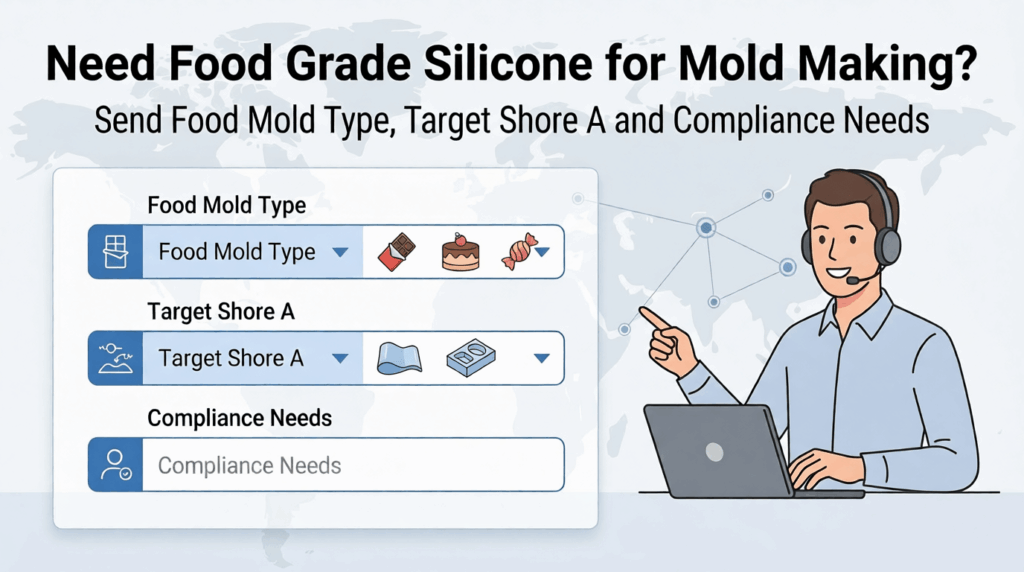
Need Technical Support for Food Mold Silicone Selection?
Choosing food grade silicone for mold making is not only about asking for a “food grade” label. Buyers should confirm the food mold type, target market, required documents, master model material and real mold-making process before selecting a grade.
For example, a soft 10A platinum cure silicone may work well for small chocolate or fondant molds, but it may deform in a larger food mold. A platinum cure silicone may be suitable in principle, but it still needs supporting documents and surface compatibility testing, especially when the master model is 3D printed, painted or coated.
If you are not sure which grade to test, you can send your food mold type, target Shore A, required documents, master model material and current silicone TDS. Topsil can help recommend a suitable platinum cure RTV-2 silicone grade for sample testing.