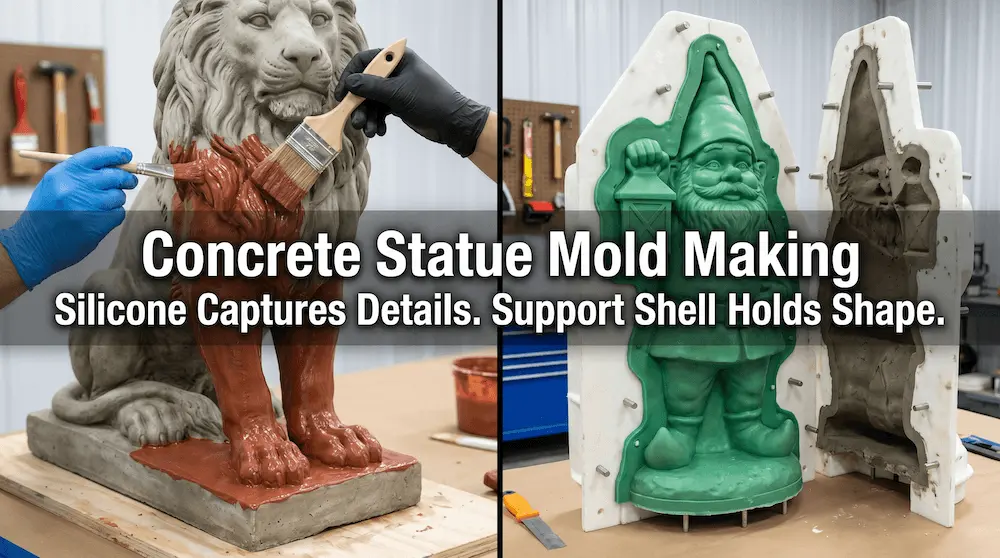

Concrete statue molds are not the same as small resin, candle or soap molds.
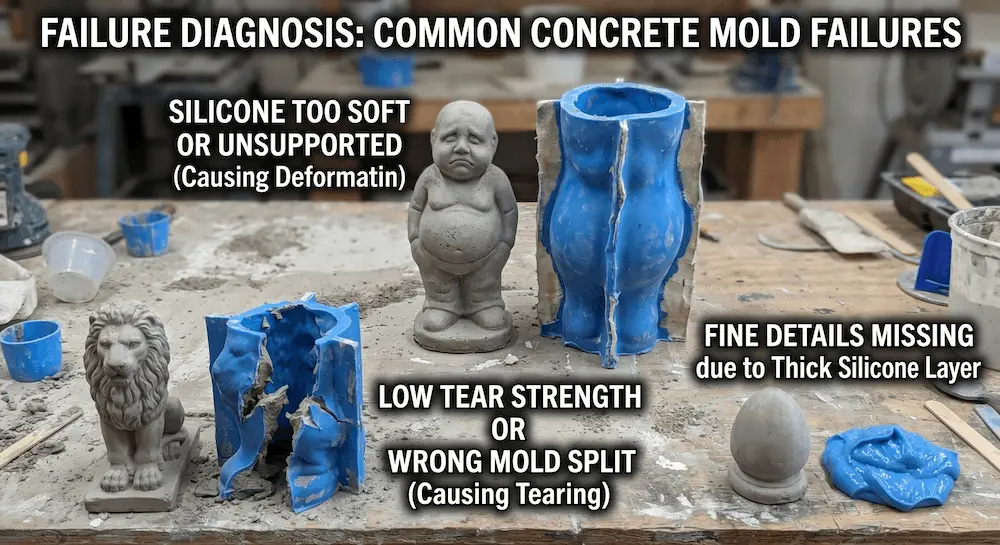
Concrete is heavy, abrasive and less forgiving during demolding. A mold may tear if the silicone cannot release undercuts. It may deform if the silicone is too soft, too thin or unsupported. It may lose details if the first silicone layer does not flow well.
For concrete statues, silicone captures the details, but the support shell holds the shape. The right mold is not only about silicone hardness. It is about mold design, wall thickness, tear strength, concrete weight and expected casting life.
This guide explains how to make a mold for concrete statues and how to choose the right Goma de silicona RTV-2 before testing.
Quick Diagnosis: Why Concrete Statue Molds Fail
Before choosing a silicone grade, first check why the mold failed.
| Mold Problem | Likely Reason | Better Decision |
| Mold tears at undercuts | Low tear strength or wrong mold split | Use high-tear silicone and cut / two-part / multi-part mold |
| Statue deforms after casting | Silicone too soft, too thin or unsupported | Improve Shore A, wall thickness and support shell |
| Fine details are missing | Silicone too thick or no detail layer | Use better-flow silicone for the first layer |
| Silicone slides down during brushing | Wrong viscosity | Use thixotropic brush-on silicone |
| Mold bulges when concrete is poured | Weak mold wall or weak mother mold | Strengthen mold thickness and support shell |
| Seam line is poor | Bad parting line or poor shell alignment | Add better registration keys |
| Mold life is short | Concrete abrasion, poor release or weak silicone | Use durable high-tear silicone and better demolding method |
The solution is not always “harder silicone” or “softer silicone”. Sometimes the real issue is mold split, wall thickness, support shell or demolding direction.
Choose the Right Mold Method by Statue Size and Shape
There is no single mold-making method for all concrete statues. The mold method should depend on statue size, shape complexity, undercuts and concrete weight.
| Statue Type | Main Risk | Better Mold Method | Dirección Silicona |
| Small simple ornament | Easy demolding, low weight | One-piece pour mold | Shore A 20–25 |
| Small detailed statue | Fine details and small undercuts | Cut mold or two-part mold | Shore A 20–30, good tear strength |
| Medium garden statue | Weight and release difficulty | Two-part mold or brush-on mold | Orilla A 25-30 |
| Large outdoor statue | Deformation and high silicone consumption | Brush-on silicone + support shell | Shore A 25–35, thixotropic |
| Human / animal figure | Locking and tearing | Multi-part mold | Flexible high-tear silicone |
| Thin or fragile details | Breakage and tearing | Controlled parting line | High-tear silicone + careful mold design |
| Molde de producción repetido | Mold wear and short life | Reinforced mold system | Durable silicone + strong mother mold |
For small simple statues, a poured silicone mold may be enough.
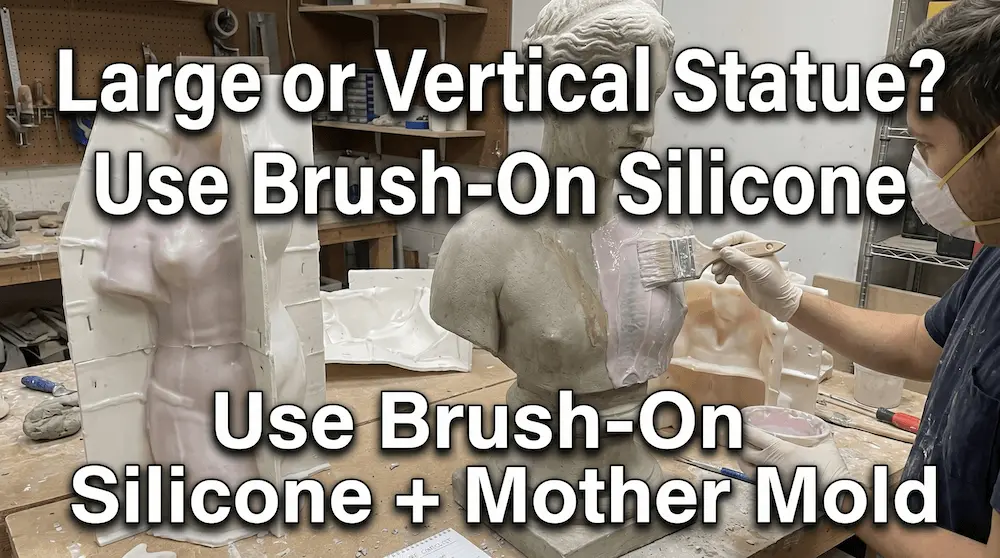
For large, vertical or complex concrete statues, brush-on silicone with a rigid support shell is usually more practical.
When Brush-On Silicone Is Better Than Pouring
Brush-on silicone is often better when the statue is large, vertical, detailed or expensive to cover with a full pour mold.
Choose brush-on silicone when:
- the statue is large
- the surface is vertical
- the shape is complex
- pouring would use too much silicone
- different areas need controlled thickness
- a rigid mother mold will be used
- the mold needs controlled parting lines
For brush-on molds, normal pourable low-viscosity silicone is usually not suitable. It may slide down and create weak thin areas.
A brush-on concrete statue mold usually needs thixotropic / non-sag RTV-2 silicone with enough working time for layering.
Shore A Is Not Enough: Hardness + Wall Thickness + Support Shell
Shore A hardness is important, but it cannot solve every concrete mold problem alone.
A 25A silicone with proper wall thickness and a strong support shell may perform better than a 35A silicone with poor mold design.
| Condition | What May Happen | Better Decision |
| Silicone too soft | Mold may deform under concrete weight | Increase Shore A or improve support shell |
| Silicone too hard | Difficult demolding, tearing around undercuts | Use softer high-tear silicone or better mold split |
| Silicone wall too thin | Easy tearing and poor mold life | Build enough wall thickness |
| No support shell | Mold may bulge or lose shape | Add rigid mother mold |
| Deep undercuts | High demolding stress | Use high-tear silicone and proper parting line |
| Large flat area | Surface may warp | Strengthen shell and mold backing |
Practical Shore A selection
| Dureza Shore A | Better For |
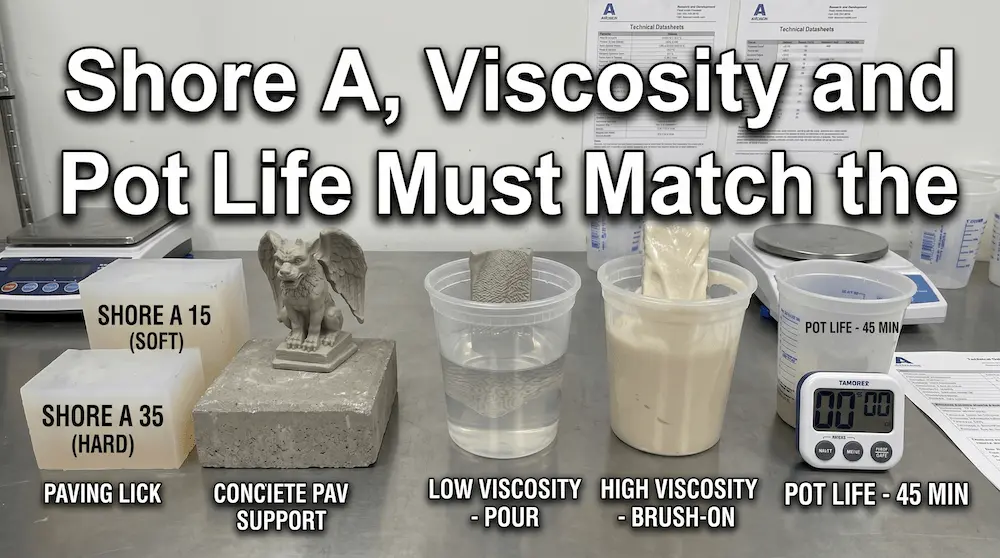
| Shore A 15–20 | Small detailed statues, deep undercuts |
| Shore A 20–25 | Small ornaments and detailed molds |
| Orilla A 25-30 | General concrete statue molds |
| Shore A 30–35 | Larger molds needing more support |
| Shore A 35-40 | Large simple molds with easy release direction |
For many concrete statue molds, Shore A 20–30 is a practical range. For large or heavy castings, support shell design is just as important as hardness.
How to Choose Viscosity for Concrete Statue Molds
Viscosity should match the mold-making method.
| Mold Area / Method | Better Viscosity Direction | Why |
| First detail layer | Good flow | Captures texture and fine details |
| Pour mold | Medium viscosity | Balanced flow and control |
| Large pour mold | Medium viscosity + longer pot life | Easier handling |
| Brush-on vertical surface | Thixotropic / non-sag silicone | Prevents sliding |
| Multi-layer brush mold | Brushable silicone | Builds thickness |
| Vacuum degassing | Low/medium viscosity | Easier bubble release |
For detailed statues, the first silicone layer is critical. It should wet the surface and capture fine texture clearly.
For vertical brush-on work, viscosity alone is not enough. You need thixotropic behavior so the silicone stays on the statue surface.
How to Choose Pot Life for Concrete Statue Molds
Concrete statue molds often need more working time than small craft molds.
| Mold Process | Suggested Pot Life |
| Small simple pour mold | 20–30 min |
| Detailed statue mold | 30–45 min |
| Large pour mold | 30–60 min |
| Brush-on statue mold | 30–60 min |
| Multi-layer brush mold | 30–60 min |
| Hot workshop | Longer pot life or slower catalyst |
A very fast silicone may reduce demold time, but it can also cause poor detail coverage, brush marks, bubbles or uneven thickness.
For concrete statue molds, enough working time is usually safer than very fast curing.
Step-by-Step: How to Make a Concrete Statue Mold
This is a simplified process. The exact method should be adjusted according to statue size, shape and production requirements.
Step 1: Evaluate the statue
Check the statue size, surface details, undercuts, concrete weight and demolding direction.
Step 2: Choose the mold method
Use a pour mold for small simple shapes. Use a cut mold, two-part mold or multi-part mold for undercuts and complex shapes. Use brush-on silicone for large or vertical statues.
Step 3: Select the silicone grade
Choose Shore A hardness, tear strength, viscosity and pot life according to the mold method and expected casting life.
Step 4: Prepare the master model
Clean the surface. Seal porous materials such as plaster, gypsum, clay, foam, wood or existing concrete. Test painted or coated surfaces before full mold making.
Step 5: Apply release agent
Apply a thin and even release layer when needed. Too much release agent may affect surface detail.
Step 6: Apply or pour silicone
For pour molds, pour slowly from one side and let silicone flow naturally.
For brush-on molds, apply a thin first detail layer, then build additional layers for strength.
Step 7: Build the support shell and cast concrete
Build a rigid support shell for medium and large molds. After demolding the master, assemble the mold and shell, pour concrete carefully, and demold after the concrete cures properly.
How to Test Silicone Before Bulk Use
A small cup test is not enough for concrete statue molds. The real test is concrete casting and demolding.
| Test Item | What to Check |
| Detail layer test | Can the silicone capture texture clearly? |
| Brush-on test | Does it stay on vertical surfaces? |
| Tear test | Can it release undercuts without tearing? |
| Pot life test | Is there enough time for brushing or pouring? |
| Support shell test | Does the shell hold shape correctly? |
| Concrete casting test | Does the mold deform under concrete weight? |
| Demolding test | Can the statue be released safely? |
| Repeated casting test | How many castings can one mold support? |
For production molds, repeated casting is more useful than judging only the cured silicone sample.
How Topsil Recommends Silicone for Concrete Statue Molds
Topsil Silicone is a China RTV-2 silicone rubber manufacturer with 15+ years of production and application experience.
When a customer sends us a concrete statue photo, we first judge three things:
- Can the statue be released from one direction?
- Will the concrete weight require stronger mold support?
- Should the silicone be poured or brushed?
If the statue is small and simple, a pourable tin cure silicone may be enough.
If the statue is large, vertical or complex, we usually consider brush-on thixotropic silicone with a rigid support shell.
When a customer only asks for “20A” or “30A”, we still need to confirm the mold method and support shell. Without proper mold design, even the right Shore A may fail.
Based on the real statue design, Topsil can recommend or adjust:
- Dureza Shore A
- tear strength direction
- viscosidad
- vida útil
- tiempo de curado
- catalyst speed
- pourable or brush-on version
The goal is to help the customer build a concrete statue mold that can copy details, hold shape and support repeated casting.
What to Send Us for Concrete Statue Mold Silicone Recommendation
| Information | Why We Need It |
| Statue size | Determines mold method and silicone hardness |
| Statue photos or drawings | Helps check details, undercuts and demolding direction |
| Concrete casting weight | Helps judge support requirement |
| Mold method | Pour mold, brush-on mold, cut mold or two-part mold |
| Current silicone TDS | Helps compare hardness, viscosity and pot life |
| Current problem | Tearing, deformation, missing details or short mold life |
| Target Shore A | Helps balance flexibility and support |
| Viscosity requirement | Pourable or brushable silicone selection |
| Pot life requirement | Must match brushing or pouring time |
| Support shell design | Critical for medium and large statues |
| Expected casting times | Helps select tear strength and grade |
| Annual consumption | Helps recommend sample and bulk supply solution |
These details help us recommend a suitable concrete statue mold silicone instead of sending a random sample.
PREGUNTAS FRECUENTES
Need Help Choosing Silicone for Concrete Statue Molds?
Topsil can help recommend a suitable RTV-2 silicone rubber for concrete statue molds and adjust hardness, viscosity, pot life or catalyst speed according to your real application.