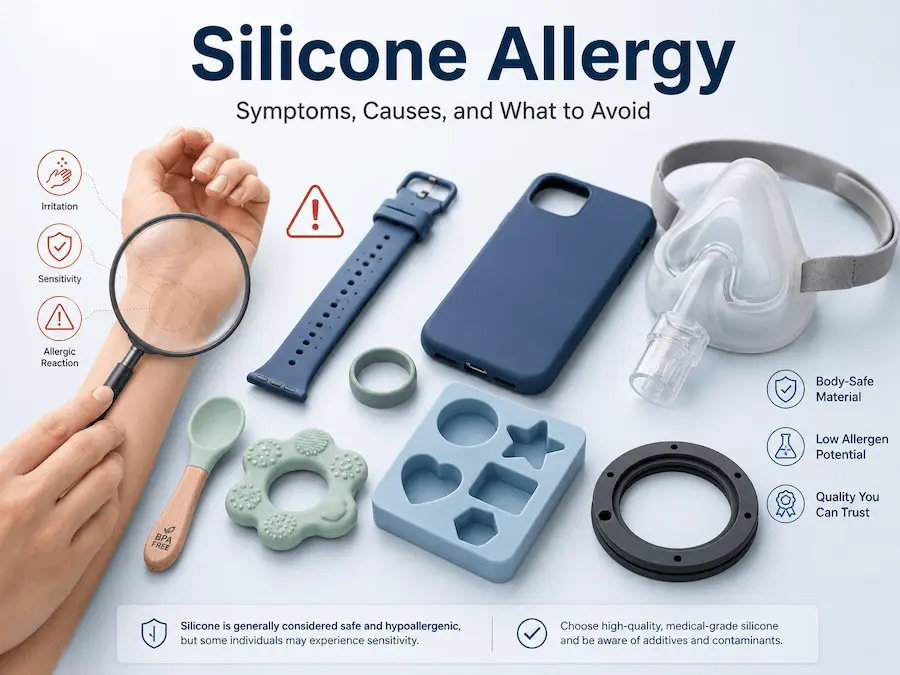

Silicone is used in many everyday and industrial products, including watch bands, rings, phone cases, kitchenware, baby products, medical devices, seals, gaskets, silicone molds, and silicone rubber parts.
Because silicone is so common, some people become concerned when they notice redness, itching, swelling, or a rash after contact with a silicone product.
Quick Answer: Can You Be Allergic to Silicone?
Yes, some people may experience allergy-like skin reactions after contact with silicone products. However, a rash near a silicone product does not automatically mean the person is allergic to silicone itself.
Many silicone-related skin reactions may actually involve contact dermatitis. Contact dermatitis is an itchy rash caused by direct contact with a substance or an allergic reaction to it, and it is not contagious.
Possible triggers include:
- tight contact or friction
- sweat and trapped moisture
- soap or detergent residue
- adhesives or tapes
- dyes, pigments, or fillers
- latex or rubber chemicals
- metal parts
- incomplete curing
- low-quality material formulation
If the rash is severe, spreading, blistering, painful, or persistent, the user should stop using the product and consult a qualified healthcare professional or dermatologist.
Silicone Allergy Symptoms
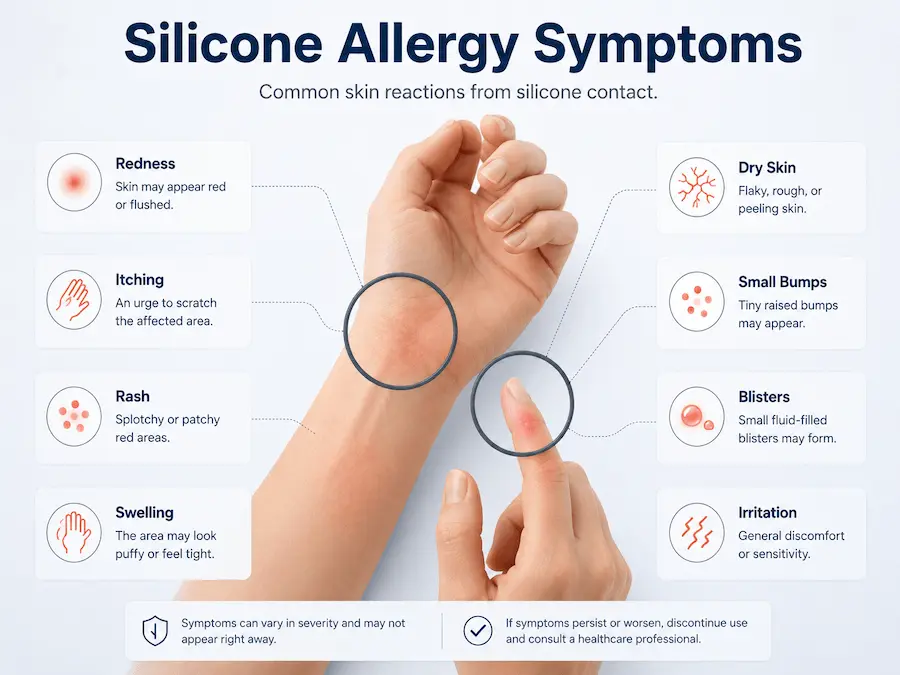
Possible silicone allergy symptoms or silicone-related skin reactions may include:
- redness
- itching
- rash
- swelling
- burning or stinging feeling
- dry or cracked skin
- small bumps
- peeling
- blisters
- skin tenderness
- irritation around the contact area
These symptoms may appear where the silicone product touches the skin. For example, a silicone watch band reaction may appear around the wrist, while a silicone ring reaction may appear around the finger.
However, these symptoms are not unique to silicone allergy. The NHS notes that contact dermatitis can make skin itchy, blistered, dry, and cracked, and the reaction may occur within hours or days after exposure to an irritant or allergen.
That is why symptoms alone cannot confirm the exact cause.
What Does a Silicone Allergy Rash Look Like?
A silicone allergy rash may look like red, itchy, swollen, dry, cracked, or blistered skin near the contact area.
Depending on skin tone, redness may appear differently. The affected area may feel hot, tight, sore, irritated, or uncomfortable. In some cases, the rash may look like small bumps or dry patches. In more severe cases, blistering or oozing may occur.
Common examples include:
- Silicone watch band allergy
- Silicone ring allergy
- Silicone bracelet allergy
- Silicone earbuds allergy
- Silicone nose pad allergy
- Silicone CPAP mask allergy
- Silicone skin allergy
- Silicone allergy on the face
But appearance alone cannot prove the rash is caused by silicone. Similar rashes may be caused by friction, sweat, soaps, cleaning residues, adhesives, dyes, latex, rubber additives, or other materials in the product.
Silicone Allergy vs. Contact Dermatitis
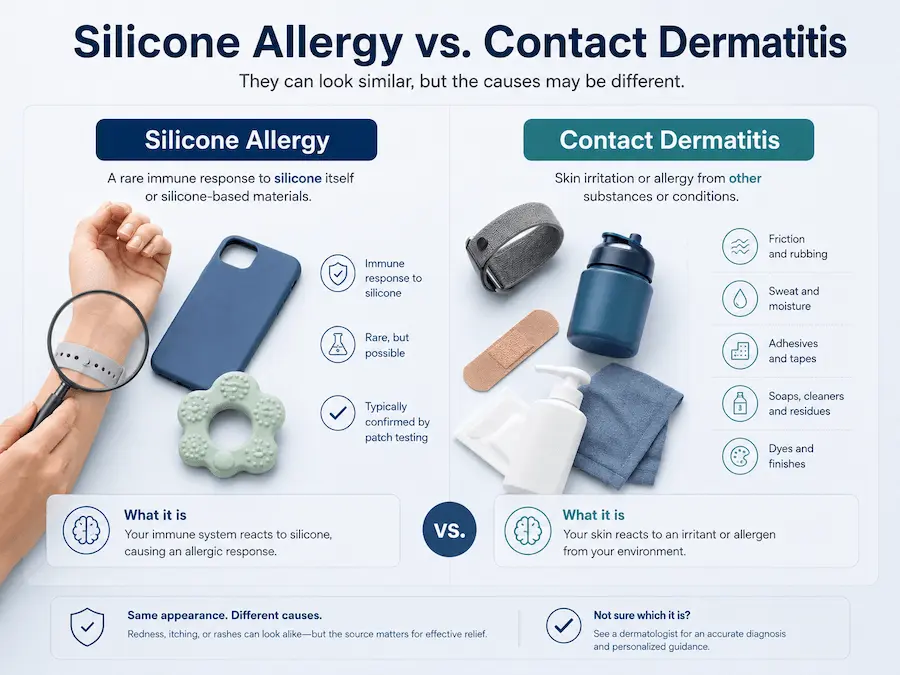
Many people use the phrase “silicone allergy” to describe any reaction that happens after contact with a silicone product. In reality, several different skin reactions may look similar.
| Term | What It Means |
| Silicone allergy | A possible immune reaction to silicone or materials associated with silicone |
| Allergic contact dermatitis | A delayed skin reaction caused by contact with a specific allergen |
| Irritant contact dermatitis | Skin irritation caused by friction, sweat, moisture, chemicals, or repeated exposure |
| Friction rash | Irritation caused by rubbing, pressure, or tight contact |
| Material sensitivity | A reaction to additives, coatings, dyes, adhesives, metals, or other components |
This difference matters because the solution depends on the real cause.
If the issue is friction, the fit may need to change.
If the issue is moisture, the product may need to be worn less tightly.
If the issue is adhesive-related, changing the adhesive may help.
If the issue is a true allergy, the specific allergen needs to be identified and avoided.
Common Causes of Silicone-Related Skin Reactions
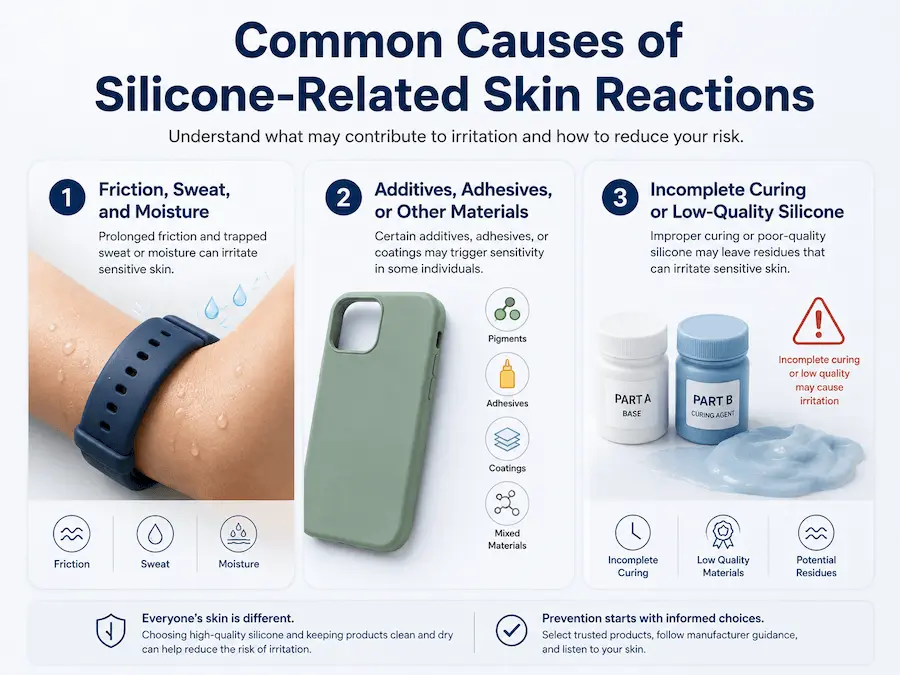
A skin reaction near a silicone product does not always mean the user is allergic to silicone itself. In many cases, the cause may be friction, moisture, additives, adhesives, or poor curing quality.
1. Friction, Sweat, and Moisture
Silicone products such as watch bands, rings, masks, and wearable devices often stay close to the skin for long periods. If the product is too tight, it can trap sweat and moisture, causing redness, itching, soreness, or rash.
Soap, lotion, sunscreen, or cleaning residue left on the surface can also make irritation worse.
2. Additives, Adhesives, or Other Materials
Some reactions may come from materials used with silicone rather than the silicone itself. These may include color pigments, fillers, coatings, adhesives, tapes, metal parts, latex, or rubber chemicals.
This is why someone may react to one silicone product but not another.
3. Incomplete Curing or Low-Quality Silicone
If silicone rubber is not fully cured, it may feel sticky, oily, tacky, or have an unusual odor. Poor curing may result from an incorrect mixing ratio, contamination, cure inhibition, or a low-quality formulation.
For skin-contact, food-contact, or sensitive applications, buyers should check the silicone grade, cure system, curing conditions, and documentation instead of choosing based solely on color, softness, or price.
Is Silicone Allergy Common?
Silicone allergy is generally considered uncommon, but it is still possible. Published medical case reports describe silicone-related allergic reactions in specific medical device contexts, which show that silicone hypersensitivity can occur, even if it is not common.
For most users, a rash near a silicone product is more likely to involve one or more practical factors, such as:
- tight contact
- sweat buildup
- friction
- adhesive materials
- cleaning residues
- dyes or pigments
- latex or rubber chemicals
- another component in the product
A proper evaluation may be needed to identify the real trigger.
Is Silicone Safe for Latex Allergies?
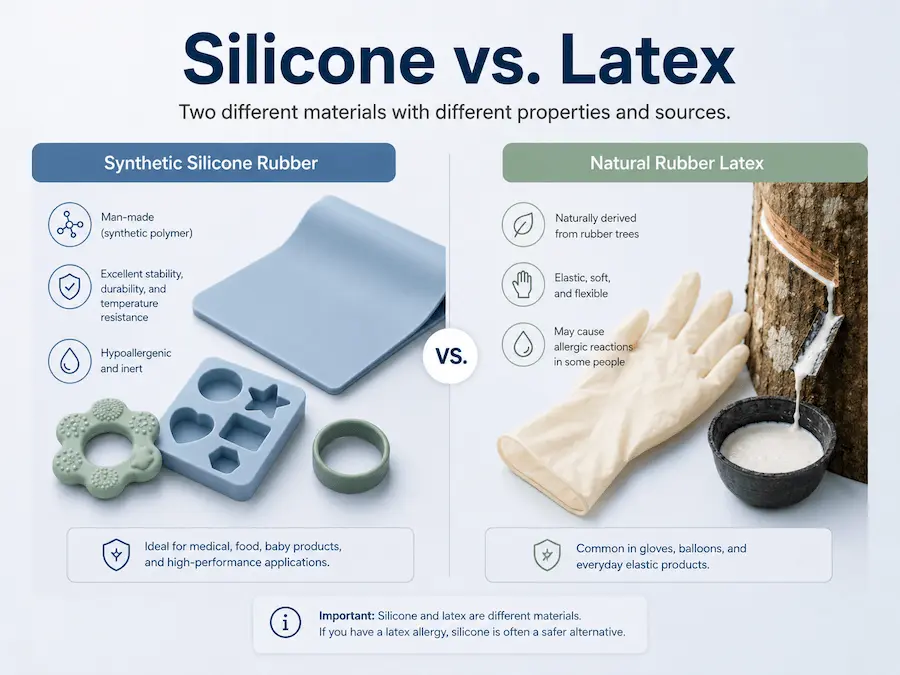
Silicone and latex are not the same material.
Silicone rubber is synthetic. Natural rubber latex comes from rubber tree sap and contains latex proteins that can trigger latex allergy in sensitive individuals.
Because of this, silicone is often used in products where latex avoidance is important. However, users should still check whether the whole product is latex-free.
A product may contain silicone plus other materials, including adhesives, coatings, pigments, plastics, metals, or rubber parts. For sensitive users, the complete material composition matters.
Can Silicone Watch Bands Cause a Rash?
Yes, silicone watch bands can be associated with skin irritation or rash.
But the most common reasons may include:
- tight fit
- trapped sweat
- friction
- long-term wear
- soap residue
- bacteria buildup
- pigments or dyes
- metal contact points
- cleaning chemical residue
If the rash improves after removing the band, that suggests the product or wearing condition may be involved. But it still does not prove a true silicone allergy.
A practical first step is to stop wearing the product temporarily, clean the skin gently, clean and rinse the product properly, and avoid tight long-term wear. If the rash returns or becomes severe, medical advice is recommended.
How to Test for Silicone Allergy
Do not self-diagnose a silicone allergy based only on a rash.
If allergic contact dermatitis is suspected, a dermatologist may recommend patch testing. Patch testing is commonly used to help identify substances that may cause allergic contact dermatitis. Mayo Clinic also lists patch testing as one method doctors may use when trying to identify a cause of contact dermatitis.
In some cases, evaluation may need to consider not only silicone, but also:
- latex
- adhesives
- lubricants
- cleaning agents
- plastics
- metals
- dyes
- rubber chemicals
- other materials in the product
A healthcare professional can help decide what should be tested based on the exposure history and symptoms.
What to Do If You Suspect a Silicone Allergy
If you develop a rash or irritation after using a silicone product:
- Stop using the product temporarily.
- Wash the affected area gently.
- Avoid scratching the skin.
- Check whether the product was tight, sweaty, or worn for a long time.
- Check whether soaps, lotions, detergents, or cleaning residues were involved.
- Avoid reusing the product until the reaction improves.
- Seek medical advice if symptoms persist, spread, blister, or become severe.
This article is for general information only and is not medical advice.
What to Avoid If You Have Silicone-Related Skin Reactions
If silicone-related skin reactions are suspected, consider avoiding:
- tight silicone products worn for long periods
- wearing silicone over sweaty or wet skin
- low-quality products with unknown additives
- products with a strong odor or a sticky surface
- uncured or poorly cured silicone
- harsh adhesives
- silicone products that trap moisture
- Repeated exposure before the cause is identified
- products with unclear material composition
For industrial or commercial buyers, avoid using general-purpose silicone rubber for food-contact, skin-contact, or sensitive applications unless the grade and documentation support that use.