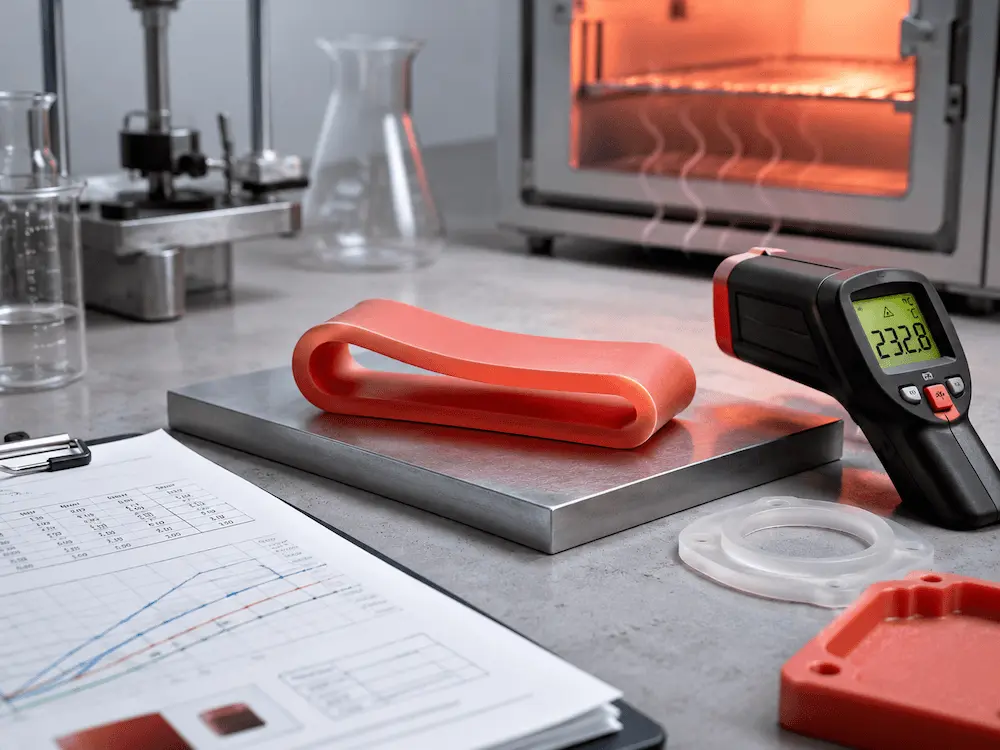

A massive number of people search Google every day for the “silicone melting point” or ask a deceptively simple question: Does silicone melt?
The short, shop-floor answer is no. Cured silicone rubber does not melt like ordinary plastic. Instead of liquefying into a puddle when exposed to extreme heat, it undergoes thermal degradation—meaning it will gradually harden, crack, discolor, and eventually turn into a brittle white ash.
The reason behind this traces back to silicone’s unique chemical architecture. To help process engineers and purchasing managers avoid costly material selection mistakes, let’s break down the real science of silicone heat resistance using plain English.
The Core Difference: Why Silicone Refuses to Melt Like Plastic
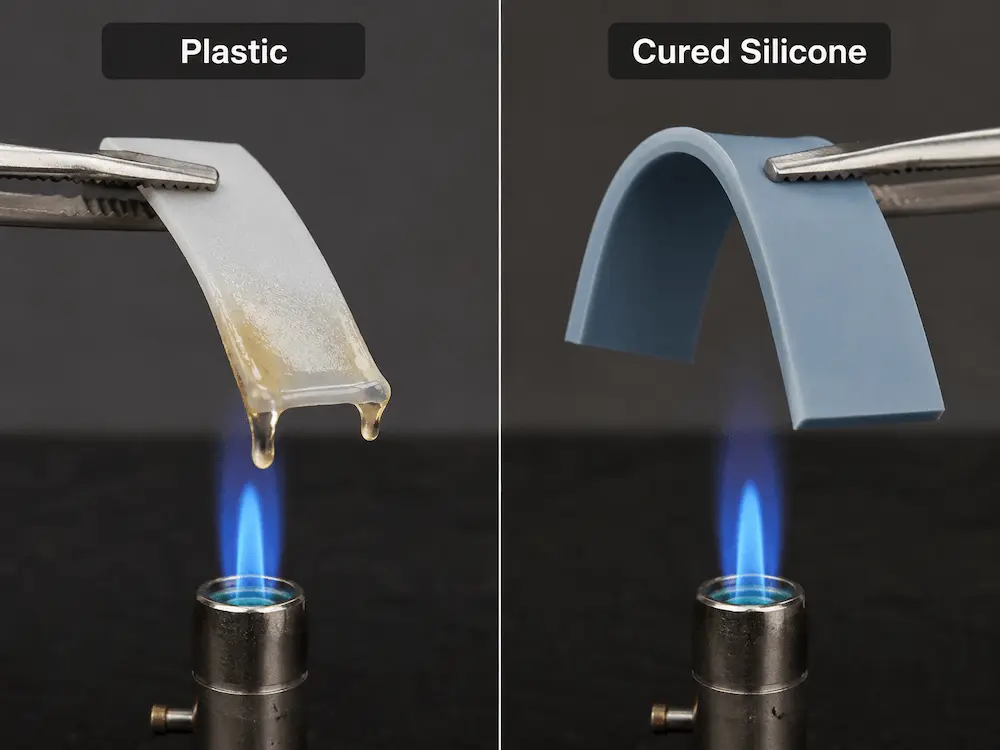
To understand why cured silicone cannot turn back into a liquid, it helps to look at a simple everyday analogy.
- Standard Plastics (Thermoplastics like ABS, Polyethylene, or Nylon): Think of these like chocolate or candle wax. Their molecular chains are like loose strands of warm spaghetti. When you apply heat, the strands slide past each other easily, turning the plastic into a flowable liquid. When the temperature drops, they freeze solid again. This process can be repeated over and over.
- Silicone Rubber (Thermoset Elastomers like RTV-2): Think of silicone like a raw egg. When you pour A and B components together and let them cure, you are chemically “cooking” the material. The molecules cross-link into a permanent, interconnected 3D net. Once that egg is hard-boiled, no amount of heat will ever turn it back into a runny liquid yolk. It will simply burn.
Furthermore, while common plastics rely on a weak Carbon-Carbon (C-C) molecular backbone, silicone is engineered with a Silicon-Oxygen (Si-O) backbone—the same chemical bond found in rugged natural materials like quartz glass and flint. This built-in genetic advantage is why silicone can withstand brutal thermal environments where ordinary plastics instantly fail.
Why “Silicone Melting Point” Is a Misnomer
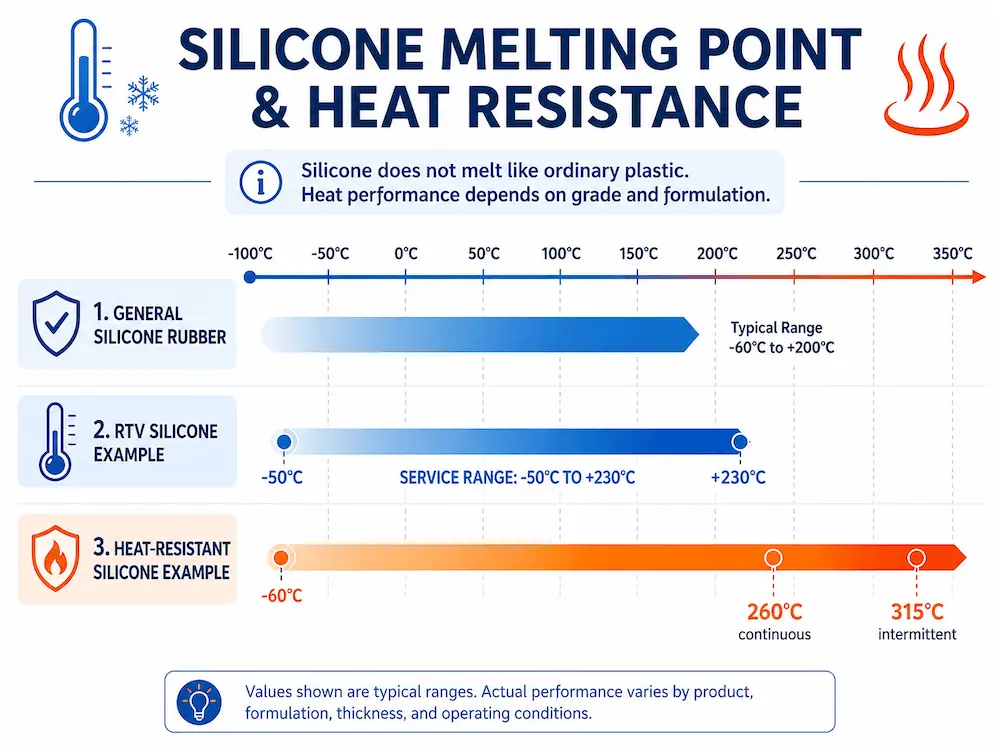
In the B2B manufacturing world, demanding a specific “melting point number” from a silicone supplier is a major red flag. Silicone doesn’t have a sharp melting point like a block of aluminum or ice.
Instead of looking for a melting point on a Technical Datasheet (TDS), engineers must look at two distinct metrics: Continuous Service Temperature and Intermittent Max Temperature.
Let’s look at a real-world industrial benchmark: DOWSIL™ 736 Heat Resistant Sealant. You won’t find a melting point anywhere in its official documentation. Instead, Dow defines its limits based on practical exposure:
| Temperature Specification | What It Actually Means on the Production Line |
| 260°C (500°F) Continuous Exposure | The material can safely run at this temperature for thousands of hours without losing its rubbery seal or insulation properties. |
| 315°C (600°F) Intermittent Exposure | The maximum spike temperature the silicone can handle for short bursts or emergency cycles before the polymer matrix begins to degrade. |
Different applications—whether it’s a baking mold, a high-voltage [electronics potting silicone], or a heavy-duty gasket—rely on specific formulations packed with custom heat-stabilizing fillers. There is no one-size-fits-all number.
What Happens When Silicone Gets Too Hot? (The Failure Stages)
Even though silicone won’t turn into a liquid puddle, pushing it past its thermal limits will completely tank its performance. If your components or molds are overheating on the floor, they will pass through these distinct degradation stages:
| Degradation Level | Visual & Physical Symptoms | The Resulting Line Failure |
| Phase 1: Mild Overheating | The silicone loses its elastic recovery and begins to feel noticeably stiffer and harder. | Molds lose their flex, making it incredibly difficult to demold parts without damaging them. |
| Phase 2: Moderate Overheating | The surface discolors (turning a distinct dark yellow, brown, or amber) and develops micro-cracks. | The tear strength of the mold plummets, causing it to split open during routine handling. |
| Phase 3: Severe Overheating | Deep structural cracking occurs; the material becomes completely brittle and loses all tensile strength. | Electronics potting compounds lose their dielectric insulation, causing electrical shorts and moisture ingress. |
| Phase 4: Thermal Breakdown | Pushed past 350°C, the polymer skeleton collapses entirely, releasing white silica smoke. | The silicone crumbles into a completely useless, non-conductive, chalky white ash (silicon dioxide). |
Does RTV Silicone Melt After Curing?
RTV stands for Room Temperature Vulcanizing. Whether you are using a one-part RTV-1 adhesive or a two-part (RTV-2), once the curing reaction is finished, the material has bought a one-way ticket. It will never revert back to its liquid form under heat.
⚠️ An Old Shop-Floor Warning for Process Techs: If you are running an electronics heat-cycle test and you notice that your cured silicone potting compound has suddenly turned into a sticky, wet, liquefied mess, it didn’t melt. You are looking at a classic case of Cure Inhibition (Catalyst Poisoning). Certain contaminants (like sulfur, tin, or uncured epoxy) can permanently stall a platinum-cure system, leaving the core of the gel wet and uncured.
Does Food-Grade Silicone Melt in the Oven?
This is the number one question asked by procurement managers sourcing baking molds, kitchenware, or food-contact seals.
The absolute answer is no—not under standard baking conditions. Commercial and residential ovens rarely exceed 230°C to 250°C. High-purity, platinum-cured food-grade silicone safely retains its mechanical elasticity and chemical stability up to 260°C of continuous heat. It will not leach chemicals or deform into your food.
However, why do some food molds still char and ruin? This happens when users place the silicone mold in direct contact with an open broiler flame or a red-hot electric heating element. The surface temperature of an open heating element can easily blast past 500°C. This instantly snaps the Si-O molecular bonds, causing the mold to discolor, turn chalky, and split apart.
The Heat-Related Selection Checklist for Techs & Buyers
If your next engineering project involves continuous heat exposure, don’t ask your supplier for a generic melting point. Instead, hand your manufacturing partner these four specific parameters to ensure you get the right grade:
Regulatory and Environmental Compliance: If the hot silicone will face food contact, skin contact, or aerospace vacuums, ensure the formulation is explicitly certified for FDA, LFGB, or low-outgassing standards.
The True Thermal Profile: Define your exact operating windows. Does your component need to survive 180°C continuously for months, or does it just need to survive a 230°C wave soldering line for 30 seconds?
Mechanical Retention at Temperature: Silicone softens slightly as it gets hot. Ask for the material’s durometer (Shore A hardness) and tear strength retention at your target operating temperature, not just at room temperature.
Thermal Conductivity Requirements: Standard silicone is a natural heat insulator. If you are potting heat-generating components like MOSFETs or power transformers, you must specify a thermally conductive grade filled with specialized ceramic powders to pull heat away from the board.