
“How many impressions should one silicone pad last?”
A commonly cited industry reference is roughly 50,000–100,000 impressions, but that figure is not a universal specification.
A pad printing a smooth plastic part under moderate compression does not experience the same load as a pad repeatedly contacting sharp edges, deep contours or aggressive ink systems.
The more useful question is:
How many acceptable impressions can this pad produce under my actual production conditions?
That is what should define pad life.
Respuesta rápida
For production purposes:
Usable Pad Life = The number of acceptable impressions produced before the pad can no longer meet the required print-quality standard consistently.
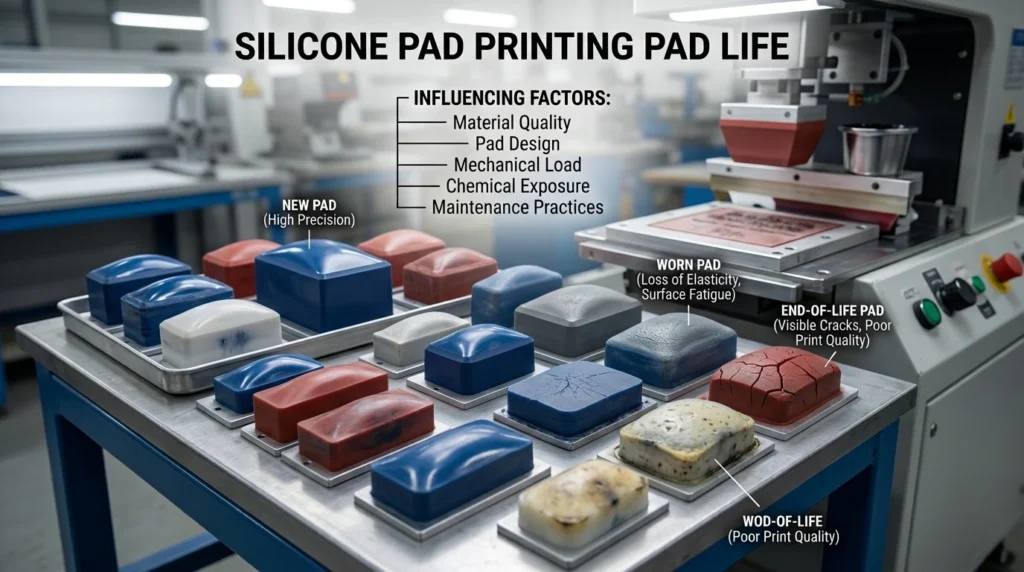
Pad life is mainly controlled by four interacting systems:
BASE — silicone formulation and finished hardness LOAD — pad design, machine compression and part geometry CHEMISTRY — ink, thinner and hardener exposure CARE — cleaning, handling and storage
The eight factors below explain how those systems affect actual pad life.
What Does “Pad Life” Really Mean?
Calendar days are a poor way to compare printing pads.
A pad used for 500 cycles per day and one used for 20,000 cycles per day may both be called “one-month-old,” but their mechanical histories are completely different.
Physical failure alone is also not enough.
A pad may still look intact while already showing:
- Reduced ink pickup or release
- Loss of fine detail
- Increased print instability
- Surface deterioration
- A need for increasing machine adjustment
So the better metric is:
Acceptable Impressions
If a pad physically survives 80,000 cycles but begins producing unacceptable prints at 45,000, its usable life for that application is approximately 45,000 acceptable impressions.
This distinction becomes especially important when comparing different silicone formulations or suppliers.
The Four Systems That Control Pad Life
Pad life is not determined by one TDS number.
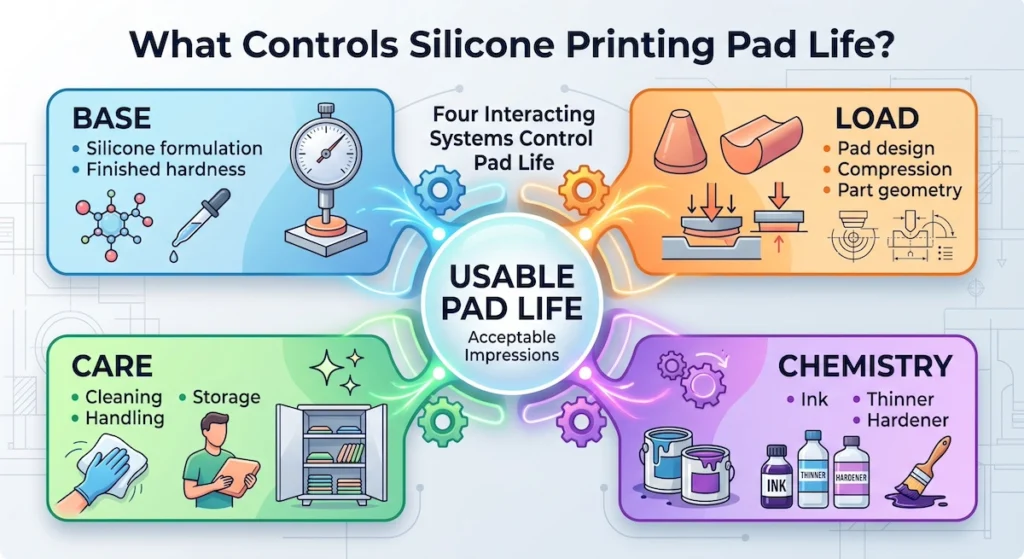
It is the result of four interacting systems:
BASE
What the pad starts with.
LOAD
What mechanical stress it experiences during each cycle.
CHEMISTRY
What materials repeatedly contact the pad.
CARE
How the pad is cleaned, handled and stored.
Within those four systems, eight factors deserve the most attention.
Silicone Formulation Sets the Starting Durability
Two pads can have the same shape and nominal Shore hardness but still behave differently over long production runs.
That is because hardness describes only one part of the material.
Other relevant properties can include:
- Tear resistance
- Tensile behavior
- Elongation
- Cure consistency
- Resistance to repeated deformation
- Chemical compatibility
A strong TDS is useful, but it should not be converted directly into an impression-life claim.
A higher tear-strength value does not automatically mean a specific number of additional printing cycles.
Pad life still has to be validated under the actual geometry, ink, substrate and machine conditions.
View PP-30 & AP-30 Pad Printing Silicone
Finished Hardness and Oil Adjustment Change How the Pad Deforms
Finished hardness affects how a pad responds to repeated compression.
A softer pad may conform more easily to complex geometry, while a firmer pad may deform less under the same load.
Neither automatically means longer life.
The correct hardness depends on:
- Pad geometry
- Printed part
- Machine force
- Required image quality
Silicone oil is often used to adjust finished hardness, but oil dosage alone cannot predict service life.
Hardness data tells you how soft the pad became. It does not tell you how many acceptable impressions it will produce.
If the oil level changes substantially, treat the adjusted material as a changed formulation and validate the finished pad in production.
Silicone Oil Dosage for Pad Printing Silicone
For Shore-scale selection:
Pad Printing Pad Hardness: Shore A vs Shore 00
Pad Design Determines How Mechanical Load Is Distributed
It determines how load is distributed across the silicone during every cycle.
A pad that is too small, too flat or poorly matched to the image may concentrate deformation into a limited area.
That can create:
- Repeated flexing
- Local stress concentration
- Uneven contact
- Greater dependence on machine pressure
A larger or better-shaped pad may cost more to manufacture, but it can sometimes achieve the same print with less deformation.
The lowest-cost pad design is not always the lowest-cost production solution.
For broader pad and silicone selection:
Complete Pad Printing Silicone Selection Guide
Machine Compression Is a Lifetime Variable
This factor is different from pad design.
Even a correctly shaped pad can wear prematurely if the machine compresses it more than necessary.
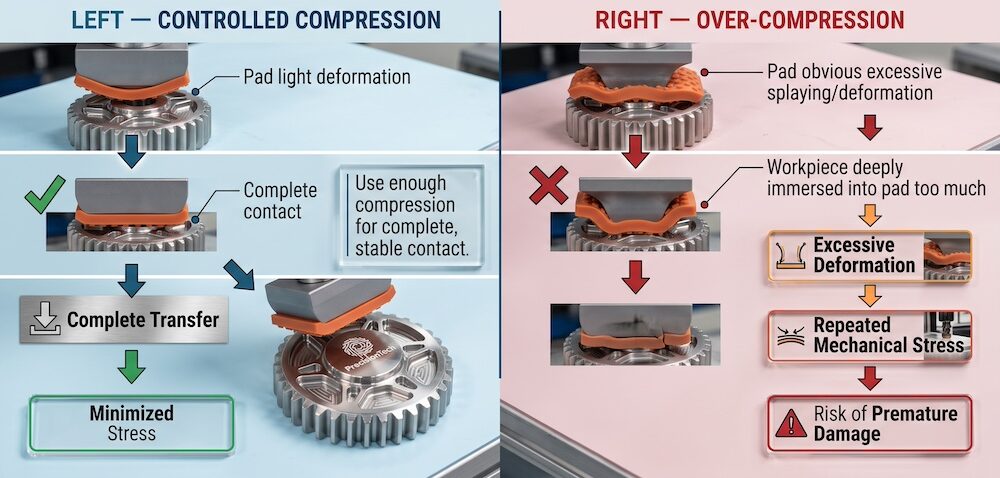
Over-compression can occur when:
- A taller part is introduced
- Pad height changes
- Transfer stroke is not readjusted
- Operators increase pressure to compensate for another printing problem
A useful production rule is:
Use the minimum compression that still produces complete and stable transfer.
Once complete contact is achieved, additional pressure does not automatically improve printing.
It may simply increase deformation and repeated mechanical stress.
If pad life suddenly drops after a machine or part setup change, review compression before changing the silicone grade.
The Printed Part May Be Physically Attacking the Pad
The third LOAD factor is the component itself.
This is different from pad design and machine pressure.
Certain parts create severe localized contact because of:
- Sharp edges
- Burrs
- Mold flash
- Abrasive texture
- Deep recesses
- Strong curvature
- Repeated contact at one small area
A particularly useful diagnostic clue is:
Does the pad repeatedly fail in the same location?
If yes, inspect the matching area of the component.
Repeated tearing in one position may indicate:
- Sharp local geometry
- Burrs or flash
- Abrasion
- Localized compression
- An unfavorable contact path
before it indicates a general silicone-quality problem.
Ink, Thinner and Hardener Exposure Can Change Pad Life
A pad is repeatedly exposed to printing chemistry throughout its service life.
Different ink systems can create very different chemical environments.
Important variables include:
- Ink type
- Thinner / solvent
- Hardener
- Cleaning chemistry
- Contact frequency
- Production duration
This means a supplier claim such as:
“Our pad lasts 100,000 impressions.”
is incomplete unless the application conditions are known.
A more meaningful question is:
Under what ink, thinner, hardener, substrate and production conditions was that lifespan achieved?
When comparing materials, chemical exposure should be kept as consistent as possible.
Cleaning Can Protect the Pad—or Accelerate Surface Damage
Cleaning is necessary, but first-use pad preparation and routine production cleaning are not the same thing.
Some finished pads require supplier-specific first-use preparation or surface conditioning.
Routine cleaning during production should follow the finished-pad supplier’s validated method.
Adhesive tape is widely used in the pad-printing industry for removing dry ink and dust without repeatedly exposing the pad to strong cleaning chemicals.
The safest general principle is:
Use the gentlest validated cleaning method that keeps the pad surface suitable for transfer.
Do not assume that a cleaner suitable for first-use preparation should also be used repeatedly throughout production.
Storage and Handling Affect the Remaining Useful Life
Pads can be damaged even when they are not running.
Protect the working surface from:
- Direct sunlight
- Excessive heat
- Dust
- Chemical contamination
- Sharp objects
- Deformation during storage
- Contact with other pad surfaces
The printing surface should not remain compressed against another object.
Good storage cannot compensate for an unsuitable formulation or severe over-compression, but poor storage can shorten the useful life of an otherwise good pad.
How Did the Pad Fail?
A low impression count alone does not tell you why the pad life was short.
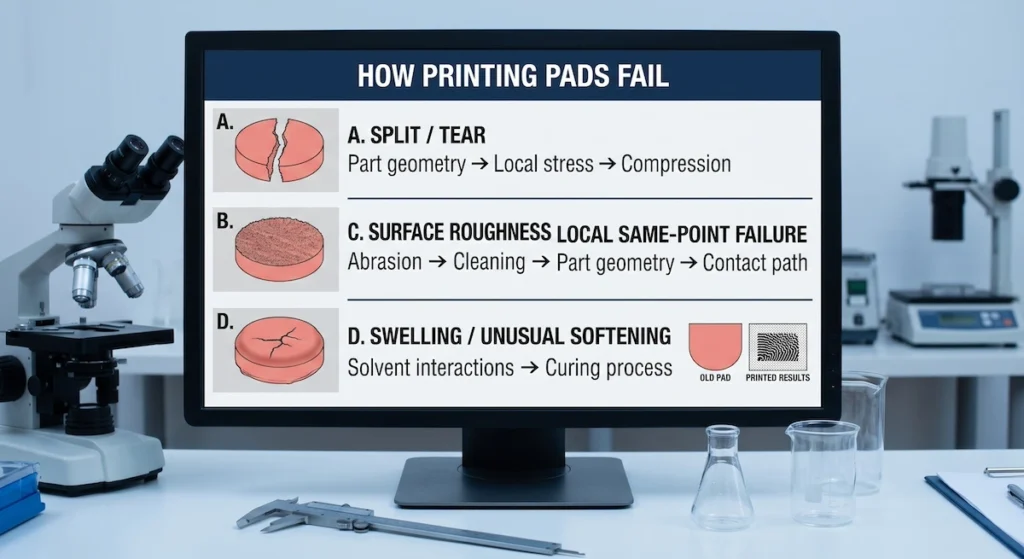
En failure mode often gives a much better diagnostic clue.
| Failure mode | First direction to investigate |
| Split / tear | Part geometry, local stress, compression |
| Surface roughness or damage | Abrasion, cleaning, chemical exposure |
| Poor pickup / release | Surface condition, contamination, wear |
| Loss of fine detail | Surface wear, deformation, hardness change |
| Swelling or unusual softening | Chemical exposure, formulation compatibility |
| Same-location failure every time | Part geometry and contact path |
This is why:
“Our pad lasted only 30,000 prints.”
is less useful diagnostically than:
“After about 30,000 prints, every pad begins tearing at the same edge.”
The second statement already points toward a possible root cause.
When Should You Replace a Silicone Printing Pad?
Do not define end-of-life only by visible cracking.
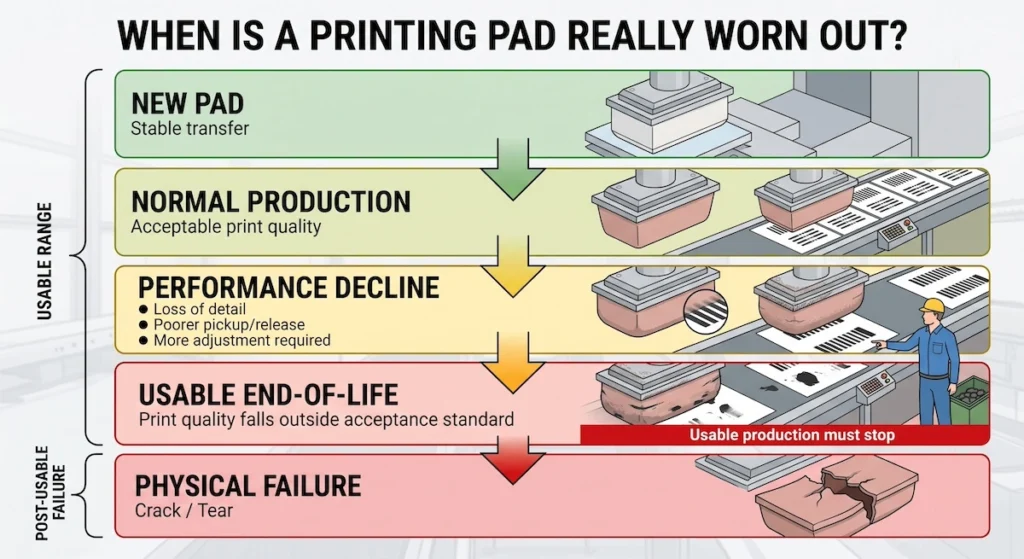
Consider replacing or investigating the pad when:
- Pickup, release or fine-detail reproduction deteriorates consistently
- The surface becomes permanently damaged or rough
- Pad behavior or hardness changes significantly
- Increasing pressure or operator intervention is required to maintain the previous print quality
The best replacement criterion is:
The pad can no longer produce acceptable prints consistently under the validated process.
A visually intact pad may therefore already be at the end of its usable production life.
How to Compare Two Silicone Formulations: Pad Life + Cost
Supplier lifespan claims are difficult to compare if the test conditions are different.
A better method is a controlled A/B qualification.
Keep the Production Conditions the Same
Where practical, keep:
- Pad mold and geometry
- Finished hardness and Shore scale
- Ink / thinner / hardener
- Substrate
- Machine
- Compression
- Cycle settings
- Cleaning procedure
Then change only:
Silicone Formulation A → Silicone Formulation B
Record the result:
| Qualification item | Pad A | Pad B |
| Silicone / formulation | ||
| Finished hardness / scale | ||
| Pad geometry | Same | Same |
| Ink + substrate | Same | Same |
| Machine + compression | Same | Same |
| First quality decline | ||
| Failure mode | ||
| Acceptable impressions | ||
| Finished pad cost | ||
| Cost / 1,000 acceptable impressions |
Compare acceptable impressions under the same conditions—not supplier lifespan claims produced in unrelated applications.
Calculate Cost per 1,000 Acceptable Impressions
For purchasing decisions, compare usable output rather than pad price alone.
Use:
Cost per 1,000 Acceptable Impressions = Finished Pad Cost ÷ Acceptable Impressions × 1,000
Example
Pad A
Finished pad cost: $20 Acceptable impressions: 30,000
Cost = $0.67 per 1,000 acceptable impressions
Pad B
Finished pad cost: $28 Acceptable impressions: 60,000
Cost = $0.47 per 1,000 acceptable impressions
Pad B costs more initially, but its cost per usable output is lower.
For manufacturers producing pads internally, use the complete finished-pad manufacturing cost, not only the silicone raw-material price.
And remember that even this calculation does not include:
- Pad-change downtime
- Scrap
- Re-adjustment
- Operator labor
- Quality rejects
So the lowest-cost silicone per kilogram is not necessarily the lowest-cost production solution.
Preguntas frecuentes
Is Your Pad Life Shorter Than Expected?
To review a pad-life problem, start by sending Topsil silicone:
- Failed-pad photo
- Approximate usable impressions
- Main failure mode
- Finished hardness and Shore scale
- Printed part / photo
- Ink, thinner and hardener system
If available, also include:
- Silicone grade
- Silicone-oil dosage
- Pad geometry
- Compression / machine setup
- Cleaning method
We can use this information to determine whether the first investigation should focus on:
BASE → LOAD → CHEMISTRY → CARE
rather than changing silicone grade before the failure mode has been understood.
View PP-30 & AP-30 Pad Printing Silicone →
Read the Silicone Oil Dosage Guide →
Read the Ink Transfer Troubleshooting Guide →
Technical References
Inkcups — Pad Printing Troubleshooting
Printing International — Pad Printing Pad Care
Is your pad life falling short of expectations?
Stop guessing whether the issue is your base, load, chemistry, or care. Send us a photo of your failed pad along with your process details, and our experts will help you pinpoint the root cause.