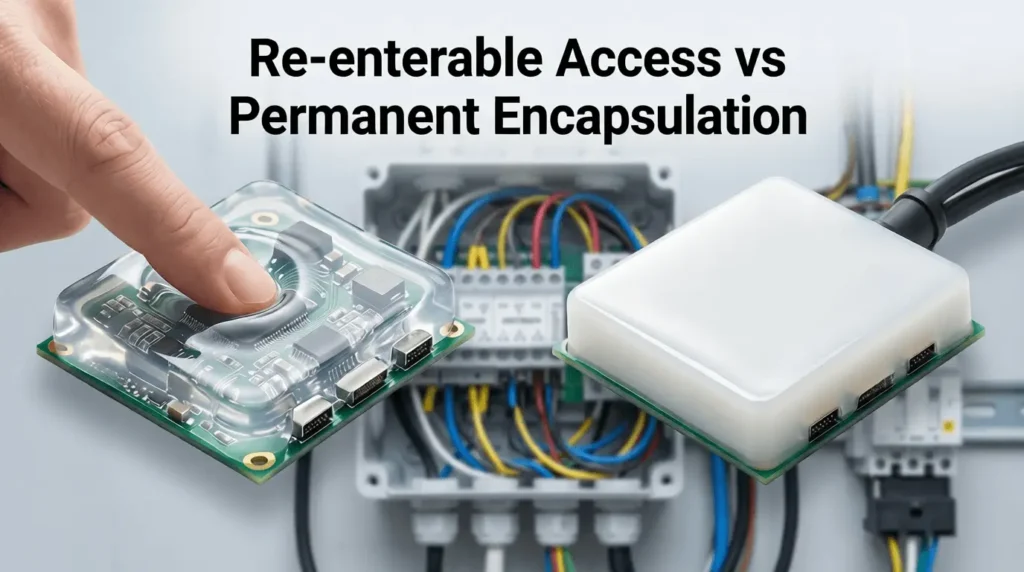

Once a PCB module, cable joint or electrical box is fully potted, re-entry can become slow, risky or even impossible without damage.
If your product may need future inspection, repair, probe testing, cable reconnection or field maintenance, the material should not be selected only by waterproofing or insulation. Re-enterability must be considered before potting.
The key question is simple:
Does your product need future access, or does it need stronger permanent encapsulation?
Key Takeaways
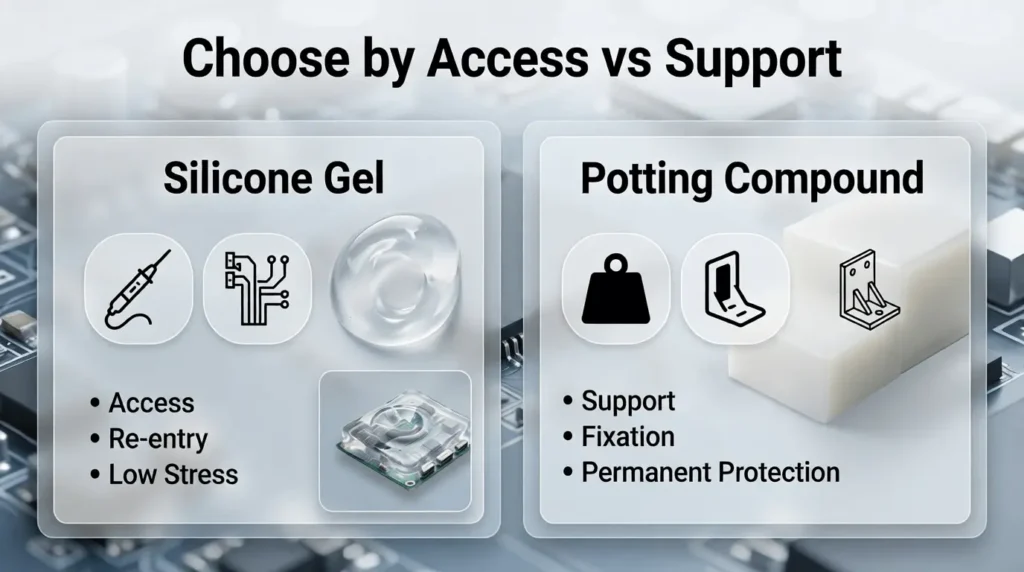
- Choose silicone gel when future re-entry, repair, inspection, probe testing or reconnection is required.
- Choose silicone potting compound when stronger component fixation, vibration resistance, thermal options, specific hardness or permanent encapsulation is required.
- Re-enterable does not mean damage-free removal. It means lower access difficulty compared with harder or more permanent potting systems.
- The key trade-off is access vs support. Silicone gel improves serviceability and low-stress protection, while compuesto de silicona para macetas improves mechanical stability and component fixation.
- Low-hardness RTV-2 silicone can be a middle option when silicone gel is too soft but standard potting compound is too difficult to re-enter.
- The final choice must be tested in the real enclosure, especially for voltage, moisture exposure, potting depth, aging, hardness and field maintenance process.
What Re-enterable Protection Really Means
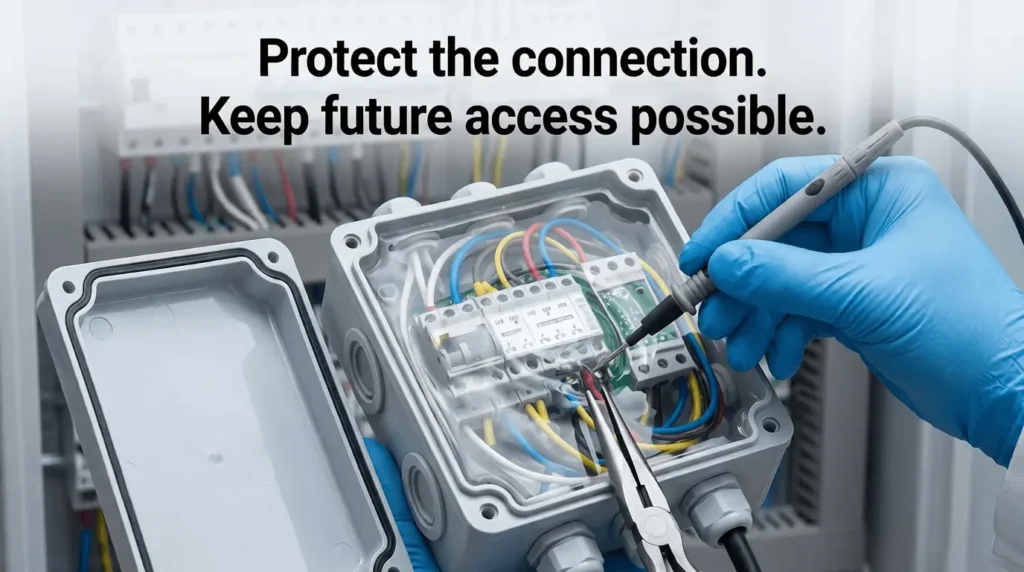
Re-enterable electrical insulating resin is commonly used for sealing and insulating low-voltage cable connections in electrical boxes.
Re-enterable protection means the protective material allows future access for inspection, testing, repair or reconnection with lower damage risk compared with harder or permanent encapsulation systems.
In practical applications, this means the material remains soft enough so that a field technician can move, cut, peel, displace or access the protected area more easily.
It does not mean:
- zero-risk removal
- unlimited reuse
- guaranteed no damage to PCB or components
- the same mechanical support as harder potting systems
Re-enterable protection is especially important for:
- junction box maintenance
- cable reconnection
- telecom closure sealing
- field-serviceable modules
- prototype PCB testing
- terminal block protection
- connector inspection
- low-voltage electrical sealing
For these applications, the goal is not only to protect the electronics. The goal is to protect the electronics while keeping future access possible.
Silicone Gel vs Silicone Potting Compound: Quick Decision Table
| Decision Factor | Better Starting Point | Why |
| Future field access | Silicone gel | Easier to displace, cut or re-enter |
| Cable reconnection | Silicone gel | Better for serviceable cable joints or closures |
| Junction box maintenance | Silicone gel | Allows easier inspection and re-entry |
| Prototype PCB testing | Silicone gel or low-hardness RTV silicone | Easier to modify or inspect during development |
| Low-stress protection | Silicone gel | Very soft, lower stress on sensitive parts |
| Component fixation | Encapsulado de silicona | Better support and stability |
| High vibration environment | Encapsulado de silicona | Stronger encapsulation and mechanical holding |
| Permanent outdoor module | Encapsulado de silicona | Better for fixed protection when re-entry is not required |
| Thermal management | Encapsulado de silicona | Thermally conductive grades may be available |
| Flame-retardant requirement | Encapsulado de silicona | Easier to specify tested flame-retardant grades |
| Semi-permanent protection | Low-hardness RTV silicone | Balance between softness and support |
| Repair after aging | Silicone gel, but test first | Softer materials are easier to access, but aging must be checked |
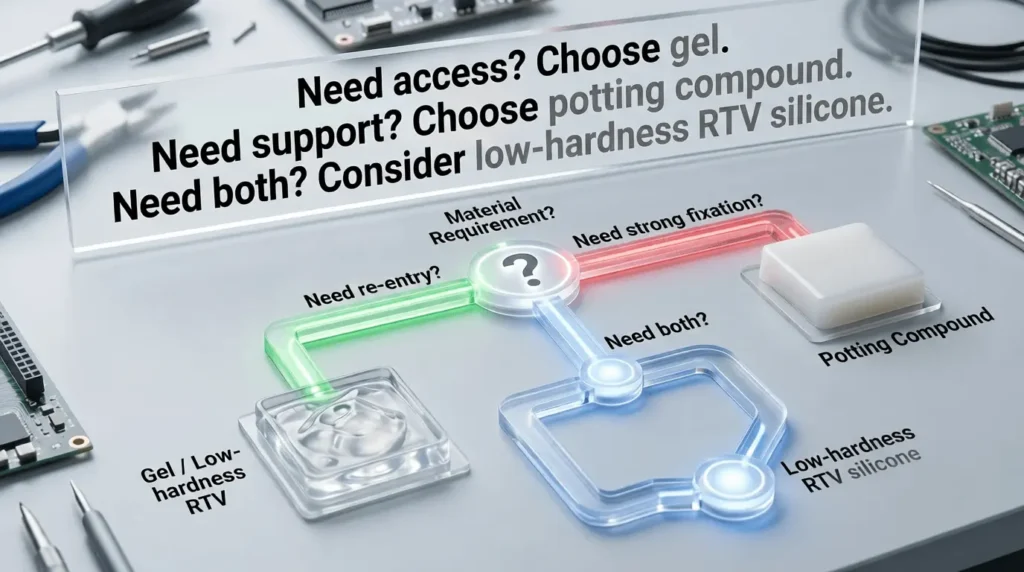
Simple rule: If future access is the priority, start with silicone gel. If mechanical support is the priority, start with silicone potting compound. If you need both, consider low-hardness RTV-2 silicone.
Decision Flow: Which Material Should You Start With?
Use this decision flow before requesting a sample.
- Will the product need future re-entry?
If yes, start with gel de silicona o low-hardness RTV-2 silicone.
If no, continue to the next question.
- Does the assembly need strong component fixation?
If yes, start with compuesto de silicona para macetas.
Silicone gel is soft and normally provides limited mechanical holding. If the material must fix components, resist vibration or support the assembly, standard RTV-2 silicone potting compound may be more suitable.
- Is the product a junction box, cable joint or telecom closure?
If yes, gel de silicona is often a better starting point because these applications may require cable access, inspection, reconnection or field service.
- Is the product a LED driver, power supply or fixed control module?
If yes, compuesto de silicona para macetas is often a better starting point because these applications usually need stronger encapsulation, insulation stability, vibration protection, thermal options or more permanent sealing.
- Do you need both re-entry and better support?
If yes, consider low-hardness RTV-2 silicone.
This can be a practical middle option when silicone gel is too soft but standard potting compound is too difficult to access later.
cal middle option when silicone gel is too soft but standard potting compound is too difficult to access later.
Silicone Gel: Best for Soft, Re-enterable Electrical Protection
Silicone gel is a very soft silicone material used for electrical insulation, moisture sealing and low-stress protection.
After curing, it remains gel-like instead of forming a harder elastomer. This allows the material to be displaced, cut, peeled or accessed more easily than many standard potting compounds.
Its main advantage is access and low stress, not strong mechanical fixation.
El gel de silicona se suele tener en cuenta para:
- telecom cable closures
- electrical junction boxes
- low-voltage cable joints
- outdoor electrical connections
- terminal block protection
- repairable electronics
- soft sealing around connectors
- field-serviceable modules
- stress-sensitive components
- prototype electronics
Choose silicone gel when the customer wants protection but does not want to permanently lock all components inside a harder material.
For example, if a field technician may need to reopen a junction box, reconnect cables or inspect a protected electrical connection, silicone gel is usually easier to work with than standard silicone potting compound.
Silicone Potting Compound: Best for Stronger, More Permanent Encapsulation
Silicone potting compound is usually a two-component RTV silicone that cures into a flexible elastomer.
Compared with silicone gel, standard silicone potting compound normally provides stronger encapsulation, better component fixation and higher mechanical support.
Its main advantage is support and permanent protection, not easy re-entry.
Silicone potting compound is often used for:
- PCB modules
- LED drivers
- power supplies
- sensors
- connectors
- outdoor electronics
- control modules
- vibration-sensitive assemblies
- more permanent encapsulation
Choose silicone potting compound when the assembly should remain sealed and protected during long-term use, and future access is not a major requirement.
For many fixed electronic modules, permanent protection is more important than repair access. In these cases, RTV-2 silicone potting compound may be more suitable than silicone gel.
What If You Need Both Re-entry and Better Support?
Some projects are not clearly “gel” or “standard potting compound.”
The customer may need:
- more support than silicone gel
- lower stress than harder potting compounds
- limited repair access
- semi-permanent sealing
- better handling for prototype or serviceable modules
- softer protection without full gel-like behavior
In these cases, low-hardness RTV-2 silicone can be a practical middle option.
It is often worth considering for:
- repairable PCB modules
- low-stress sensors
- connectors
- prototype electronics
- serviceable electrical assemblies
- semi-permanent protection
The key is to define how the customer plans to re-enter the material.
Will it be cut, peeled, displaced, probed, partially removed or permanently fixed?
Without this information, hardness alone is not enough for material selection.
Application-Based Selection Guide
Gel-filled cable joints are widely used for low-voltage cable connection protection, including 0.6/1 kV cable joint applications.
| Aplicación | Better Starting Point | Key Question |
| Telecom cable closure | Silicone gel | Will technicians need to reopen the closure? |
| Electrical junction box | Silicone gel | Will inspection or reconnection be required? |
| Low-voltage cable joint | Silicone gel | Will future cable access be needed? |
| Terminal block protection | Silicone gel | Does the connection need field service? |
| Repairable PCB module | Silicone gel or low-hardness RTV silicone | Will the circuit need probe testing or repair? |
| Prototype electronics | Silicone gel or low-hardness RTV silicone | Will the design change during testing? |
| Outdoor connector | Silicone gel or soft RTV silicone | Is re-entry more important than fixation? |
| Sensor module | Depends on design | Is permanent sealing or future access more important? |
| LED driver | Encapsulado de silicona | Is permanent protection more important than repair? |
| Power supply | Encapsulado de silicona | Are thermal, vibration or insulation requirements critical? |
| Fixed control module | Encapsulado de silicona | Should the assembly remain permanently sealed? |
| Vibration-sensitive module | Encapsulado de silicona | Does the material need to support components? |
This table should be used as a starting point. Final selection should be confirmed through real product testing.
Does Re-enterable Mean Weaker Protection?
Not necessarily.
Re-enterable silicone gel can still provide moisture protection and electrical insulation when the enclosure design, voltage level and application conditions are suitable.
But the protection type is different.
Electrical Protection
Silicone gel can provide electrical insulation when properly selected. However, the design must be checked according to voltage level, insulation distance, humidity exposure and aging requirements.
For cable joints, terminal blocks and junction boxes, the gel must be tested in the real enclosure or connection structure.
Protección contra la humedad
Silicone gel can provide soft moisture sealing, especially when the enclosure and cable entry design support the sealing structure.
However, the final waterproof result does not depend only on the material. It also depends on:
- enclosure design
- cable entry design
- filling completeness
- contact with housing and cables
- aging condition
- field installation quality
Mechanical Protection
This is where silicone gel is usually weaker.
Silicone gel is very soft and normally does not provide strong component fixation. If the assembly needs mechanical support, vibration resistance or permanent encapsulation, silicone potting compound is usually a better choice.
In short: silicone gel is not necessarily weaker electrically, but it is usually weaker mechanically.
Key Selection Factors
- Re-entry Requirement
The first question is whether the product will need to be opened, inspected, repaired or reconnected later.
If future access is required, silicone gel or low-hardness RTV silicone should be considered before standard potting compound.
Pregunta:
- Will technicians inspect it later?
- Will the cable or connector be reworked?
- Will field maintenance be needed?
- Is the product still in prototype stage?
- Re-entry Method
Do not ask only for “soft silicone.”
Define how the material will be accessed later.
Pregunta:
- Will it be cut?
- Will it be peeled?
- Will it be displaced by hand?
- Will technicians need probe access?
- Will the connection be reopened?
- Will only part of the material be removed?
- Should the material stay in place after re-entry?
Different re-entry methods may require different hardness, adhesion and flow behavior.
- Voltage and Insulation Requirement
Both silicone gel and silicone potting compound can provide electrical insulation when properly selected.
However, the voltage level, insulation distance, humidity exposure and aging conditions must be confirmed.
Pregunta:
- What is the operating voltage?
- Is it low-voltage or higher-voltage protection?
- Is dielectric strength required?
- Is insulation resistance after humidity aging required?
- Moisture and Enclosure Design
For outdoor or wet environments, the final product should be evaluated according to the enclosure design and relevant IP protection requirements.
For outdoor or wet environments, the material alone does not decide final waterproof performance.
The final result depends on:
- enclosure design
- cable entry design
- sealing structure
- material filling quality
- adhesion or contact with the housing
- product-level testing
Silicone gel may be suitable for re-enterable moisture sealing in junction boxes and cable connections. Silicone potting compound may be better for full encapsulation of fixed electronic modules.
- Mechanical Support and Vibration
Silicone gel is soft and provides limited component fixation. Silicone potting compound cures into a stronger elastomer and can provide better mechanical support.
Choose stronger potting compound when:
- components need to be fixed firmly
- vibration is expected
- the module must resist movement
- mechanical support is part of the design
Choose silicone gel when:
- low stress is more important
- re-entry is required
- components do not need strong fixation
- soft sealing is enough
- Hardness, Flowability and Potting Depth
Hardness decides how soft or supportive the cured material will be. Flowability decides whether the material can fill the real structure.
Low viscosity helps fill narrow gaps, cable areas, connector spaces and deep cavities. But very low viscosity may also leak if the enclosure is not sealed well.
Pregunta:
- What is the potting depth?
- Are there narrow gaps?
- Is there a risk of leakage?
- Is vacuum potting or degassing needed?
- Does the material need to flow around wires or components?
- Is gel too soft for the product structure?
- Production and Field Service Process
The best material must match how the product will be produced and serviced.
Factory potting, field installation and repair work may require different material behavior.
Pregunta:
- Will the material be applied manually or by equipment?
- Is the application done in the factory or in the field?
- Is the working time long enough?
- Is fast handling required?
- Can technicians re-enter the material safely and consistently?
Common Mistakes When Choosing Re-enterable Protection
Mistake 1: Choosing Only by Waterproof Claim
Waterproofing is important, but it is not the only factor. Re-entry, voltage, mechanical support, hardness and enclosure design must also be considered.
Mistake 2: Using Hard Potting When Re-entry Is Required
If the product may need future repair, inspection or reconnection, a harder potting material may create unnecessary rework difficulty.
Mistake 3: Using Silicone Gel When Strong Support Is Needed
Silicone gel is soft. It is not the best choice when the product needs strong component fixation, vibration resistance or structural support.
Mistake 4: Asking for the Lowest Hardness Without Defining Re-entry Method
Many customers say they need “soft silicone,” but they do not define how the material should be accessed later.
A material for probe testing may not be the same as a material for cable reconnection. A material that can be displaced by hand may not be suitable for permanent fixation.
Before choosing hardness, define whether the material needs to be cut, peeled, displaced, probed or fixed.
Mistake 5: Using the Same Material Strategy for Prototype and Mass Production
Prototype electronics may need frequent changes, inspection and rework. Mass production may need stronger sealing, better fixation and long-term stability.
The best material for prototype testing may not always be the best material for final production.
Mistake 6: Approving Material Without Testing the Real Enclosure
A small material test does not prove that the product is easy to open, inspect, repair or reconnect.
Re-entry should be tested in the real product structure, with real cables, components, terminals or enclosure design.
3-Level Testing Plan Before Approval
Before choosing between silicone gel, low-hardness RTV silicone and standard silicone potting compound, test the material in three levels.
Level 1: Material Property Test
Use this level to understand basic material behavior.
Check:
- hardness or softness
- viscosidad
- mixing ratio
- vida útil
- tiempo de curado
- tackiness after cure
- dielectric strength
- insulation resistance
- adhesion or contact behavior
- material stability after aging
This level helps compare silicone gel, low-hardness silicone and standard potting compound before product-level testing.
Level 2: Re-entry Test
Use this level to confirm whether the material can be accessed in the real product structure.
Check:
- cut test
- peel test
- displacement test
- probe testing simulation
- cable reconnection simulation
- partial removal test
- technician handling test
- visual inspection after re-entry
- component damage check after re-entry
This level is especially important for junction boxes, cable closures, terminal blocks, repairable PCB modules and prototype electronics.
Level 3: Reliability Test
Use this level to confirm whether the selected material can protect the product after aging and service conditions.
Check:
- moisture sealing test
- thermal cycling
- humidity aging
- insulation resistance after aging
- voltage withstand test if required
- field service simulation
- vibration test if mechanical support is required
- re-entry after aging
- comparison with current material
For re-enterable protection, do not test only initial sealing performance. Test how the material behaves after aging, after opening and after field-like handling.
What Information Should You Send Before Requesting a Sample?
A supplier cannot recommend the right material based only on the sentence “We need silicone for electrical protection.”
Before requesting a sample, prepare the following information:
- Application: junction box, cable closure, PCB module, sensor, connector, LED driver, etc.
- Voltage level
- Indoor or outdoor use
- Whether future re-entry is required
- Expected repair or inspection frequency
- Re-entry method: cut, peel, displace, probe test, reconnect or permanent fixation
- Potting depth
- Enclosure material
- Required hardness or softness
- Moisture or IP requirement
- Electrical insulation requirement
- Mechanical support requirement
- Temperature range
- Manual or automatic application
- Current material problem
- Estimated monthly or annual usage
- Photos or drawings of the product structure, if available
The most important question is:
Will the product need to be opened, inspected, repaired or reconnected after potting?
If the answer is yes, silicone gel or low-hardness RTV silicone should be considered before standard potting compound is approved.
Topsil silicone Practical Recommendation
As a 15+ years RTV-2 silicone manufacturer, Topsil silicone usually helps customers compare three material directions:
- Silicone gel for re-enterable, soft, low-stress protection
- Low-hardness RTV-2 silicone for semi-permanent protection with better support than gel
- Standard silicone potting compound for stronger encapsulation and more permanent protection
Not sure which one fits your project?
Send Topsil silicone your enclosure photo, potting depth, voltage level, re-entry requirement and whether the material needs to be cut, peeled, displaced, probed or permanently fixed.
Topsil silicone can help suggest a practical material direction for testing based on your application and service requirement.