
When evaluating flexible elastomers for regulated industries—such as medical devices, food-contact manufacturing, infant care, and skin-contact prosthetics—material purity dictates operational safety.
Generic or low-tier silicones often fail strict regulatory audits due to chemical leaching and volatile outgassing. Platinum silicone (addition-cure RTV-2) represents the industrial benchmark for absolute biocompatibility, resolving the critical risks of structural degradation and toxicological contamination on your production floor.
This technical framework analyzes the molecular mechanics, global compliance standards, and selection criteria required to validate platinum-cured systems for body-safe applications.
Addition-Cure vs. Peroxide Systems

The fundamental difference between platinum-cured silicone and regular (peroxide-cured) silicone lies in the vulcanization chemistry. This distinction directly controls the leachable profile of the final cured component.
1. Peroxide-Cure Mechanics (The Legacy Standard)
Peroxide systems rely on free-radical reactions triggered by heat. This process forces the polymer chains to bond but leaves behind volatile organic organic compounds (VOCs) and acid residues, such as 2,4-dichlorobenzoic acid. Without expensive, prolonged high-temperature post-baking, these acid fractions slowly migrate to the rubber surface, causing a bitter taste, sour odor, and potential skin irritation.
2. Platinum Addition-Cure Mechanics (The Pure Matrix)
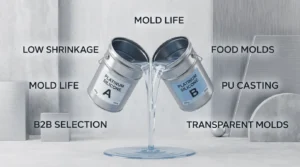
Platinum-cured silicone utilizes a platinum-catalyzed addition reaction. Part A contains a vinyl-terminated silicone polymer combined with a trace platinum complex catalyst (typically at a 5 to 10 ppm concentration). Part B acts as a hydride-functional crosslinker.
When mixed, the hydride and vinyl groups form stable, permanent ethylenic bridges.
- Zero Curing Byproducts: The addition reaction modifies the molecular architecture without generating any volatile outgassing or chemical split-offs.
- Trace Catalyst Safety: Unlike generic marketing claims stating “zero metal,” platinum silicone does contain microscopic trace amounts of platinum metal to initiate cross-linking. However, this catalyst is chemically locked into the inert matrix at parts-per-million scales, rendering it completely non-reactive and bio-inert.
Still not sure which silicone grade fits your application?
Tell us your casting material, target hardness, working time, and expected use. Topsil will help recommend a suitable RTV-2 silicone grade for sample testing.
Global Material Compliance & Certification Matrix
For industrial buyers and quality assurance directors, “body-safe” is not a marketing term—it is a verifiable legal standard. The table below outlines the mandatory global testing certifications required for verified operations:
| Regulatory Standard | Target Sector | Core Evaluation Focus | Linear Shrinkage | Structural Longevity |
| ISO 10993 (Parts 5 & 10) | Medical Devices & Biocompatible Implants | Audits cytotoxicity, systemic toxicity, and tissue irritation profiles. | < 0.1% | 10+ Years (Inert Degradation) |
| USP Class VI | Pharmaceutical & Bioprocess Fluids | Evaluates systemic biological reactivity inside medical plastic and rubber. | < 0.1% | High Extraction Resistance |
| FDA 21 CFR 177.2600 | Food-Contact Equipment & Kitchenware | Measures total extractive limits in distilled water and n-hexane over time. | < 0.1% | Fat & Acid Resistant |
| EU LFGB / BfR XV | European Food Safety Regulation | Imposes strict limits on volatile organic matter (strictly below 0.5%). | < 0.1% | Odorless / Zero Odor Transfer |
Also Read: Platinum Cure vs Tin Cure Silicone: Which One Should You Choose?
Core Applications of Biocompatible Platinum Elastomers
Because addition-cure matrices maintain operational flexibility from -60°C to 250°C without losing mechanical properties, they are deployed across four zero-tolerance industrial sectors:
1. Healthcare & Bioprocess Engineering
Platinum RTV-2 formulations are inherently hypoallergenic, hydrophobic, and non-porous. This resists microbial and bacterial growth on critical components. Standard applications include liquid injection molded (LIM) surgical tool grips, peristaltic pump tubing, orthopedic prosthetic liners, and long-term diagnostic seals.
2. Infant Care Components
Infant products require absolute resistance to chemical leaching when exposed to continuous saliva and heat sterilization cycles. Certified addition-cure polymers ensure that liquid-delivery bottle nipples, teething toys, and pacifiers remain completely free of bisphenol-A (BPA), phthalates, and aromatic amines.
3. Food-Contact Tooling & Commercial Bakeware
Industrial baking molds and conveyor elements must withstand aggressive organic fatty acids and continuous thermal cycles. Peroxide-cured alternatives crack and leach chalky white residues under extended heat. Platinum matrices maintain structural rebound and zero flavor migration over thousands of production cycles.
4. Advanced Skin-Contact Interfaces
In the production of wearable consumer electronics, smartwatches, and high-spec theatrical prosthetics, material choice directly affects user dermatology. Platinum silicones eliminate chemical sensitization, ensuring zero skin reactions across prolonged wear times.
How to Verify Genuine Platinum Compliance
Low-cost suppliers often mislabel peroxide-free compounds or blended silicones to bypass testing budgets. Quality control teams should execute these three steps to audit material authenticity:
- Verify the Post-Cure Certification: Request the independent lab data verifying volatile organic matter limits. Genuine compliance under European LFGB parameters requires volatile metrics under 0.5% by weight.
- The Manual Stretch Deformation Test: When highly stretched, low-grade silicones containing cheap mineral fillers (like calcium carbonate or crystalline silica) will show a stark white stress line at the bending axis. Premium, high-purity addition-cure silicone retains its clear, translucent, or specified pigment color under maximum elongation.
- Examine the TGA Profile (Thermogravimetric Analysis): Request a TGA report from your raw material supplier. True platinum-cured matrices exhibit flat, un-deviated degradation lines up to 250°C, proving the complete absence of volatile processing oils or un-reacted plasticizers.
RECOMMENDED NEXT STEP
Choosing the right silicone involves more than just hardness or cure system.
Send us your application details, and we’ll map out the exact grade for your testing.
Compare RTV-2 Silicone Grades